Tool Retrieval Bridge: Aligning Vague Instructions with Retriever Preferences via Bridge Model
Pith reviewed 2026-05-10 17:50 UTC · model grok-4.3
The pith
A bridge model rewrites vague tool-use instructions into specific forms that standard retrievers can process effectively.
A machine-rendered reading of the paper's core claim, the machinery that carries it, and where it could break.
Core claim
The central claim is that a bridge model can close the gap between ambiguous human instructions and the specific formats preferred by tool retrievers, resulting in substantial performance lifts such as BM25's NDCG rising from 9.73 to 19.59.
What carries the argument
The Tool Retrieval Bridge (TRB), a rewriting model that takes vague user instructions and produces more detailed versions aligned with retriever preferences.
If this is right
- Standard retrievers become viable for vague real-world instructions without any changes to their training.
- The gains appear across multiple retrieval settings and algorithms, including both sparse and dense methods.
- The approach separates instruction clarification from the retrieval step itself, allowing reuse of existing tools.
Where Pith is reading between the lines
- The rewriting step could extend to other retrieval tasks where user queries are imprecise, such as web or document search.
- Instead of a separate bridge, retrievers might be trained end-to-end on vague data, though the modular design keeps the core retriever unchanged.
Load-bearing premise
The bridge model can rewrite vague instructions without adding incorrect details that mislead the retriever away from the user's true intent.
What would settle it
An experiment in which retrieval accuracy on the rewritten instructions falls below accuracy on the original vague instructions would disprove the claimed benefit.
Figures


read the original abstract
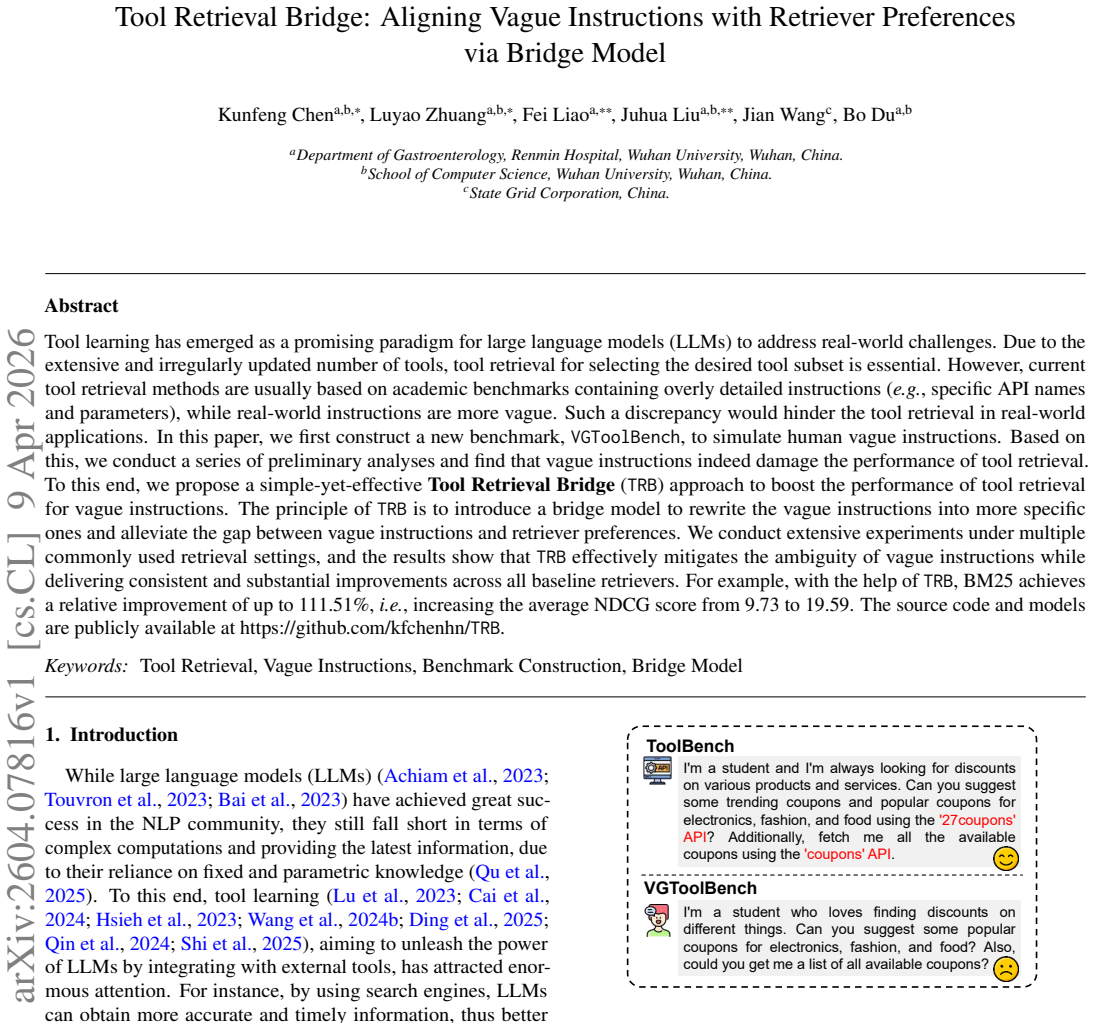
Tool learning has emerged as a promising paradigm for large language models (LLMs) to address real-world challenges. Due to the extensive and irregularly updated number of tools, tool retrieval for selecting the desired tool subset is essential. However, current tool retrieval methods are usually based on academic benchmarks containing overly detailed instructions (e.g., specific API names and parameters), while real-world instructions are more vague. Such a discrepancy would hinder the tool retrieval in real-world applications. In this paper, we first construct a new benchmark, VGToolBench, to simulate human vague instructions. Based on this, we conduct a series of preliminary analyses and find that vague instructions indeed damage the performance of tool retrieval. To this end, we propose a simple-yet-effective Tool Retrieval Bridge (TRB) approach to boost the performance of tool retrieval for vague instructions. The principle of TRB is to introduce a bridge model to rewrite the vague instructions into more specific ones and alleviate the gap between vague instructions and retriever preferences.We conduct extensive experiments under multiple commonly used retrieval settings, and the results show that TRB effectively mitigates the ambiguity of vague instructions while delivering consistent and substantial improvements across all baseline retrievers. For example, with the help of TRB, BM25 achieves a relative improvement of up to 111.51%, i.e., increasing the average NDCG score from 9.73 to 19.59. The source code and models are publicly available at https://github.com/kfchenhn/TRB.
Editorial analysis
A structured set of objections, weighed in public.
Referee Report
Summary. The paper constructs VGToolBench to simulate vague real-world tool-use instructions (by degrading detailed academic queries), shows that vagueness degrades standard retriever performance, and proposes Tool Retrieval Bridge (TRB): a bridge model that rewrites vague instructions into more specific ones before retrieval. Experiments across multiple retrievers (including BM25) report large gains, e.g., BM25 NDCG rising from 9.73 to 19.59 (111.51% relative improvement), with code released.
Significance. If the rewrites reliably preserve user intent without introducing ungrounded details, TRB would address a practically important mismatch between academic tool benchmarks and real-world vague queries, potentially improving tool-augmented LLM systems. The public release of code and models is a positive for reproducibility.
major comments (3)
- [VGToolBench construction] Benchmark construction (VGToolBench section): The benchmark simulates vagueness by starting from detailed instructions and removing specifics; the bridge model is therefore trained to recover those held-out details. This setup risks the observed NDCG gains arising from the model guessing the original detailed version rather than resolving genuine ambiguity. The paper should report the exact simulation procedure, the distribution of removed information, and results on naturally occurring vague instructions outside this construction process.
- [Experiments and analysis] Evaluation and analysis sections: No fidelity, entailment, or intent-preservation metrics are provided (e.g., whether the rewritten instruction entails the original vague query or human ratings of intent match). Without these, it is impossible to rule out that gains stem from the bridge model adding plausible but incorrect parameters or tool names that happen to align with the ground-truth tools in the benchmark.
- [Main results table] Table reporting main results (e.g., the BM25 row): The absolute and relative improvements are large, but the paper provides no error analysis of cases where the rewrite introduces details that cause retrieval of incorrect tools, nor controls for the quality of the bridge model's outputs. This leaves the central claim that TRB 'mitigates the ambiguity of vague instructions' only partially supported.
minor comments (2)
- [Introduction and preliminary analysis] The abstract and introduction refer to 'preliminary analyses' showing vagueness harms retrieval, but the corresponding section could more clearly separate the analysis from the main TRB experiments.
- [Method] Notation for the bridge model input/output could be formalized (e.g., an equation defining the rewrite function) to improve clarity for readers.
Simulated Author's Rebuttal
Thank you for the detailed review and constructive feedback on our manuscript. We appreciate the referee's insights into the potential limitations of our benchmark construction and evaluation. We address each major comment below and outline the revisions we will make to strengthen the paper.
read point-by-point responses
-
Referee: Benchmark construction (VGToolBench section): The benchmark simulates vagueness by starting from detailed instructions and removing specifics; the bridge model is therefore trained to recover those held-out details. This setup risks the observed NDCG gains arising from the model guessing the original detailed version rather than resolving genuine ambiguity. The paper should report the exact simulation procedure, the distribution of removed information, and results on naturally occurring vague instructions outside this construction process.
Authors: We will expand the VGToolBench section to include the exact simulation procedure for degrading detailed instructions into vague ones, along with the distribution of removed information categories (such as specific parameters, tool names, and constraints). This will clarify how the benchmark was built. Regarding results on naturally occurring vague instructions, our work focuses on a controlled simulation derived from existing academic benchmarks to isolate the impact of vagueness; we do not have paired data for real-world vague queries with verified tool ground truths, which would require new data collection efforts beyond the scope of this study. The substantial gains with BM25 (a lexical retriever) support that TRB learns to add generally useful details rather than merely reconstructing the originals. revision: partial
-
Referee: Evaluation and analysis sections: No fidelity, entailment, or intent-preservation metrics are provided (e.g., whether the rewritten instruction entails the original vague query or human ratings of intent match). Without these, it is impossible to rule out that gains stem from the bridge model adding plausible but incorrect parameters or tool names that happen to align with the ground-truth tools in the benchmark.
Authors: We agree that additional metrics are needed to better support the claims. In the revised manuscript, we will add automatic entailment evaluation (using an LLM-based judge to verify consistency between the original vague query and the rewritten instruction) as well as a human study on a sample of outputs assessing intent preservation and fidelity. These will help address concerns about potential introduction of ungrounded details. revision: yes
-
Referee: Table reporting main results (e.g., the BM25 row): The absolute and relative improvements are large, but the paper provides no error analysis of cases where the rewrite introduces details that cause retrieval of incorrect tools, nor controls for the quality of the bridge model's outputs. This leaves the central claim that TRB 'mitigates the ambiguity of vague instructions' only partially supported.
Authors: We will add an error analysis subsection examining failure cases where the bridge model's rewrites lead to incorrect tool retrieval, categorizing the types of introduced details that cause issues. We will also include controls, such as comparisons against outputs from an untrained or randomly initialized bridge model, to demonstrate that the trained TRB specifically contributes to the observed gains rather than any plausible rewrite. revision: yes
- Providing empirical results on naturally occurring vague instructions outside the simulated VGToolBench construction process.
Circularity Check
No circularity in derivation chain
full rationale
The paper's chain consists of constructing VGToolBench by simulating vagueness, running preliminary retrieval analyses on it, training a separate bridge model to rewrite vague instructions, and measuring downstream NDCG gains on held-out retrieval settings. No equations, fitted parameters, or self-citations are shown that make the reported improvements (e.g., BM25 NDCG rising from 9.73 to 19.59) equivalent to the benchmark construction or training inputs by definition. The bridge model and final metrics are presented as independently trained and evaluated components, satisfying the criteria for a self-contained empirical result.
Axiom & Free-Parameter Ledger
axioms (1)
- domain assumption Vague instructions can be rewritten into specific ones that preserve user intent and improve retriever accuracy
Lean theorems connected to this paper
-
IndisputableMonolith/Cost/FunctionalEquation.leanwashburn_uniqueness_aczel unclear?
unclearRelation between the paper passage and the cited Recognition theorem.
The principle of TRB is to introduce a bridge model to rewrite the vague instructions into more specific ones and alleviate the gap between vague instructions and retriever preferences... two-stage processes: ❶ we fine-tune the model... ❷ the SFT model is further optimized... by using the retrieval performance as the reward for reinforcement learning (RL).
-
IndisputableMonolith/Foundation/RealityFromDistinction.leanreality_from_one_distinction unclear?
unclearRelation between the paper passage and the cited Recognition theorem.
We first construct a new benchmark, VGToolBench, to simulate human vague instructions... TRB effectively mitigates the ambiguity of vague instructions while delivering consistent and substantial improvements across all baseline retrievers.
What do these tags mean?
- matches
- The paper's claim is directly supported by a theorem in the formal canon.
- supports
- The theorem supports part of the paper's argument, but the paper may add assumptions or extra steps.
- extends
- The paper goes beyond the formal theorem; the theorem is a base layer rather than the whole result.
- uses
- The paper appears to rely on the theorem as machinery.
- contradicts
- The paper's claim conflicts with a theorem or certificate in the canon.
- unclear
- Pith found a possible connection, but the passage is too broad, indirect, or ambiguous to say the theorem truly supports the claim.
Reference graph
Works this paper leans on
-
[1]
Topic extraction and interactive knowledge graphs for learning resources. Sustainability 14, 226. Bai, J., Bai, S., Chu, Y ., Cui, Z., Dang, K., Deng, X., Fan, Y ., Ge, W., Han, Y ., Huang, F., et al., 2023. Qwen technical report. arXiv preprint arXiv:2309.16609 . Brown, T., Mann, B., Ryder, N., Subbiah, M., Kaplan, J.D., Dhariwal, P., Neelakantan, A., Sh...
work page internal anchor Pith review Pith/arXiv arXiv 2023
-
[2]
Detecting cyberbullying using deep learning techniques: a pre-trained glove and focal loss technique. PeerJ Computer Science 10, e1961. Farghaly, H.M., Ali, A.A., Abd El-Hafeez, T., 2020a. Build- ing an effective and accurate associative classifier based on support vector machine. Sylwan 164, 39–56. Farghaly, H.M., Ali, A.A., El-Hafeez, T.A., 2020b. Devel...
work page internal anchor Pith review Pith/arXiv arXiv 2024
-
[3]
Information Systems 100, 101785
Multi-label arabic text classification in online social networks. Information Systems 100, 101785. Patil, S.G., Mao, H., Yan, F., Ji, C.C.J., Suresh, V ., Stoica, I., Gonzalez, J.E., 2025. The berkeley function calling leader- board (BFCL): From tool use to agentic evaluation of large language models, in: Forty-second International Conference on Machine L...
work page 2025
-
[4]
Proximal Policy Optimization Algorithms
Revisiting, benchmarking and exploring api recom- mendation: How far are we? IEEE Transactions on Software Engineering 49, 1876–1897. Qian, C., He, B., Zhuang, Z., Deng, J., Qin, Y ., Cong, X., Zhang, Z., Zhou, J., Lin, Y ., Liu, Z., et al., 2024. Tell me more! towards implicit user intention understanding of language model driven agents, in: Proceedings ...
work page internal anchor Pith review Pith/arXiv arXiv 2024
-
[5]
Dynamic two-way sign language interpretation, in: International Conference on Intelligent Manufacturing and Energy Sustainability, Springer. pp. 463–476. Shao, Z., Wang, P., Zhu, Q., Xu, R., Song, J., Bi, X., Zhang, H., Zhang, M., Li, Y ., Wu, Y ., et al., 2024. Deepseekmath: Push- ing the limits of mathematical reasoning in open language models. arXiv pr...
work page internal anchor Pith review Pith/arXiv arXiv 2024
discussion (0)
Sign in with ORCID, Apple, or X to comment. Anyone can read and Pith papers without signing in.