Machine Learning the order-disorder Jahn-Teller transition in LaMnO₃
Pith reviewed 2026-05-10 17:52 UTC · model grok-4.3
The pith
The Jahn-Teller transition in LaMnO3 is driven by ordering of Q2 distortions on MnO6 octahedra.
A machine-rendered reading of the paper's core claim, the machinery that carries it, and where it could break.
Core claim
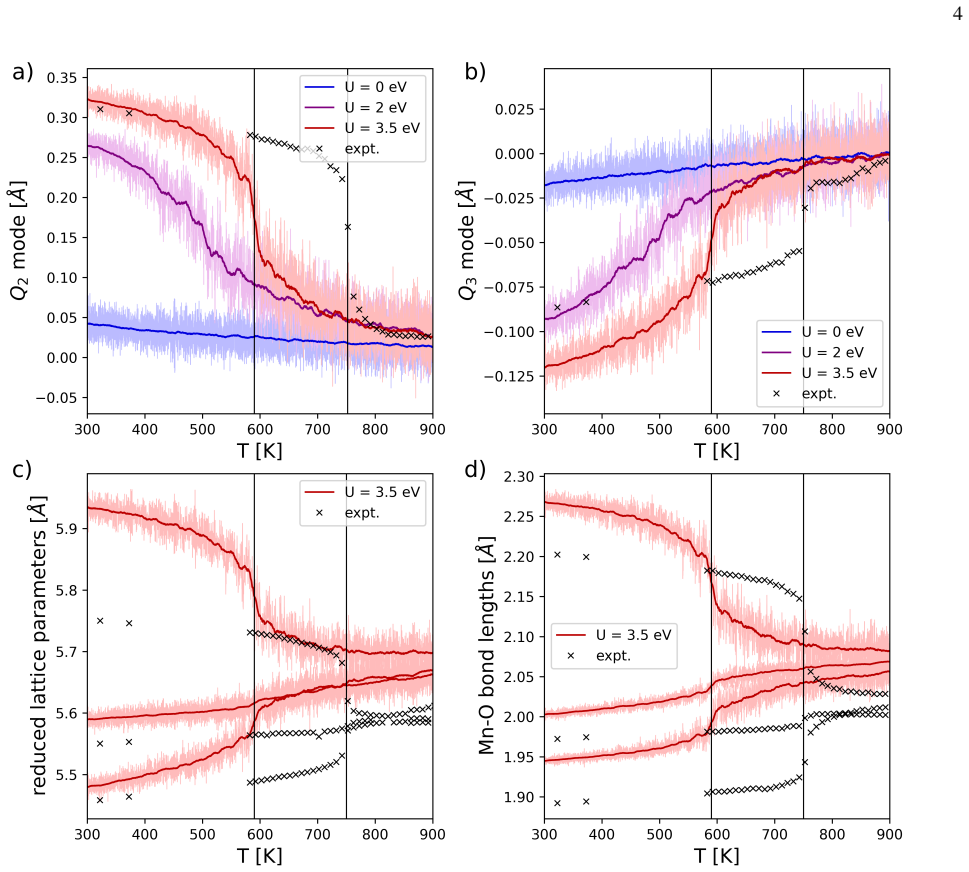
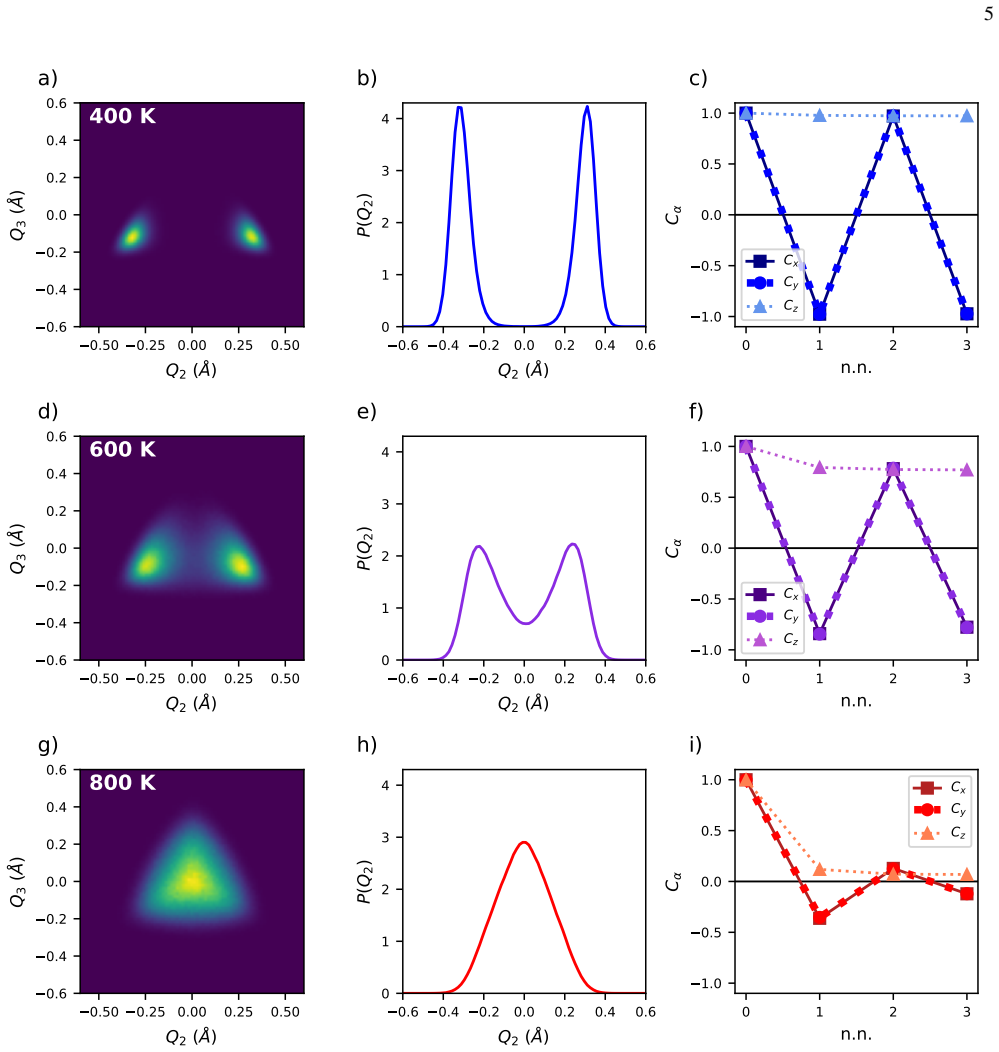
Analysis of the site-site correlation function of the distortions reveals that the transition is driven by the ordering of the Q2 Jahn-Teller distortion of the MnO6 octahedra, which acts as the order parameter and establishes the order-disorder nature of the transition. Dynamical local distortions persist above T_JT, while the simulations reproduce the experimental temperature dependence of both structural and phonon properties.
What carries the argument
The site-site correlation function of Q2 Jahn-Teller distortions, used to track long-range ordering as the transition mechanism.
If this is right
- The transition remains order-disorder even though local distortions survive above T_JT.
- Anharmonic lattice dynamics control the vibrational spectra throughout the transition region.
- Velocity autocorrelation functions extracted from the trajectories separate order-disorder from displacive behavior.
- Machine-learned potentials trained on ab initio data suffice to resolve microscopic mechanisms in perovskite phase transitions.
Where Pith is reading between the lines
- The same correlation-function approach could test proposed order parameters in other Jahn-Teller or charge-ordered perovskites.
- Local-probe experiments sensitive to Mn-O bond lengths above 750 K should still detect fluctuating Q2 distortions.
- The method offers a route to distinguish transition mechanisms in materials where neutron or X-ray data alone remain ambiguous.
Load-bearing premise
The machine-learned force fields must reproduce the actual high-temperature atomic vibrations and local shape fluctuations without adding artificial order or changing the apparent driving distortion.
What would settle it
Direct measurement of the temperature evolution of the correlation length or amplitude of Q2 distortions between neighboring Mn sites, for example via diffuse scattering, would confirm or contradict the ordering picture.
Figures
read the original abstract
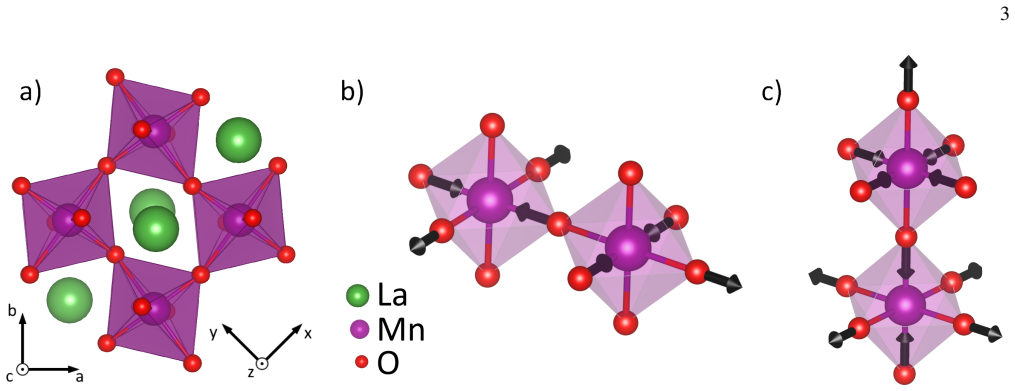
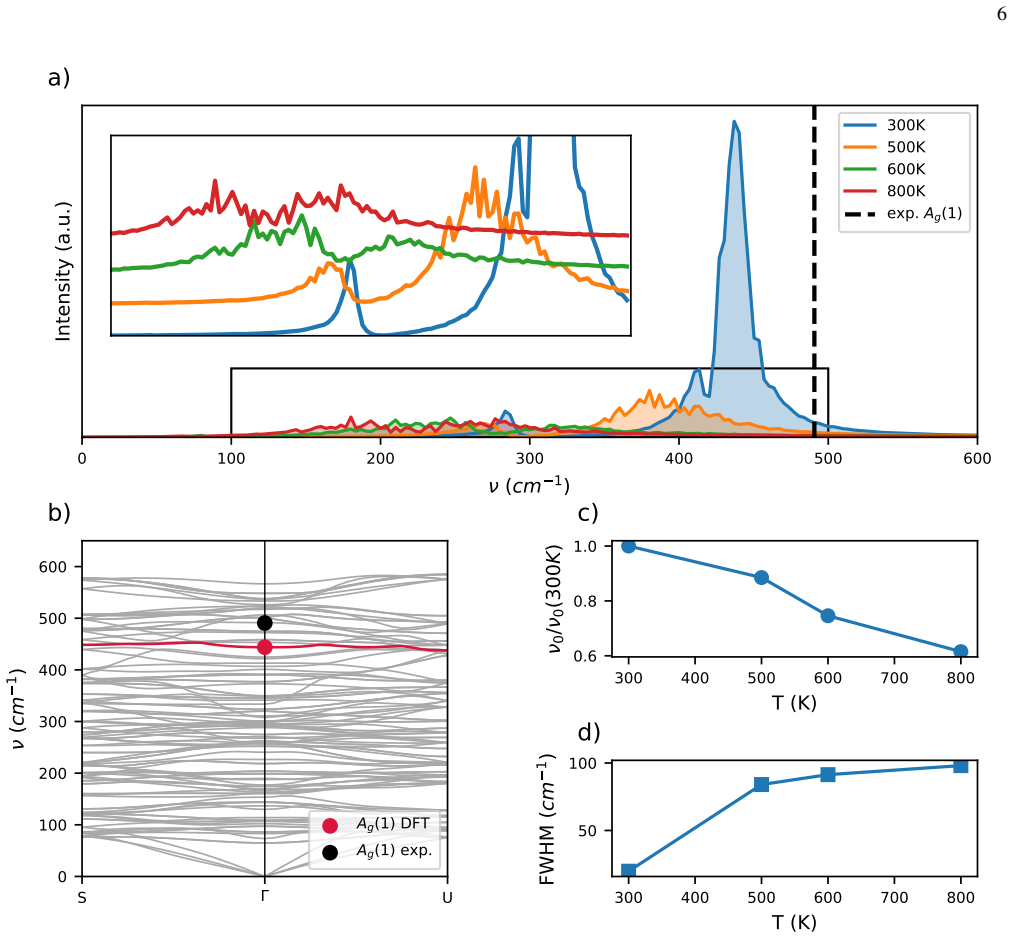
We investigate the Jahn-Teller structural phase transition in LaMnO$_3$ at $T_{JT} \simeq 750$ K using molecular dynamics simulations based on machine-learning force fields trained on ab initio data. Analysis of the site-site correlation function of the distortions reveals that the transition is driven by the ordering of the $Q_2$ Jahn-Teller distortion of the MnO$_6$ octahedra, which acts as the order parameter and establishes the order-disorder nature of the transition. Dynamical local distortions are found to persist above $T_{JT}$. Our results reproduce the experimental temperature dependence of both structural and phonon properties and highlight the presence of anharmonic effects at finite temperature. More broadly, the combined use of machine-learning molecular dynamics and velocity autocorrelation function analysis provides a robust framework for uncovering the microscopic mechanisms of structural phase transitions in correlated materials. In particular, this approach enables a clear distinction between order-disorder transitions and alternative mechanisms, such as displacive behavior, through the temperature evolution of vibrational properties.
Editorial analysis
A structured set of objections, weighed in public.
Referee Report
Summary. The paper performs molecular dynamics simulations of the Jahn-Teller transition in LaMnO3 at T_JT ≈ 750 K using machine-learning force fields trained on ab initio data. Analysis of site-site correlation functions of the MnO6 octahedral distortions identifies the Q2 Jahn-Teller mode as the order parameter, establishing the transition as order-disorder in character, with local distortions persisting above T_JT. The simulations are reported to reproduce the experimental temperature dependence of structural and phonon properties, highlighting anharmonic effects and providing a general framework to distinguish order-disorder from displacive mechanisms via ML-MD and velocity autocorrelation analysis.
Significance. If the ML force fields are shown to faithfully reproduce the relevant high-temperature anharmonic sampling, the work supplies a concrete microscopic demonstration that the JT transition in LaMnO3 is driven by ordering of local Q2 distortions rather than a soft-mode instability. The approach of extracting order parameters directly from correlation functions on MD trajectories offers a transferable route for classifying structural transitions in other correlated oxides, provided the force-field fidelity in the anharmonic regime is established.
major comments (1)
- [Methods (ML force field training and validation)] The central claim that the transition is order-disorder with Q2 as order parameter rests on the fidelity of the ML force field for finite-T anharmonic fluctuations of the local distortions. Standard force-error metrics on the training set do not guarantee unbiased sampling of the barrier heights or mode couplings that control the persistence and correlation length of Q2 above T_JT. Direct validation against ab initio thermal distributions P(Q2, T) or temperature-dependent correlation functions is required to rule out bias that could alter the apparent transition character.
minor comments (2)
- [Abstract] The abstract states that the simulations 'reproduce the experimental temperature dependence' of structural and phonon properties; explicit error bars, RMSD values, or direct overlay plots versus experiment should be added for quantitative assessment.
- [Results] Notation for the Q2 distortion mode and the definition of the site-site correlation function should be introduced with a brief equation or reference in the main text to aid readers unfamiliar with Jahn-Teller coordinates.
Simulated Author's Rebuttal
We thank the referee for the careful reading of our manuscript and the constructive feedback. The concern regarding validation of the ML force field in the anharmonic regime is well taken, and we address it directly below.
read point-by-point responses
-
Referee: The central claim that the transition is order-disorder with Q2 as order parameter rests on the fidelity of the ML force field for finite-T anharmonic fluctuations of the local distortions. Standard force-error metrics on the training set do not guarantee unbiased sampling of the barrier heights or mode couplings that control the persistence and correlation length of Q2 above T_JT. Direct validation against ab initio thermal distributions P(Q2, T) or temperature-dependent correlation functions is required to rule out bias that could alter the apparent transition character.
Authors: We agree that standard force-error metrics alone are insufficient to fully certify sampling of anharmonic barriers and mode couplings. Our ML force field was trained on ab initio configurations that explicitly include high-temperature anharmonic sampling, and the simulations reproduce the experimental temperature dependence of lattice parameters, the JT transition temperature, and phonon spectra. Nevertheless, to directly address the referee's point, we will add in the revised manuscript a comparison of the ML-MD thermal distributions P(Q2, T) and site-site correlation functions against short ab initio MD runs performed at selected temperatures above and below T_JT. This additional validation will confirm that the persistence and correlation length of Q2 distortions are faithfully reproduced. revision: yes
Circularity Check
No significant circularity; central claims emerge from independent MD analysis
full rationale
The derivation proceeds by training an ML force field on ab initio data (independent of the finite-T transition), running MD trajectories, and then computing site-site correlation functions of the Q2 distortions to identify the order parameter and order-disorder character. This analysis is not fitted to the transition temperature or any target observable; the transition and its nature arise as output from the dynamics. No self-citations are invoked as load-bearing uniqueness theorems, no ansatz is smuggled, and no fitted input is relabeled as prediction. The reproduction of experimental structural and phonon properties serves as external check rather than tautology. Model dependence of the MLFF exists but does not constitute circularity under the defined criteria.
Axiom & Free-Parameter Ledger
free parameters (1)
- ML force field parameters
axioms (2)
- domain assumption Ab initio calculations (typically DFT) provide a sufficiently accurate reference potential energy surface for the MnO6 distortions and inter-octahedra couplings.
- domain assumption Classical molecular dynamics with the MLFF can access the relevant timescales and capture the anharmonic dynamics near 750 K.
Reference graph
Works this paper leans on
-
[1]
S. Ivantchev, E. Kroumova, G. Madariaga, J. M. Pérez-Mato, and M. I. Aroyo, Journal of Applied Crystallography 33, 1190 (2000)
work page 2000
-
[2]
D. Orobengoa, C. Capillas, M. I. Aroyo, and J. M. Perez-Mato, Journal of Applied Crystallography 42, 820 (2009)
work page 2009
-
[3]
J. M. Perez-Mato, D. Orobengoa, and M. I. Aroyo, Acta Crystallographica Section A 66, 558 (2010). 5
work page 2010
discussion (0)
Sign in with ORCID, Apple, or X to comment. Anyone can read and Pith papers without signing in.