3D microprinting anisotropic and deformable active matter -- A perspective
Pith reviewed 2026-05-10 18:01 UTC · model grok-4.3
The pith
3D microprinting enables fabrication of anisotropic and deformable active particles beyond spheres.
A machine-rendered reading of the paper's core claim, the machinery that carries it, and where it could break.
Core claim
Active colloidal particles have largely been limited to spherical shapes by fabrication constraints, despite theoretical predictions that anisotropy and flexibility would dramatically alter dynamics, interparticle interactions, and emergent collective behavior. Recent progress in 3D microprinting supplies the design freedom needed to create particles with tailored shapes, deformability, and localized active forces. This capability supplies new model systems for probing non-equilibrium physics in active and soft matter and simultaneously advances toward microrobotic systems that exhibit programmable dynamics and emergent functionalities.
What carries the argument
3D microprinting as an additive manufacturing method that supplies design freedom to control particle anisotropy, flexibility, active force locations, and functionality at the microscale.
Load-bearing premise
3D microprinting can deliver reliable, scalable control over particle anisotropy, flexibility, and active force location without introducing fabrication artifacts that obscure the predicted dynamical effects.
What would settle it
An experiment in which 3D-printed anisotropic or deformable active particles exhibit no dynamical enrichment relative to spheres, traceable to unresolved fabrication defects or scalability limits.
Figures
read the original abstract
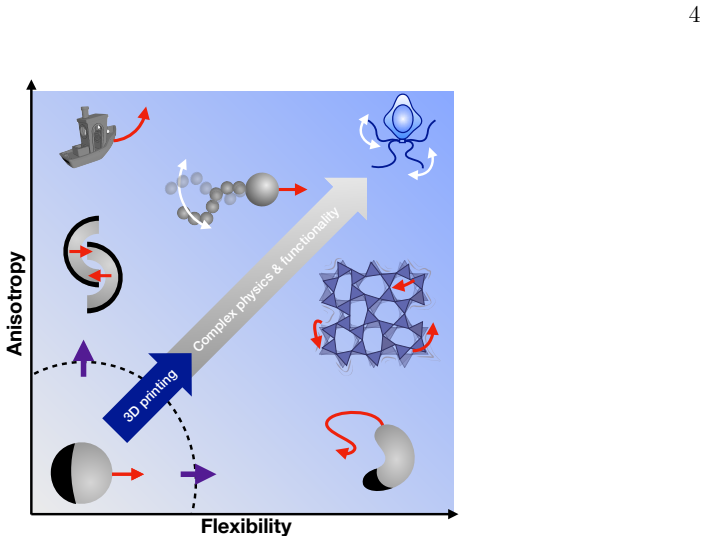
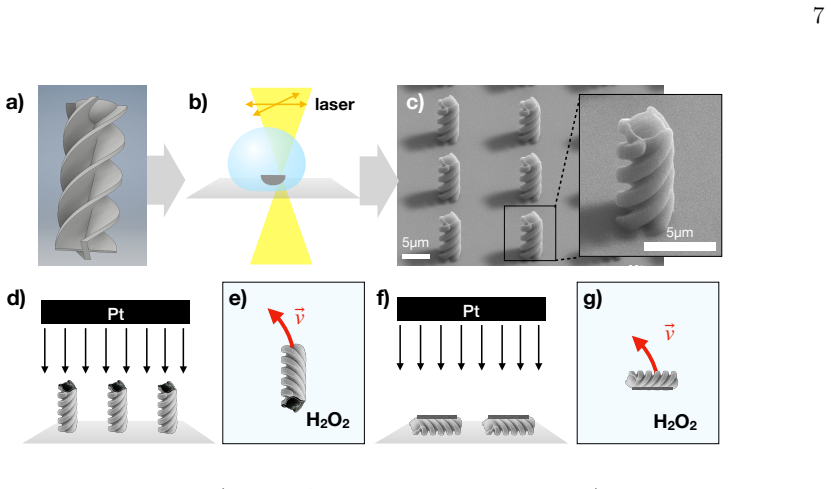
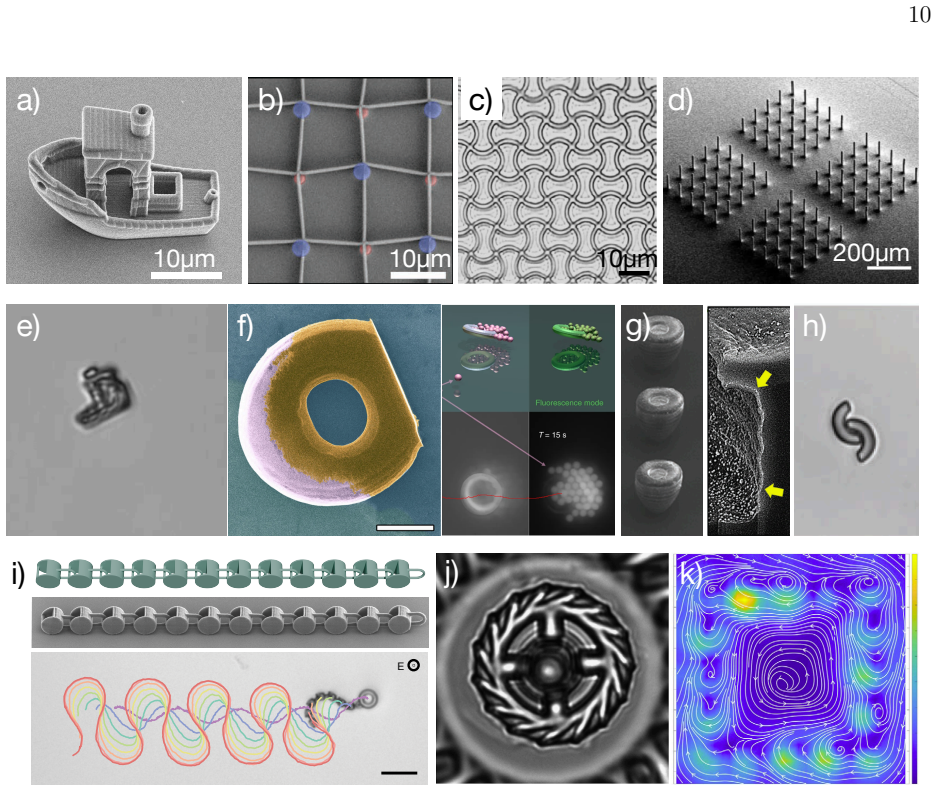
Active colloidal particles provide versatile model systems for exploring non-equilibrium physics in motile matter. To date, most experimental realizations have focused on spherical particles, largely due to fabrication constraints. However, theoretical and computational studies have long predicted that particle anisotropy and flexibility can dramatically enrich single-particle dynamics, interparticle interactions, and emergent collective behavior. Here, we highlight recent advances in the fabrication of anisotropic active particles and architectures enabled by the unprecedented design freedom of 3D microprinting. We discuss how additive manufacturing is expanding the accessible parameter space of active soft matter, allowing precise control over shape, location of active forces, and functionality at the microscale. These developments establish new model platforms for uncovering fundamental principles of active and soft matter, and simultaneously pave the way toward microrobotic systems with programmable dynamics and emergent functionalities.
Editorial analysis
A structured set of objections, weighed in public.
Referee Report
Summary. The manuscript is a perspective article that reviews recent advances in 3D microprinting techniques for fabricating anisotropic and deformable active colloidal particles. It contrasts these with prior experimental limitations to spherical particles, discusses how additive manufacturing provides control over particle shape, active force location, and functionality, and claims that the resulting platforms will uncover new principles in active and soft matter while enabling programmable microrobotic systems.
Significance. If the synthesis of fabrication advances holds, the perspective is significant for bridging theoretical predictions on anisotropy and flexibility with emerging experimental capabilities. It expands the accessible parameter space for active matter studies and offers a forward-looking view on microrobotics. The strength lies in its compilation of recent work rather than new derivations or data; this provides a useful overview for the field without introducing untested models.
minor comments (2)
- The abstract states that the developments 'establish new model platforms' but does not specify concrete examples of printed particle geometries or force placements that have already been realized; adding one or two brief references to published structures in the abstract would strengthen the grounding.
- In the discussion of microrobotic applications, the text could more explicitly distinguish between demonstrated capabilities and projected ones to avoid conflating current fabrication limits with future potential.
Simulated Author's Rebuttal
We thank the referee for their positive assessment of our perspective article and for recommending acceptance. We appreciate the recognition that the work provides a useful overview bridging fabrication advances with theoretical predictions in active matter.
Circularity Check
No significant circularity; perspective article with no derivations or self-referential predictions
full rationale
This is a perspective article summarizing external fabrication advances in 3D microprinting of anisotropic active particles. The provided abstract and context contain no equations, fitted parameters, quantitative predictions, or derivation chains. Central claims are descriptive and forward-looking, referencing external work without internal self-citation load-bearing steps or reductions of results to inputs by construction. The paper is self-contained as a review of existing developments and does not exhibit any of the enumerated circularity patterns.
Axiom & Free-Parameter Ledger
Lean theorems connected to this paper
-
IndisputableMonolith/Cost/FunctionalEquation.leanwashburn_uniqueness_aczel unclear?
unclearRelation between the paper passage and the cited Recognition theorem.
Anisotropic particle shapes have been predicted to significantly enrich the behavior of active systems... circular, helical, and spiral paths... elasto-active instabilities.
What do these tags mean?
- matches
- The paper's claim is directly supported by a theorem in the formal canon.
- supports
- The theorem supports part of the paper's argument, but the paper may add assumptions or extra steps.
- extends
- The paper goes beyond the formal theorem; the theorem is a base layer rather than the whole result.
- uses
- The paper appears to rely on the theorem as machinery.
- contradicts
- The paper's claim conflicts with a theorem or certificate in the canon.
- unclear
- Pith found a possible connection, but the passage is too broad, indirect, or ambiguous to say the theorem truly supports the claim.
Reference graph
Works this paper leans on
- [1]
-
[2]
C. Bechinger, R. Di Leonardo, H. L¨ owen, C. Reichhardt, G. Volpe, and G. Volpe, Active Particles in Complex and Crowded Environments, Reviews Of Modern Physics88, 1 (2016)
work page 2016
-
[3]
B. Liebchen and A. K. Mukhopadhyay, Interactions in active colloids, Journal of Physics: Condensed Matter34, 083002 (2021)
work page 2021
-
[4]
J. Palacci, S. Sacanna, A. P. Steinberg, D. J. Pine, and P. M. Chaikin, Living crystals of light-activated colloidal surfers, Science339, 936 (2013)
work page 2013
-
[5]
I. Buttinoni, J. Bialk´ e, F. K¨ ummel, H. L¨ owen, C. Bechinger, and T. Speck, Dynamical Clustering and Phase Separation in Suspensions of Self-Propelled Colloidal Particles, Physical Review Letters110, 238301 (2013)
work page 2013
-
[6]
I. Theurkauff, C. Cottin-Bizonne, J. Palacci, C. Ybert, and L. Bocquet, Dynamic Clustering in Active Colloidal Suspensions with Chemical Signaling, Physical Review Letters108, 268303 15 (2012)
work page 2012
-
[7]
M. E. Cates and J. Tailleur, Motility-induced phase separation, Annu. Rev. Condens. Matter Phys.6, 219 (2015)
work page 2015
-
[8]
A. Bricard, J.-B. Caussin, D. Das, C. Savoie, V. Chikkadi, K. Shitara, O. Chepizhko, F. Peruani, D. Saintillan, and D. Bartolo, Emergent vortices in populations of colloidal rollers, Nature Communications6, 7470 (2015), number: 1
work page 2015
-
[10]
K. D. Young, The selective value of bacterial shape, Microbiology and molecular biology reviews 70, 660 (2006)
work page 2006
-
[11]
Sitti, Physical intelligence as a new paradigm, Extreme Mechanics Letters46, 101340 (2021)
M. Sitti, Physical intelligence as a new paradigm, Extreme Mechanics Letters46, 101340 (2021)
work page 2021
-
[12]
S. C. Glotzer and M. J. Solomon, Anisotropy of building blocks and their assembly into complex structures, Nature Materials6, 557 (2007)
work page 2007
-
[13]
F. K¨ ummel, B. Ten Hagen, R. Wittkowski, I. Buttinoni, R. Eichhorn, G. Volpe, H. L¨ owen, and C. Bechinger, Circular motion of asymmetric self-propelling particles, Physical review letters 110, 198302 (2013)
work page 2013
-
[14]
R. Wittkowski and H. Lowen, Self-propelled Brownian spinning top: Dynamics of a biaxial swimmer at low Reynolds numbers, Physical Review E85, 021406 (2012)
work page 2012
- [15]
-
[16]
O. Shemi and M. J. Solomon, Self-Propulsion and Active Motion of Janus Ellipsoids, The Journal of Physical Chemistry B122, 10247 (2018)
work page 2018
-
[17]
Z. Wang, Z. Wang, J. Li, S. T. H. Cheung, C. Tian, S.-H. Kim, G.-R. Yi, E. Ducrot, and Y. Wang, Active patchy colloids with shape-tunable dynamics, Journal of the American Chemical Society141, 14853 (2019)
work page 2019
-
[18]
T. Ohta, Dynamics of Deformable Active Particles, Journal of the Physical Society of Japan 86, 072001 (2017)
work page 2017
-
[19]
R. G. Winkler and G. Gompper, The physics of active polymers and filaments, The Journal of Chemical Physics153, 040901 (2020)
work page 2020
-
[20]
B. ten Hagen, F. K. u. mmel, R. Wittkowski, D. Takagi, H. L. o. wen, and C. Bechinger, 16 Gravitaxis of asymmetric self-propelled colloidal particles, Nature Communications5, 1 (2014)
work page 2014
-
[21]
B. Liebchen, P. Monderkamp, B. ten Hagen, and H. L¨ owen, Viscotaxis: Microswimmer Navigation in Viscosity Gradients, Physical Review Letters120, 208002 (2018)
work page 2018
-
[22]
H. H. Wensink and H. L¨ owen, Emergent states in dense systems of active rods: from swarming to turbulence, Journal of Physics: Condensed Matter24, 464130 (2012)
work page 2012
-
[23]
H. H. Wensink, H. Lowen, M. Marechal, A. H¨ artel, R. Wittkowski, U. Zimmermann, A. Kaiser, and A. M. Menzel, Differently shaped hard body colloids in confinement: From passive to active particles, The European Physical Journal Special Topics222, 3023 (2013)
work page 2013
-
[24]
L. F. Cugliandolo, P. Digregorio, G. Gonnella, and A. Suma, Phase Coexistence in Two- Dimensional Passive and Active Dumbbell Systems, Physical Review Letters119, 268002 (2017)
work page 2017
-
[25]
R. van Damme, J. Rodenburg, R. van Roij, and M. Dijkstra, Interparticle torques suppress motility-induced phase separation for rodlike particles, The Journal of Chemical Physics150, 164501 (2019)
work page 2019
- [26]
-
[27]
T. C. Rebocho, M. Tasinkevych, and C. S. Dias, Effect of anisotropy on the formation of active particle films, Physical Review E106, 024609 (2022)
work page 2022
-
[28]
S. E. Moran, I. R. Bruss, P. W. A. Sch¨ onh¨ ofer, and S. C. Glotzer, Particle anisotropy tunes emergent behavior in active colloidal systems, Soft Matter18, 1044 (2022)
work page 2022
-
[29]
A. M. Menzel and T. Ohta, Soft deformable self-propelled particles, Europhysics Letters99, 58001 (2012)
work page 2012
- [30]
-
[31]
M. L. Manning, Essay: Collections of Deformable Particles Present Exciting Challenges for Soft Matter and Biological Physics, Physical Review Letters130, 130002 (2023)
work page 2023
-
[32]
Z. Wang, Y. Mu, D. Lyu, M. Wu, J. Li, Z. Wang, and Y. Wang, Engineering shapes of active colloids for tunable dynamics, Current Opinion in Colloid & Interface Science61, 101608 (2022)
work page 2022
-
[33]
F. Ma, S. Wang, D. T. Wu, and N. Wu, Electric-field–induced assembly and propulsion of 17 chiral colloidal clusters, Proceedings of the national academy of sciences112, 6307 (2015)
work page 2015
-
[34]
A. M. Brooks, M. Tasinkevych, S. Sabrina, D. Velegol, A. Sen, and K. J. Bishop, Shape-directed rotation of homogeneous micromotors via catalytic self-electrophoresis, Nature communications 10, 495 (2019)
work page 2019
-
[35]
S. A. Caipa Cure and D. J. Kraft, Fabrication and characterization of bimetallic silica-based and 3d-printed active colloidal cubes, Langmuir41, 11638 (2025)
work page 2025
-
[36]
H. R. Vutukuri, Z. Preisler, T. H. Besseling, A. Van Blaaderen, M. Dijkstra, and W. T. Huck, Dynamic self-organization of side-propelling colloidal rods: experiments and simulations, Soft Matter12, 9657 (2016)
work page 2016
- [37]
-
[38]
T. Lefranc, A. Dinelli, C. Fern´ andez-Rico, R. P. A. Dullens, J. Tailleur, and D. Bartolo, Quorum sensing and absorbing phase transitions in colloidal active matter (2025), arXiv:2502.13919 [cond-mat]
-
[39]
L. Alvarez, M. A. Fernandez-Rodriguez, A. Alegria, S. Arrese-Igor, K. Zhao, M. Kr¨ oger, and L. Isa, Reconfigurable artificial microswimmers with internal feedback, Nature Communications 12, 4762 (2021), number: 1
work page 2021
-
[40]
A. Sciortino, H. A. Faizi, D. A. Fedosov, L. Frechette, P. M. Vlahovska, G. Gompper, and A. R. Bausch, Active membrane deformations of a minimal synthetic cell, Nature Physics21, 799 (2025)
work page 2025
-
[41]
H. R. Vutukuri, M. Hoore, C. Abaurrea-Velasco, L. van Buren, A. Dutto, T. Auth, D. A. Fedosov, G. Gompper, and J. Vermant, Active particles induce large shape deformations in giant lipid vesicles, Nature586, 52 (2020), number: 7827
work page 2020
-
[42]
P. W. A. Sch¨ onh¨ ofer and S. C. Glotzer, Collective behavior of “flexicles”, Proceedings of the National Academy of Sciences122, e2426850122 (2025), company: National Academy of Sciences Distributor: National Academy of Sciences Institution: National Academy of Sciences Label: National Academy of Sciences
work page 2025
-
[43]
Q. Martinet, Y. Li, A. Aubret, E. Hannezo, and J. Palacci, Emergent Dynamics of Active Elastic Microbeams, Physical Review X15, 041017 (2025)
work page 2025
-
[44]
M. Wei, M. Y. Ben Zion, and O. Dauchot, Reconfiguration, Interrupted Aging, and Enhanced Dynamics of a Colloidal Gel Using Photoswitchable Active Doping, Physical Review Letters 18 131, 018301 (2023)
work page 2023
-
[45]
Y. C. Saraswat, F. Ibis, L. Rossi, L. Sasso, H. B. Eral, and P. Fanzio, Shape anisotropic colloidal particle fabrication using 2-photon polymerization, Journal of Colloid and Interface Science564, 43 (2020)
work page 2020
-
[46]
M. Mayarani, J. Laurent, M. Lenz, O. d. Roure, and J. Heuvingh, Lifetime and fluctuations of specific bonds between anisotropic colloids mediated through depletion interactions, Soft Matter21, 7851 (2025)
work page 2025
-
[47]
R. Di Leonardo, L. Angelani, D. Dell’Arciprete, G. Ruocco, V. Iebba, S. Schippa, M. P. Conte, F. Mecarini, F. De Angelis, and E. Di Fabrizio, Bacterial ratchet motors, Proceedings of the National Academy of Sciences107, 9541 (2010)
work page 2010
-
[48]
K. Liu, H. Ding, S. Li, Y. Niu, Y. Zeng, J. Zhang, X. Du, and Z. Gu, 3D printing col- loidal crystal microstructures via sacrificial-scaffold-mediated two-photon lithography, Nature Communications13, 4563 (2022)
work page 2022
-
[49]
S. van Kesteren, X. Shen, M. Aldeghi, and L. Isa, Printing on Particles: Com- bining Two-Photon Nanolithography and Capillary Assembly to Fabricate Mul- timaterial Microstructures, Advanced Materials35, 2207101 (2023), eprint: https://advanced.onlinelibrary.wiley.com/doi/pdf/10.1002/adma.202207101
-
[50]
H. Reinken, D. Nishiguchi, S. Heidenreich, A. Sokolov, M. B¨ ar, S. H. Klapp, and I. S. Aranson, Organizing bacterial vortex lattices by periodic obstacle arrays, Communications Physics3, 76 (2020)
work page 2020
-
[51]
S. Ketzetzi, M. Rinaldin, P. Dr¨ oge, J. d. Graaf, and D. J. Kraft, Activity-induced interac- tions and cooperation of artificial microswimmers in one-dimensional environments, Nature Communications13, 1772 (2022)
work page 2022
-
[52]
E. van den Pol, A. V. Petukhov, D. M. E. Thies-Weesie, D. V. Byelov, and G. J. Vroege, Experimental Realization of Biaxial Liquid Crystal Phases in Colloidal Dispersions of Boardlike Particles, Physical Review Letters103, 258301 (2009)
work page 2009
- [53]
-
[54]
C. Fern´ andez-Rico, M. Chiappini, T. Yanagishima, H. de Sousa, D. G. A. L. Aarts, M. Dijkstra, and R. P. A. Dullens, Shaping colloidal bananas to reveal biaxial, splay-bend nematic, and smectic phases., Science369, 950 (2020). 19
work page 2020
-
[55]
P. F. Damasceno, M. Engel, and S. C. Glotzer, Predictive Self-Assembly of Polyhedra into Complex Structures, Science337, 453 (2012)
work page 2012
-
[56]
S. Sacanna, W. T. M. Irvine, P. M. Chaikin, and D. J. Pine, Lock and key colloids., Nature 464, 575 (2010)
work page 2010
-
[57]
D. J. Kraft, R. Ni, F. Smallenburg, M. Hermes, K. Yoon, D. A. Weitz, A. van Blaaderen, J. Groenewold, M. Dijkstra, and W. K. Kegel, Surface roughness directed self-assembly of patchy particles into colloidal micelles., Proceedings of the National Academy of Sciences109, 10787 (2012)
work page 2012
-
[58]
M. Liu, X. Zheng, V. Grebe, D. J. Pine, and M. Weck, Tunable assembly of hybrid colloids induced by regioselective depletion, Nature Materials19, 1354 (2020)
work page 2020
-
[59]
S. Gu, C. Mao, A. Guell Izard, S. Sadana, D. Terrel-Perez, M. Mettry-Yassa, W. Choi, W. Zhou, H. Yan, Z. Zhou, T. Massey, A. Abelson, Y. Zhou, S. Huang, C. Daraio, T. U. Tumkur, J. A. Fan, and X. Xia, 3D nanolithography with metalens arrays and spatially adaptive illumination, Nature648, 591 (2025)
work page 2025
- [60]
-
[61]
H. Le Roy, Collective Deformation Modes Promote Fibrous Self-Assembly in Deformable Particles, Physical Review X15, 10.1103/PhysRevX.15.011022 (2025)
-
[62]
Z. Liu, C. Wang, Z. Ren, C. Wang, W. Wang, J. Ko, S. Song, C. Hong, X. Chen, H. Wang, W. Hu, and M. Sitti, 3D-printed low-voltage-driven ciliary hydrogel microactuators, Nature , 1 (2026)
work page 2026
-
[63]
W. Zhou, S. Nadarajah, L. Li, A. G. Izard, H. Yan, A. K. Prachet, P. Patel, X. Xia, and C. Daraio, 3D polycatenated architected materials, Science387, 269 (2025)
work page 2025
- [64]
-
[65]
K. Bertoldi, V. Vitelli, J. Christensen, and M. van Hecke, Flexible mechanical metamaterials, Nature Reviews Materials2, 17066 (2017)
work page 2017
- [66]
-
[67]
M. Zhang, H. Shahsavan, Y. Guo, A. Pena-Francesch, Y. Zhang, and M. Sitti, Liquid-Crystal- 20 Elastomer-Actuated Reconfigurable Microscale Kirigami Metastructures, Advanced Materials 33, 2008605 (2021), eprint: https://onlinelibrary.wiley.com/doi/pdf/10.1002/adma.202008605
- [68]
- [69]
-
[70]
R. P. Doherty, T. Varkevisser, M. Teunisse, J. Hoecht, S. Ketzetzi, S. Ouhajji, and D. J. Kraft, Catalytically propelled 3D printed colloidal microswimmers, Soft Matter85, 021406 (2020)
work page 2020
-
[71]
R. D. Baker, T. Montenegro-Johnson, A. D. Sediako, M. J. Thomson, A. Sen, E. Lauga, and I. S. Aranson, Shape-programmed 3D printed swimming microtori for the transport of passive and active agents, Nature Communications10, 10.1038/s41467-019-12904-0 (2019)
-
[72]
H. Ceylan, I. C. Yasa, and M. Sitti, 3D Chemical Patterning of Micromate- rials for Encoded Functionality, Advanced Materials29, 1605072 (2017), eprint: https://onlinelibrary.wiley.com/doi/pdf/10.1002/adma.201605072
- [73]
-
[74]
G. Vizsnyiczai, G. Frangipane, C. Maggi, F. Saglimbeni, S. Bianchi, and R. Di Leonardo, Light controlled 3D micromotors powered by bacteria, Nature Communications8, 1 (2017)
work page 2017
- [75]
-
[76]
S. Michelin and E. Lauga, Geometric tuning of self-propulsion for Janus catalytic particles, Scientific Reports7, 42264 (2017)
work page 2017
-
[77]
C. L. Smart, T. G. Pearson, Z. Liang, M. X. Lim, M. I. Abdelrahman, F. Monticone, I. Cohen, and P. L. McEuen, Magnetically programmed diffractive robotics, Science386, 1031 (2024)
work page 2024
-
[78]
H. L¨ owen, Inertial effects of self-propelled particles: From active Brownian to active Langevin motion, The Journal of Chemical Physics152, 040901 (2020)
work page 2020
- [79]
-
[80]
P. Baconnier, D. Shohat, C. H. L´ opez, C. Coulais, V. D´ emery, G. D¨ uring, and O. Dauchot, Selective and collective actuation in active solids, Nature Physics18, 1234 (2022), number: 10. 21
work page 2022
-
[81]
E. Ferrante, A. E. Turgut, M. Dorigo, and C. Huepe, Elasticity-based mechanism for the collective motion of self-propelled particles with springlike interactions: a model system for natural and artificial swarms, Physical review letters111, 268302 (2013)
work page 2013
discussion (0)
Sign in with ORCID, Apple, or X to comment. Anyone can read and Pith papers without signing in.