High-precision ab initio nuclear theory: Learning to overcome model-space limitations
Pith reviewed 2026-05-10 17:47 UTC · model grok-4.3
The pith
Machine learning models trained on truncated nuclear calculations can extrapolate observables to the infinite model-space limit with quantified precision.
A machine-rendered reading of the paper's core claim, the machinery that carries it, and where it could break.
Core claim
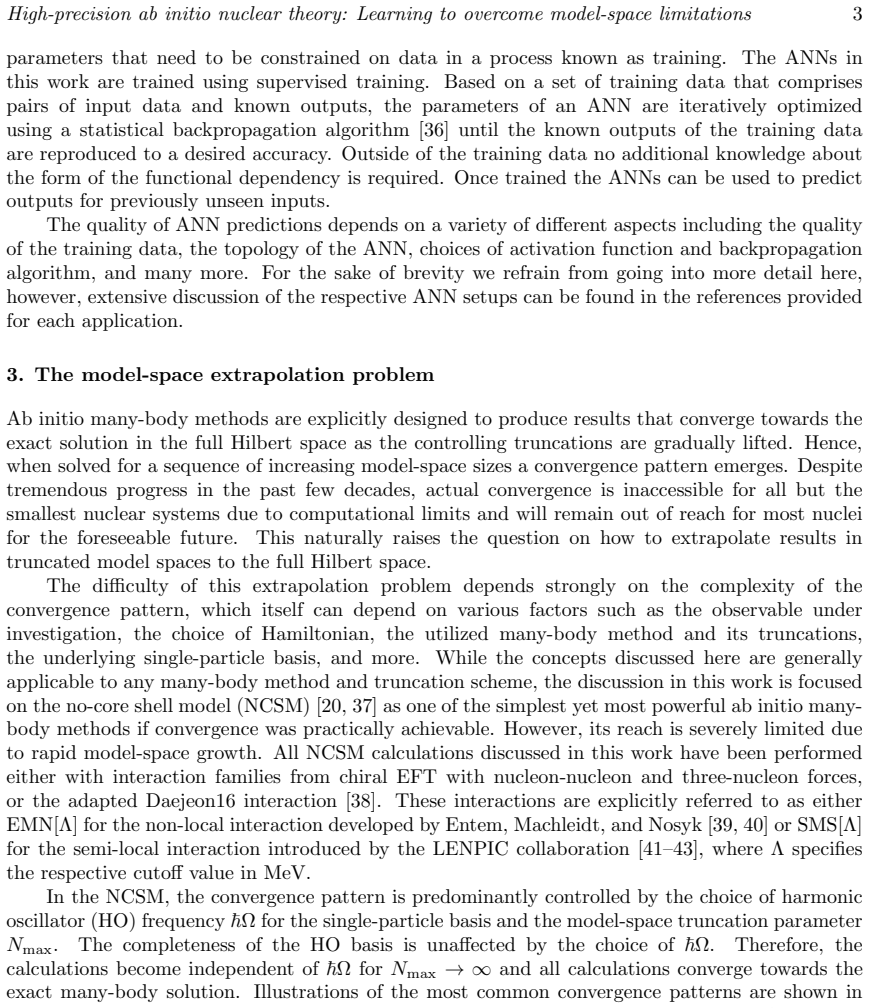
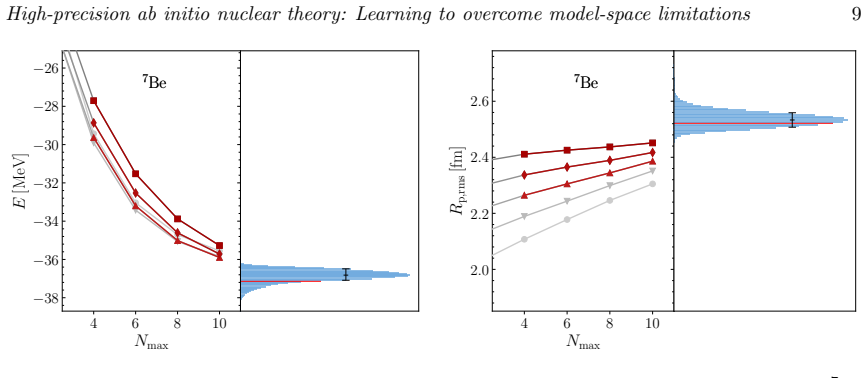
By training machine-learning models on sequences of ab initio calculations performed in progressively larger but still truncated model spaces, the approach learns the underlying convergence behavior and produces extrapolated values for nuclear observables together with statistical uncertainty estimates that are competitive with or superior to conventional extrapolation techniques.
What carries the argument
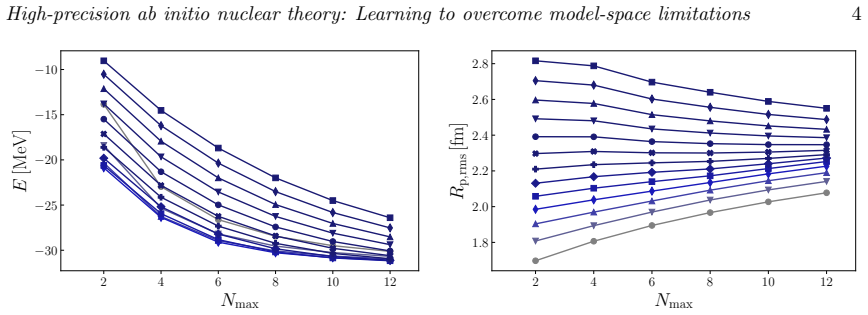
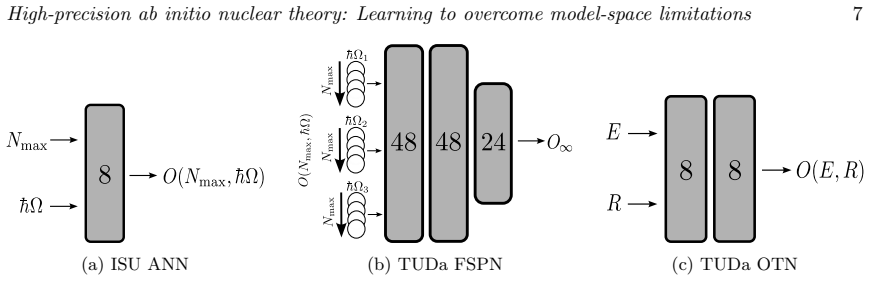
Artificial neural network frameworks that take results from finite model spaces as input and output extrapolated infinite-space limits for observables, trained to capture convergence patterns.
If this is right
- Energy spectra, radii, and electromagnetic transition strengths can be predicted with reduced model-space error.
- Uncertainty estimates for extrapolated observables become available through statistical and correlation-based methods.
- The same trained networks can be reused across multiple nuclei and observables once convergence patterns are learned.
- Ab initio calculations remain feasible in smaller spaces while still reaching precision targets that previously demanded larger spaces.
Where Pith is reading between the lines
- The same learning strategy could be tested on other many-body truncations such as coupled-cluster or in-medium similarity renormalization group calculations.
- If the networks generalize across different nuclear interactions, they might reduce the need for repeated large-basis runs when varying the Hamiltonian parameters.
- Integration with experimental data could further constrain the extrapolation models and tighten uncertainty estimates.
Load-bearing premise
Machine-learning models fitted to truncated-space data will not introduce systematic biases that lie outside the statistical uncertainty bands when applied to the infinite-space limit.
What would settle it
A direct comparison in which a high-precision calculation in a much larger model space or an experimental measurement lies outside the extrapolated central value plus its quoted uncertainty band.
Figures
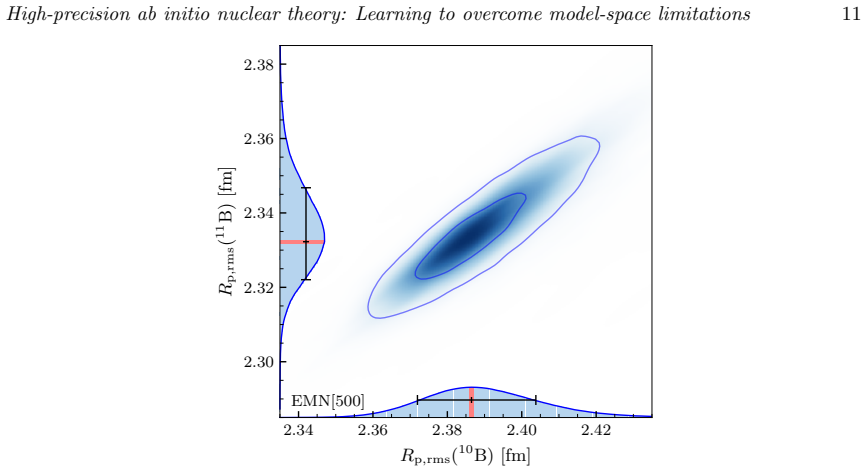
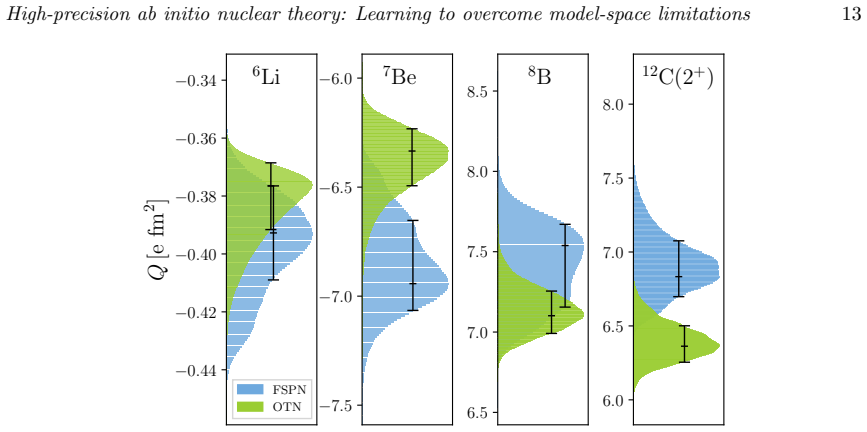
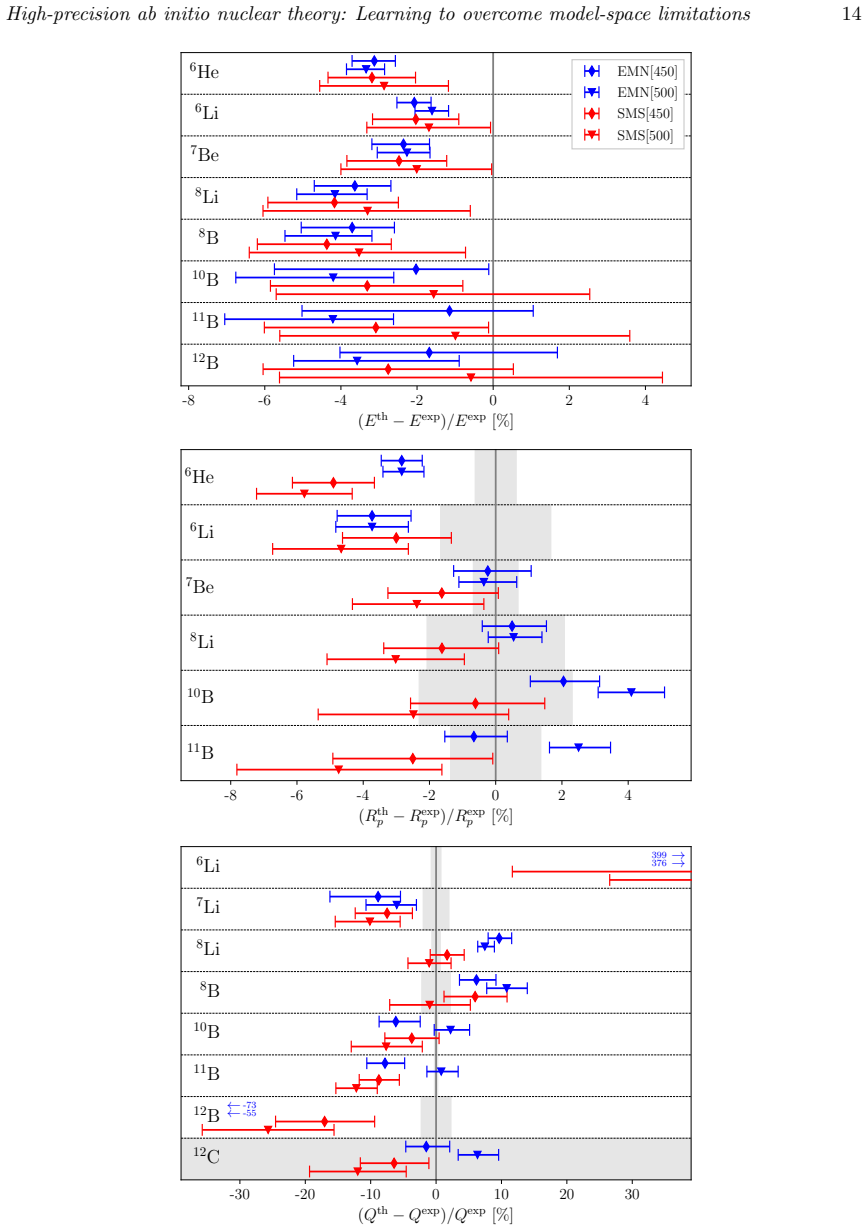
read the original abstract
High-precision predictions of nuclear properties are a central objective of ab initio nuclear structure theory. However, state-of-the-art many-body methods rely on truncated model spaces to render the nuclear many-body problem tractable, which remains a major source of theoretical error in computations of nuclear observables. In recent years, machine learning, and artificial neural network approaches in particular, have emerged as a powerful data-driven framework for learning convergence patterns directly from ab initio calculations and enabling precision extrapolations beyond the reach of conventional schemes. This review focuses on model-space extrapolation methods developed for the no-core shell model and related many-body methods. We discuss machine learning extrapolation frameworks in comparison to conventional methods and assess their performance for energy spectra, radii, and electromagnetic observables, with particular emphasis on achievable precision and uncertainty estimates through statistical and correlation-based strategies. These developments establish machine learning as an increasingly important component of the precision toolbox in ab initio nuclear theory, enhancing the reliability and predictive power of ab initio nuclear structure calculations.
Editorial analysis
A structured set of objections, weighed in public.
Referee Report
Summary. The manuscript is a review of machine learning (primarily neural network) approaches for extrapolating nuclear observables from truncated model spaces in ab initio calculations such as the no-core shell model. It compares these data-driven methods to conventional extrapolation schemes, assesses their performance on energy spectra, radii, and electromagnetic observables, and emphasizes achievable precision together with statistical and correlation-based uncertainty estimates.
Significance. If the reviewed methods prove reliable, the work is significant for ab initio nuclear theory because model-space truncation remains a dominant source of theoretical uncertainty; successful ML extrapolations could extend the reach of existing computations to higher precision without proportional increases in basis size, thereby strengthening predictive power for nuclear structure observables.
major comments (1)
- [Section on performance assessment and uncertainty quantification] The central claim that ML methods enhance reliability and predictive power rests on the premise that neural networks trained on truncated model-space results can extrapolate convergence patterns without introducing new systematic biases. The review compares ML frameworks to conventional extrapolations and discusses statistical and correlation-based uncertainty estimates, yet it does not provide a concrete test or quantitative bound showing that residual biases (e.g., from incomplete long-range correlations or interaction-specific features) are either absent or fully captured by the reported uncertainties. This is load-bearing for the reliability assessment.
minor comments (1)
- [Abstract and Introduction] The abstract and introduction would benefit from a brief, explicit statement of the review's scope (e.g., which many-body methods and observables are covered) to help readers quickly assess relevance.
Simulated Author's Rebuttal
We thank the referee for the thoughtful review and for identifying the importance of rigorously addressing potential systematic biases in the ML extrapolation methods. We respond to the major comment below and will revise the manuscript accordingly to strengthen the reliability assessment.
read point-by-point responses
-
Referee: The central claim that ML methods enhance reliability and predictive power rests on the premise that neural networks trained on truncated model-space results can extrapolate convergence patterns without introducing new systematic biases. The review compares ML frameworks to conventional extrapolations and discusses statistical and correlation-based uncertainty estimates, yet it does not provide a concrete test or quantitative bound showing that residual biases (e.g., from incomplete long-range correlations or interaction-specific features) are either absent or fully captured by the reported uncertainties. This is load-bearing for the reliability assessment.
Authors: We agree that demonstrating the absence or bounding of new systematic biases is essential and load-bearing for the central claims. As a review, the manuscript summarizes validations already present in the cited literature, including direct comparisons of ML-extrapolated results to exact solutions in smaller model spaces where full convergence is achievable, cross-checks against other ab initio methods, and consistency with experimental data. However, we acknowledge that a more explicit discussion of residual biases (e.g., from long-range correlations or interaction dependence) and how the reported statistical/correlation uncertainties capture them would improve the assessment. We will add a dedicated paragraph in the performance assessment section that reviews quantitative tests from the literature, including error bounds obtained from comparisons to larger-basis calculations and evaluations of interaction-specific features. This revision will provide the requested concrete discussion without introducing new calculations. revision: yes
Circularity Check
Review paper with no original derivations or predictions exhibits no circularity
full rationale
This is a review summarizing existing ML extrapolation methods for no-core shell model and related ab initio calculations. The abstract and provided text discuss frameworks, comparisons to conventional extrapolations, performance on observables, and uncertainty strategies, but contain no new derivations, equations, or first-principles results that reduce to fitted inputs or self-citations by construction. Claims about ML enhancing reliability rest on referenced prior work rather than any self-referential chain within this manuscript. No load-bearing steps match the enumerated circularity patterns.
Axiom & Free-Parameter Ledger
Reference graph
Works this paper leans on
-
[1]
McDonnell J D, Schunck N, Higdon D, Sarich J, Wild S M and Nazarewicz W 2015Phys. Rev. Lett.114(12) 122501
-
[2]
Neufcourt L, Cao Y, Nazarewicz W and Viens F 2018Phys. Rev. C98(3) 034318
-
[3]
Lasseri R D, Regnier D, Ebran J P and Penon A 2020Phys. Rev. Lett.124(16) 162502
-
[4]
Gao Z P, Wang Y J, L¨ u H L, Li Q F, Shen C W and Liu L 2021Nuclear Science and Techniques 32109
-
[5]
Mumpower M R, Sprouse T M, Lovell A E and Mohan A T 2022Phys. Rev. C106(2) L021301
-
[6]
Y¨ uksel E, Soydaner D and Bahtiyar H 2024Phys. Rev. C109(6) 064322
-
[7]
Boehnlein A, Diefenthaler M, Sato N, Schram M, Ziegler V, Fanelli C, Hjorth-Jensen M, Horn T, Kuchera M P, Lee D, Nazarewicz W, Ostroumov P, Orginos K, Poon A, Wang X N, Scheinker A, Smith M S and Pang L G 2022Rev. Mod. Phys.94(3) 031003
-
[8]
He W, Li Q, Ma Y, Niu Z, Pei J and Zhang Y 2023Science China Physics, Mechanics & Astronomy66282001
-
[9]
Carleo G, Cirac I, Cranmer K, Daudet L, Schuld M, Tishby N, Vogt-Maranto L and Zdeborov´ a L 2019Rev. Mod. Phys.91(4) 045002
-
[10]
Hergert H 2020Frontiers in Physics8379
-
[11]
Epelbaum E, Krebs H and Reinert P 2020Frontiers in Physics898
-
[12]
Machleidt R and Sammarruca F 2024Progress in Particle and Nuclear Physics137104117
-
[13]
Furnstahl R J, Klco N, Phillips D R and Wesolowski S 2015Phys. Rev. C92(2) 024005
-
[14]
Melendez J A, Furnstahl R J, Phillips D R, Pratola M T and Wesolowski S 2019Phys. Rev. C100(4) 044001
-
[15]
Svensson I, Ekstr¨ om A and Forss´ en C 2023Phys. Rev. C107(1) 014001
- [16]
-
[17]
Keller J, Hebeler K and Schwenk A 2023Phys. Rev. Lett.130(7) 072701
-
[18]
Belley A, Munoz J M and Garcia Ruiz R F 2026Phys. Rev. Lett.136(8) 082501
-
[19]
Ekstr¨ om A, Forss´ en C, Dimitrakakis C, Dubhashi D, Johansson H T, Muhammad A S, Salomonsson H and Schliep A 2019Journal of Physics G: Nuclear and Particle Physics46 095101
-
[20]
Barrett B R, Navr´ atil P and Vary J P 2013Prog. Part. Nucl. Phys.69131–181 REFERENCES 17
-
[21]
Hagen G, Papenbrock T, Hjorth-Jensen M and Dean D J 2014Reports on Progress in Physics 77096302
-
[22]
Hergert H, Bogner S, Morris T, Schwenk A and Tsukiyama K 2016Physics Reports621 165–222 memorial Volume in Honor of Gerald E. Brown
-
[23]
Som` a V 2020Frontiers in Physics8340
-
[24]
Bogner S K, Furnstahl R J and Perry R J 2007Phys. Rev. C75(6) 061001
-
[25]
Bogner S, Furnstahl R and Schwenk A 2010Progress in Particle and Nuclear Physics65 94–147
-
[26]
Roth R, Neff T and Feldmeier H 2010Progress in Particle and Nuclear Physics6550–93
-
[27]
Furnstahl R J and Hebeler K 2013Reports on Progress in Physics76126301
-
[28]
Roth R, Calci A, Langhammer J and Binder S 2014Phys. Rev. C90(2) 024325
-
[29]
Negoita G A, Vary J P, Luecke G R, Maris P, Shirokov A, Shin I J, Kim Y, Ng N G, Yang C and Lockner M 2019Phys. Rev. C99054308
-
[30]
Jiang W G, Hagen G and Papenbrock T 2019Phys. Rev. C100(5) 054326
-
[31]
Mazur A, Sharypov R and Shirokov A 2024Moscow University Physics Bulletin79318–329
-
[32]
Kn¨ oll M, Wolfgruber T, Agel M L, Wenz C and Roth R 2023Physics Letters B839137781
-
[33]
Wolfgruber T, Kn¨ oll M and Roth R 2024Phys. Rev. C110(1) 014327
-
[34]
Kn¨ oll M, Agel M L, Wolfgruber T, Maris P and Roth R 2025Phys. Rev. C112(3) 034306
-
[35]
Goodfellow I, Bengio Y, Courville A and Bengio Y 2016Deep learningvol 1 (MIT press Cambridge)
-
[36]
Rojas R 1996 The backpropagation algorithmNeural networks: a systematic introduction (Springer) pp 149–182
work page 1996
-
[37]
Navr´ atil P, Quaglioni S, Stetcu I and Barrett B 2009Journal of Physics G: Nuclear and Particle Physics36083101
-
[38]
Shirokov A, Shin I, Kim Y, Sosonkina M, Maris P and Vary J 2016Physics Letters B761 87–91
-
[39]
Entem D R, Machleidt R and Nosyk Y 2017Phys. Rev. C96(2) 024004
-
[40]
H¨ uther T, Vobig K, Hebeler K, Machleidt R and Roth R 2020Physics Letters B808135651
-
[41]
Reinert P, Krebs H and Epelbaum E 2018The European Physical Journal A5486
-
[42]
Maris P, Epelbaum E, Furnstahl R J, Golak J, Hebeler K, H¨ uther T, Kamada H, Krebs H, Meißner U G, Melendez J A, Nogga A, Reinert P, Roth R, Skibi´ nski R, Soloviov V, Topolnicki K, Vary J P, Volkotrub Y, Wita la H and Wolfgruber T (LENPIC Collaboration) 2021Phys. Rev. C103(5) 054001
-
[43]
Maris P, Roth R, Epelbaum E, Furnstahl R J, Golak J, Hebeler K, H¨ uther T, Kamada H, Krebs H, Le H, Meißner U G, Melendez J A, Nogga A, Reinert P, Skibi´ nski R, Vary J P, Wita la H and Wolfgruber T (LENPIC Collaboration) 2022Phys. Rev. C106(6) 064002
-
[44]
Bogner S, Furnstahl R, Maris P, Perry R, Schwenk A and Vary J 2008Nuclear Physics A801 21–42
-
[45]
Roth R 2009Phys. Rev. C79(6) 064324
-
[46]
Maris P, Vary J P and Shirokov A M 2009Phys. Rev. C79(1) 014308 REFERENCES 18
-
[47]
Caprio M A, Maris P and Vary J P 2014Phys. Rev. C90(3) 034305
-
[48]
Furnstahl R J, Hagen G and Papenbrock T 2012Phys. Rev. C86(3) 031301
-
[49]
Coon S A, Avetian M I, Kruse M K G, van Kolck U, Maris P and Vary J P 2012Physical Review C86054002
-
[50]
More S N, Ekstr¨ om A, Furnstahl R J, Hagen G and Papenbrock T 2013Physical Review C87 044326
-
[51]
Furnstahl R J, Hagen G, Papenbrock T and Wendt K A 2015Journal of Physics G: Nuclear and Particle Physics42034032
-
[52]
Wendt K A, Forss´ en C, Papenbrock T and S¨ a¨ af D 2015Phys. Rev. C91(6) 061301
-
[53]
Sun X X, Le H, Meißner U G and Nogga A 2025Phys. Rev. C112(2) 024317
-
[54]
Yoshida S 2020Phys. Rev. C102(2) 024305
-
[55]
Negoita G A, Luecke G R, Vary J P, Maris P, Shirokov A M, Shin I J, Kim Y, Ng E G and Yang C 2018 Deep Learning: A Tool for Computational Nuclear PhysicsComputational Tools 2018ed Luecke G R and Mauri J L pp 20 – 28 ISBN 978-1-61208-613-2
work page 2018
-
[56]
Sharypov R, Mazur A and Shirokov A 2025Journal of Subatomic Particles and Cosmology4 100083
-
[57]
Kn¨ oll M, Lockner M, Maris P, McCarty R J, Roth R, Vary J P and Wolfgruber T 2025Phys. Rev. C111(6) 064304
-
[58]
Vida˜ na I 2023Nuclear Physics A1032122625
-
[59]
McCarty R 2024Ab Initio Nuclear Structure of Lithium Isotopes With Applications of Deep LearningPh.D. thesis
-
[60]
Kn¨ oll M and Roth R 2023Physics Letters B846138258
-
[61]
Wolfgruber T, Gesser T, Kn¨ oll M, Maris P and Roth R 2025Phys. Rev. C112(1) 014306
-
[62]
Caprio M A, Fasano P J and Maris P 2022Phys. Rev. C105(6) L061302
-
[63]
Caprio M A, Maris P and Fasano P J 2025Phys. Rev. C112(4) 044318
-
[64]
Maris P, Le H, Nogga A, Roth R and Vary J 2023Frontiers in Physics111098262
-
[65]
K¨ onig S, Ekstr¨ om A, Hebeler K, Lee D and Schwenk A 2020Physics Letters B810135814
-
[66]
Drischler C, Melendez J, Furnstahl R, Garcia A and Zhang X 2023Frontiers in Physics10 1092931
-
[67]
Ekstr¨ om A, Forss´ en C, Hagen G, Jansen G, Jiang W and Papenbrock T 2023Frontiers in Physics111129094
-
[68]
Duguet T, Ekstr¨ om A, Furnstahl R J, K¨ onig S and Lee D 2024Rev. Mod. Phys.96(3) 031002
-
[69]
Wang M, Huang W, Kondev F, Audi G and Naimi S 2021Chinese Physics C45030003
-
[70]
Angeli I and Marinova K 2013Atomic Data and Nuclear Data Tables9969–95
-
[71]
Stone N 2016Atomic Data and Nuclear Data Tables111-1121–28
-
[72]
Epelbaum E, Krebs H and Meißner U G 2015The European Physical Journal A5153
-
[73]
Melendez J A, Wesolowski S and Furnstahl R J 2017Phys. Rev. C96(2) 024003
discussion (0)
Sign in with ORCID, Apple, or X to comment. Anyone can read and Pith papers without signing in.