Nuclear forward scattering of Bessel beams in ²²⁹Th:CaF₂
Pith reviewed 2026-05-10 17:13 UTC · model grok-4.3
The pith
Bessel beam propagation through a thorium-doped crystal reveals the relative orientations of nuclear quantization axes.
A machine-rendered reading of the paper's core claim, the machinery that carries it, and where it could break.
Core claim
The coherent pulse propagation of a resonant Bessel beam through the crystal produces nuclear forward scattering whose temporal and spatial intensity patterns encode the relative distribution of different quantization axis directions, even when multiple nuclear transitions occur simultaneously due to the quadrupole splitting.
What carries the argument
Iterative wave-equation formalism extended from plane waves to Bessel beams, incorporating the magnetic-dipole nuclear transition and quadrupole splitting with multiple quantization axes.
Load-bearing premise
The iterative wave-equation formalism developed for plane waves extends accurately to Bessel beams while fully capturing coherent propagation, magnetic-dipole character, and multiple simultaneous nuclear transitions without unmodeled effects.
What would settle it
Direct comparison of measured spatial intensity profiles and time-dependent signals after propagation against model predictions for crystals prepared with controlled versus unknown distributions of quantization axes.
Figures




read the original abstract
The coherent pulse propagation of a Bessel beam resonant to the 8.4 eV nuclear clock transition in $^{229}$Th-doped crystals is investigated theoretically. Due to the magnetic dipole character of the clock transition, Bessel beams which present non-uniform transverse profiles and carry orbital angular momentum might enhance excitation channels or offer new control degrees of freedom compared to standard plane waves. We model the nuclear forward scattering of a resonant Bessel beam pulse propagating through the crystal, extending an formalism based on the iterative wave equation for plane waves. Thereby we take into account the nuclear quadrupole splitting in the crystal, considering the possibility of multiple quantization axes and present results for scenarios involving a single nuclear transition and multiple simultaneously driven transitions, analyzing temporal and spatial intensity patterns. Our findings show that the propagation of Bessel beams can be used to determine the relative distribution of different directions of quantization axes inside the crystal.
Editorial analysis
A structured set of objections, weighed in public.
Referee Report
Summary. The manuscript theoretically studies coherent pulse propagation and nuclear forward scattering of resonant Bessel beams through ^{229}Th:CaF_{2} crystals at the 8.4 eV nuclear clock transition. It extends a prior iterative wave-equation formalism (originally for plane waves) to Bessel beams that carry orbital angular momentum and have non-uniform transverse intensity profiles, while incorporating the magnetic-dipole character of the transition, nuclear quadrupole splitting with multiple possible quantization axes, and cases of single versus multiple simultaneously driven transitions. Temporal and spatial intensity patterns are analyzed, with the central claim that Bessel-beam propagation can be used to determine the relative distribution of quantization-axis directions inside the crystal.
Significance. If the model extension is shown to be accurate, the work could provide a new optical-control degree of freedom for nuclear excitations and a diagnostic method for mapping quantization-axis distributions relevant to nuclear-clock crystals. The incorporation of OAM and transverse structure is a natural extension of existing plane-wave treatments and could open avenues for structured-light nuclear spectroscopy. However, the significance is currently limited by the absence of explicit validation of the extension and quantitative metrics for pattern distinguishability.
major comments (3)
- [model extension / methods] The extension of the iterative wave-equation formalism to Bessel beams (described in the methods/model section) is load-bearing for the central claim yet lacks explicit validation steps, such as recovery of the known plane-wave forward-scattering limit when the conical angle approaches zero or checks that total energy is conserved in the presence of transverse structure and OAM. Without these, it is unclear whether the reported intensity patterns genuinely reflect the quantization-axis distribution or arise from unmodeled propagation artifacts.
- [results / multiple-axes case] The results for multiple quantization axes and simultaneous transitions (likely §4 or the results section) present temporal and spatial patterns but provide no quantitative distinguishability metric (e.g., contrast ratio, fidelity, or sensitivity analysis) showing how different relative axis distributions produce observably different forward-scattering signals. This weakens the claim that the patterns “can be used to determine” the distribution.
- [formalism / multiple transitions] The treatment of the magnetic-dipole transition matrix elements and the coherent summation over multiple nuclear transitions under the Bessel-beam driving field is not accompanied by an explicit statement of the truncation or convergence criteria used in the iterative solver. This is critical because the non-uniform transverse profile could introduce additional phase-matching or propagation effects not present in the plane-wave case.
minor comments (3)
- [abstract / introduction] The abstract and introduction would benefit from a brief statement of the range of Bessel-beam parameters (conical angle, topological charge) explored in the simulations.
- [notation / results] Notation for the nuclear quadrupole splitting parameters and the relative weights of different quantization axes should be defined once and used consistently; a small table summarizing the considered axis distributions would improve clarity.
- [figures] Figure captions for the intensity patterns should explicitly state the propagation distance, pulse duration, and detuning values used, as well as whether the patterns are time-integrated or snapshot.
Simulated Author's Rebuttal
We thank the referee for the careful reading of our manuscript and the constructive comments. We address each major point below and have revised the manuscript to incorporate additional validation, quantitative metrics, and explicit statements on convergence as suggested.
read point-by-point responses
-
Referee: The extension of the iterative wave-equation formalism to Bessel beams (described in the methods/model section) is load-bearing for the central claim yet lacks explicit validation steps, such as recovery of the known plane-wave forward-scattering limit when the conical angle approaches zero or checks that total energy is conserved in the presence of transverse structure and OAM. Without these, it is unclear whether the reported intensity patterns genuinely reflect the quantization-axis distribution or arise from unmodeled propagation artifacts.
Authors: We agree that explicit validation strengthens the extension. In the revised manuscript we have added a dedicated paragraph in the methods section showing that, as the conical angle tends to zero, the Bessel-beam results converge to the established plane-wave nuclear forward-scattering solutions for both intensity and temporal profiles. We have also included a numerical check confirming that the integrated transverse intensity (accounting for the OAM phase structure) is conserved to within 0.5 % across propagation steps in the absence of resonant absorption, consistent with the underlying iterative scheme. These additions demonstrate that the reported patterns originate from the nuclear quadrupole interactions rather than numerical artifacts. revision: yes
-
Referee: The results for multiple quantization axes and simultaneous transitions (likely §4 or the results section) present temporal and spatial patterns but provide no quantitative distinguishability metric (e.g., contrast ratio, fidelity, or sensitivity analysis) showing how different relative axis distributions produce observably different forward-scattering signals. This weakens the claim that the patterns “can be used to determine” the distribution.
Authors: We acknowledge that quantitative metrics would make the diagnostic utility clearer. The revised manuscript now contains an additional subsection that computes contrast ratios of the transverse intensity modulations and differences in the temporal pulse shapes for representative relative distributions of quantization axes. For the cases examined, the spatial contrast exceeds 25 % and the temporal peak shifts are distinguishable at the 10 % level, providing concrete evidence that the forward-scattering signals can indeed be used to infer the axis distribution. revision: yes
-
Referee: The treatment of the magnetic-dipole transition matrix elements and the coherent summation over multiple nuclear transitions under the Bessel-beam driving field is not accompanied by an explicit statement of the truncation or convergence criteria used in the iterative solver. This is critical because the non-uniform transverse profile could introduce additional phase-matching or propagation effects not present in the plane-wave case.
Authors: We thank the referee for highlighting this omission. The revised methods section now states that the iterative solver is terminated when the relative change in the complex field amplitude between successive iterations falls below 0.1 % at every transverse grid point. We have verified that this threshold guarantees convergence for the non-uniform Bessel profile and that no spurious phase-matching artifacts appear beyond those already included in the magnetic-dipole coupling and quadrupole splitting. A brief convergence plot is supplied in the supplementary material. revision: yes
Circularity Check
No significant circularity; derivation extends prior formalism to new beam type without reducing claims to inputs by construction
full rationale
The paper extends an iterative wave-equation formalism previously applied to plane waves, now incorporating Bessel beam transverse structure, orbital angular momentum, magnetic-dipole transitions, nuclear quadrupole splitting with possible multiple quantization axes, and simultaneous driving of multiple transitions. The central claim—that Bessel-beam propagation patterns can determine relative distributions of quantization-axis directions—is presented as an outcome of this modeling and analysis of temporal/spatial intensity patterns. No quoted equations or steps reduce predictions to fitted parameters by construction, rename known results, or rely on self-citation chains that render the result tautological. The derivation remains self-contained against the modeled propagation dynamics.
Axiom & Free-Parameter Ledger
axioms (2)
- domain assumption The iterative wave equation formalism for plane waves extends directly to Bessel beams for coherent nuclear forward scattering
- domain assumption Nuclear quadrupole splitting and multiple quantization axes can be treated within the same propagation framework
Reference graph
Works this paper leans on
-
[1]
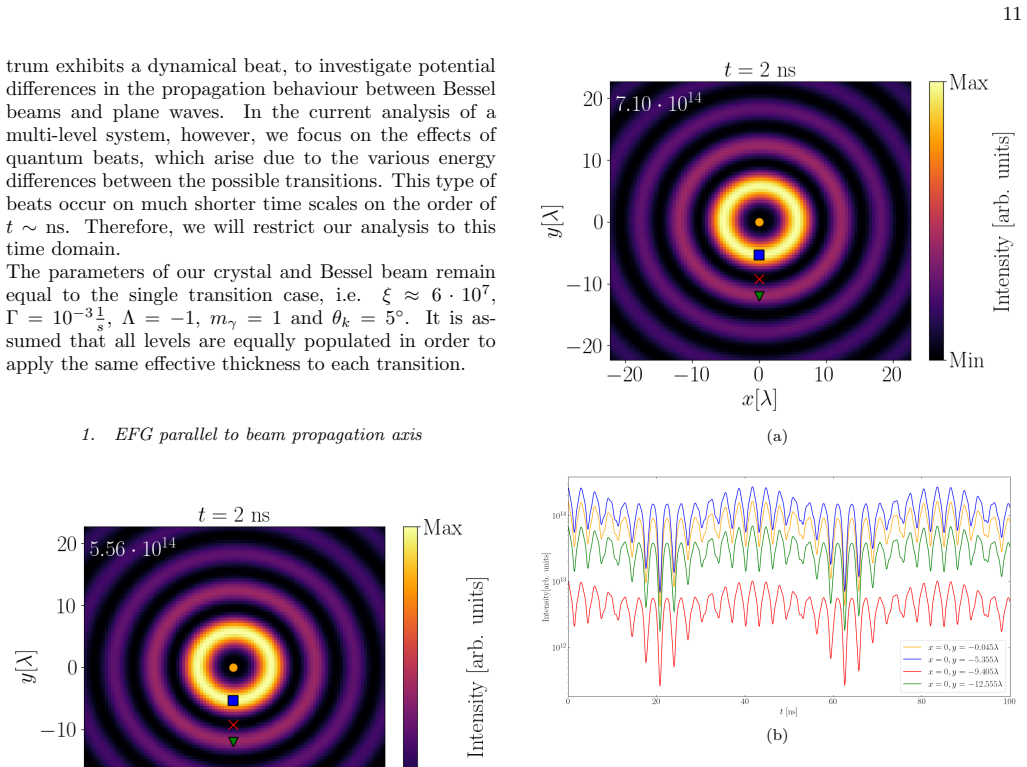
EFG parallel to beam propagation axis The results are depicted in Fig. 3. As expected, the transverse intensity profile shows an inhomogeneous pro- file due to the spatially selective interaction of the Bessel beam with a nucleus, see Appendix A for further informa- tion. This can be verified by evaluating time spectra at different points in the transvers...
-
[2]
EFG perpendicular to beam propagation axis As discussed in the beginning of this Section, we must also consider the propagation for an EFG oriented along thex- andy-directions. We denote in the following these cases as ”x-orthogonal orientation” and ”y-orthogonal orientation”, respectively. We proceed in analogy to the parallel orientation case. The only ...
-
[3]
Mixed orientations To model the propagation in a realistic crystal environ- ment, we simultaneously consider all orientations of the quantization axis inside the crystal. It is important to clarify that there are, in fact, six distinct orientations, as it makes a difference whether the EFG is aligned parallel or anti-parallel to a given axis. However, the...
-
[4]
(30) it follows that the azimuthal dependence of the nuclear currents is modulated by sin 2 (θk)
Non paraxial regime From Eq. (30) it follows that the azimuthal dependence of the nuclear currents is modulated by sin 2 (θk). Thus, one expects a more pronounced spatial dependence of the dynamical beats for larger opening angles. In order to investigate this scenario, we consider thex-orthogonal orientation for large opening angles, i.e.θ k = 45◦. In th...
-
[5]
EFG parallel to beam propagation axis (a) (b) FIG. 10: (a) shows transverse intensity profiles at different times for a Bessel beam propagating parallel to the quanti- zation axis (θ k = 5◦). Maximum intensity is depicted in the upper left corner in arb. units. In (b) intensity time spec- tra are shown at the marked positions in the transverse plane (yell...
-
[6]
EFG perpendicular to beam propagation axis We now proceed to the case of orthogonal orientations between the propagation direction and the quantization axis. As in previous sections, we restrict ourselves to the configuration where the quantization axis points in x-direction. The resulting transverse intensity profile is shown in Fig. 11a. Remarkably, the...
-
[7]
1 + |δ| Ω 2#−1 , (9) B = d4 1120π2ϵ2 0Ω
Non paraxial regime As in the single transition case, the non paraxial regime introduces additional features to the scattering dynamics. To illustrate these effects, we consider thex-orthogonal configuration. Fig. 12 shows the corresponding trans- verse intensity profile at different times. In contrast to the paraxial regime, one observes fluctuations bet...
- [8]
-
[9]
E. Peik, T. Schumm, M. Safronova, A. Palffy, J. Weiten- berg, and P. G. Thirolf, Quantum Science and Technol- 16 ogy6, 034002 (2021)
work page 2021
- [10]
- [11]
-
[12]
E. V. Tkalya, Physics-Uspekhi46, 315 (2003)
work page 2003
-
[13]
Seiferle et al., Nature (London)573, 243 (2019)
B. Seiferle et al., Nature (London)573, 243 (2019)
work page 2019
- [14]
- [15]
-
[16]
C. J. Campbell, A. G. Radnaev, A. Kuzmich, V. A. Dzuba, V. V. Flambaum, and A. Derevianko, Phys. Rev. Lett.108, 120802 (2012)
work page 2012
-
[17]
R. Elwell, C. Schneider, J. Jeet, J. E. S. Terhune, H. W. T. Morgan, A. N. Alexandrova, H. B. Tran Tan, A. Derevianko, and E. R. Hudson, Phys. Rev. Lett. 133, 013201 (2024), URLhttps://link.aps.org/doi/ 10.1103/PhysRevLett.133.013201
-
[18]
W. G. Rellergert, D. DeMille, R. R. Greco, M. P. Hehlen, J. R. Torgerson, and E. R. Hudson, Phys. Rev. Lett. 104, 200802 (2010), URLhttps://link.aps.org/doi/ 10.1103/PhysRevLett.104.200802
-
[19]
G. Kazakov, A. Litvinov, V. Romanenko, L. Yatsenko, A. Romanenko, M. Schreitl, G. Winkler, and T. Schumm, New Journal of physics14, 083019 (2012)
work page 2012
-
[20]
J. Jeet, C. Schneider, S. T. Sullivan, W. G. Rellergert, S. Mirzadeh, A. Cassanho, H. Jenssen, E. V. Tkalya, and E. R. Hudson, Physical Review Letters114, 253001 (2015)
work page 2015
-
[21]
P. G. Thirolf, S. Kraemer, D. Moritz, and K. Scharl, The European Physical Journal Special Topics pp. 1–19 (2024)
work page 2024
-
[22]
P. Dessovic, P. Mohn, R. Jackson, G. Winkler, M. Schre- itl, G. Kazakov, and T. Schumm, Journal of Physics: Condensed Matter26, 105402 (2014)
work page 2014
- [23]
-
[24]
Physical Review A33(5), 2913–2927 (1986)
L. Allen, M. W. Beijersbergen, R. J. C. Spreeuw, and J. P. Woerdman, Phys. Rev. A45, 8185 (1992), URLhttps://link.aps.org/doi/10.1103/PhysRevA. 45.8185
- [25]
-
[26]
A. Peshkov, D. Seipt, A. Surzhykov, and S. Fritzsche, Physical Review A96, 023407 (2017)
work page 2017
-
[27]
A. M. Yao and M. J. Padgett, Advances in optics and photonics3, 161 (2011)
work page 2011
-
[28]
A. Afanasev, C. E. Carlson, and A. Mukherjee, Journal of Optics18, 074013 (2016)
work page 2016
-
[29]
A. Afanasev, C. E. Carlson, and M. Solyanik, Physical Review A97, 023422 (2018)
work page 2018
-
[30]
A. Afanasev, C. E. Carlson, and A. Mukherjee, Physical Review A88, 033841 (2013)
work page 2013
-
[31]
H. M. Scholz-Marggraf, S. Fritzsche, V. G. Serbo, A. Afanasev, and A. Surzhykov, Phys. Rev. A90, 013425 (2014), URLhttps://link.aps.org/doi/10. 1103/PhysRevA.90.013425
work page 2014
-
[32]
A. Surzhykov, D. Seipt, V. G. Serbo, and S. Fritzsche, Phys. Rev. A91, 013403 (2015), URLhttps://link. aps.org/doi/10.1103/PhysRevA.91.013403
-
[33]
A. Peshkov, A. Volotka, A. Surzhykov, and S. Fritzsche, Physical Review A97, 023802 (2018)
work page 2018
- [34]
-
[35]
R. Schmidt, S. Ramakrishna, A. Peshkov, N. Hunte- mann, E. Peik, S. Fritzsche, and A. Surzhykov, Physical Review A109, 033103 (2024)
work page 2024
-
[36]
H. R. Hamedi, J. Ruseckas, E. Paspalakis, and G. Juzeli¯ unas, Physical Review A99, 033812 (2019)
work page 2019
-
[37]
M. Mahdavi, Z. Amini Sabegh, M. Mohammadi, M. Mah- moudi, and H. R. Hamedi, Physical Review A101, 063811 (2020)
work page 2020
-
[38]
C. Meng, T. Shui, and W.-X. Yang, Physical Review A 107, 053712 (2023)
work page 2023
-
[39]
H. R. Hamedi, V. Kudriaˇ sov, N. Jia, J. Qian, and G. Juzeli¯ unas, Optics Letters46, 4204 (2021)
work page 2021
-
[40]
T. Kirschbaum, T. Schumm, and A. P´ alffy, Physical Re- view C110, 064326 (2024)
work page 2024
-
[41]
Y. V. Shvyd’ko, S. Popov, and G. Smirnov, Journal of Physics: Condensed Matter5, 1557 (1993)
work page 1993
-
[42]
Y. V. Shvyd’ko, Hyperfine Interactions90, 287 (1994)
work page 1994
-
[43]
Y. V. Shvyd’ko, Hyperfine Interactions123, 275 (1999)
work page 1999
- [44]
- [45]
-
[46]
A. A. Peshkov, E. Jordan, M. Kromrey, K. K. Mehta, T. E. Mehlst¨ aubler, and A. Surzhykov, Annalen der Physik535, 2300204 (2023), https://onlinelibrary.wiley.com/doi/pdf/10.1002/andp.202300204, URLhttps://onlinelibrary.wiley.com/doi/abs/10. 1002/andp.202300204
-
[47]
A. Surzhykov, D. Seipt, and S. Fritzsche, Physical Review A94, 033420 (2016)
work page 2016
-
[48]
M. Abramowitz and I. A. Stegun,Handbook of mathemat- ical functions: with formulas, graphs, and mathematical tables, vol. 55 (Courier Corporation, 1965)
work page 1965
-
[49]
G. W. Rubloff, Physical review B5, 662 (1972)
work page 1972
- [50]
-
[51]
T. Tsujibayashi, K. Toyoda, S. Sakuragi, M. Kamada, and M. Itoh, Applied physics letters80, 2883 (2002)
work page 2002
-
[52]
R. Collins and J. C. Travis, inM¨ ossbauer Effect Method- ology: Volume 3 Proceedings of the Third Symposium on M¨ ossbauer Effect Methodology New York City, January 29, 1967(Springer, 1967), pp. 123–161
work page 1967
- [53]
-
[54]
E. V. Tkalya, Phys. Rev. Lett.106, 162501 (2011), URL https://link.aps.org/doi/10.1103/PhysRevLett. 106.162501
-
[55]
J. Thielking, M. V. Okhapkin, P. G lowacki, D. M. Meier, L. von der Wense, B. Seiferle, C. E. D¨ ullmann, P. G. Thirolf, and E. Peik, Nature556, 321 (2018)
work page 2018
-
[56]
A. R. Edmonds,Angular momentum in quantum me- chanics(Princeton university press, 1996)
work page 1996
- [57]
-
[58]
W.-T. Liao, S. Das, C. H. Keitel, and A. P´ alffy, Phys. Rev. Lett.109, 262502 (2012), URLhttps://link.aps. 17 org/doi/10.1103/PhysRevLett.109.262502
-
[59]
A. P´ alffy, J. Evers, and C. H. Keitel, Phys. Rev. C 77, 044602 (2008), URLhttps://link.aps.org/doi/ 10.1103/PhysRevC.77.044602
-
[60]
P. Ring and P. Schuck,The nuclear many-body problem (Springer Science & Business Media, 2004)
work page 2004
-
[61]
D. A. Varshalovich, A. N. Moskalev, and V. K. Kher- sonskii,Quantum theory of angular momentum(World Scientific, 1988)
work page 1988
-
[62]
T. Kirschbaum, N. Minkov, and A. P´ alffy, Phys. Rev. C 105, 064313 (2022), URLhttps://link.aps.org/doi/ 10.1103/PhysRevC.105.064313
-
[63]
M. O. Scully and M. S. Zubairy,Quantum optics(Cam- bridge university press, 1997)
work page 1997
-
[64]
Shore,The theory of coherent atomic excitation (1991)
B. Shore,The theory of coherent atomic excitation (1991)
work page 1991
-
[65]
W.-T. Liao, C. H. Keitel, and A. P´ alffy, Physical review letters113, 123602 (2014)
work page 2014
discussion (0)
Sign in with ORCID, Apple, or X to comment. Anyone can read and Pith papers without signing in.