A metallic CrS₂ phase bridging the gap between two- and three-dimensional dichalcogenides
Pith reviewed 2026-05-10 16:52 UTC · model grok-4.3
The pith
A new CrS2 phase with ladder structure is metallic and bridges 2D and 3D dichalcogenides.
A machine-rendered reading of the paper's core claim, the machinery that carries it, and where it could break.
Core claim
The authors establish that a CrS2 phase can be prepared as nanorods under high pressure and adopts a ladder-type structure built from portions of 1T-type CrS2 layers linked by chains of edge-sharing CrS6 octahedra. Ab initio calculations of this relaxed geometry demonstrate energetic stability together with substantial Cr 3d–S 3p hybridization that produces metallic bands. Direct electrical measurements on single nanorods give resistivities of 2–20 mΩ cm at 4 K, confirming the predicted metallic state. The structure is further noted to contain open channels along the chain direction.
What carries the argument
The ladder-type structure formed by 1T-type CrS2 layer segments connected through edge-sharing CrS6 octahedra chains, which simultaneously accounts for the observed composition, stability, and metallic conduction.
If this is right
- The material remains stable after structural relaxation in density functional theory.
- Strong covalent Cr–S bonding produces metallic bands and low-temperature resistivity of a few to tens of milliohm-centimeters.
- Open channels run continuously along the nanorod axis and are available for ionic species.
- The phase mixes structural motifs of two-dimensional layered and three-dimensional marcasite dichalcogenides.
Where Pith is reading between the lines
- Analogous ladder phases may form in other transition-metal dichalcogenides when synthesized under comparable high-pressure conditions.
- The combination of metallic conduction and open channels could be exploited in nanoscale devices that require both electron and ion transport.
- Systematic variation of pressure or temperature during synthesis might produce related structures with tunable channel sizes or doping levels.
Load-bearing premise
The Precession Electron Diffraction Tomography refinement has correctly fixed both the CrS2 stoichiometry and the precise ladder arrangement of the atoms.
What would settle it
A high-resolution diffraction experiment on the same nanorods that yields a significantly different set of atomic coordinates or a non-stoichiometric composition would falsify the proposed structure and its metallic prediction.
Figures


read the original abstract
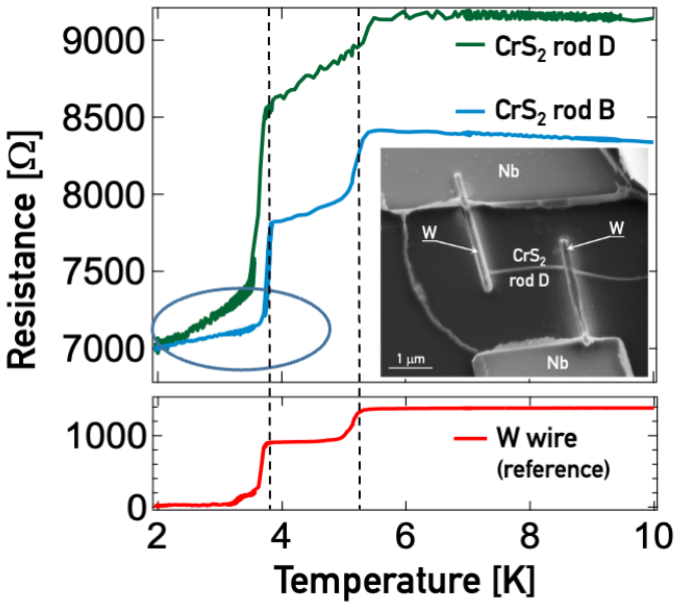
We report on the high-pressure synthesis of a CrS$_2$ phase in the form of single-crystalline nanorods. A structural refinement of Precession Electron Diffraction Tomography data confirms the nominal CrS$_2$ composition and unveils a ladder-type structure formed by portions of 1T-type CrS$_2$ layers characteristic of two-dimensional (2D) dichalcogenides connected by chains of edge-sharing CrS$_6$ octahedra characteristic of 3D dichalcogenides with marcasite structure. Ab initio density functional theory calculations of the relaxed structure confirm the stability of this structure and indicate a strong overlap of the 3d states of Cr with the 3p states of S, thus suggesting strong covalent Cr-S bonds and metallic behavior. Electrical resistivity, $\varrho$, measurements on single nanorods confirm this behavior and yield $\varrho \sim 2-20$ m$\Omega$ cm at 4 K. The proposed ladder-like structure of CrS$_2$ forms open channels along the chain direction, which may be suitable for ionic conduction.
Editorial analysis
A structured set of objections, weighed in public.
Referee Report
Summary. The manuscript reports the high-pressure synthesis of single-crystalline CrS2 nanorods with a novel ladder-type structure formed by 1T-type CrS2 layers connected via chains of edge-sharing CrS6 octahedra. Precession Electron Diffraction Tomography (PEDT) data are refined to confirm the nominal CrS2 stoichiometry and the hybrid 2D-3D connectivity; ab initio DFT on the relaxed structure establishes dynamical stability and metallic character via strong Cr 3d–S 3p orbital overlap; single-nanorod resistivity measurements yield ρ ∼ 2–20 mΩ cm at 4 K, consistent with metallicity; open channels along the ladder direction are noted as potentially suitable for ionic conduction.
Significance. If the structural assignment is robust, the work introduces a rare CrS2 phase that explicitly bridges the structural and electronic regimes of 2D and 3D dichalcogenides, with DFT-supported metallicity and a geometry that may enable ion transport. The combination of high-pressure synthesis, PEDT tomography, first-principles relaxation, and direct nanoscale transport constitutes a coherent multi-technique demonstration that could stimulate further exploration of dimensionality-tuned TMD phases.
major comments (2)
- [PEDT structural refinement] PEDT structural refinement (Results section describing the tomography data): The central claim that the refinement unambiguously establishes both the exact CrS2 stoichiometry and the ladder motif of edge-sharing CrS6 octahedra linking 1T layers rests on the quality of the atomic model. The manuscript provides no tabulated refinement statistics (R1, wR2, goodness-of-fit), number of independent reflections, or explicit tests for Cr/S site disorder or partial occupancies. Because PEDT intensities are susceptible to dynamical scattering and because Cr and S have comparable scattering factors, even modest deviations from the ideal model would render the subsequent DFT orbital-overlap argument and the attribution of the measured resistivity to this specific structure less conclusive.
- [Electrical transport measurements] Electrical transport measurements (section reporting single-nanorod resistivity): The values ρ ∼ 2–20 mΩ cm at 4 K are presented as confirmation of metallic behavior. However, the text does not specify the contact geometry (two- vs. four-probe), the physical dimensions of the measured nanorods, the number of independent devices, or any temperature-dependent data above 4 K. Without these details it remains difficult to exclude contact or surface contributions and to quantify the reproducibility of the low resistivity that is used to corroborate the DFT metallicity prediction.
minor comments (2)
- [Abstract and main text] Notation inconsistency: the abstract uses ρ while the main text employs ϱ; a uniform symbol should be adopted throughout.
- [Introduction or Discussion] The manuscript would benefit from a brief comparison table or paragraph placing the new ladder phase against known CrS2 polymorphs (e.g., 1T, 2H, or marcasite-type) to clarify the structural novelty.
Simulated Author's Rebuttal
We thank the referee for the careful and constructive review. We address each major comment below and have revised the manuscript to strengthen the presentation of the structural refinement and transport data.
read point-by-point responses
-
Referee: PEDT structural refinement lacks tabulated statistics (R1, wR2, goodness-of-fit), number of independent reflections, or explicit tests for Cr/S site disorder or partial occupancies. PEDT intensities are susceptible to dynamical scattering and Cr and S have comparable scattering factors.
Authors: We agree that explicit refinement statistics are required to substantiate the structural model. In the revised manuscript we have added a table listing R1, wR2, goodness-of-fit, and the number of independent reflections. We have also included the results of occupancy refinements, which show full Cr and S site occupancies with no detectable disorder. Precession geometry was employed precisely to reduce dynamical scattering; the converged model is chemically reasonable and yields the nominal CrS2 stoichiometry, supporting the ladder motif and subsequent DFT analysis. revision: yes
-
Referee: Resistivity values ρ ∼ 2–20 mΩ cm at 4 K are presented without specifying contact geometry (two- vs. four-probe), nanorod dimensions, number of independent devices, or temperature-dependent data above 4 K, making it difficult to exclude contact or surface contributions.
Authors: We have clarified in the revised text that measurements were performed in a four-probe geometry on five independent nanorods with typical lengths of several micrometers and diameters of 50–100 nm. These additions allow better assessment of contact contributions. However, the reported data were acquired at 4 K; we do not have temperature-dependent resistivity curves above this temperature for the same nanorods. The low absolute resistivity values remain consistent with the metallic state predicted by DFT. revision: partial
Circularity Check
No significant circularity in the derivation chain
full rationale
The paper derives its central claims through a linear sequence of independent steps: high-pressure synthesis of nanorods, structural model obtained via Precession Electron Diffraction Tomography (PEDT) refinement that determines composition and ladder motif, ab initio DFT relaxation and electronic-structure calculation performed on that fixed experimental model, and separate resistivity measurements on the same nanorods. None of these steps is self-definitional, none renames a fitted parameter as a prediction, and no uniqueness theorem or ansatz is imported via self-citation. The DFT calculation tests stability and metallicity of the experimentally proposed structure rather than defining it; the resistivity data provide an external check rather than a tautological confirmation. The chain therefore remains self-contained against external benchmarks.
Axiom & Free-Parameter Ledger
axioms (1)
- standard math Standard assumptions of density functional theory (exchange-correlation functional, pseudopotentials, k-point sampling) are sufficient to assess structural stability and electronic character.
invented entities (1)
-
ladder-type CrS2 structure
no independent evidence
Lean theorems connected to this paper
-
IndisputableMonolith/Foundation/AbsoluteFloorClosure.leanreality_from_one_distinction unclear?
unclearRelation between the paper passage and the cited Recognition theorem.
A structural refinement of Precession Electron Diffraction Tomography data confirms the nominal CrS2 composition and unveils a ladder-type structure formed by portions of 1T-type CrS2 layers ... connected by chains of edge-sharing CrS6 octahedra
-
IndisputableMonolith/Cost/FunctionalEquation.leanwashburn_uniqueness_aczel unclear?
unclearRelation between the paper passage and the cited Recognition theorem.
Ab initio density functional theory calculations of the relaxed structure confirm the stability ... strong overlap of the 3d states of Cr with the 3p states of S
What do these tags mean?
- matches
- The paper's claim is directly supported by a theorem in the formal canon.
- supports
- The theorem supports part of the paper's argument, but the paper may add assumptions or extra steps.
- extends
- The paper goes beyond the formal theorem; the theorem is a base layer rather than the whole result.
- uses
- The paper appears to rely on the theorem as machinery.
- contradicts
- The paper's claim conflicts with a theorem or certificate in the canon.
- unclear
- Pith found a possible connection, but the passage is too broad, indirect, or ambiguous to say the theorem truly supports the claim.
Reference graph
Works this paper leans on
-
[1]
(1) Wiegers, G. Physical properties of first-row transition metal dichalcogenides and their inter- calates.Physica B+C1980,99, 151–165. (2) Wang, Q. H.; Kalantar-Zadeh, K.; Kis, A.; Coleman, J. N.; Strano, M. S. Electronics and optoelectronicsoftwo-dimensionaltransitionmetaldichalcogenides.Nature Nanotechnology 2012,7, 699–712. (3) Wu, Y.; Li, D.; Wu, C.-...
work page 2012
-
[2]
(5) Mak, K. F.; Shan, J. Photonics and optoelectronics of 2D semiconductor transition metal dichalcogenides.Nature Photonics2016,10, 216–226. (6) Fu, Q.; Bao, X. Surface chemistry and catalysis confined under two-dimensional materials. Chem. Soc. Rev.2017,46, 1842–1874. (7) Fang, C. M.; Bruggen, C. F. v.; Groot, R. A. d.; Wiegers, G. A.; Haas, C. The elec...
work page 2017
-
[3]
(12) Murphy,D.W.;Cros,C.;DiSalvo,F.J.;Waszczak,J.V.PreparationandpropertiesofLi 𝑥VS2 (0≤𝑥≤1).Inorganic Chemistry1977,16, 3027–3031. 20 (13) Gauzzi, A.; Sellam, A.; Rousse, G.; Klein, Y.; Taverna, D.; Giura, P.; Calandra, M.; Lou- pias,G.; Gozzo,F.; Gilioli,E.; Bolzoni,F.; Allodi,G.; DeRenzi,R.; Calestani,G.L.; Roy,P. Possible phase separation and weak loc...
discussion (0)
Sign in with ORCID, Apple, or X to comment. Anyone can read and Pith papers without signing in.