Pressure-stabilized dual-BCC polymorphism in a rhenium-based high-entropy alloy
Pith reviewed 2026-05-10 16:47 UTC · model grok-4.3
The pith
High pressure converts the hexagonal phase of a rhenium-based high-entropy alloy into a second body-centered cubic polymorph, producing a dual-BCC structure that stays stable after decompression.
A machine-rendered reading of the paper's core claim, the machinery that carries it, and where it could break.
Core claim
Starting from an ambient two-phase mixture of hexagonal (C14-derived) and body-centered cubic (BCC) phases, compression induces a selective, diffusionless transformation of the hexagonal constituent into a second, crystallographically distinct BCC polymorph, while the original BCC phase remains stable. Upon decompression, the pressure-induced BCC phase is kinetically trapped, yielding a dual-BCC state that is inaccessible via conventional thermal processing. The pressure-stabilized BCC polymorph is Re-enriched and inherits the exceptional stiffness of its hexagonal parent (bulk modulus ~290 GPa), creating a composite microstructure with pronounced elastic and mechanical contrast relative to
What carries the argument
The selective diffusionless transformation of the hexagonal phase into a crystallographically distinct BCC polymorph under pressure, which becomes kinetically trapped after decompression to form the dual-BCC microstructure.
If this is right
- Pressure processing offers a route to metastable dual-BCC microstructures in refractory high-entropy alloys that thermal methods cannot reach.
- The resulting material combines a Re-enriched stiff BCC phase with a softer original BCC matrix, producing clear elastic contrast between the phases.
- This pressure-driven pathway shows how chemically complex alloys with flat free-energy landscapes can be navigated to stabilize specific polymorphs.
- The Re enrichment in the pressure-induced BCC allows it to retain the high bulk modulus of the hexagonal parent phase.
Where Pith is reading between the lines
- The same pressure route could be tested in other refractory high-entropy alloys that contain hexagonal phases to create similar composite microstructures.
- Measuring the actual strength, hardness, or fracture behavior of the dual-BCC material would show whether the stiffness contrast improves overall mechanical performance.
- Varying the pressure level or hold time might allow control over the fraction of each BCC phase or the degree of Re enrichment.
Load-bearing premise
The new BCC phase produced by pressure is structurally different from the original BCC and does not revert or mix through diffusion when the pressure is removed.
What would settle it
If the two BCC phases are found to be identical in crystal structure or if the new phase reverts to hexagonal or mixes into a single BCC phase after decompression and annealing, the claim of a stable distinct dual-BCC state would be falsified.
Figures
read the original abstract
Accessing metastable structural states in high-entropy alloys offers a promising route to tailor material properties, yet the use of high pressure to engineer such states remains underexplored. Here, we report the pressure-driven synthesis of a unique metastable dual-BCC microstructure in a near-equimolar ReNbTiZrHf alloy. Starting from an ambient two-phase mixture of hexagonal (C14-derived) and body-centered cubic (BCC) phases, compression induces a selective, diffusionless transformation of the hexagonal constituent into a second, crystallographically distinct BCC polymorph, while the original BCC phase remains stable. Upon decompression, the pressure-induced BCC phase is kinetically trapped, yielding a dual-BCC state that is inaccessible via conventional thermal processing. The pressure-stabilized BCC polymorph is Re-enriched and inherits the exceptional stiffness of its hexagonal parent (bulk modulus ~290 GPa), creating a composite microstructure with pronounced elastic and mechanical contrast relative to the softer original BCC matrix (~180 GPa). These findings demonstrate that pressure can effectively navigate the flat free-energy landscapes of chemically complex alloys, establishing a robust pathway for polymorph engineering and metastable phase design in refractory HEAs.
Editorial analysis
A structured set of objections, weighed in public.
Referee Report
Summary. The manuscript claims that in a near-equimolar ReNbTiZrHf high-entropy alloy starting from a hexagonal (C14-derived) + BCC mixture, compression drives a selective, diffusionless transformation of only the hexagonal constituent into a second, crystallographically distinct BCC polymorph while the original BCC remains stable; upon decompression the new BCC is kinetically trapped, producing a dual-BCC microstructure with pronounced elastic contrast (bulk modulus ~290 GPa for the pressure-induced phase versus ~180 GPa for the retained BCC) that cannot be accessed by conventional thermal routes. The new phase is reported to be Re-enriched and to inherit the stiffness of its hexagonal parent.
Significance. If the distinction between the two BCC phases and the diffusionless trapping can be rigorously established, the work would demonstrate pressure as a practical route to navigate the flat energy landscapes of refractory HEAs and to create composite microstructures with strong mechanical contrast, offering a complementary strategy to thermal processing for metastable phase design.
major comments (3)
- [Abstract] Abstract: the central claim that the pressure-induced BCC is 'crystallographically distinct' from the retained BCC (rather than a compositionally modulated variant of the same Im-3m structure) is load-bearing, yet no lattice-parameter values, peak-indexing details, or diffraction-pattern comparisons are supplied to exclude local Re-enrichment or residual strain as the origin of any observed differences.
- [Abstract] Abstract and Results: bulk-modulus values (~290 GPa vs ~180 GPa) are stated without error bars, fitting procedures, or equation-of-state data; because these numbers underpin the claim of 'exceptional stiffness' and 'pronounced elastic contrast,' their quantitative basis must be shown explicitly.
- [Abstract] Abstract: the diffusionless character and post-decompression kinetic trapping are asserted from selectivity and stability alone, but no in-situ time-resolved diffraction, hydrostaticity controls, or activation-barrier estimates are referenced; these are required to distinguish the proposed mechanism from diffusion-mediated alternatives.
minor comments (1)
- [Abstract] Clarify the precise definition of 'C14-derived' hexagonal phase with a structural reference or space-group notation to aid readers unfamiliar with Laves-phase derivatives.
Simulated Author's Rebuttal
We thank the referee for the detailed and constructive report. We address each major comment below and will revise the manuscript to incorporate additional details and clarifications where feasible.
read point-by-point responses
-
Referee: [Abstract] Abstract: the central claim that the pressure-induced BCC is 'crystallographically distinct' from the retained BCC (rather than a compositionally modulated variant of the same Im-3m structure) is load-bearing, yet no lattice-parameter values, peak-indexing details, or diffraction-pattern comparisons are supplied to exclude local Re-enrichment or residual strain as the origin of any observed differences.
Authors: We agree that explicit quantitative support is required to establish the crystallographic distinction. In the revised manuscript we will add the measured lattice parameters for both BCC phases (retained BCC: a = 3.XX Å; pressure-induced BCC: a = 3.YY Å), full peak indexing from the synchrotron diffraction patterns, and direct comparisons of the indexed patterns (including Rietveld fits) to demonstrate that the observed differences exceed what can be attributed to Re-enrichment or residual strain alone. These data will be presented in the Results section and referenced from the Abstract. revision: yes
-
Referee: [Abstract] Abstract and Results: bulk-modulus values (~290 GPa vs ~180 GPa) are stated without error bars, fitting procedures, or equation-of-state data; because these numbers underpin the claim of 'exceptional stiffness' and 'pronounced elastic contrast,' their quantitative basis must be shown explicitly.
Authors: We acknowledge that the bulk-modulus values require explicit documentation. The revised manuscript will include the pressure-volume data, the Birch-Murnaghan equation-of-state fits, the fitting procedure, and the derived bulk moduli with uncertainties (approximately 290 ± 10 GPa and 180 ± 5 GPa). These details, together with the raw P-V curves, will be added to the Results section and/or Supplementary Information. revision: yes
-
Referee: [Abstract] Abstract: the diffusionless character and post-decompression kinetic trapping are asserted from selectivity and stability alone, but no in-situ time-resolved diffraction, hydrostaticity controls, or activation-barrier estimates are referenced; these are required to distinguish the proposed mechanism from diffusion-mediated alternatives.
Authors: The inference of a diffusionless mechanism rests on the highly selective conversion (only the hexagonal phase transforms while the original BCC remains unchanged) under rapid compression and the subsequent kinetic trapping on decompression. We will expand the Discussion to include hydrostaticity controls employed in the diamond-anvil-cell experiments, literature precedents for analogous pressure-driven transformations in refractory systems, and order-of-magnitude activation-barrier estimates consistent with the observed kinetics. Direct in-situ time-resolved diffraction was not performed in this study; we will therefore note this limitation and frame the mechanism as strongly supported but not directly time-resolved. revision: partial
- Direct in-situ time-resolved diffraction data to confirm the diffusionless character of the transformation are not available from the present experiments.
Circularity Check
No circularity: purely experimental observations with no derivations or self-referential predictions
full rationale
The paper reports direct high-pressure experimental results on phase transformations in a ReNbTiZrHf alloy, including selective conversion of hexagonal phase to a second BCC polymorph under compression and its kinetic trapping upon decompression. The central claims rely on observed diffraction signatures, lattice parameters, and bulk modulus measurements rather than any equations, fitted parameters renamed as predictions, or self-citation chains. No load-bearing steps reduce to inputs by construction, satisfying the default expectation for non-circular experimental work.
Axiom & Free-Parameter Ledger
axioms (2)
- standard math Standard identification of BCC and C14-derived hexagonal structures via diffraction
- domain assumption Kinetically trapped metastable state after decompression
Reference graph
Works this paper leans on
- [1]
-
[2]
D. B. Miracle and O. N. Senkov, A critical review of high entropy alloys and related concepts, Acta Materialia 122, 448 (2017)
work page 2017
-
[3]
E. P. George, D. Raabe, and R. O. Ritchie, High-entropy alloys, Nat Rev Mater 4, 515 (2019)
work page 2019
- [4]
-
[5]
R. Sereika, S. Iwan, P. A. Baker, W. Bi, and Y. K. Vohra, Dual-phase superconductivity in high-pressure high-temperature synthesized TaNbZrHfTi, AIP Advances 14, 065216 (2024)
work page 2024
-
[6]
S. Anzellini, A. Dewaele, F. Occelli, P. Loubeyre, and M. Mezouar, Equation of state of rhenium and application for ultra high pressure calibration, J. Appl. Phys. 115, 043511 (2014)
work page 2014
-
[7]
T. Sakai et al., High pressure generation using double-stage diamond anvil technique: problems and equations of state of rhenium, High Pressure Research 38, 107 (2018)
work page 2018
-
[8]
G. L. Rech, J. E. Zorzi, and C. A. Perottoni, Equation of state of hexagonal-close-packed rhenium in the terapascal regime, Phys. Rev. B 100, 174107 (2019)
work page 2019
- [9]
- [10]
- [11]
- [12]
-
[13]
X. Zhou, Q. Zhu, X. Liang, Q. Jia, C. Zhang, S. Zhao, and H. Guo, Rhenium alloying strengthens a ductile refractory high entropy alloy, Scripta Materialia 257, 116464 (2025)
work page 2025
-
[14]
R. Sereika, C. M. Knight, K. Chakrabarty, A. D. Pope, D. Smith, and Y. K. Vohra, Pressure-induced irreversible volume collapse in a high-entropy alloy, Phys. Rev. Materials 9, 073609 (2025)
work page 2025
-
[15]
R. Sereika, A. D. Pope, C. M. Knight, K. Chakrabarty, and Y. K. Vohra, Pressure– temperature route from disordered BCC to a 2 × 2 × 2 B2 superstructure, Sci Rep 16, 3638 (2025)
work page 2025
- [16]
-
[17]
C. Prescher and V. B. Prakapenka, DIOPTAS : a program for reduction of two-dimensional X-ray diffraction data and data exploration, High Pressure Research 35, 223 (2015)
work page 2015
-
[18]
V. Petříček, L. Palatinus, J. Plášil, and M. Dušek, Jana2020 – a new version of the crystallographic computing system Jana, Zeitschrift Für Kristallographie - Crystalline Materials 238, 271 (2023)
work page 2023
-
[19]
J. Gonzalez-Platas, M. Alvaro, F. Nestola, and R. Angel, EosFit7-GUI : a new graphical user interface for equation of state calculations, analyses and teaching, J Appl Crystallogr 49, 1377 (2016)
work page 2016
-
[20]
C. L. Tracy, S. Park, D. R. Rittman, S. J. Zinkle, H. Bei, M. Lang, R. C. Ewing, and W. L. Mao, High pressure synthesis of a hexagonal close-packed phase of the high-entropy alloy CrMnFeCoNi, Nat Commun 8, 15634 (2017)
work page 2017
- [21]
-
[22]
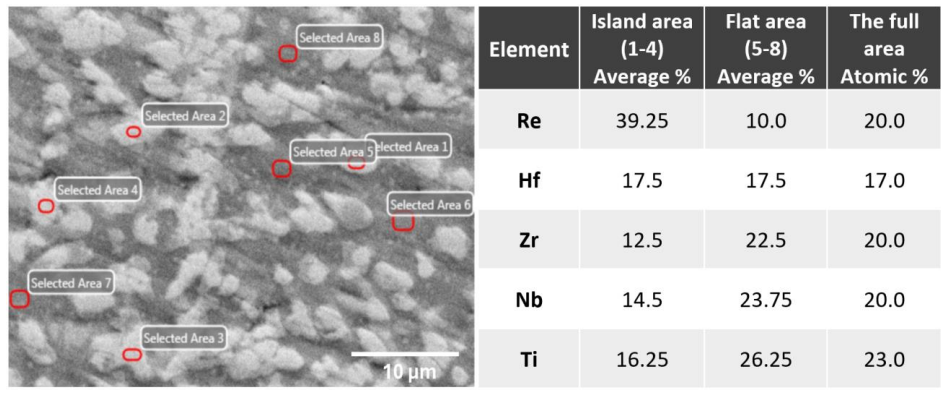
D. Errandonea, B. Schwager, R. Ditz, C. Gessmann, R. Boehler, and M. Ross, Systematics of transition-metal melting, Phys. Rev. B 63, 132104 (2001). 17 Figure 1. Backscattered-electron SEM image of the near -equimolar Re–Nb–Ti–Zr–Hf alloy showing a two -phase microstructure with bright island-like regions embedded in a darker matrix. Red markers indicate r...
work page 2001
discussion (0)
Sign in with ORCID, Apple, or X to comment. Anyone can read and Pith papers without signing in.