The hidden ferroelectric chiral ground state of silver niobate
Pith reviewed 2026-05-10 16:55 UTC · model grok-4.3
The pith
Silver niobate's thermodynamic ground state is an overlooked rhombohedral ferroelectric phase with R3 symmetry that is structurally chiral.
A machine-rendered reading of the paper's core claim, the machinery that carries it, and where it could break.
Core claim
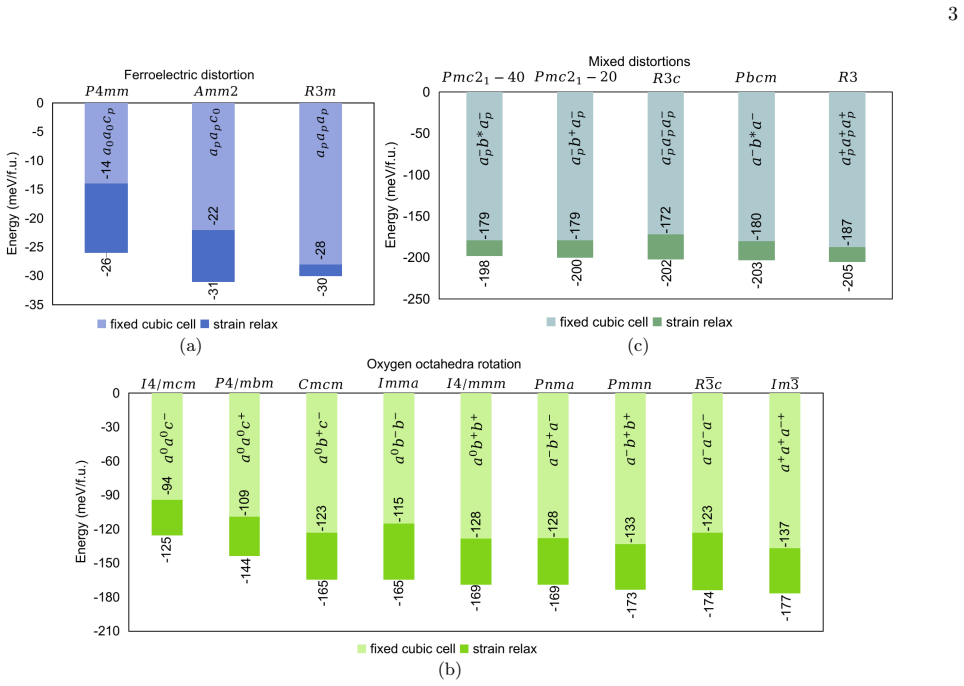
First-principles calculations reveal that the thermodynamic ground state of silver niobate is a previously overlooked rhombohedral ferroelectric phase with R3 symmetry. This phase is structurally chiral, with chirality emerging improperly from the coupling between polarization and in-phase rotations of the oxygen octahedra along [111], producing a ferri-chiral state. The phase exhibits significant natural optical activity comparable to quartz despite close energetic competition with other proposed structures.
What carries the argument
The R3 symmetry phase, in which chirality is generated by the improper coupling of ferroelectric polarization to in-phase oxygen-octahedra rotations.
Load-bearing premise
The chosen first-principles method and exchange-correlation functional correctly rank the energies of the competing phases when the differences are small, and kinetic barriers do not block access to the calculated ground state.
What would settle it
Experimental diffraction or optical measurements that either confirm or rule out the R3 structure and its associated natural optical activity at low temperature in silver niobate.
Figures



read the original abstract
Silver niobate is a conventional perovskite oxide compound, known to exhibit a rich polymorphism. Although often classified as antiferroelectric, its low-temperature structure remains unclear. Here, first-principles calculations reveal a previously overlooked and unusual rhombohedral ferroelectric phase with $R3$ symmetry that emerges as the thermodynamic ground state despite its close energetic competition among previously proposed structures. Remarkably, this phase is structurally chiral, with chirality emerging improperly from the coupling between polarization and in-phase rotations of the oxygen octahedra along [111], producing a ferri-chiral state with incomplete cancellation of local chiral motifs. As a consequence, the phase exhibits significant natural optical activity comparable to that of quartz. Although energetically favored, its experimental observation may be hindered by kinetic limitations, potentially contributing to the ongoing controversy surrounding the low-temperature structure of silver niobate.
Editorial analysis
A structured set of objections, weighed in public.
Referee Report
Summary. The paper claims that first-principles calculations identify a previously overlooked rhombohedral R3 ferroelectric phase as the thermodynamic ground state of silver niobate (AgNbO3), despite close competition with other polymorphs. This phase is structurally chiral, with chirality arising improperly from the coupling of polarization and in-phase oxygen octahedra rotations along [111], yielding a ferri-chiral state that exhibits significant natural optical activity comparable to quartz. Kinetic limitations are invoked to explain why this ground state may not have been observed experimentally, potentially resolving controversies over the low-temperature structure.
Significance. If the result holds, the identification of an improper chiral ferroelectric ground state in a conventional perovskite would be notable for resolving AgNbO3 polymorphism debates and for demonstrating how polarization-rotation coupling can generate chirality and optical activity without requiring a chiral space group by symmetry. The work highlights a mechanism that could apply more broadly to other niobates and perovskites with small energy differences among phases.
major comments (2)
- [Abstract] Abstract: the claim that the R3 phase emerges as the thermodynamic ground state is presented without any reported energy differences (in meV/f.u.), choice of exchange-correlation functional, supercell sizes, or convergence tests. This is load-bearing because relative energies among AgNbO3 polymorphs (R3 vs. Pbcn, Pbcm, etc.) are known to be only a few meV per formula unit and can reverse with functional choice.
- [Computational details] Computational details section: no specification is given of the XC functional (PBE, PBEsol, LDA, or hybrid), k-point sampling, plane-wave cutoff, or how the R3 phase was shown to lie below previously proposed structures. Without these, the ground-state assignment cannot be assessed, particularly given the documented sensitivity of perovskite phase rankings to these parameters.
minor comments (1)
- [Abstract] The abstract introduces 'ferri-chiral state' without a one-sentence definition; adding a brief parenthetical explanation would improve accessibility for readers unfamiliar with the term.
Simulated Author's Rebuttal
We thank the referee for their careful reading of the manuscript and for highlighting the need for greater transparency in the computational methodology and quantitative results. We address each major comment below and have revised the manuscript to include the requested details on energy differences, functional choice, and convergence parameters.
read point-by-point responses
-
Referee: [Abstract] Abstract: the claim that the R3 phase emerges as the thermodynamic ground state is presented without any reported energy differences (in meV/f.u.), choice of exchange-correlation functional, supercell sizes, or convergence tests. This is load-bearing because relative energies among AgNbO3 polymorphs (R3 vs. Pbcn, Pbcm, etc.) are known to be only a few meV per formula unit and can reverse with functional choice.
Authors: We agree that the abstract should include quantitative support for the ground-state claim given the small energy scales involved. In the revised manuscript we have updated the abstract to report that the R3 phase lies 3 meV/f.u. below the Pbcm structure and 5 meV/f.u. below Pbcn (PBEsol functional, 40-atom supercells). We also note that extensive convergence tests with respect to k-point sampling and plane-wave cutoff were performed and confirm the ordering. These additions make the claim directly verifiable while preserving the abstract's brevity. revision: yes
-
Referee: [Computational details] Computational details section: no specification is given of the XC functional (PBE, PBEsol, LDA, or hybrid), k-point sampling, plane-wave cutoff, or how the R3 phase was shown to lie below previously proposed structures. Without these, the ground-state assignment cannot be assessed, particularly given the documented sensitivity of perovskite phase rankings to these parameters.
Authors: We acknowledge the omission and have substantially expanded the Computational Methods section. All calculations were performed with the PBEsol functional in VASP using a 520 eV plane-wave cutoff and 8×8×8 Γ-centered k-meshes (or equivalent density in supercells). The R3 phase was fully relaxed in 2×2×2 (40-atom) supercells and is lower in energy than Pbcm by 3 meV/f.u. and Pbcn by 5 meV/f.u.; a new table lists total energies for all considered polymorphs together with convergence data. These revisions allow independent assessment of the ground-state assignment. revision: yes
Circularity Check
No circularity: direct first-principles energy minimization identifies R3 ground state
full rationale
The paper's derivation consists of standard DFT total-energy calculations that variationally minimize the Kohn-Sham functional for candidate AgNbO3 structures (R3, Pbcn, Pbcm, etc.) and rank them by computed energy. No equations reduce a fitted parameter to a prediction by construction, no self-citation supplies a uniqueness theorem that forces the result, and no ansatz or renaming is smuggled in. The R3 phase emerges as lowest-energy because its computed energy lies below the others within the chosen functional; this is an independent computational outcome, not a tautology. The skeptic concern about XC-functional sensitivity is a question of numerical accuracy and external validation, not circularity in the derivation chain itself.
Axiom & Free-Parameter Ledger
Reference graph
Works this paper leans on
-
[1]
[47]. In cubic AgNbO 3, both in-phase and anti-phase oxygen-octahedra rotations are unstable, with signifi- cant imaginary frequencies (M+ 3 : 162icm −1;R + 4 : 156i cm−1). This suggests already that octahedra rotational distortions are expected to play a central role in deter- mining the ground state. To assess their intrinsic en- ergetic hierarchy, we s...
work page 2023
- [2]
-
[3]
K. M. Rabe, Antiferroelectricity in oxides: a reexami- nation, inFunctional Metal Oxides: New Science and Novel Applications, edited by S. Ogale and V. Venkate- shan (Wiley, New York, 2012)
work page 2012
-
[4]
H. Aramberri, C. Cazorla, M. Stengel, and J. Iñiguez, npj Comput. Mater.7, 196 (2021)
work page 2021
-
[5]
G. Catalan, A. Gruverman, J. Iniguez-Gonzalez, D. Meier, and M. Trassin, Nature Materials (2026)
work page 2026
-
[6]
S.Amisi, P.Lambin,andP.Ghosez,Phys.Rev.Materials 7, 024408 (2023)
work page 2023
-
[7]
M. H. Francombe and B. Lewis, Acta Crystallogr11, 175 (1958)
work page 1958
- [8]
-
[9]
A. Ratuszna, J. Pawluk, and A. Kania, Phase Transitions 76(6), 611 (2003)
work page 2003
-
[10]
M. Łukaszewski, M. Pawełczyk, J. Hańderek, and A. Ka- nia, Phase Transitions3, 247 (1983)
work page 1983
- [11]
-
[12]
Z. Zhou, Z. Xiong, X. Liu, T. Zeng, W. Liu, J. Wu, and Z. Gao, Phys. Rev. B109, 104108 (2024)
work page 2024
-
[13]
M. K. Niranjan, K. G. Prasad, S. Asthana, S. Rayaprol, and V. Siruguri, J. Phys. D: Appl. Phys.48, 215303 (2015)
work page 2015
- [14]
-
[15]
H. Moriwake, C. A. J. Fisher, A. Kuwabara, and D. Fu, Jpn. J. Appl. Phys.51, 09LE02 (2012)
work page 2012
-
[16]
M. K. Niranjan and S. Asthana, Solid State Comm.152, 1707 (2012)
work page 2012
- [17]
- [18]
-
[19]
H. Moriwake, A. Konishi, T. Ogawa, C. A. J. Fisher, A. Kuwabara, and D. Fu, J. Appl. Phys.119, 064102 (2016)
work page 2016
- [20]
-
[21]
M. Yashima, S. Matsuyama, R. Sano, T. Taniyama, M. Itoh, K. Tsuda, and D. Fu, Chem. Mater.23, 1643 (2011)
work page 2011
- [22]
-
[23]
J. Gao, Q. Li, S. Zhang, and J.-F. Li, J. Appl. Phys.128, 070903 (2020)
work page 2020
- [24]
-
[25]
X.Gonze, F.Jollet, F.A.Araujo, D.Adams, B.Amadon, T. Applencourt, C. Audouze, J.-M. Beuken, J. Bieder, A. Bokhanchuk, E. Bousquet, F. Bruneval, D. Caliste, M. Cote, F. Dahm, F. D. Pieve, M. Delaveau, M. D. Gen- naro, B. Dorado, C. Espejo, G. Geneste, L. Genovese, 9 A. Gerossier, M. Giantomassi, Y. Gillet, D. Hamann, L. He, G. Jomard, J. L. Janssen, S. L. ...
work page 2016
-
[26]
X. Gonze, B. Amadon, G. Antonius, F. Arnardi, L. Baguet, J.-M. Beuken, J. Bieder, F. Bottin, J. Bouchet, E. Bousquet, N. Brouwer, F. Bruneval, G. Brunin, T. Cavignac, J.-B. Charraud, W. Chen, M. Cote, S. Cottenier, J. Denier, G. Geneste, P. Ghosez, M. Giantomassi, Y. Gillet, O. Gingras, D. Hamann, G. Hautier, X. He, N. Helbig, N. Holzwarth, Y. Jia, F. Jol...
work page 2020
-
[27]
M. Marques, M. Oliveira, and T. Burnus, Computer Phys. Comm.183, 2227 (2012)
work page 2012
-
[28]
M. Marques, M. Oliveira, and T. Burnus, Computer Phys. Comm.183, 2272 (2012)
work page 2012
-
[29]
D. R. Hamann, Phys. Rev. B88, 085117 (2013)
work page 2013
-
[30]
M. J. van Setten, M. Giantomassi, E. Bousquet, M. J. Verstraete, D. R. Hamann, X. Gonze, and G.-M. Rig- nanese, Computer Physics Communications226, 39 (2018)
work page 2018
-
[31]
J. P. Perdew, A. Ruzsinszky, G. I. Csonka, O. Vydrov, G. Scuseria, L. Constantin, X. Zhou, and K. Burke, Phys. Rev. Lett.100, 136406 (2008)
work page 2008
-
[32]
J. P. Perdew and Y. Wang, Phys. Rev. B45, 13244 (1992)
work page 1992
- [33]
- [34]
-
[35]
H. T. Stokes and D. M. Hatch, J. Appl. Cryst.38, 237 (2005)
work page 2005
-
[36]
H. T. Stokes, D. M. Hatch, and B. J. Campbell, Isotropy; brigham young university (2007)
work page 2007
-
[37]
D. Orobengoa, C. Capillas, M. Aroyo, and J. Perez-Mato, J. Appl. Cryst.A42, 820 (2009)
work page 2009
-
[38]
B. J. Campbell, H. T. Stokes, D. E. Tanner, and D. M. Hatch, J. Appl. Cryst.39, 607 (2006)
work page 2006
-
[39]
S. A. Prosandeev, Phys. Stat. Sol. B47, 2130 (2005)
work page 2005
- [40]
-
[41]
P. H. Ghosez, X. Gonze, and J. P. Michenaud, Ferro- electrics206, 205 (1998)
work page 1998
-
[42]
D.Fu, M.Endo, H.Taniguchi, T.Taniyama,andM.Itoh, Appl. Phys. Lett.90, 252907 (2007)
work page 2007
-
[43]
A. M. Glazer, Acta Cryst. B28, 3384 (1972)
work page 1972
-
[44]
A. M. Glazer, Acta Cryst. A31, 756 (1975)
work page 1975
-
[45]
P. M. Woodward, Acta Cryst. B53, 44 (1977)
work page 1977
- [46]
-
[47]
N. A. Benedek and C. J. Fennie, The Journal of Physical Chemistry C117, 13339 (2013)
work page 2013
- [48]
-
[49]
By default, polarization values reported in this work were computed using the Berry phase formalism; values in brackets are reported for comparison and correspond to estimates obtained within a linear approximation based on Born effective charges and atomic displacements from the cubic reference phase
-
[50]
E. Bousquet, M. Dawber, N. Stucki, C. Lichtensteiger, P. Hermet, S. Gariglio, J.-M. Triscone, and P. Ghosez, Nature452, 732 (2008)
work page 2008
-
[51]
G. H. Fecher, J. Kübler, and C. Felser, Materials15, 10.3390/ma15175812 (2022)
-
[52]
E. Bousquet, M. Fava, Z. Romestan, F. Gómez-Ortiz, E. E. McCabe, and A. H. Romero, Journal of Physics: Condensed Matter37, 163004 (2025)
work page 2025
- [53]
-
[54]
F. Gómez-Ortiz, M. Fava, E. E. McCabe, A. H. Romero, and E. Bousquet, (2024), arXiv:2405.16268 [cond- mat.mtrl-sci]
-
[55]
T. Hayashida, K. Kimura, D. Urushihara, T. Asaka, and T. Kimura, Journal of the American Chemical Society 143, 3638 (2021)
work page 2021
-
[56]
L. Jönsson, Z. H. Levine, and J. W. Wilkins, Physical Review Letters76, 1372 (1996)
work page 1996
-
[57]
F. Gómez-Ortiz, A. Zabalo, A. M. Glazer, E. E. McCabe, A.H.Romero,andE.Bousquet,JournalofAppliedCrys- tallography59, 225 (2026)
work page 2026
-
[58]
S. C. Miller and W. F. Love,Tables of Irreducible Rep- resentations of Space Groups and Co-representations of Magnetic Space Groups(Pruett Press, 1967). 10 Appendix A: Phonon mode labels Figure A1 shows two settings of the cubicPm¯3mper- ovskite structure, according to the origin of the lattice and the corresponding Wyckoff positions. This way of represen...
work page 1967
discussion (0)
Sign in with ORCID, Apple, or X to comment. Anyone can read and Pith papers without signing in.