Algebraic structure of Fock-state lattices
Pith reviewed 2026-05-10 17:28 UTC · model grok-4.3
The pith
Fock-state lattices arise from Lie algebra generators, linking their connectivity and dynamics to phase-space geometry.
A machine-rendered reading of the paper's core claim, the machinery that carries it, and where it could break.
Core claim
Starting from a Lie algebra, a Fock-state lattice is defined by letting its Cartan generators label the sites and its root generators label the bonds. For several standard Lie algebras this produces both an explicit lattice and its associated Lie phase space, establishing a direct map between FSL dynamics and phase-space geometry. Both the lattice and the phase space can carry nontrivial curvature. The construction fails for many integrable Hamiltonians that are nonlinear in the generators and, for systems with mixed degrees of freedom, the appropriate underlying structure is often a Lie superalgebra rather than an ordinary Lie algebra.
What carries the argument
The mapping from a Lie algebra to a Fock-state lattice in which Cartan generators define sites and root generators define bonds, simultaneously producing a Lie phase space whose geometry governs the lattice dynamics.
If this is right
- Dimensionality, bond connectivity, and symmetry constraints of any FSL are fixed once the underlying algebra is identified.
- Transport and revival phenomena are restricted by the root-system structure of the algebra.
- Dynamics on the lattice inherit the geometry, including curvature, of the associated Lie phase space.
- Systems with nonlinear Hamiltonians or mixed bosonic-fermionic degrees of freedom generally require structures beyond ordinary Lie algebras.
Where Pith is reading between the lines
- The same algebraic construction could be used to engineer synthetic lattices whose curvature is chosen in advance by selecting the Lie algebra.
- Experimental signatures of curved phase-space geometry might appear as modified revival times or anomalous diffusion in multi-mode bosonic systems.
- The framework suggests a classification of all FSLs that admit an algebraic origin, leaving a remainder class that must be treated by other means.
Load-bearing premise
The action of any Lie algebra's generators on Fock states always yields a lattice whose connectivity and geometry remain physically meaningful and extend to the dynamics of integrable Hamiltonians.
What would settle it
An explicit integrable Hamiltonian whose Fock-state connectivity and allowed transitions cannot be reproduced by the generators of any Lie algebra or Lie superalgebra.
Figures


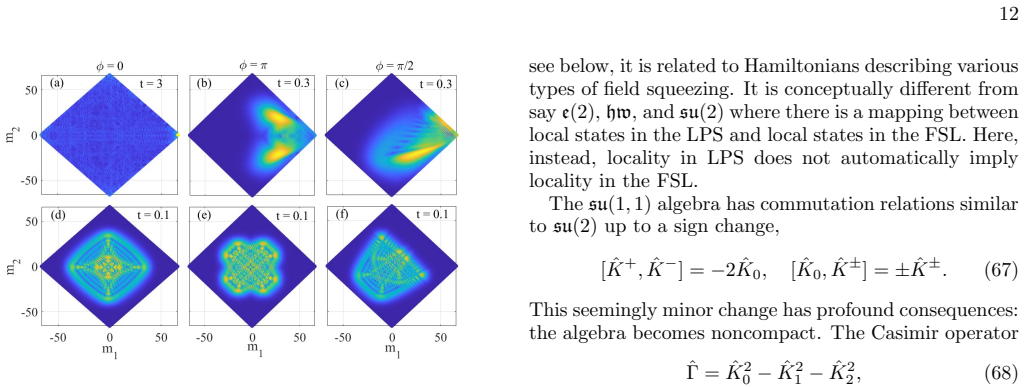
read the original abstract
We analyze Fock-state lattices (FSLs) from an algebraic viewpoint. Starting from a Lie algebra, we associate a FSL constructed from the action of its generators: diagonal (Cartan) generators define the lattice sites, while off-diagonal (root) generators determine the lattice bonds. This construction reveals that identifying an underlying algebraic structure provides direct physical insight into FSLs, including their dimensionality, connectivity, symmetry constraints, and possible transport and revival phenomena. By examining several common Lie algebras, we identify not only their associated FSLs but also the corresponding Lie phase spaces, thereby establishing a systematic connection between FSL dynamics and phase-space geometry. In many cases, both the phase space and the FSL exhibit nontrivial curvature, opening possibilities for exploring quantum dynamics in curved synthetic spaces. We further address whether every integrable Hamiltonian admits an underlying Lie algebra that reproduces the same FSL structure. We show that this is not generally the case, particularly for Hamiltonians that are nonlinear in the generators, and that for systems combining different types of degrees of freedom the appropriate underlying structure may instead be a Lie superalgebra.
Editorial analysis
A structured set of objections, weighed in public.
Referee Report
Summary. The paper claims that Fock-state lattices (FSLs) admit a systematic algebraic construction from Lie algebras, with Cartan generators labeling sites and root generators labeling bonds. This yields direct insight into FSL dimensionality, connectivity, symmetry constraints, transport, and revival phenomena, while linking FSL dynamics to the geometry of the corresponding Lie phase spaces (often curved). The authors illustrate the construction for several common Lie algebras and show that the correspondence does not hold in general for nonlinear Hamiltonians or for mixed bosonic-fermionic systems (where superalgebras are required instead).
Significance. If the generator-to-lattice mapping is free of post-hoc choices, the framework supplies a useful organizing principle that connects abstract algebraic data to concrete geometric features of FSLs and their dynamics. The explicit treatment of scope limitations (nonlinear Hamiltonians, superalgebras) is a strength, as is the emphasis on phase-space curvature as a route to synthetic curved-space quantum mechanics.
minor comments (3)
- The abstract refers to 'several common Lie algebras' without naming them; an explicit list (e.g., su(2), su(1,1), etc.) together with the corresponding FSL dimensions and curvatures would improve readability.
- A compact table or diagram summarizing the site/bond assignments for each algebra examined would make the central construction easier to verify at a glance.
- The discussion of why nonlinear Hamiltonians fall outside the construction would benefit from one fully worked counter-example showing that no Lie algebra reproduces the same connectivity.
Simulated Author's Rebuttal
We thank the referee for the positive summary, significance assessment, and recommendation of minor revision. The recognition that the generator-to-lattice mapping supplies an organizing principle linking algebraic data to geometric features of FSLs, together with the explicit discussion of scope limitations, is appreciated. As the report contains no enumerated major comments, we have no specific points to address point-by-point. We will incorporate any minor editorial or presentational suggestions in the revised manuscript.
Circularity Check
No significant circularity identified
full rationale
The paper defines an explicit mapping from any Lie algebra's Cartan and root generators to FSL sites and bonds, then applies this construction to several standard algebras to recover their associated lattices and phase spaces. This is a direct, non-predictive association rather than a derivation that reduces to fitted inputs or prior self-citations. The subsequent claim that the mapping supplies geometric insight follows immediately from the algebraic structure itself. The negative result—that not every integrable Hamiltonian admits such a Lie algebra—is established by counterexamples (nonlinear generators and bosonic-fermionic mixtures requiring superalgebras), which are independent of the main construction and do not rely on self-referential theorems. No step matches the enumerated circularity patterns.
Axiom & Free-Parameter Ledger
axioms (2)
- domain assumption The generators of a Lie algebra act on Fock states such that diagonal (Cartan) elements label distinct sites and off-diagonal (root) elements define bonds.
- domain assumption The resulting lattice geometry and connectivity capture the essential symmetry and transport properties of the physical system.
Reference graph
Works this paper leans on
-
[1]
I. M. Georgescu, S. Ashhab, and F. Nori, Quantum sim- ulation, Reviews of Modern Physics86, 153 (2014)
work page 2014
- [2]
- [3]
-
[4]
M. Lewenstein, A. Sanpera, V. Ahufinger, B. Damski, A. Sen, and U. Sen, Ultracold atomic gases in optical lat- tices: mimicking condensed matter physics and beyond, Advances in Physics56, 243 (2007)
work page 2007
-
[5]
R. Blatt and C. F. Roos, Quantum simulations with trapped ions, Nature Physics8, 277 (2012)
work page 2012
-
[6]
J. W. Britton, B. C. Sawyer, A. C. Keith, C.-C. J. 16 Wang, J. K. Freericks, H. Uys, M. J. Biercuk, and J. J. Bollinger, Engineered two-dimensional ising interactions in a trapped-ion quantum simulator with hundreds of spins, Nature484, 489 (2012)
work page 2012
-
[7]
C. Schneider, D. Porras, and T. Schaetz, Experimental quantum simulations of many-body physics with trapped ions, Reports on Progress in Physics75, 024401 (2012)
work page 2012
-
[8]
A. Aspuru-Guzik and P. Walther, Photonic quantum sim- ulators, Nature physics8, 285 (2012)
work page 2012
-
[9]
M. J. Hartmann, Quantum simulation with interacting photons, Journal of Optics18, 104005 (2016)
work page 2016
- [10]
-
[11]
A. Celi, P. Massignan, J. Ruseckas, N. Goldman, I. B. Spielman, G. Juzeli¯ unas, and M. Lewenstein, Synthetic gauge fields in synthetic dimensions, Physical review let- ters112, 043001 (2014)
work page 2014
- [12]
-
[13]
J. Arg¨ uello-Luengo, U. Bhattacharya, A. Celi, R. W. Chhajlany, T. Grass, M. P lodzie´ n, D. Rakshit, T. Sala- mon, P. Stornati, L. Tarruell,et al., Synthetic dimen- sions for topological and quantum phases, Communica- tions Physics7, 143 (2024)
work page 2024
-
[14]
D. Yu, W. Song, L. Wang, R. Srikanth, S. Kaushik Srid- har, T. Chen, C. Huang, G. Li, X. Qiao, X. Wu,et al., Comprehensive review on developments of synthetic di- mensions, Photonics Insights4, R06 (2025)
work page 2025
-
[15]
H. M. Price, T. Ozawa, and N. Goldman, Synthetic di- mensions for cold atoms from shaking a harmonic trap, Physical Review A95, 023607 (2017)
work page 2017
-
[16]
T. Chen, C. Huang, I. Velkovsky, K. R. Hazzard, J. P. Covey, and B. Gadway, Strongly interacting rydberg atoms in synthetic dimensions with a magnetic flux, Na- ture communications15, 2675 (2024)
work page 2024
- [17]
-
[18]
A. Bermudez, T. Schaetz, and D. Porras, Synthetic gauge fields for vibrational excitations of trapped ions, Physical review letters107, 150501 (2011)
work page 2011
-
[19]
T. Manovitz, Y. Shapira, N. Akerman, A. Stern, and R. Ozeri, Quantum simulations with complex geometries and synthetic gauge fields in a trapped ion chain, PRX quantum1, 020303 (2020)
work page 2020
-
[20]
D.-W. Wang, H. Cai, R.-B. Liu, and M. O. Scully, Meso- scopic superposition states generated by synthetic spin- orbit interaction in fock-state lattices, Physical review letters116, 220502 (2016)
work page 2016
-
[21]
P. Saugmann and J. Larson, Fock-state-lattice approach to quantum optics, Physical Review A108, 033721 (2023)
work page 2023
-
[22]
J. Larson and T. Mavrogordatos,The Jaynes–Cummings model and its descendants: modern research directions (IoP Publishing, 2021)
work page 2021
-
[23]
J. Yuan, H. Cai, and D.-W. Wang, Quantum simula- tion in Fock-state lattices, Advances in Physics: X9, 2325611 (2024), publisher: Taylor & Francis eprint: https://doi.org/10.1080/23746149.2024.2325611
-
[24]
H. Cai and D.-W. Wang, Topological phases of quantized light, National Science Review8, nwaa196 (2021)
work page 2021
-
[25]
R. Moessner and A. P. Ramirez, Geometrical frustration, Physics Today59, 24 (2006)
work page 2006
-
[26]
J. Deng, H. Dong, C. Zhang, Y. Wu, J. Yuan, X. Zhu, F. Jin, H. Li, Z. Wang, H. Cai, C. Song, H. Wang, J. Q. You, and D.-W. Wang, Observing the quantum topology of light, Science378, 966 (2022), publisher: American Association for the Advancement of Science
work page 2022
-
[27]
C. Wu, W. Liu, Y. Jia, G. Chen, and F. Chen, Obser- vation of topological pumping of a defect state in a fock photonic lattice, Physical Review A107, 033501 (2023)
work page 2023
-
[28]
M. Yang, J.-S. Xu, C.-F. Li, and G.-C. Guo, Simulating topological materials with photonic synthetic dimensions in cavities, Quantum Frontiers1, 10 (2022)
work page 2022
- [29]
-
[30]
J. Yang, Y. Li, Y. Yang, X. Xie, Z. Zhang, J. Yuan, H. Cai, D.-W. Wang, and F. Gao, Realization of all-band- flat photonic lattices, Nature Communications15, 1484 (2024)
work page 2024
- [31]
-
[32]
Y. Yao, L. Xiang, Z. Guo, Z. Bao, Y.-F. Yang, Z. Song, H. Shi, X. Zhu, F. Jin, J. Chen,et al., Observation of many-body fock space dynamics in two dimensions, Na- ture Physics19, 1459 (2023)
work page 2023
-
[33]
J. Larson, Floquet analysis perspective of driven light– matter interaction models, Journal of the Optical Society of America B41, C235 (2024)
work page 2024
-
[34]
X. Zhao, Y. Xu, L.-M. Kuang, and J.-Q. Liao, Dark- state engineering in fock-state lattices, Physical Review Research7, 033070 (2025)
work page 2025
- [35]
-
[36]
T. Ben-Ami, M. Heyl, and R. Moessner, Many-body cages: Disorder-free glassiness from flat bands in fock space, and many-body rabi oscillations, arXiv preprint arXiv:2504.13086 (2025)
-
[37]
Localized Fock Space Cages in Kinetically Constrained Models
C. Jonay and F. Pollmann, Localized fock space cages in kinetically constrained models, arXiv preprint arXiv:2504.20987 (2025)
work page internal anchor Pith review Pith/arXiv arXiv 2025
- [38]
-
[39]
C. B. Naves and J. Larson, Liouville-fock-state lat- tices: From environment-induced frustration to synthetic lattice dynamics, Physical Review Research7, 043233 (2025)
work page 2025
-
[40]
D. M. Basko, I. L. Aleiner, and B. L. Altshuler, Metal– insulator transition in a weakly interacting many-electron system with localized single-particle states, Annals of physics321, 1126 (2006)
work page 2006
-
[41]
J. Yuan, H. Cai, and D.-W. Wang, Quantum simulation in fock-state lattices, Advances in Physics: X9, 2325611 (2024)
work page 2024
-
[42]
J. J. Sakurai and J. Napolitano,Modern quantum me- chanics(Cambridge University Press, 2020)
work page 2020
-
[43]
Auerbach,Interacting electrons and quantum mag- netism(Springer Science & Business Media, 2012)
A. Auerbach,Interacting electrons and quantum mag- netism(Springer Science & Business Media, 2012)
work page 2012
-
[44]
R. Anishetty, M. Mathur, and I. Raychowdhury, Irre- 17 ducible su (3) schwinger bosons, Journal of mathematical physics50(2009)
work page 2009
-
[45]
Georgi,Lie algebras in particle physics: from isospin to unified theories(Taylor & Francis, 2000)
H. Georgi,Lie algebras in particle physics: from isospin to unified theories(Taylor & Francis, 2000)
work page 2000
-
[46]
Gilmore,Lie groups, Lie algebras, and some of their applications(Courier Corporation, 2006)
R. Gilmore,Lie groups, Lie algebras, and some of their applications(Courier Corporation, 2006)
work page 2006
-
[47]
A. M. Perelomov, Generalized coherent states and some of their applications, Soviet Physics Uspekhi20, 703 (1977)
work page 1977
-
[48]
A. M. Perelomov,Generalized Coherent States and Their Applications, Theoretical and Mathematical Physics (Springer, Berlin, Heidelberg, 1986)
work page 1986
-
[49]
M. O. Scully and M. S. Zubairy,Quantum optics(Cam- bridge university press, 1997)
work page 1997
-
[50]
H. J. Carmichael,Statistical methods in quantum op- tics 1: master equations and Fokker-Planck equations (Springer Science & Business Media, 2013)
work page 2013
-
[51]
W. P. Schleich,Quantum optics in phase space(John Wiley & Sons, 2015)
work page 2015
-
[52]
G. S. Agarwal, Relation between atomic coherent-state representation, state multipoles, and generalized phase- space distributions, Physical Review A24, 2889 (1981)
work page 1981
-
[53]
C. Brif and A. Mann, Phase-space formulation of quantum mechanics and quantum state reconstruction for physical systems with lie-group symmetries, arXiv preprint quant-ph/9809052 (1998)
-
[54]
A. B. Klimov and H. De Guise, General approach to quasi-distribution functions, Journal of Physics A: Math- ematical and Theoretical43, 402001 (2010)
work page 2010
- [55]
-
[56]
A. B. Klimov and S. M. Chumakov,A group-theoretical approach to quantum optics: models of atom-field inter- actions, Vol. 10 (Wiley Online Library, 2009)
work page 2009
-
[57]
T. Hartmann, F. Keck, H. Korsch, and S. Mossmann, Dynamics of bloch oscillations, New Journal of Physics 6, 2 (2004)
work page 2004
-
[58]
L. Susskind and J. Glogower, Quantum mechanical phase and time operator, Physics Physique Fizika1, 49 (1964)
work page 1964
-
[59]
D. Pegg and S. Barnett, Phase properties of the quantized single-mode electromagnetic field, Physical Review A39, 1665 (1989)
work page 1989
- [60]
-
[61]
M. Christandl, N. Datta, A. Ekert, and A. J. Landahl, Perfect state transfer in quantum spin networks, Physical review letters92, 187902 (2004)
work page 2004
-
[62]
M. Mathur and D. Sen, Coherent states for su (3), Jour- nal of Mathematical Physics42, 4181 (2001)
work page 2001
-
[63]
V. Buˇ zek, Su (1, 1) squeezing of su (1, 1) generalized coherent states, Journal of Modern Optics37, 303 (1990)
work page 1990
-
[64]
Duan, Quantum walk for su (1, 1), Physical Review A 107, 022224 (2023)
L. Duan, Quantum walk for su (1, 1), Physical Review A 107, 022224 (2023)
work page 2023
-
[65]
L. Mandel and E. Wolf,Optical coherence and quantum optics(Cambridge university press, 1995)
work page 1995
-
[66]
R. Y. Chiao and T. F. Jordan, Lorentz-group berry phases in squeezed light, Physics Letters A132, 77 (1988)
work page 1988
-
[67]
F. Hong-Yi and H. Zaidi, Berry phase for the su (1, 1) co- herent state, Canadian Journal of Physics66, 978 (1988)
work page 1988
-
[68]
B. Buck and C. Sukumar, Exactly soluble model of atom- phonon coupling showing periodic decay and revival, Physics Letters A81, 132 (1981)
work page 1981
-
[69]
V. Buˇ zek, Jaynes-cummings model with intensity- dependent coupling interacting with holstein-primakoff su (1, 1) coherent state, Physical review A39, 3196 (1989)
work page 1989
-
[70]
T. Holstein and H. Primakoff, Field dependence of the in- trinsic domain magnetization of a ferromagnet, Physical Review58, 1098 (1940)
work page 1940
-
[71]
C. C. Gerry, Correlated two-mode su (1, 1) coherent states: nonclassical properties, Journal of the Optical So- ciety of America B8, 685 (1991)
work page 1991
-
[72]
L. Gilles and P. Knight, Non-classical properties of two- mode su (1, 1) coherent states, Journal of Modern Optics 39, 1411 (1992)
work page 1992
-
[73]
Braak, Integrability of the rabi model, Physical Re- view Letters107, 100401 (2011)
D. Braak, Integrability of the rabi model, Physical Re- view Letters107, 100401 (2011)
work page 2011
-
[74]
Gazeau,Coherent states in quantum physics(Wiley Online Library, 2009)
J.-P. Gazeau,Coherent states in quantum physics(Wiley Online Library, 2009)
work page 2009
-
[75]
V. I. Arnol’d,Mathematical methods of classical mechan- ics, Vol. 60 (Springer Science & Business Media, 2013)
work page 2013
discussion (0)
Sign in with ORCID, Apple, or X to comment. Anyone can read and Pith papers without signing in.