Phase-enhanced excitations in pumped collective nuclear systems
Pith reviewed 2026-05-10 16:49 UTC · model grok-4.3
The pith
When two x-ray fields share the same frequency, their relative phase controls nuclear excitation levels through cross-correlations in the decay channels of a driven ensemble.
A machine-rendered reading of the paper's core claim, the machinery that carries it, and where it could break.
Core claim
When the frequencies of the applied coherent fields are identical, cross-correlations among the existing decay channels increase the nuclear excitation probabilities depending on the phase difference of the applied fields. The excited state of the nuclear ensemble may exhibit sub- to super-Poissonian nuclear statistics, demonstrating induced correlations during photon absorption or emission processes. The role of cross-correlations for the superradiant decay and the collective Lamb shift of the ensemble is also investigated.
What carries the argument
Cross-correlations among decay channels within a master-equation description of two-level nuclear systems driven by two coherent x-ray fields of identical frequency.
If this is right
- Nuclear excitation probability varies directly with the phase difference between the two identical-frequency drives.
- The photon-number statistics of the excited nuclear state can be tuned between sub-Poissonian and super-Poissonian regimes.
- Superradiant decay rates and the collective Lamb shift both shift when cross-correlations are retained in the model.
- Correlations appear between the processes of photon absorption and emission from the ensemble.
Where Pith is reading between the lines
- Phase tuning of this kind could serve as a practical dial for increasing the yield of x-ray-triggered nuclear transitions.
- The same cross-correlation mechanism may appear in other driven collective systems such as atomic ensembles or quantum-dot arrays.
- Controlling the statistics could influence the coherence length or noise properties of light generated by nuclear ensembles.
- The results suggest testing whether the phase effect survives when the cavity loss rate or the number of nuclei is varied experimentally.
Load-bearing premise
The nuclear ensemble and cavity can be treated as a collection of coherently driven two-level systems whose full dynamics, including cross-correlations between decay channels, are captured by a standard master equation.
What would settle it
Measure the nuclear excitation probability while scanning the relative phase between two identical-frequency x-ray pumps and find that the probability remains unchanged across all phases.
Figures
read the original abstract
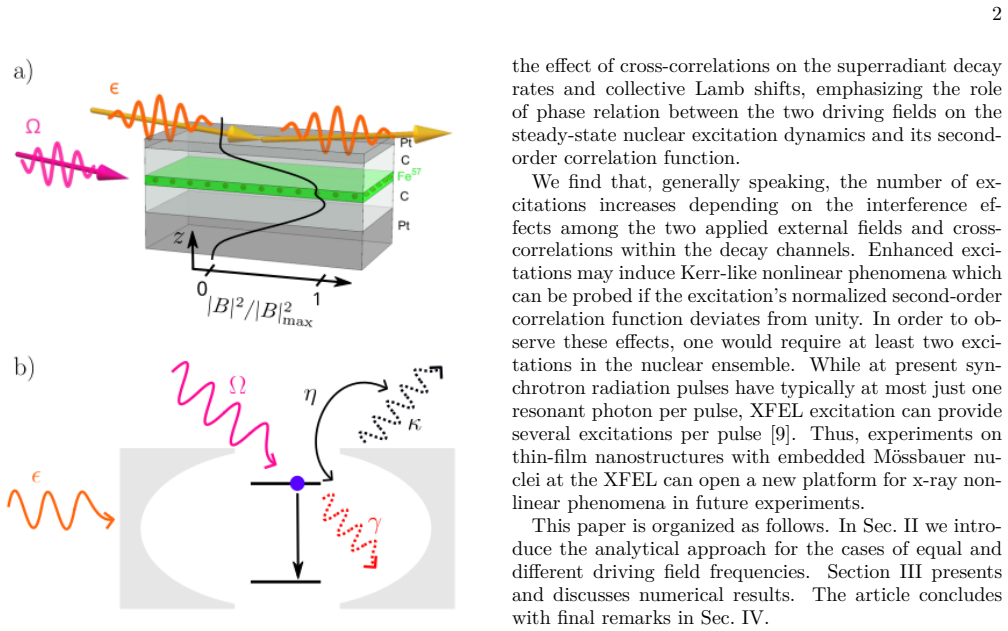
The quantum dynamics of an externally driven ensemble of nuclear two-level systems embedded in a leaky broadband cavity is investigated theoretically. In the considered scenario both the nuclear ensemble and the cavity mode are coherently pumped by two externally applied x-ray electromagnetic fields. When the frequencies of the applied coherent fields are identical, cross-correlations among the existing decay channels increase the nuclear excitation probabilities depending on the phase difference of the applied fields. Our results show that the excited state of the nuclear ensemble may exhibit sub- to super-Poissonian nuclear statistics, demonstrating induced correlations during photon absorption or emission processes. The role of cross-correlations for the superradiant decay and the collective Lamb shift of the ensemble is also investigated.
Editorial analysis
A structured set of objections, weighed in public.
Referee Report
Summary. The manuscript theoretically investigates the quantum dynamics of an externally driven ensemble of nuclear two-level systems embedded in a leaky broadband cavity, with both the ensemble and cavity mode pumped by two coherent x-ray fields. When the driving frequencies are identical, cross-correlations among decay channels are shown to enhance nuclear excitation probabilities in a manner dependent on the relative phase of the applied fields. The excited-state statistics of the ensemble range from sub- to super-Poissonian, indicating induced correlations in absorption/emission processes; the effects of these correlations on superradiant decay and the collective Lamb shift are also examined.
Significance. If the central results hold, the work is significant for x-ray quantum optics and collective nuclear phenomena. It demonstrates phase-controlled enhancement of excitations and tunable photon statistics arising from standard cross-correlation terms in the master equation, without introducing free parameters or ad-hoc entities. This provides a concrete, falsifiable prediction for how driving-phase differences can induce sub-/super-Poissonian nuclear statistics and modulate collective decay rates, strengthening the case for coherent control techniques in nuclear ensembles.
major comments (2)
- [Model and master equation] The master-equation derivation (presumably §2) must explicitly display the cross-correlation terms between decay channels and show how they produce the claimed phase dependence when the two driving frequencies coincide. Without these steps, it is impossible to confirm that the enhancement is not an artifact of the rotating-wave or Markov approximations.
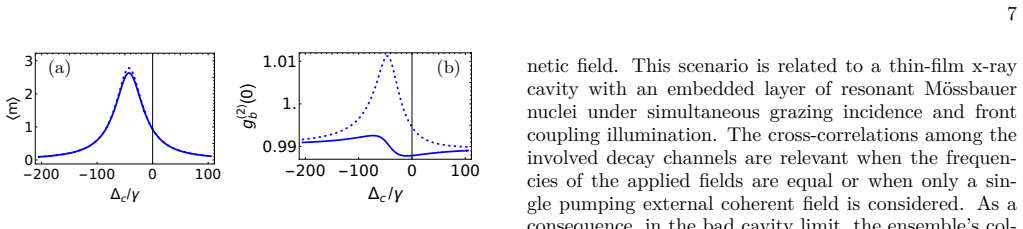
- [Results on nuclear statistics] The transition from the master equation to the reported sub- to super-Poissonian statistics (likely §4) requires an explicit expression for the second-order correlation function or Mandel Q-parameter; the current description leaves unclear whether the statistics are computed for the steady state or during transient dynamics.
minor comments (2)
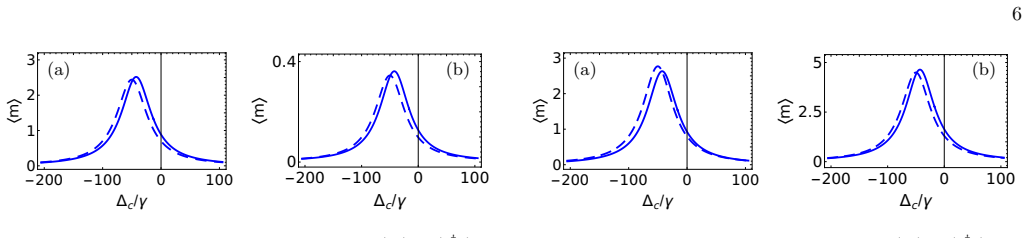
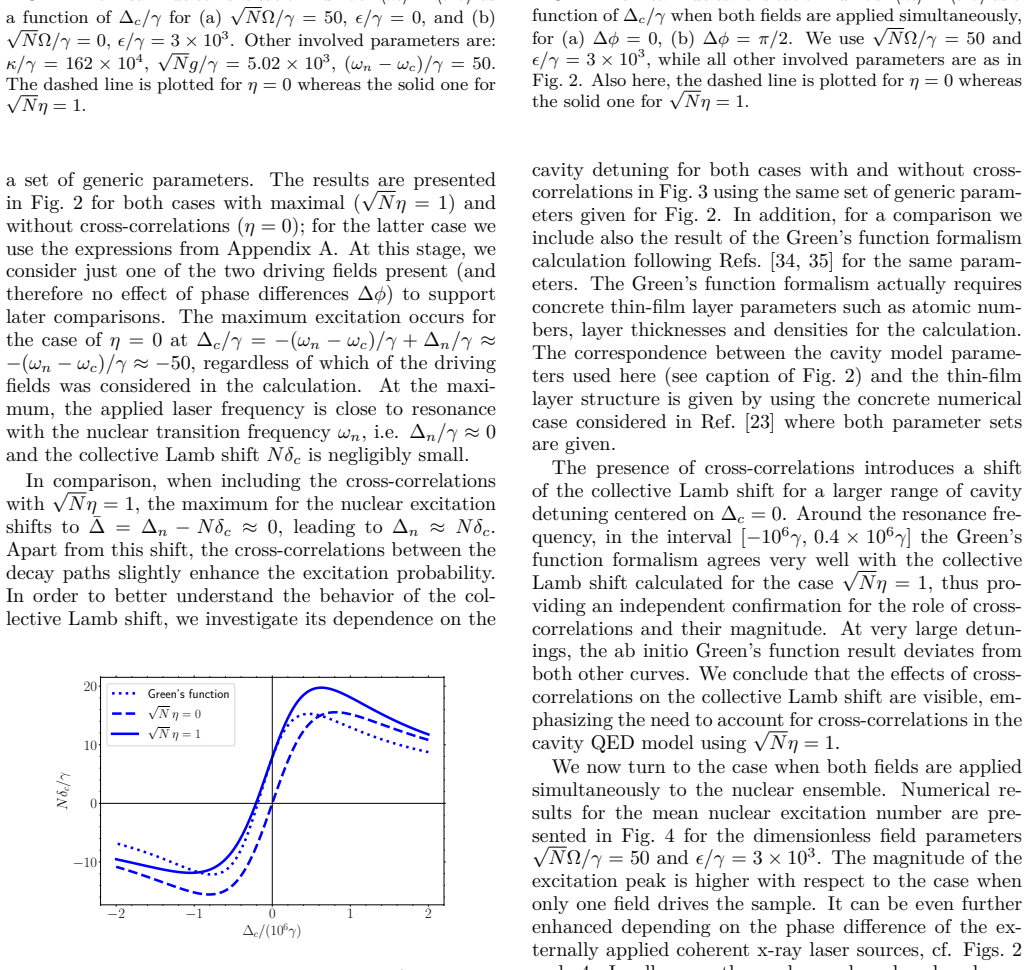
- [Figures] Figure captions should specify the exact values of the driving Rabi frequencies, cavity decay rate, and collective coupling strength used in each panel to allow direct reproduction.
- [Abstract] The abstract would be strengthened by a single sentence stating the form of the master equation or the key observable (e.g., the phase-dependent excitation probability).
Simulated Author's Rebuttal
We thank the referee for the positive assessment of our work and for the constructive comments, which have helped us improve the clarity of the manuscript. We address each major comment below and have revised the paper accordingly.
read point-by-point responses
-
Referee: [Model and master equation] The master-equation derivation (presumably §2) must explicitly display the cross-correlation terms between decay channels and show how they produce the claimed phase dependence when the two driving frequencies coincide. Without these steps, it is impossible to confirm that the enhancement is not an artifact of the rotating-wave or Markov approximations.
Authors: We agree that the derivation requires more explicit detail. In the revised manuscript we have expanded Section 2 to present the full derivation of the master equation starting from the system Hamiltonian. The cross-correlation terms between the two decay channels appear explicitly as off-diagonal contributions in the Lindblad operators when the driving frequencies are identical; these terms yield a phase-dependent factor cos(Δφ) multiplying the collective decay rate and the excitation probability. We have also included a brief check that retains counter-rotating terms outside the rotating-wave approximation; the phase dependence survives, confirming it is not an artifact of the approximations used. revision: yes
-
Referee: [Results on nuclear statistics] The transition from the master equation to the reported sub- to super-Poissonian statistics (likely §4) requires an explicit expression for the second-order correlation function or Mandel Q-parameter; the current description leaves unclear whether the statistics are computed for the steady state or during transient dynamics.
Authors: We thank the referee for this clarification request. In the revised Section 4 we now give the explicit expression for the Mandel Q-parameter, Q = (⟨(Δn)²⟩/⟨n⟩) − 1, obtained from the steady-state density matrix after numerical solution of the master equation. The reported sub- to super-Poissonian behavior refers to the steady state under continuous driving. For completeness we also supply the second-order correlation function g⁽²⁾(0) of the emitted field and discuss its phase dependence; transient dynamics are summarized in a new appendix. revision: yes
Circularity Check
No significant circularity detected
full rationale
The paper derives its results from the standard Lindblad master equation for a driven collective ensemble of two-level nuclei coupled to a leaky cavity mode, with coherent driving terms and cross-damping rates between decay channels. All reported phase-dependent excitation enhancements, sub- to super-Poissonian statistics, and modifications to superradiant decay follow by direct numerical or analytic solution of these equations; no fitted parameters are re-labeled as predictions, no ansatz is smuggled via self-citation, and no uniqueness theorem or self-referential definition closes the derivation loop. The model rests on established quantum-optical techniques whose validity is independent of the present results.
Axiom & Free-Parameter Ledger
Reference graph
Works this paper leans on
-
[1]
for nuclei residing in their excited state, is then given by g(2) b (0) = ⟨b†2b2⟩/⟨b†b⟩2. (21) Here, In = Θ 2N − n 1F1(1 + Θ, 1 + Θ + n − 2N ; p), and 1F1(a, b; z) = ∞X k=0 Γ(a + k)Γ(b) Γ(a)Γ(b + k) zk k! , is the generalized hypergeometric function, with Γ(x) be- ing the gamma function. The mean excitation number as well as the second- order correlation ...
-
[2]
T. J. Bürvenich, J. Evers, and C. H. Keitel, Phys. Rev. Lett. 96, 142501 (2006)
work page 2006
-
[3]
F. Vagizov, V. Antonov, Y. Radeonychev, R. Shakhmu- ratov, and O. Kocharovskaya, Nature 508, 80 (2014)
work page 2014
-
[4]
R. Röhlsberger, K. Schlage, D. B. Sahoo, S. Couet, and R. Rüffer, Science (New York, N.Y.) 328, 1248 (2010)
work page 2010
-
[5]
K. P. Heeg, H.-C. Wille, K. Schlage, T. Guryeva, D. Schumacher, I. Uschmann, K. S. Schulze, B. Marx, T. Kämpfer, G. G. Paulus, R. Röhlsberger, and J. Evers, Phys. Rev. Lett. 111, 073601 (2013)
work page 2013
-
[6]
Y. Shvyd’ko, R. Röhlsberger, O. Kocharovskaya, J. Ev- ers, G. A. Geloni, P. Liu, D. Shu, A. Miceli, B. Stone, W. Hippler, B. Marx-Glowna, I. Uschmann, R. Loet- zsch, O. Leupold, H.-C. Wille, I. Sergeev, M. Gerharz, X. Zhang, C. Grech, M. Guetg, V. Kocharyan, N. Kujala, S. Liu, W. Qin, A. Zozulya, J. Hallmann, U. Boesenberg, W. Jo, J. Möller, A. Rodriguez-...
work page 2023
-
[7]
E. Peik, T. Schumm, M. S. Safronova, A. Pálffy, J. Weit- enberg, and P. G. Thirolf, Quantum Science and Tech- nology 6, 034002 (2021)
work page 2021
-
[8]
K. P. Heeg, A. Kaldun, C. Strohm, C. Ott, R. Subrama- nian, D. Lentrodt, J. Haber, H.-C. Wille, S. Goerttler, R. Rüffer, C. H. Keitel, R. Röhlsberger, T. Pfeifer, and J. Evers, Nature 590, 401–404 (2021)
work page 2021
- [9]
-
[10]
A. I. Chumakov, A. Q. R. Baron, I. Sergueev, C. Strohm, O. Leupold, Y. Shvyd’ko, G. V. Smirnov, R. Rüf- fer, Y. Inubushi, M. Yabashi, K. Tono, T. Kudo, and T. Ishikawa, Nature Physics 14, 261
-
[11]
S. L. Ruby and D. I. Bolef, Phys. Rev. Lett. 5, 5 (1960)
work page 1960
-
[12]
G. J. Perlow, Phys. Rev. Lett. 40, 896 (1978)
work page 1978
-
[13]
P. Helistö, I. Tittonen, M. Lippmaa, and T. Katila, Phys. Rev. Lett. 66, 2037 (1991)
work page 2037
-
[14]
Y. V. Shvyd’ko and G. V. Smirnov, Journal of Physics: Condensed Matter 4, 2663 (1992)
work page 1992
-
[15]
K. P. Heeg, A. Kaldun, C. Strohm, P. Reiser, C. Ott, R. Subramanian, D. Lentrodt, J. Haber, H.-C. Wille, S. Goerttler, R. Rüffer, C. H. Keitel, R. Röhlsberger, T. Pfeifer, and J. Evers, Science 357, 375 (2017)
work page 2017
-
[16]
Y. V. Shvyd’ko, S. L. Popov, and G. V. Smirnov, Journal of Physics: Condensed Matter 5, 1557 (1993)
work page 1993
-
[17]
Y. V. Shvyd’ko, A. I. Chumakov, G. V. Smirnov, T. Her- trich, U. van Bürck, H. D. Rüter, O. Leupold, J. Metge, and E. Gerdau, Europhysics Letters 26, 215 (1994)
work page 1994
-
[18]
Y. Shvyd’ko, T. Hertrich, J. Metge, O. Leupold, E. Ger- dau, and H. Rüter, Phys. Rev. B 52, R711 (1995)
work page 1995
-
[19]
Y. V. Shvyd’ko, T. Hertrich, U. van Bürck, E. Gerdau, O. Leupold, J. Metge, H. D. Rüter, S. Schwendy, G. V. 9 Smirnov, W. Potzel, and P. Schindelmann, Phys. Rev. Lett. 77, 3232 (1996)
work page 1996
-
[20]
M. Lippmaa, I. Tittonen, J. Lindén, and T. Katila, Phys. Rev. B 52, 10268 (1995)
work page 1995
-
[21]
Y. V. Shvyd’ko, G. V. Smirnov, S. L. Popov, and T. Her- trich, Soviet Journal of Experimental and Theoretical Physics Letters 53, 69 (1991)
work page 1991
-
[22]
J. B. Hastings, D. P. Siddons, U. van Bürck, R. Hollatz, and U. Bergmann, Phys. Rev. Lett. 66, 770 (1991)
work page 1991
-
[23]
U. van Bürck, D. P. Siddons, J. B. Hastings, U. Bergmann, and R. Hollatz, Phys. Rev. B 46, 6207 (1992)
work page 1992
-
[24]
K. P. Heeg and J. Evers, Phys. Rev. A 88, 043828 (2013)
work page 2013
-
[25]
R. Röhlsberger, H.-C. Wille, K. Schlage, and D. B. Sa- hoo, Nature 482, 199 (2012)
work page 2012
- [26]
- [27]
- [28]
-
[29]
L. M. Lohse, P. Andrejić, S. Velten, M. Vassholz, C. Neuhaus, A. Negi, A. Panchwanee, I. Sergeev, A. Pálffy, T. Salditt, and R. Röhlsberger, Phys. Rev. Lett. 135, 053601 (2025)
work page 2025
-
[30]
C. W. Gardiner, Phys. Rev. Lett. 70, 2269 (1993)
work page 1993
-
[32]
L. G. Parratt, Phys. Rev. 95, 359 (1954)
work page 1954
-
[33]
R. Röhlsberger, Nuclear Condensed Matter Physics with Synchrotron Radiation: Basic Principles, Methodology and Applications (Springer Science & Business Media)
-
[34]
K. P. Heeg and J. Evers, Phys. Rev. A 91, 063803 (2015)
work page 2015
-
[35]
X. Kong, D. E. Chang, and A. Pálffy, Phys. Rev. A 102, 033710 (2020)
work page 2020
-
[36]
D. Lentrodt, K. P. Heeg, C. H. Keitel, and J. Evers, Phys. Rev. Research 2, 023396 (2020)
work page 2020
-
[37]
D. Walls and G. Milburn, Quantum Optics , Springer Study Edition (Springer Berlin Heidelberg, 1995)
work page 1995
-
[38]
M. Kiffner, M. Macovei, J. Evers, and C. Keitel, Progress in Optics 55, 85 (2010)
work page 2010
-
[39]
G. S. Agarwal, Quantum statistical theories of sponta- neous emission and their relation to other approaches, in Quantum Optics , edited by G. Höhler (Springer Berlin Heidelberg, Berlin, Heidelberg, 1974) pp. 1–128
work page 1974
-
[40]
H. J. Carmichael, Phys. Rev. Lett. 70, 2273 (1993)
work page 1993
-
[41]
C. A. Downing and T. J. Sturges, Europhysics Letters 140, 35001 (2022)
work page 2022
-
[42]
E. M. Purcell, Spontaneous emission probabilities at ra- dio frequencies, in Confined Electrons and Photons: New Physics and Applications , edited by E. Burstein and C. Weisbuch (Springer US, Boston, MA, 1995) pp. 839– 839
work page 1995
-
[43]
D. Lentrodt, O. Diekmann, C. H. Keitel, S. Rotter, and J. Evers, Phys. Rev. Lett. 130, 263602 (2023)
work page 2023
-
[44]
S. Y. Kilin, Sov. Phys. JETP 55, 38 (1982)
work page 1982
-
[45]
R. Puri, Mathematical Methods of Quantum Optics , Springer Series in Optical Sciences (Springer Berlin Hei- delberg, 2001)
work page 2001
- [46]
-
[47]
P. D. Drummond and D. F. Walls, Journal of Physics A: Mathematical and General 13, 725 (1980)
work page 1980
-
[48]
R. J. Glauber, Phys. Rev. 130, 2529 (1963)
work page 1963
- [49]
-
[50]
J. Shan, Y. Chang, L. Zhang, F. Wang, J. Yuan, X. Kong, and Y.-G. Ma, Phys. Rev. Lett. 136, 113601 (2026)
work page 2026
discussion (0)
Sign in with ORCID, Apple, or X to comment. Anyone can read and Pith papers without signing in.