Human vs. Machine Deception: Distinguishing AI-Generated and Human-Written Fake News Using Ensemble Learning
Pith reviewed 2026-05-10 16:32 UTC · model grok-4.3
The pith
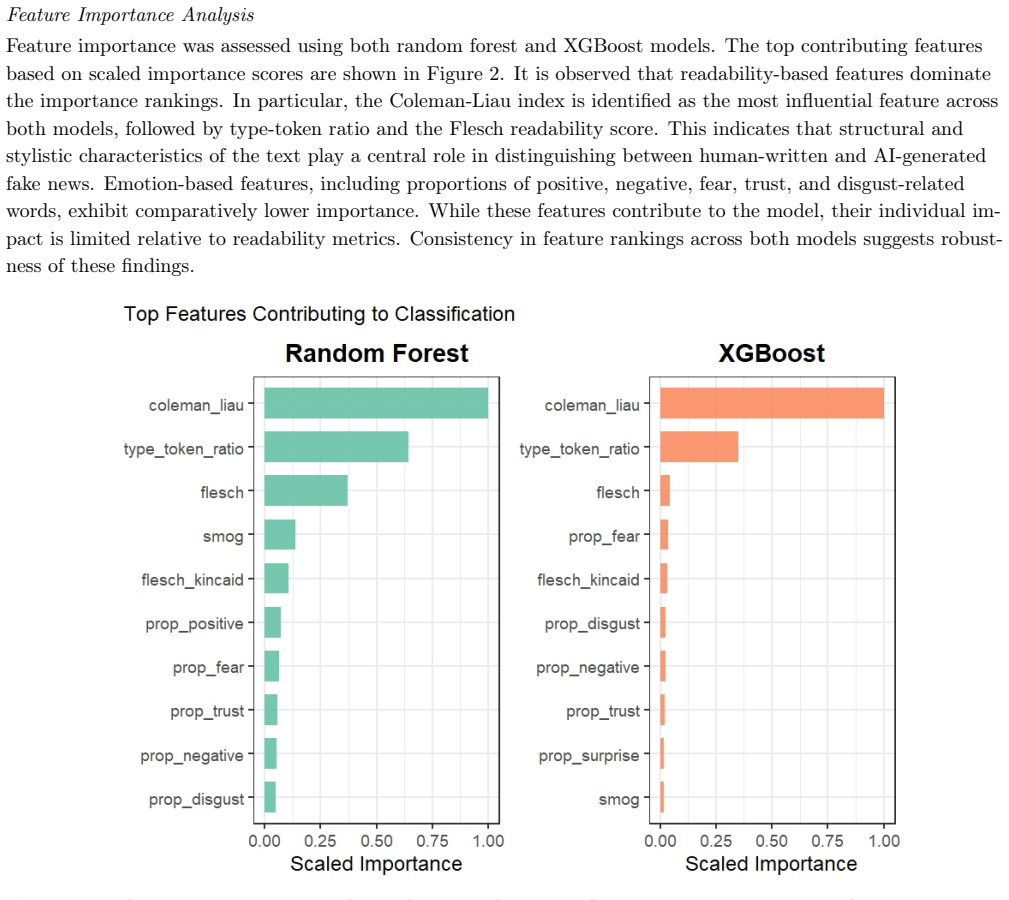
AI-generated fake news can be distinguished from human-written fake news using readability and stylistic features with ensemble machine learning.
A machine-rendered reading of the paper's core claim, the machinery that carries it, and where it could break.
Core claim
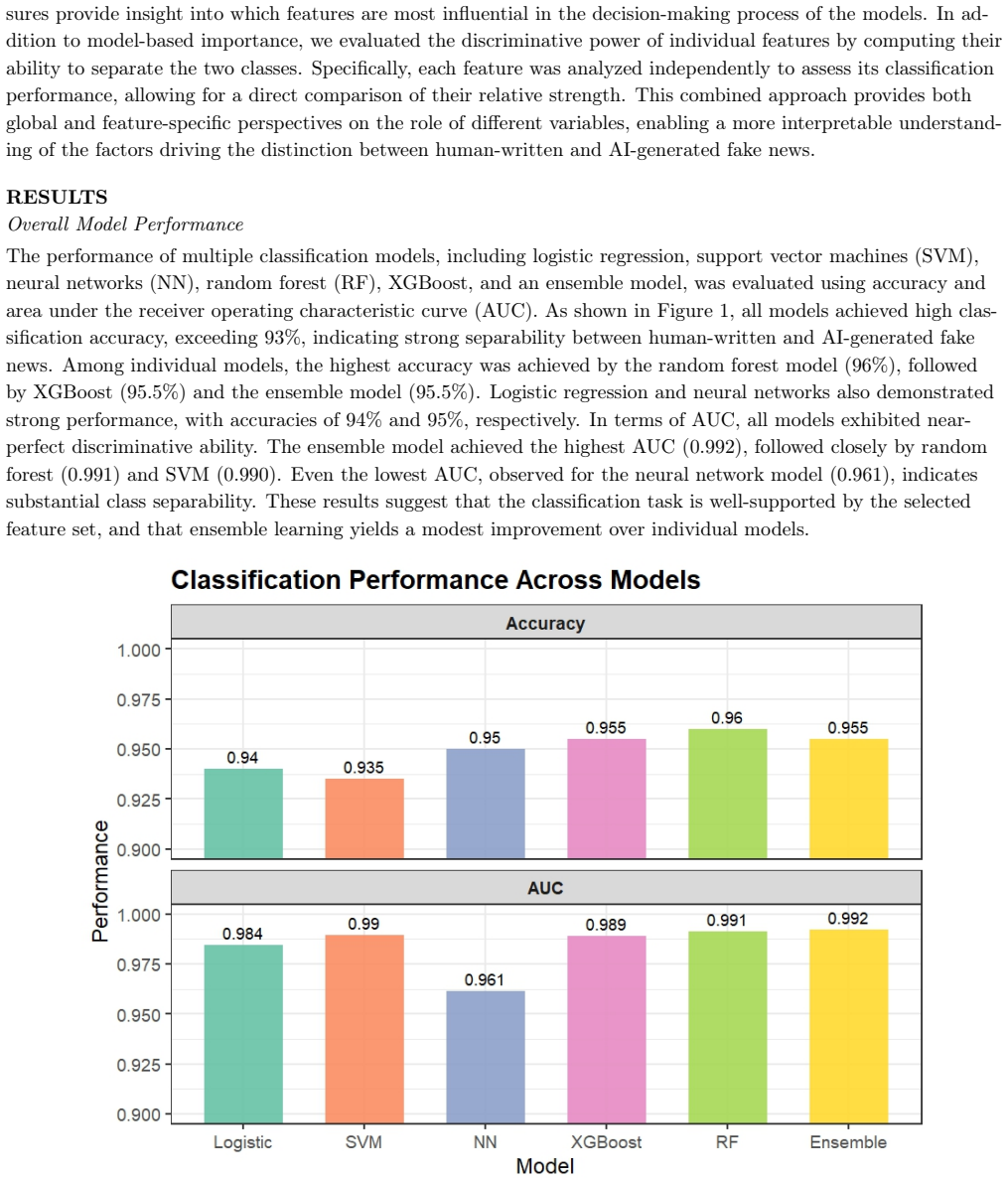
The authors claim that readability-based features are the strongest predictors for distinguishing AI-generated fake news from human-written fake news, with AI text displaying more uniform stylistic patterns overall. Ensemble methods that combine logistic regression, random forests, support vector machines, gradient boosting, and neural networks yield modest but consistent gains in accuracy and AUC over individual models, supporting the use of structural and affective text properties for reliable detection.
What carries the argument
A document-level feature representation incorporating sentence structure, lexical diversity, punctuation patterns, readability indices, and emotion scores for dimensions like fear and anger, fed into an ensemble of classifiers.
If this is right
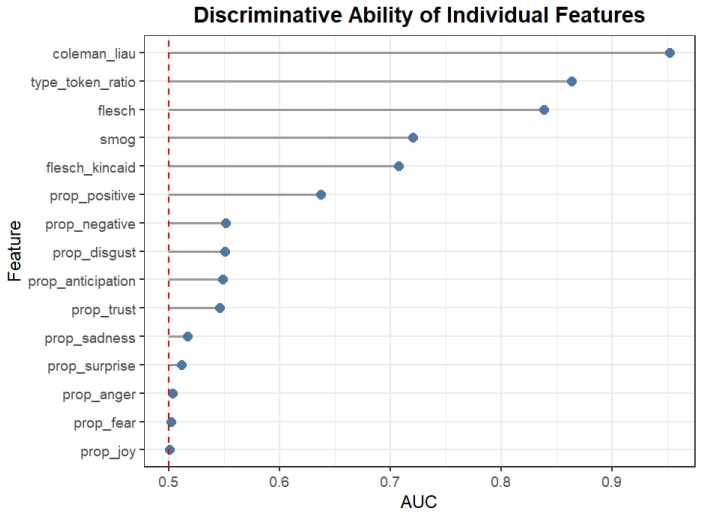
- Readability indices emerge as the top features for identifying AI-generated content.
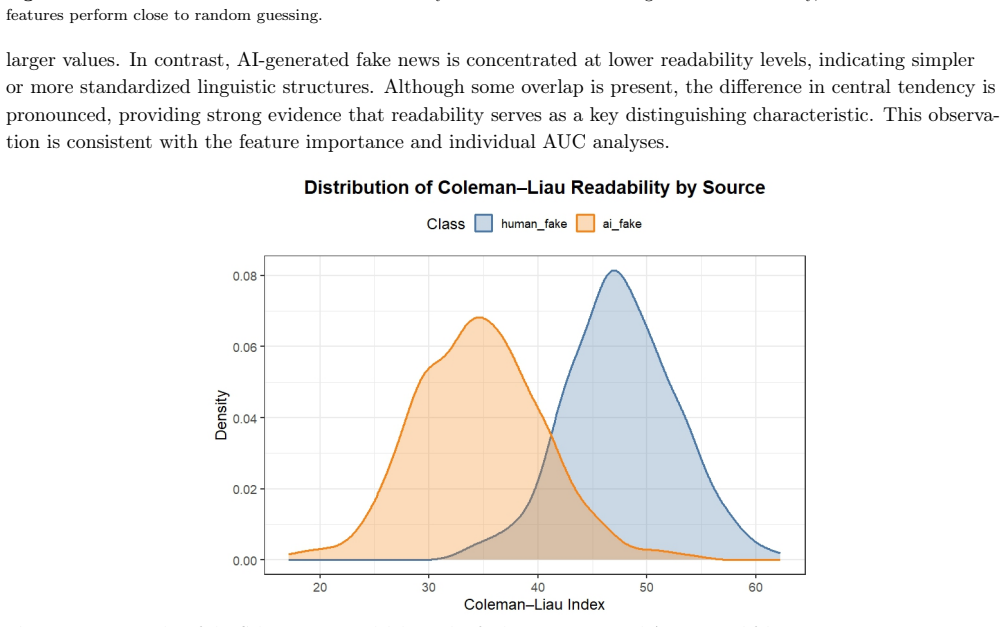
- AI-generated fake news exhibits greater stylistic uniformity than human equivalents.
- Ensemble aggregation improves classification performance modestly but reliably.
- Stylistic and structural text properties provide a robust foundation for detection systems.
Where Pith is reading between the lines
- If the features prove stable across topics, they could be applied to detect AI assistance in other writing domains like opinion pieces or reviews.
- Future work might test whether evolving AI models erode these detectable differences over time.
- Integration into social media platforms could prioritize review of content flagged as potentially AI-sourced deception.
Load-bearing premise
The collected examples of human-written and AI-generated fake news represent the broader range of real-world deceptive content, and the chosen features capture inherent differences rather than biases from specific sources or subjects.
What would settle it
Repeating the classification on a new dataset of human and AI fake news collected from different platforms or covering unrelated topics, and observing if accuracy drops substantially below the reported levels.
Figures
read the original abstract
The rapid adoption of large language models has introduced a new class of AI-generated fake news that coexists with traditional human-written misinformation, raising important questions about how these two forms of deceptive content differ and how reliably they can be distinguished. This study examines linguistic, structural, and emotional differences between human-written and AI-generated fake news and evaluates machine learning and ensemble-based methods for distinguishing these content types. A document-level feature representation is constructed using sentence structure, lexical diversity, punctuation patterns, readability indices, and emotion-based features capturing affective dimensions such as fear, anger, joy, sadness, trust, and anticipation. Multiple classification models, including logistic regression, random forest, support vector machines, extreme gradient boosting, and a neural network, are applied alongside an ensemble framework that aggregates predictions across models. Model performance is assessed using accuracy and area under the receiver operating characteristic curve. The results show strong and consistent classification performance, with readability-based features emerging as the most informative predictors and AI-generated text exhibiting more uniform stylistic patterns. Ensemble learning provides modest but consistent improvements over individual models. These findings indicate that stylistic and structural properties of text provide a robust basis for distinguishing AI-generated misinformation from human-written fake news.
Editorial analysis
A structured set of objections, weighed in public.
Referee Report
Summary. The paper claims that linguistic, structural, and emotional features—particularly readability indices—can reliably distinguish AI-generated fake news from human-written fake news. It constructs document-level representations using sentence structure, lexical diversity, punctuation, readability scores, and emotion dimensions (fear, anger, joy, etc.), then evaluates logistic regression, random forest, SVM, XGBoost, neural networks, and an ensemble aggregator, reporting strong accuracy and AUC performance with readability features as the top predictors, more uniform AI stylistic patterns, and modest ensemble gains.
Significance. If the central claim holds after controlling for data artifacts, the work would offer a practical, feature-based approach to detecting AI misinformation and highlight stable stylistic markers separating human and machine deception. The emphasis on readability and ensemble aggregation could inform downstream detection systems, though the absence of quantified results and controls currently limits its immediate utility.
major comments (2)
- [Abstract and Data Collection section] Abstract and Data Collection section: The central claim that readability and stylistic features distinguish generation methods requires that human and AI examples are balanced on topics and sources. The manuscript provides no description of dataset sizes, collection procedures, topic matching, stratification, or domain labels, leaving open the possibility that observed differences in lexical diversity, sentence structure, and readability indices reflect topic or source confounds rather than inherent generation differences.
- [Results section] Results section: The abstract asserts 'strong and consistent classification performance' and 'modest but consistent improvements' from the ensemble without reporting specific accuracy/AUC values, baseline comparisons, error bars, or statistical tests. This is load-bearing for the claim of reliable distinction, as it prevents assessment of effect sizes or whether improvements exceed noise.
minor comments (2)
- [Methods] The ensemble aggregation method (e.g., voting weights or stacking) is not described in sufficient detail to allow replication.
- [Results] Feature importance analysis for readability indices is mentioned but not supported by specific scores, ablation results, or tables showing relative contributions.
Simulated Author's Rebuttal
We thank the referee for the constructive feedback, which highlights important areas for improving the clarity and rigor of our manuscript. We address each major comment below and will make the necessary revisions to strengthen the presentation of our data collection and results.
read point-by-point responses
-
Referee: [Abstract and Data Collection section] Abstract and Data Collection section: The central claim that readability and stylistic features distinguish generation methods requires that human and AI examples are balanced on topics and sources. The manuscript provides no description of dataset sizes, collection procedures, topic matching, stratification, or domain labels, leaving open the possibility that observed differences in lexical diversity, sentence structure, and readability indices reflect topic or source confounds rather than inherent generation differences.
Authors: We agree that the absence of detailed dataset information leaves the central claim vulnerable to potential confounds from topics or sources. The current Data Collection section is indeed too brief. In the revised manuscript we will expand it to report exact dataset sizes (number of human-written and AI-generated articles), collection procedures (sources for human fake news and the specific LLM prompting strategy for AI examples), methods used for topic matching and stratification to ensure balance across categories, and any available domain labels. We will also add a short discussion of how these controls mitigate topic or source biases. revision: yes
-
Referee: [Results section] Results section: The abstract asserts 'strong and consistent classification performance' and 'modest but consistent improvements' from the ensemble without reporting specific accuracy/AUC values, baseline comparisons, error bars, or statistical tests. This is load-bearing for the claim of reliable distinction, as it prevents assessment of effect sizes or whether improvements exceed noise.
Authors: We acknowledge that the current manuscript reports performance only qualitatively ('strong and consistent') without the quantitative details needed to evaluate effect sizes or statistical reliability. We will revise the Results section to include explicit accuracy and AUC values for all models and the ensemble, add baseline comparisons (e.g., against a majority-class or random classifier), report error bars or standard deviations from cross-validation folds, and include statistical tests (such as McNemar's test or paired t-tests) for the ensemble improvements. We will also update the abstract to incorporate the key numerical results. revision: yes
Circularity Check
No circularity: standard empirical ML pipeline on held-out labels
full rationale
The paper's chain consists of (1) collecting labeled human-written and AI-generated fake news examples, (2) extracting fixed linguistic/readability/emotion features, (3) training off-the-shelf classifiers (LR, RF, SVM, XGBoost, NN) and an ensemble, and (4) reporting accuracy/AUC on held-out test data. None of these steps reduces to its inputs by construction: the performance numbers are not a re-expression of the feature definitions or training labels, nor are they obtained by fitting a parameter and then relabeling it a prediction. No uniqueness theorems, ansatzes, or self-citations are invoked to force the result. The evaluation is falsifiable against external ground-truth origin labels, satisfying the self-contained benchmark criterion.
Axiom & Free-Parameter Ledger
free parameters (1)
- model hyperparameters
axioms (2)
- domain assumption The extracted features (readability, lexical diversity, emotion scores) are stable and informative discriminators independent of topic or source bias.
- domain assumption Human-written and AI-generated fake news samples are drawn from distributions that reflect real-world deceptive content.
Reference graph
Works this paper leans on
-
[1]
Lazer, D.M., Baum, M.A., Benkler, Y., Berinsky, A.J., Greenhill, K.M., Menczer, F., Metzger, M.J., Nyhan, B., Pennycook, G., Rothschild, D. and Schudson, M., 2018. The science of fake news. Science, 359(6380), pp.1094-1096
work page 2018
-
[2]
Vosoughi, S., Roy, D. and Aral, S., 2018. The spread of true and false news online. science, 359(6380), pp.1146-1151
work page 2018
-
[3]
Ghosh, D., Boettcher, W.A., Johnston, R. and Lahiri, S., 2025. THANOS: a predictive model of electoral campaigns using twitter data and opinion polls. Data Science in Science, 4(1), p.2484180
work page 2025
-
[4]
Shu, K., Sliva, A., Wang, S., Tang, J. and Liu, H., 2017. Fake news detection on social media: A data mining perspective. ACM SIGKDD explorations newsletter, 19(1), pp.22-36
work page 2017
-
[5]
Ghosh, D., Boettcher, W., Johnston, R. and Lahiri, S., 2026. Machine Learning Based Bot Detection on X With Temporal and Semantic Feature Integration. IEEE Transactions on Computational Social Systems
work page 2026
-
[6]
Brown, T., Mann, B., Ryder, N., Subbiah, M., Kaplan, J.D., Dhariwal, P., Neelakantan, A., Shyam, P., Sastry, G., Askell, A. and Agarwal, S., 2020. Language models are few-shot learners. Advances in neural information processing systems, 33, pp.1877-1901
work page 2020
-
[7]
Achiam, J., Adler, S., Agarwal, S., Ahmad, L., Akkaya, I., Aleman, F.L., Almeida, D., Altenschmidt, J., Altman, S., Anadkat, S. and Avila, R., 2023. Gpt-4 technical report. arXiv preprint arXiv:2303.08774
work page internal anchor Pith review Pith/arXiv arXiv 2023
-
[8]
Rashkin, H., Choi, E., Jang, J.Y., Volkova, S. and Choi, Y., 2017, September. Truth of varying shades: Analyzing language in fake news and political fact-checking. In Proceedings of the 2017 conference on empirical methods in natural language processing (pp. 2931-2937)
work page 2017
-
[9]
and Mihalcea, R., 2018, August
P\'erez-Rosas, V., Kleinberg, B., Lefevre, A. and Mihalcea, R., 2018, August. Automatic detection of fake news. In Proceedings of the 27th international conference on computational linguistics (pp. 3391-3401)
work page 2018
-
[10]
Shu, K., Wang, S. and Liu, H., 2019, January. Beyond news contents: The role of social context for fake news detection. In Proceedings of the twelfth ACM international conference on web search and data mining (pp. 312-320)
work page 2019
-
[11]
Zhou, X. and Zafarani, R., 2020. A survey of fake news: Fundamental theories, detection methods, and opportunities. ACM Computing Surveys (CSUR), 53(5), pp.1-40
work page 2020
-
[12]
Oshikawa, R., Qian, J. and Wang, W.Y., 2020, May. A survey on natural language processing for fake news detection. In Proceedings of the Twelfth Language Resources and Evaluation Conference (pp. 6086-6093)
work page 2020
-
[13]
Zhang, J., Cui, L., Fu, Y. and Gouza, F.B., 2018. Fake news detection with deep diffusive network model. arXiv preprint arXiv:1805.08751, pp.1-10
-
[14]
Clark, E., August, T., Serrano, S., Haduong, N., Gururangan, S. and Smith, N.A., 2021, August. All that's ‘human'is not gold: Evaluating human evaluation of generated text. In Proceedings of the 59th Annual Meeting of the Association for Computational Linguistics and the 11th International Joint Conference on Natural Language Processing (Volume 1: Long Pa...
work page 2021
-
[15]
Kreps, S., McCain, R.M. and Brundage, M., 2022. All the news that's fit to fabricate: AI-generated text as a tool of media misinformation. Journal of experimental political science, 9(1), pp.104-117
work page 2022
-
[16]
A survey of modern authorship attribution methods
Stamatatos, E., 2009. A survey of modern authorship attribution methods. Journal of the American Society for information Science and Technology, 60(3), pp.538-556
work page 2009
-
[17]
Certain language skills in children; their development and interrelationships
Templin, M.C., 1957. Certain language skills in children; their development and interrelationships
work page 1957
-
[18]
Tweedie, F.J. and Baayen, R.H., 1998. How variable may a constant be? Measures of lexical richness in perspective. Computers and the Humanities, 32(5), pp.323-352
work page 1998
-
[19]
Flesch, R., 1948. A new readability yardstick. Journal of applied psychology, 32(3), p.221
work page 1948
-
[20]
Kincaid, J.P., Fishburne Jr, R.P., Rogers, R.L. and Chissom, B.S., 1975. Derivation of new readability formulas (automated readability index, fog count and flesch reading ease formula) for navy enlisted personnel (No. RBR875)
work page 1975
-
[21]
SMOG grading-a new readability formula
Mc Laughlin, G.H., 1969. SMOG grading-a new readability formula. Journal of reading, 12(8), pp.639-646
work page 1969
-
[22]
Coleman, M. and Liau, T.L., 1975. A computer readability formula designed for machine scoring. Journal of Applied Psychology, 60(2), p.283
work page 1975
-
[23]
Mohammad, S.M. and Turney, P.D., 2013. Crowdsourcing a word-emotion association lexicon. Computational intelligence, 29(3), pp.436-465
work page 2013
-
[24]
Rincy, T.N. and Gupta, R., 2020, February. Ensemble learning techniques and its efficiency in machine learning: A survey. In 2nd international conference on data, engineering and applications (IDEA) (pp. 1-6). IEEE
work page 2020
-
[25]
and Alzheimer's Disease Neuroimaging Initiative, 2025
Ghosh, D., Pal, S., Lutz, M., Luo, S. and Alzheimer's Disease Neuroimaging Initiative, 2025. Ensemble survival analysis for preclinical cognitive decline prediction in Alzheimer's disease using longitudinal biomarkers. Journal of Alzheimer's Disease, 107(3), pp.1256-1266
work page 2025
-
[26]
and Bhatia, M.P.S., 2016, December
Srivastava, R. and Bhatia, M.P.S., 2016, December. Ensemble methods for sentiment analysis of on-line micro-texts. In 2016 International Conference on Recent Advances and Innovations in Engineering (ICRAIE) (pp. 1-6). IEEE
work page 2016
discussion (0)
Sign in with ORCID, Apple, or X to comment. Anyone can read and Pith papers without signing in.