Dynamic multiphase flow triggers chaotic mixing in porous media
Pith reviewed 2026-05-10 15:02 UTC · model grok-4.3
The pith
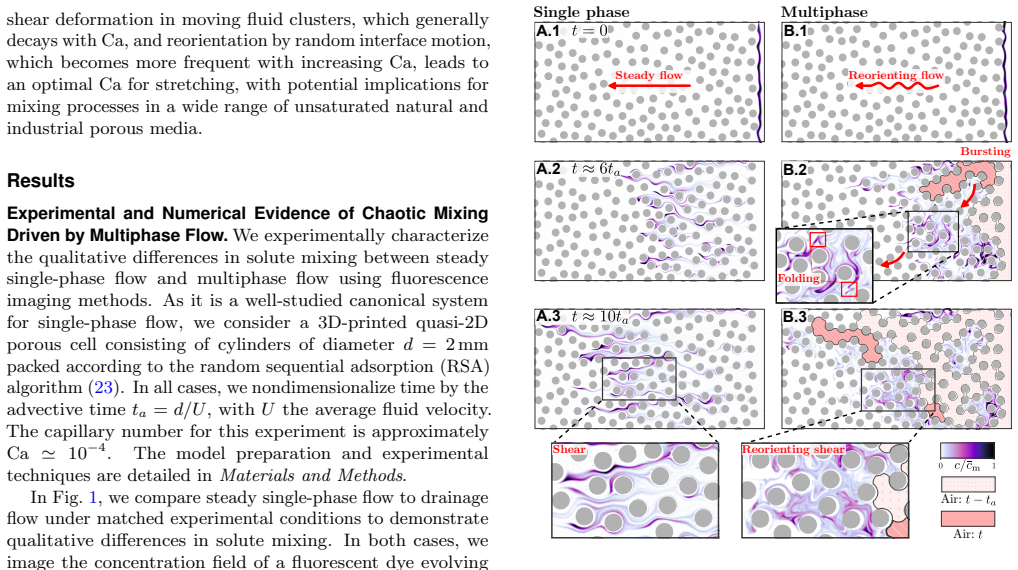
Dynamic two-phase flows in porous media trigger chaotic mixing by exponentially stretching fluid elements, far beyond the linear stretching of steady single-phase flows.
A machine-rendered reading of the paper's core claim, the machinery that carries it, and where it could break.
Core claim
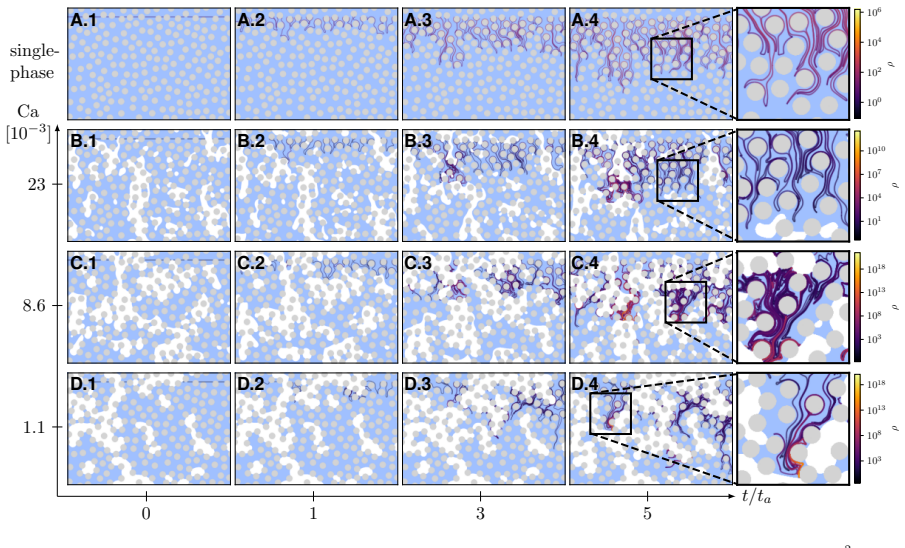
Dynamic two-phase flows induce chaotic mixing, characterized by exponential stretching of fluid elements, leading to strongly enhanced mixing compared to steady single phase flows. By extensive numerical multiphase flow simulations, dynamic steady states are established where the mean fluid stretching rate is measured as a function of flow rate. Stretching reaches a maximum at an optimum flow rate that balances fluid shear deformation against the frequency of flow reorientation by the intermittent motion of the fluid interface. A mechanistic model connects basic multiphase flow characteristics directly to the observed stretching rate.
What carries the argument
The mean fluid stretching rate, which measures the average exponential growth of fluid-element lengths produced by repeated stretching and folding from moving interfaces.
If this is right
- Mixing rates increase substantially once flow becomes unsteady and multiphase compared with any steady single-phase case.
- An optimum flow rate exists that maximizes stretching and therefore mixing efficiency.
- The mechanistic model allows stretching rates to be estimated from measurable multiphase flow properties without solving the full flow field.
- Mixing and reaction rates in porous media can be controlled by adjusting the flow rate to the value that optimizes interface reorientation.
Where Pith is reading between the lines
- In field settings such as soils or reservoirs where saturation fluctuates, effective mixing and reaction rates may be substantially higher than steady-flow calculations suggest.
- The same mechanism could be exploited to tune injection rates in remediation or recovery processes so that mixing is deliberately maximized or minimized.
- Extending the stretching-rate measurements to three-dimensional or strongly heterogeneous pore networks would test whether the optimum flow rate shifts with pore geometry.
- The exponential stretching implies that reaction fronts in multiphase flows can become highly convoluted on short time scales, potentially altering effective reaction kinetics.
Load-bearing premise
Numerical simulations must faithfully reproduce the interface motions seen in experiments, and the measured dynamic steady states must yield stretching rates that are not dominated by domain-size or boundary artifacts.
What would settle it
If direct experiments tracking fluid-element lengths over time at varying flow rates show only linear growth instead of exponential growth, or if stretching rates fail to peak at an intermediate flow rate, the claim of chaotic mixing induced by dynamic two-phase flow would be refuted.
Figures




read the original abstract
Solute mixing plays a pivotal role in a broad spectrum of chemical and biological processes across natural and engineered porous media. However, current understanding of mixing dynamics remains largely constrained to steady flows in fully or partially water-saturated environments. Multiphase flow systems are generally unsteady, with moving fluid interfaces and flow paths that change in time. Despite the widespread occurrence of dynamic multiphase flows, their impacts on solute mixing are largely unknown. Here, we use experiments and numerical simulations to investigate the effect of dynamic two-phase flow on the stretching and folding of fluid elements, a fundamental mechanism driving solute mixing and reactions in porous media. We find that dynamic two-phase flows induce chaotic mixing, characterized by exponential stretching of fluid elements, leading to strongly enhanced mixing compared to steady single phase flows. By extensive numerical multiphase flow simulations, we establish dynamic steady states where we reliably measure the mean fluid stretching rate as a function of flow rate. We show that stretching is maximized at an optimum flow rate which balances fluid shear deformation against the frequency of flow reorientation by the intermittent motion of the fluid interface. The findings are rationalized by a mechanistic model linking basic multiphase flow characteristics to the stretching rate, opening new perspectives to understand and control mixing and reactions in a wide range of multiphase flow systems.
Editorial analysis
A structured set of objections, weighed in public.
Referee Report
Summary. The paper claims that dynamic two-phase flows in porous media induce chaotic mixing, characterized by exponential stretching of fluid elements, which strongly enhances mixing relative to steady single-phase flows. Through experiments and extensive numerical multiphase simulations, the authors identify dynamic steady states in which the mean fluid-element stretching rate is measured as a function of flow rate; this rate peaks at an optimum value that balances shear deformation against the frequency of flow reorientation caused by intermittent interface motion. A mechanistic model is presented to rationalize the optimum.
Significance. If the central claim holds, the work provides a new mechanistic link between multiphase flow intermittency and chaotic mixing, with clear implications for solute transport and reactions in natural and engineered porous media. The combination of experiments with large-scale simulations and the derivation of an optimum flow rate from basic multiphase characteristics constitute a substantive advance over prior steady-flow studies.
major comments (3)
- [Numerical simulations] Numerical simulations section: the assertion that 'dynamic steady states' are established and allow reliable extraction of mean stretching rates lacks supporting convergence tests with respect to domain size, boundary conditions, or simulation duration. Given the intermittent interface motion highlighted in the abstract, it is essential to demonstrate that the reported exponential stretching and its flow-rate dependence are independent of these artifacts.
- [Results] Results on stretching rate vs. flow rate: no error bars, standard deviations, or quantitative metrics (e.g., R² values or statistical tests) are provided for the mean stretching rates or the location of the optimum; this omission makes it difficult to assess the robustness of the claimed peak and its comparison to single-phase flows.
- [Mechanistic model] Mechanistic model: the balance between shear deformation and interface reorientation frequency appears to be calibrated against the same simulation data used to measure the stretching rates, introducing potential circularity that weakens the claim that the model independently predicts the optimum flow rate.
minor comments (2)
- [Abstract] The abstract states that stretching is 'maximized at an optimum flow rate' but supplies no numerical value or uncertainty for that rate; adding this would improve clarity.
- [Figures] Figure captions and legends should explicitly state the number of independent realizations or time windows used to compute mean stretching rates.
Simulated Author's Rebuttal
We thank the referee for the constructive and detailed comments on our manuscript. We have addressed each major point below, providing clarifications and indicating revisions where the manuscript will be updated to strengthen the presentation.
read point-by-point responses
-
Referee: Numerical simulations section: the assertion that 'dynamic steady states' are established and allow reliable extraction of mean stretching rates lacks supporting convergence tests with respect to domain size, boundary conditions, or simulation duration. Given the intermittent interface motion highlighted in the abstract, it is essential to demonstrate that the reported exponential stretching and its flow-rate dependence are independent of these artifacts.
Authors: We agree that explicit convergence tests would better substantiate the robustness of the dynamic steady states. While the original simulations were performed over long durations to achieve statistical convergence in the stretching statistics, we did not include dedicated tests for domain size or boundary condition sensitivity in the main text. In the revised manuscript, we will add a supplementary section with convergence data demonstrating that the mean stretching rate and its flow-rate dependence stabilize for domain sizes above a threshold comparable to several pore lengths and for simulation times exceeding several interface turnover periods. This confirms that the exponential stretching behavior is independent of these numerical parameters. revision: yes
-
Referee: Results on stretching rate vs. flow rate: no error bars, standard deviations, or quantitative metrics (e.g., R² values or statistical tests) are provided for the mean stretching rates or the location of the optimum; this omission makes it difficult to assess the robustness of the claimed peak and its comparison to single-phase flows.
Authors: We acknowledge the value of including quantitative uncertainty measures. The reported mean stretching rates were obtained by averaging over multiple independent realizations and extended simulation times, but error bars and fit metrics were not shown. In the revised version, we will include standard deviation error bars on the stretching rate versus flow rate plot and report the R² value for the agreement between the mechanistic model prediction and the simulation data to allow better assessment of the peak's robustness and the comparison to single-phase cases. revision: yes
-
Referee: Mechanistic model: the balance between shear deformation and interface reorientation frequency appears to be calibrated against the same simulation data used to measure the stretching rates, introducing potential circularity that weakens the claim that the model independently predicts the optimum flow rate.
Authors: We disagree that the model involves circularity or calibration to the stretching data. The mechanistic model is derived a priori from fundamental multiphase flow characteristics: the characteristic shear deformation rate is taken from the single-phase flow field, and the interface reorientation frequency is estimated from the capillary number and independently measured statistics of interface motion (e.g., from separate interface tracking without reference to stretching). The optimum flow rate is obtained by equating these two timescales, yielding a parameter-free prediction that is then compared to the simulation results for validation. We will revise the text to more explicitly state that no parameters were fitted to the stretching rates themselves. revision: no
Circularity Check
No significant circularity; derivation rests on independent simulation measurements and mechanistic rationalization
full rationale
The paper's chain proceeds from experiments and multiphase simulations that establish dynamic steady states, extract mean stretching rates versus flow rate, and identify an optimum; a separate mechanistic model then links shear deformation to interface reorientation frequency using basic multiphase characteristics. No quoted step reduces a claimed prediction or uniqueness result to a fitted parameter or self-citation by construction. The central finding of enhanced chaotic mixing is reported as an output of the simulations rather than presupposed in the model or definitions.
Axiom & Free-Parameter Ledger
free parameters (1)
- optimum flow rate
axioms (2)
- standard math Pore-scale flow obeys the Navier-Stokes equations with appropriate boundary conditions at fluid-fluid interfaces
- domain assumption Dynamic steady states with well-defined mean stretching rates can be reached in finite domains
Reference graph
Works this paper leans on
-
[1]
PC Hohenberg, BI Halperin, Theory of dynamic critical phenomena.Rev. Mod. Phys.49, 435 (1977)
work page 1977
-
[2]
D Jacqmin, Calculation of two-phase Navier–Stokes flows using phase-field modeling.J. Comput. Phys.155, 96–127 (1999)
work page 1999
-
[3]
DM Anderson, GB McFadden, AA Wheeler, Diffuse-interface methods in fluid mechanics.Annu. Rev. Fluid Mech.30, 139–165 (1998)
work page 1998
-
[4]
H Ding, PD Spelt, C Shu, Diffuse interface model for incompressible two-phase flows with large density ratios.J. Comput. Phys.226, 2078–2095 (2007)
work page 2078
-
[5]
H Abels, H Garcke, G Grün, Thermodynamically consistent, frame indifferent diffuse interface models for incompressible two-phase flows with different densities.Math. Model. Methods Appl. Sci.22, 1150013 (2012)
work page 2012
-
[6]
A Carlson, G Bellani, G Amberg, Universality in dynamic wetting dominated by contact-line friction.Phys. Rev. E85, 045302 (2012)
work page 2012
-
[7]
G Linga, Twoasis - high-level/high-performance two-phase flow simulation (2025) https://github.com/gautelinga/twoasis
work page 2025
-
[8]
physics communications188, 177–188 (2015)
M Mortensen, K Valen-Sendstad, Oasis: A high-level/high-performance open source Navier–Stokes solver.Comput. physics communications188, 177–188 (2015)
work page 2015
-
[9]
(Springer Science & Business Media) Vol
A Logg, KA Mardal, G Wells,Automated solution of differential equations by the finite element method: The FEniCS book. (Springer Science & Business Media) Vol. 84, (2012)
work page 2012
-
[10]
S Aland, A Voigt, Benchmark computations of diffuse interface models for two-dimensional bubble dynamics.Int. J. for Numer. Methods Fluids69, 747–761 (2012)
work page 2012
-
[11]
G Linga, A Bolet, J Mathiesen, Bernaise: A flexible framework for simulating two-phase electrohydrodynamic flows in complex domains.Front. Phys.7, 21 (2019)
work page 2019
-
[12]
fluid mechanics662, 134–172 (2010)
P Meunier, E Villermaux, The diffusive strip method for scalar mixing in two dimensions.J. fluid mechanics662, 134–172 (2010)
work page 2010
-
[13]
Fluid Mech.837, 230–257 (2018)
D Martínez-Ruiz, P Meunier, B Favier, L Duchemin, E Villermaux, The diffusive sheet method for scalar mixing.J. Fluid Mech.837, 230–257 (2018)
work page 2018
-
[14]
E Villermaux, Mixing versus stirring.Annu. Rev. Fluid Mech.51, 245–273 (2019)
work page 2019
-
[15]
J Heyman, DR Lester, R Turuban, Y Méheust, T Le Borgne, Stretching and folding sustain microscale chemical gradients in porous media.Proc. Natl. Acad. Sci.117, 13359–13365 (2020)
work page 2020
-
[16]
WJA Dahm, PE Dimotakis, Measurements of entrainment and mixing in turbulent jets.AIAA J.25(1987). 12 of 12 Gaute Linga, Kevin Pierce, Marcel Moura, Joachim Mathiesen, François Renard, and Tanguy Le Borgne
work page 1987
discussion (0)
Sign in with ORCID, Apple, or X to comment. Anyone can read and Pith papers without signing in.