Recognition: unknown
ReContraster: Making Your Posters Stand Out with Regional Contrast
Pith reviewed 2026-05-10 15:41 UTC · model grok-4.3
The pith
ReContraster generates attention-grabbing posters by applying regional contrast through a training-free multi-agent system that emulates human designer decisions.
A machine-rendered reading of the paper's core claim, the machinery that carries it, and where it could break.
Core claim
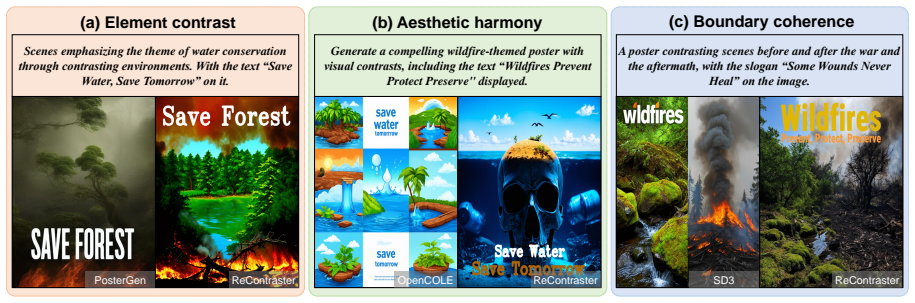
ReContraster is the first training-free model to leverage regional contrast to make posters stand out by emulating the cognitive behaviors of a poster designer with a compositional multi-agent system to identify elements, organize layout, and evaluate generated poster candidates, while integrating a hybrid denoising strategy during the diffusion process to ensure harmonious transitions across region boundaries.
What carries the argument
The compositional multi-agent system that identifies elements, organizes layouts, and evaluates candidates, paired with a hybrid denoising strategy applied during diffusion to blend region boundaries.
If this is right
- Produces posters that capture attention quickly while clearly conveying messages.
- Outperforms relevant state-of-the-art methods across seven quantitative metrics.
- Receives higher ratings in four separate user studies for visual appeal.
- Supports fair comparisons through the contributed benchmark dataset.
- Requires no training or fine-tuning on poster-specific data.
Where Pith is reading between the lines
- The multi-agent decomposition could transfer to related tasks such as generating social media graphics or presentation slides.
- Training-free contrast handling may reduce data collection costs for other attention-focused image synthesis problems.
- Extending the agent evaluation step with direct viewer feedback loops could further improve output quality over time.
Load-bearing premise
The multi-agent system can reliably identify design elements, organize layouts, and select candidates to produce posters that are both visually striking and harmonious.
What would settle it
A blind user study with target viewers showing no measurable improvement in attention capture or message retention for ReContraster outputs compared to standard diffusion poster generators.
Figures


read the original abstract
Effective poster design requires rapidly capturing attention and clearly conveying messages. Inspired by the ``contrast effects'' principle, we propose ReContraster, the first training-free model to leverage regional contrast to make posters stand out. By emulating the cognitive behaviors of a poster designer, ReContraster introduces the compositional multi-agent system to identify elements, organize layout, and evaluate generated poster candidates. To further ensure harmonious transitions across region boundaries, ReContraster integrates the hybrid denoising strategy during the diffusion process. We additionally contribute a new benchmark dataset for comprehensive evaluation. Seven quantitative metrics and four user studies confirm its superiority over relevant state-of-the-art methods, producing visually striking and aesthetically appealing posters.
Editorial analysis
A structured set of objections, weighed in public.
Referee Report
Summary. The manuscript presents ReContraster, a training-free approach for poster design enhancement that leverages regional contrast. It introduces a compositional multi-agent system to emulate poster designer cognitive behaviors by identifying elements, organizing layouts, and evaluating candidates, integrated with a hybrid denoising strategy in the diffusion process. The authors contribute a new benchmark dataset and demonstrate superiority over state-of-the-art methods through seven quantitative metrics and four user studies.
Significance. Should the central claims be substantiated with additional validation, this work has the potential to advance automated design tools in computer vision and graphics by offering a novel, interpretable method without training requirements. The benchmark dataset represents a valuable resource for the community to standardize evaluations in poster generation tasks. The integration of multi-agent systems with diffusion models for design control is an interesting direction.
major comments (2)
- [§3] §3 (Method, Compositional Multi-Agent System subsection): No quantitative validation is provided for the individual agents, such as precision/recall for element identification, layout harmony scores, or accuracy of the evaluation agent. This is load-bearing for the core claim that the system emulates designer cognition to produce superior regional contrast, as the abstract and experiments assert superiority without ablations isolating the multi-agent contribution from the diffusion backbone.
- [§5] §5 (Experiments): The new benchmark dataset and user studies are presented without details on construction criteria, potential selection bias, or failure modes (e.g., inconsistent region boundaries or biased candidate selection). This undermines the reliability of the seven quantitative metrics and four user studies as evidence for the method's superiority and harmonious outputs.
minor comments (2)
- [§2] The related work section could more explicitly compare against recent training-free diffusion control methods to strengthen the 'first' claim.
- Figure captions and the hybrid denoising description would benefit from additional notation clarity to distinguish regional contrast adjustments from standard diffusion steps.
Simulated Author's Rebuttal
We thank the referee for the constructive feedback. We address each major comment below and will incorporate revisions to strengthen the manuscript.
read point-by-point responses
-
Referee: [§3] §3 (Method, Compositional Multi-Agent System subsection): No quantitative validation is provided for the individual agents, such as precision/recall for element identification, layout harmony scores, or accuracy of the evaluation agent. This is load-bearing for the core claim that the system emulates designer cognition to produce superior regional contrast, as the abstract and experiments assert superiority without ablations isolating the multi-agent contribution from the diffusion backbone.
Authors: We agree that quantitative validation for the individual agents would strengthen the claims regarding emulation of designer cognition. In the revised manuscript, we will add ablations reporting precision/recall for element identification, layout harmony scores, and accuracy for the evaluation agent, along with comparisons isolating the multi-agent system from the hybrid denoising backbone. revision: yes
-
Referee: [§5] §5 (Experiments): The new benchmark dataset and user studies are presented without details on construction criteria, potential selection bias, or failure modes (e.g., inconsistent region boundaries or biased candidate selection). This undermines the reliability of the seven quantitative metrics and four user studies as evidence for the method's superiority and harmonious outputs.
Authors: We acknowledge that additional details are needed for transparency. In the revision, we will expand the Experiments section to describe dataset construction criteria, discuss potential selection biases and failure modes including inconsistent region boundaries, and provide more information on user study protocols, participant selection, and statistical analysis. revision: yes
Circularity Check
No circularity: novel system and empirical evaluation are self-contained
full rationale
The paper proposes ReContraster as a new training-free architecture that combines a compositional multi-agent system for element identification/layout/evaluation with a hybrid denoising strategy during diffusion; these components are introduced as original contributions rather than derived from prior fitted parameters or self-referential definitions. Evaluation relies on a newly contributed benchmark dataset plus seven quantitative metrics and four user studies, none of which reduce by construction to the method's own inputs or to load-bearing self-citations. No equations, ansatzes, or uniqueness theorems are presented that loop back to the paper's own assumptions, so the derivation chain remains independent of the patterns that would trigger circularity flags.
Axiom & Free-Parameter Ledger
Reference graph
Works this paper leans on
-
[1]
Classifier-Free Diffusion Guidance
Stytr2: Image style transfer with transformers. InIEEE/CVF Conference on Computer Vision and Pattern Recognition. Ming Ding, Zhuoyi Yang, Wenyi Hong, Wendi Zheng, Chang Zhou, Da Yin, Junyang Lin, Xu Zou, Zhou Shao, Hongxia Yang, and 1 others. 2021. Cogview: Mastering text-to-image generation via transform- ers. InAdvances in Neural Information Processing ...
work page internal anchor Pith review Pith/arXiv arXiv 2021
-
[2]
InACM SIGGRAPH Conference Papers
Sketch-guided text-to-image diffusion models. InACM SIGGRAPH Conference Papers. Zhenyu Wang, Aoxue Li, Zhenguo Li, and Xihui Liu. 2024a. Genartist: Multimodal LLM as an agent for unified image generation and editing. InAdvances in Neural Information Processing Systems. Zhouxia Wang, Xintao Wang, Liangbin Xie, Zhongang Qi, Ying Shan, Wenping Wang, and Ping...
-
[3]
IP-Adapter: Text Compatible Image Prompt Adapter for Text-to-Image Diffusion Models
IP-Adapter: Text compatible image prompt adapter for text-to-image diffusion models.(2023). arXiv preprint arXiv:2308.06721. Hui Zhang, Dexiang Hong, Tingwei Gao, Yitong Wang, Jie Shao, Xinglong Wu, Zuxuan Wu, and Yu-Gang Jiang. 2025a. CreatiLayout: Siamese multimodal dif- fusion transformer for creative layout-to-image gen- eration. InInternational Confe...
work page internal anchor Pith review arXiv 2023
discussion (0)
Sign in with ORCID, Apple, or X to comment. Anyone can read and Pith papers without signing in.