Holographic inflation and slow-roll inflation within R\'enyi entropic framework in the light of ACT DR6
Pith reviewed 2026-05-10 16:23 UTC · model grok-4.3
The pith
Holographic inflation is ruled out by ACT DR6 while slow-roll inflation with power-law potentials for n=0.2 and 0.3 is favored in the Rényi holographic dark energy framework.
A machine-rendered reading of the paper's core claim, the machinery that carries it, and where it could break.
Core claim
Within the Rényi holographic dark energy framework, holographic inflation is ruled out by ACT DR6, whereas slow-roll inflation with the power-law potential V0 ϕ^n is consistent with the data for n=0.2 and n=0.3 when the number of e-folds N is in the range 50 to 55.
What carries the argument
Rényi holographic dark energy density, constructed from Rényi entropy, that supplies the background for both holographic and slow-roll inflationary dynamics and is then confronted with ACT DR6 bounds on the spectral index and tensor-to-scalar ratio.
If this is right
- The Rényi framework supplies viable slow-roll models but excludes holographic inflation under current data.
- Power-law potentials with small exponents become observationally preferred when N is restricted to 50–55.
- The framework can link early-universe inflation to late-time acceleration through the same entropic construction.
- Tighter future bounds on inflationary parameters will further restrict or confirm the allowed range of n and N.
Where Pith is reading between the lines
- If the extension holds, entropic dark-energy models could provide a single description spanning inflation and the present acceleration.
- Other entropy choices (Tsallis, Sharma-Mittal) might yield different survival rates for holographic versus slow-roll scenarios.
- The result invites direct comparison with Planck data to test whether ACT DR6 exclusions persist across independent datasets.
Load-bearing premise
The Rényi holographic dark energy model, built for late-time acceleration, can be directly applied to the inflationary epoch without introducing dynamical inconsistencies or extra modifications.
What would settle it
A future measurement of the scalar spectral index or tensor-to-scalar ratio that lies outside the narrow window allowed by n=0.2 or 0.3 and N=50–55 in the slow-roll case, or that matches the excluded predictions of the holographic case.
Figures

read the original abstract
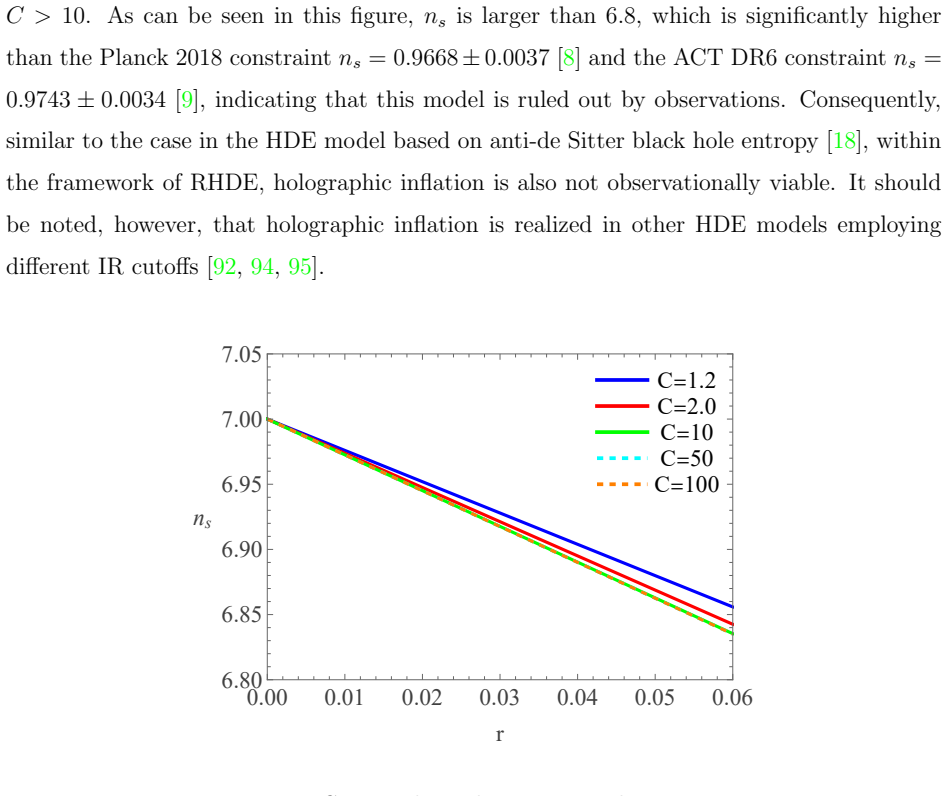
Based on the R\'enyi entropy, R\'enyi holographic dark energy has been proposed to explain the current accelerated expansion of the universe. In this paper, we analyze holographic inflation and slow-roll inflation within the framework of RHDE. Our results show that holographic inflation is ruled out by ACT DR6, while the slow-roll inflation with the power-law potential $V_{0}\phi^{n}$ is favored by ACT DR6 for the cases $n=0.2$ and $0.3$, with $N$ in the range of $50$ to $55$. These findings suggest that RHDE provides a viable framework for slow-roll inflation while disfavoring the holographic inflation scenario.
Editorial analysis
A structured set of objections, weighed in public.
Referee Report
Summary. The paper applies the Rényi holographic dark energy (RHDE) framework to both holographic inflation and slow-roll inflation with a power-law potential V_0 ϕ^n. It substitutes the RHDE energy density into the Friedmann and slow-roll equations to derive n_s and r, then compares the results to ACT DR6 constraints, concluding that holographic inflation is ruled out while the slow-roll case is favored for n=0.2 and 0.3 with N=50-55.
Significance. If the direct extension of the late-time RHDE model to the inflationary regime holds without additional corrections, the work would offer new observational constraints on these scenarios using recent ACT DR6 data. The strength lies in the explicit data comparison, but the significance is reduced by the lack of independent predictions from the model equations.
major comments (2)
- [Section deriving holographic inflation observables] The central derivation substitutes the late-time RHDE energy density (with IR cutoff tied to the future event horizon and Rényi parameter λ) directly into the inflationary Friedmann and slow-roll equations without re-deriving the consistency conditions or performing a stability analysis for the early-universe regime. This substitution is load-bearing for the claim that holographic inflation is ruled out by ACT DR6, yet the manuscript provides no justification for why the cutoff and entropy form remain unmodified at Hubble scales ~10^13 GeV.
- [Section on slow-roll inflation with power-law potential and data comparison] In the slow-roll inflation analysis, the values n=0.2, 0.3 and N=50-55 are identified as favored solely because the resulting (n_s, r) points lie inside the ACT DR6 contours. The manuscript does not show that these parameters emerge from the RHDE-modified dynamics independently of the data fit, undermining the claim that the framework 'favors' the model rather than accommodating it by parameter selection.
minor comments (2)
- [Abstract and Introduction] The abstract and introduction should explicitly state the precise functional form of the RHDE density used (including the expression for the cutoff) to allow readers to reproduce the n_s and r calculations.
- [Figures showing observational constraints] Figure captions for the n_s-r plots should include the exact error contours from ACT DR6 and the numerical values of n_s and r for each n and N case.
Simulated Author's Rebuttal
We thank the referee for the detailed and constructive comments. We address each major point below, clarifying our approach and indicating the revisions we will implement to improve the manuscript.
read point-by-point responses
-
Referee: [Section deriving holographic inflation observables] The central derivation substitutes the late-time RHDE energy density (with IR cutoff tied to the future event horizon and Rényi parameter λ) directly into the inflationary Friedmann and slow-roll equations without re-deriving the consistency conditions or performing a stability analysis for the early-universe regime. This substitution is load-bearing for the claim that holographic inflation is ruled out by ACT DR6, yet the manuscript provides no justification for why the cutoff and entropy form remain unmodified at Hubble scales ~10^13 GeV.
Authors: We acknowledge that the manuscript applies the RHDE energy density form directly to the inflationary regime without a dedicated re-derivation of consistency conditions or stability analysis at early-universe scales. This follows the standard practice in holographic inflation literature, where the same IR cutoff (future event horizon) and entropy expression are extended across cosmic epochs. However, to strengthen the presentation, we will revise the relevant section to explicitly state this assumption, discuss its motivation based on prior holographic models, and note the absence of a full stability analysis as a limitation. This will better support the claim that holographic inflation is disfavored by the data under the model's assumptions. revision: partial
-
Referee: [Section on slow-roll inflation with power-law potential and data comparison] In the slow-roll inflation analysis, the values n=0.2, 0.3 and N=50-55 are identified as favored solely because the resulting (n_s, r) points lie inside the ACT DR6 contours. The manuscript does not show that these parameters emerge from the RHDE-modified dynamics independently of the data fit, undermining the claim that the framework 'favors' the model rather than accommodating it by parameter selection.
Authors: The referee is correct that n is an input parameter of the potential, and the analysis identifies the values for which the RHDE-modified slow-roll predictions fall within the ACT DR6 contours. The RHDE density enters the Friedmann equation and alters the expressions for the slow-roll parameters, so the resulting n_s and r are not those of standard power-law inflation. We will revise the text to clarify that the framework constrains viable n values through the data comparison, rather than claiming independent emergence of specific n. This adjustment will accurately describe the results as showing consistency for n=0.2 and 0.3 at N=50-55 while ruling out holographic inflation. revision: yes
Circularity Check
No significant circularity; derivation applies external framework to new data
full rationale
The paper substitutes the RHDE energy density into the standard inflationary Friedmann and slow-roll equations to compute n_s and r, then compares the resulting values against ACT DR6 contours for different n and N. This is a direct application of an existing model to external observational data rather than any self-definitional loop, fitted parameter renamed as prediction, or load-bearing self-citation. The choice of n=0.2, 0.3 and N=50-55 emerges from the comparison itself and does not reduce the central claim to an input by construction. The extension of RHDE to inflation is an assumption about applicability, not a circular step in the derivation chain.
Axiom & Free-Parameter Ledger
free parameters (2)
- n (power-law index) =
0.2 and 0.3
- N (number of e-folds) =
50 to 55
axioms (2)
- domain assumption Rényi entropy defines a viable holographic dark energy model for cosmic acceleration
- domain assumption Standard slow-roll approximations and holographic relations remain valid during inflation
Reference graph
Works this paper leans on
- [1]
- [2]
- [3]
- [4]
-
[5]
F. Bernardeau, S. Colombi, E. Gaztanaga, R. Scoccimarro, Phys. Rep.367, 1 (2002)
work page 2002
- [6]
- [7]
-
[8]
Planck Collaboration, A&A641, A6 (2020)
work page 2020
- [9]
- [10]
- [11]
-
[12]
Planck Collaboration, A&A641, A10 (2020)
work page 2020
-
[13]
Maggiore, Gravitational Waves, Oxford Univ
M. Maggiore, Gravitational Waves, Oxford Univ. Press (2018)
work page 2018
- [14]
-
[15]
J. Yuennan, T. Eadkhong, F. Atamurotov, and P. Channuie, Phys. Dark Universe52, 102282 (2026)
work page 2026
- [16]
- [17]
- [18]
-
[19]
G. Ding, S. Jiang, and W. Zhao, JCAP10, 016 (2024)
work page 2024
- [20]
-
[21]
E. Pozdeeva, M. Skugoreva, A. Toporensky, and S. Vernov, JCAP09, 050 (2024)
work page 2024
- [22]
- [23]
- [24]
- [25]
-
[26]
A. Bhat, S. Mandal, and P. Sahoo, Chin. Phys. C47, 125104 (2023)
work page 2023
-
[27]
C. Dioguardi, A. Racioppi, E. Tomberg, J. High Energ. Phys.2022, 106 (2022)
work page 2022
- [28]
-
[29]
C. Chen, Y. Reyimuaji, X. Zhang, Phys. Dark Universe38, 101130 (2022)
work page 2022
- [30]
-
[31]
M. Forconi, W. Giare, E. Valentino, and A. Melchiorri, Phys. Rev. D104, 103528 (2021)
work page 2021
-
[32]
R. Cai, C. Chen, and C. Fu, Phys. Rev. D104, 083537 (2021)
work page 2021
- [33]
-
[34]
C. Fu, P. Wu, and H. Yu, Phys. Rev. D102, 043527 (2020)
work page 2020
-
[35]
K. Akin, A. Arapoglu, A. Yukselci, Phys. Dark Universe30, 100691 (2020)
work page 2020
-
[36]
C. Fu, P. Wu, and H. Yu, Phys. Rev. D100, 063532 (2019)
work page 2019
- [37]
-
[38]
M. Gonzalez-Espinoza, G. Otalora, N. Videla, and J. Saavedra, JCAP08, 029 (2019)
work page 2019
- [39]
-
[40]
Z. Yi , Y. Gong, and M. Sabir, Phys. Rev. D98, 083521 (2018)
work page 2018
- [41]
- [42]
- [43]
-
[44]
N. Yang, Q. Gao, and Y. Gong, Int. J. Mode. Phys. A30, 1545004 (2015)
work page 2015
- [45]
-
[46]
Q. Gao, Y. Gong, T. Li, and T. Ye, Sci. China Phys. Mech. Astron.57, 1442 (2014)
work page 2014
- [47]
- [48]
- [49]
- [50]
-
[51]
P. Brax, C. Bruck, L. Hall, and J. Weller, Phys. Rev. D79, 103508 (2009)
work page 2009
- [52]
- [53]
- [54]
- [55]
- [56]
-
[57]
Z. Yi, X. Wang, Q. Gao, and Y. Gong, Phys. Lett. B871, 140002 (2025)
work page 2025
- [58]
-
[59]
K. Choi, J. Gong, S. Kang, and R. Raveendran, JCAP01, 012 (2022)
work page 2022
-
[60]
Q. Fei, Z. Yi, Y. Yang, Universe6, 213 (2020)
work page 2020
- [61]
- [62]
-
[63]
S. Koh, B. Lee, and G. Tumurtushaa, Phys. Rev. D95, 123509 (2017)
work page 2017
-
[64]
Q. Fei, Y. Gong, J. Lin, and Z. Yi, JCAP08, 018 (2017)
work page 2017
-
[65]
J. Lin, Q. Gao, and Y. Gong, Mon. Not. Roy. Astron. Soc.459, 4029 (2016). 12
work page 2016
- [66]
- [67]
- [68]
- [69]
- [70]
- [71]
-
[72]
Q. Gao, Y. Gong, and Q. Fei, JCAP05, 005 (2018)
work page 2018
- [73]
- [74]
- [75]
-
[76]
Q. Gao, Y. Gong, and Z. Yi, Universe5, 215 (2019)
work page 2019
- [77]
- [78]
- [79]
- [80]
discussion (0)
Sign in with ORCID, Apple, or X to comment. Anyone can read and Pith papers without signing in.