Electrochemical stability and lithium insertion at the Li|Li3OCl solid electrolyte interface
Pith reviewed 2026-05-10 16:13 UTC · model grok-4.3
The pith
The Li|Li3OCl interface stays structurally stable while extra lithium atoms raise the energy in most electrolyte layers.
A machine-rendered reading of the paper's core claim, the machinery that carries it, and where it could break.
Core claim
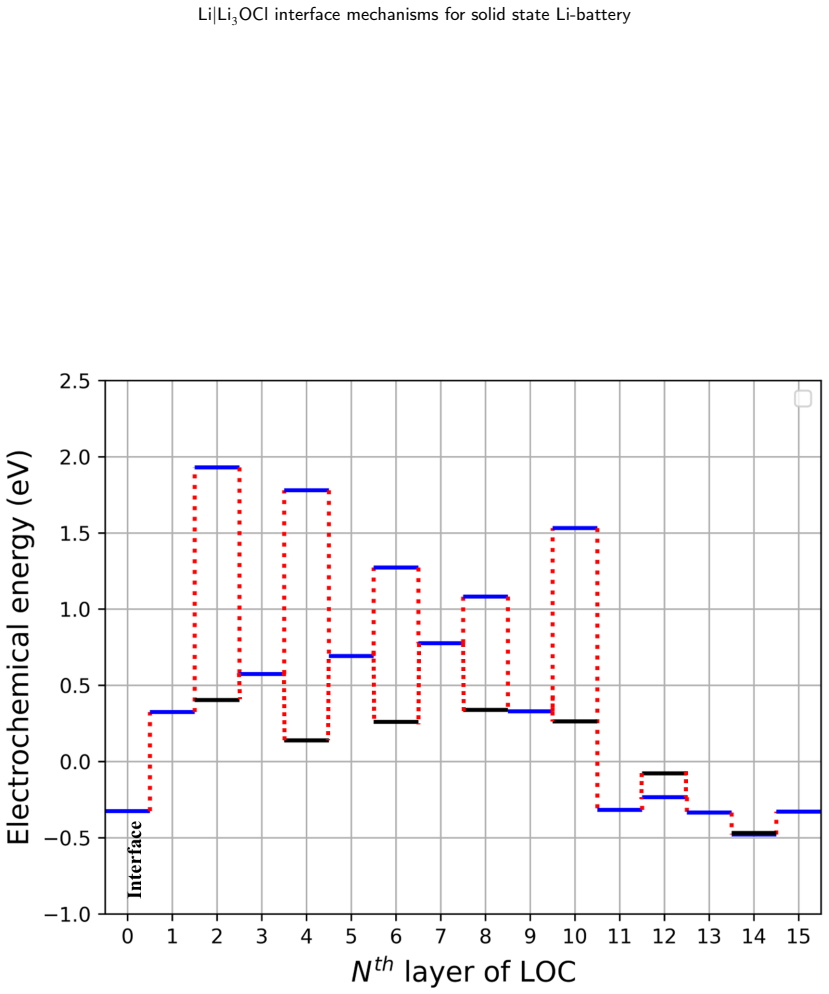
The Li|Li3OCl interface exhibits stable structural and electronic characteristics, with localized charge redistribution occurring near the interface region. The electrochemical stability against the insertion of an additional Li atom is also evaluated, showing that Li incorporation is energetically unfavorable in most layers of the electrolyte. These results suggest that the Li3OCl electrolyte maintains good electrochemical stability in contact with Li metal.
What carries the argument
Quantum mechanical simulations of multiple possible alignments between the lithium metal surface and the Li3OCl crystal, together with direct calculation of the energy required to place an extra lithium atom in each successive layer of the electrolyte.
If this is right
- Only certain alignments of the lithium metal and Li3OCl surfaces are energetically preferred.
- Electronic changes remain limited to the immediate contact zone.
- Placing an extra lithium atom inside the electrolyte raises the total energy in most layers.
- The electrolyte therefore shows resistance to the kinds of changes that would degrade battery performance.
Where Pith is reading between the lines
- If the calculated stability persists during repeated charging and discharging, the material could be used without extra protective layers at the anode.
- The same approach could be applied to rank other candidate solid electrolytes by their resistance to lithium insertion.
- Mechanical mismatch or defects at the real interface might still create pathways for lithium that the ideal models miss.
- These energy costs could be checked by comparing predicted and observed decomposition voltages in thin-film test cells.
Load-bearing premise
The chosen models of the interface and the standard setup of the calculations are assumed to capture the real behavior at the lithium-electrolyte boundary without major errors from the approximations used.
What would settle it
Direct measurement of the voltage or energy change when lithium is forced across the Li|Li3OCl contact in an operating cell; if the measured value is negative or near zero while the calculations predict positive energy, the stability claim would be contradicted.
Figures



read the original abstract
Solid-state lithium batteries have attracted considerable attention due to their potential to provide improved safety and higher energy density compared with conventional liquid electrolyte batteries. However, the stability of the interface between Li metal anodes and solid electrolytes remains a critical issue that strongly influences battery performance. In this work, first-principles density functional theory calculations are performed to investigate the interfacial properties of a solid-state battery system composed of Li metal anode and Li3OCl solid electrolyte. The structural stability, electronic structure, and electrochemical behavior of the Li|Li3OCl interface are systematically analyzed. Several interface orientations are constructed and compared in order to identify the most energetically favorable configuration. The electronic properties and interfacial charge redistribution are further examined to understand the nature of the interaction between Li metal and the Li3OCl electrolyte. Our results indicate that the Li|Li3OCl interface exhibits stable structural and electronic characteristics, with localized charge redistribution occurring near the interface region. The electrochemical stability against the insertion of an additional Li atom is also evaluated, showing that Li incorporation is energetically unfavorable in most layers of the electrolyte. These results suggest that the Li3OCl electrolyte maintains good electrochemical stability in contact with Li metal. The present study provides atomic-scale insight into the interfacial behavior of Li|Li3OCl and highlights the potential of Li3OCl as a promising solid electrolyte for solid-state lithium batteries.
Editorial analysis
A structured set of objections, weighed in public.
Referee Report
Summary. The manuscript reports first-principles DFT calculations on the Li|Li3OCl interface for solid-state lithium batteries. Several interface orientations are constructed and screened for energetic favorability; structural stability, electronic structure, and interfacial charge redistribution are analyzed; and Li insertion energies are evaluated layer-by-layer within the electrolyte. The central claims are that the interface exhibits stable structural and electronic characteristics with localized charge redistribution and that additional Li incorporation is energetically unfavorable in most layers, implying good electrochemical stability of Li3OCl against Li metal.
Significance. If the DFT parameters are properly documented and converged, the work supplies atomic-scale data on interface energetics and charge transfer that are directly relevant to solid-state battery design. The layer-resolved insertion-energy analysis is a concrete, falsifiable output that can be compared with future experiments or higher-level calculations.
minor comments (2)
- [Abstract] The abstract states conclusions from DFT but omits the exchange-correlation functional, plane-wave cutoff, k-point mesh, supercell dimensions, and any convergence or error estimates. These details are required to judge whether the reported energy differences and stability conclusions are robust against common DFT limitations such as self-interaction error or finite-size effects.
- [Interface models] The description of interface construction (orientations screened, termination choices, and relaxation protocol) should be expanded with explicit criteria for selecting the lowest-energy configuration and with quantitative measures of lattice mismatch or strain.
Simulated Author's Rebuttal
We thank the referee for the detailed summary of our DFT study on the Li|Li3OCl interface and for the positive assessment of its significance for solid-state battery design. We are pleased with the recommendation for minor revision. No specific major comments were provided in the report.
Circularity Check
No circularity: standard DFT interface modeling
full rationale
The paper performs conventional first-principles DFT calculations to screen interface orientations by energy, map charge redistribution, and compute layer-resolved Li insertion energies. These are direct outputs of the simulations with no fitted parameters renamed as predictions, no self-definitional loops in any equations, and no load-bearing self-citations or imported uniqueness theorems. The modest claims of structural stability and unfavorable insertion follow immediately from the computed quantities without reduction to the inputs by construction.
Axiom & Free-Parameter Ledger
axioms (1)
- domain assumption Standard DFT approximations (unspecified functional and settings) are sufficient to describe Li|Li3OCl interfacial stability and Li insertion energetics.
Reference graph
Works this paper leans on
-
[1]
Progress and prospective of solid-state lithium batteries.Acta Materialia, 61(3):759–770, 2013
Kazunori Takada. Progress and prospective of solid-state lithium batteries.Acta Materialia, 61(3):759–770, 2013
work page 2013
-
[2]
Yan Wang, William Davidson Richards, Shyue Ping Ong, Lincoln J Miara, Jae Chul Kim, Yifei Mo, and Gerbrand Ceder. Design princi- ples for solid-state lithium superionic conductors.Nature materials, 14(10):1026–1031, 2015
work page 2015
-
[3]
Arumugam Manthiram, Xingwen Yu, and Shaofei Wang. Lithium battery chemistries enabled by solid-state electrolytes.Nature Re- views Materials, 2(4):1–16, 2017
work page 2017
-
[4]
Motohiro Nagao, Akitoshi Hayashi, Masahiro Tatsumisago, Tsukasa Kanetsuku,TetsuyaTsuda,andSusumuKuwabata. Insitusemstudy of a lithium deposition and dissolution mechanism in a bulk-type solid-state cell with a li 2 s–p 2 s 5 solid electrolyte.Physical Chemistry Chemical Physics, 15(42):18600–18606, 2013
work page 2013
-
[5]
Gayatri Sahu, Zhan Lin, Juchuan Li, Zengcai Liu, Nancy Dudney, and Chengdu Liang. Air-stable, high-conduction solid electrolytes of arsenic-substituted li 4 sns 4.Energy & Environmental Science, 7(3):1053–1058, 2014
work page 2014
-
[6]
Solid-state lithium battery with graphite anode.Solid State Ionics, 158(3-4):269–274, 2003
Kazunori Takada, Taro Inada, Akihisa Kajiyama, Hideki Sasaki, Shigeo Kondo, Mamoru Watanabe, Masahiro Murayama, and Ryoji Kanno. Solid-state lithium battery with graphite anode.Solid State Ionics, 158(3-4):269–274, 2003
work page 2003
-
[7]
Compatibility oflithiumionconductivesulfideglasswithcarbon-lithiumelectrode
Kazunori Takada, Satoshi Nakano, Taro Inada, Akihisa Kajiyama, HidekiSasaki,ShigeoKondo,andMamoruWatanabe. Compatibility oflithiumionconductivesulfideglasswithcarbon-lithiumelectrode. Journal of The Electrochemical Society, 150(3):A274, 2003
work page 2003
-
[8]
Polymer electrolytes ii: physical principles
Peter George Bruce and Fiona Mary Gray. Polymer electrolytes ii: physical principles. InSolid state electrochemistry, pages 119–162. Cambridge University Press, 1997
work page 1997
-
[9]
MenghaoYang,YunshengLiu,AdelaideMNolan,andYifeiMo. In- terfacialatomisticmechanismsoflithiummetalstrippingandplating in solid-state batteries.Advanced Materials, 33(11):2008081, 2021
work page 2021
-
[10]
Z Liu, Y Qi, YX Lin, L Chen, P Lu, and LQ Chen. Interfacial study on solid electrolyte interphase at li metal anode: implication for li dendrite growth.Journal of The Electrochemical Society, 163(3):A592, 2016
work page 2016
-
[11]
Saskia Stegmaier, Johannes Voss, Karsten Reuter, and Alan C Luntz. Li+ defects in a solid-state li ion battery: theoretical insights with a li3ocl electrolyte.Chemistry of Materials, 29(10):4330–4340, 2017
work page 2017
-
[12]
Projector augmented-wave method.Physical review B, 50(24):17953, 1994
Peter E Blöchl. Projector augmented-wave method.Physical review B, 50(24):17953, 1994
work page 1994
-
[13]
Georg Kresse and Daniel Joubert. From ultrasoft pseudopoten- tials to the projector augmented-wave method.Physical review b, 59(3):1758, 1999
work page 1999
-
[14]
JürgenHafner.Ab-initiosimulationsofmaterialsusingvasp:Density- functional theory and beyond.Journal of computational chemistry, 29(13):2044–2078, 2008
work page 2044
-
[15]
General- ized gradient approximation made simple.Physical review letters, 77(18):3865, 1996
John P Perdew, Kieron Burke, and Matthias Ernzerhof. General- ized gradient approximation made simple.Physical review letters, 77(18):3865, 1996
work page 1996
-
[16]
John P Perdew, John A Chevary, Sy H Vosko, Koblar A Jack- son, Mark R Pederson, Dig J Singh, and Carlos Fiolhais. Atoms, molecules, solids, and surfaces: Applications of the generalized gra- dientapproximationforexchangeandcorrelation.Physical review B, 46(11):6671, 1992
work page 1992
-
[17]
MH Braga, Jorge Amaral Ferreira, V Stockhausen, JE Oliveira, and A El-Azab. Novel li 3 clo based glasses with superionic properties for lithium batteries.Journal of Materials Chemistry A, 2(15):5470– 5480, 2014
work page 2014
-
[18]
Yusheng Zhao and Luke L Daemen. Superionic conductivity in lithium-rich anti-perovskites.Journal of the American Chemical Society, 134(36):15042–15047, 2012. First Author et al.:Preprint submitted to ElsevierPage 6 of 7 Li|Li3OCl interface mechanisms for solid state Li-battery
work page 2012
-
[19]
Young Won Choi, C Moyses Araujo, and Raquel Lizarraga. Amorphisation-inducedelectrochemicalstabilityofsolid-electrolytes in li-metal batteries: The case of li3clo.Journal of Power Sources, 521:230916, 2022
work page 2022
-
[20]
Shunnian Wu, Zhili Dong, Ping Wu, and Freddy Boey. Effect of transition metal (m= co, ni, cu) substitution on electronic structure and vacancy formation of li 3 n.Journal of Materials Chemistry, 21(1):165–170, 2011
work page 2011
-
[21]
A fast and robust algorithm for bader decomposition of charge density
Graeme Henkelman, Andri Arnaldsson, and Hannes Jónsson. A fast and robust algorithm for bader decomposition of charge density. Computational Materials Science, 36(3):354–360, 2006
work page 2006
-
[22]
Musheng Wu, Bo Xu, Wenwei Luo, Baozhen Sun, Jing Shi, and Chuying Ouyang. First-principles study on the structural, electronic, andli-ionmobilitypropertiesofanti-perovskitesuperionicconductor li3ocl (1 0 0) surface.Applied Surface Science, 510:145394, 2020
work page 2020
-
[23]
MS Wu, B Xu, WW Luo, BZ Sun, and CY Ouyang. Interfacial properties and li-ion dynamics between li3ocl solid electrolyte and limetalanodeforallsolidstatelimetalbatteriesfromfirstprinciples study.Electrochimica acta, 334:135622, 2020
work page 2020
-
[24]
Predicting wettability and the electrochemicalwindowoflithium-metal/solidelectrolyteinterfaces
Kwangnam Kim and Donald J Siegel. Predicting wettability and the electrochemicalwindowoflithium-metal/solidelectrolyteinterfaces. ACS applied materials & interfaces, 11(43):39940–39950, 2019
work page 2019
-
[25]
Alexandra Emly, Emmanouil Kioupakis, and Anton Van der Ven. Phasestabilityandtransportmechanismsinantiperovskiteli3ocland li3obr superionic conductors.Chemistry of Materials, 25(23):4663– 4670, 2013
work page 2013
-
[26]
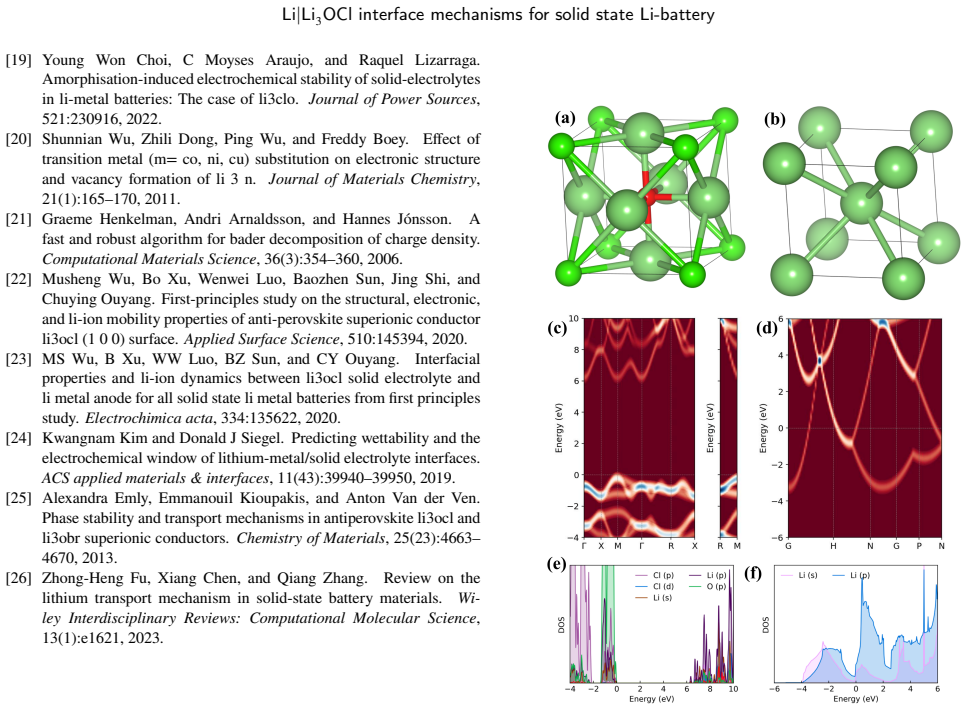
Zhong-Heng Fu, Xiang Chen, and Qiang Zhang. Review on the lithium transport mechanism in solid-state battery materials.Wi- ley Interdisciplinary Reviews: Computational Molecular Science, 13(1):e1621, 2023. Figure 1:Fully optimized atomic structure of (a) anti- perovskite material Li3OCl and (b) BCC Li system. The light green, dark green and red spheres ar...
work page 2023
discussion (0)
Sign in with ORCID, Apple, or X to comment. Anyone can read and Pith papers without signing in.