Recognition: unknown
Uncertainty-quantified Pulse Signal Recovery from Facial Video using Regularized Stochastic Interpolants
Pith reviewed 2026-05-10 15:04 UTC · model grok-4.3
The pith
A new stochastic method recovers blood volume pulse from facial video while sampling uncertainty estimates at test time.
A machine-rendered reading of the paper's core claim, the machinery that carries it, and where it could break.
Core claim
Modeling iPPG recovery as an inverse problem, we build probability paths that evolve the camera pixel distribution to the ground-truth signal distribution by predicting the instantaneous flow and score vectors of a time-dependent stochastic process; and at test-time, we sample the posterior distribution of the correct BVP waveform given the camera pixel intensity measurements by solving a stochastic differential equation. Given that physiological changes are slowly varying, we show that iPPG recovery can be improved through regularization that maximizes the correlation between the residual flow vector predictions of two adjacent time windows.
What carries the argument
Regularized Interpolants with Stochasticity for iPPG (RIS-iPPG), which defines probability paths via flow and score vector predictions and adds adjacent-window correlation regularization before sampling the posterior with a stochastic differential equation.
If this is right
- Test-time sampling produces a distribution of possible BVP waveforms rather than a single point estimate.
- Uncertainty estimates accompany each reconstruction and can indicate reliability for downstream clinical decisions.
- The correlation regularization improves signal fidelity on standard benchmark datasets.
- The approach directly targets the absence of uncertainty quantification in existing iPPG algorithms.
Where Pith is reading between the lines
- Uncertainty values could be used to automatically discard or flag low-confidence segments in continuous monitoring applications.
- The same stochastic path construction might transfer to other video-based biomedical inverse problems such as respiration or blood pressure estimation.
- The added sampling step increases computation at inference but opens the door to ensemble-style robustness checks without retraining.
Load-bearing premise
Physiological changes vary slowly enough that residual flow vector predictions from adjacent time windows are strongly correlated.
What would settle it
Run the method on video datasets recorded during rapid physiological shifts such as intense exercise or sudden stress; if the regularization term no longer improves reconstruction accuracy or the reported uncertainties fail to track actual waveform errors, the central claim is falsified.
Figures




read the original abstract
Imaging Photoplethysmography (iPPG), an optical procedure which recovers a human's blood volume pulse (BVP) waveform using pixel readout from a camera, is an exciting research field with many researchers performing clinical studies of iPPG algorithms. While current algorithms to solve the iPPG task have shown outstanding performance on benchmark datasets, no state-of-the art algorithms, to the best of our knowledge, performs test-time sampling of solution space, precluding an uncertainty analysis that is critical for clinical applications. We address this deficiency though a new paradigm named Regularized Interpolants with Stochasticity for iPPG (RIS-iPPG). Modeling iPPG recovery as an inverse problem, we build probability paths that evolve the camera pixel distribution to the ground-truth signal distribution by predicting the instantaneous flow and score vectors of a time-dependent stochastic process; and at test-time, we sample the posterior distribution of the correct BVP waveform given the camera pixel intensity measurements by solving a stochastic differential equation. Given that physiological changes are slowly varying, we show that iPPG recovery can be improved through regularization that maximizes the correlation between the residual flow vector predictions of two adjacent time windows. Experimental results on three datasets show that RIS-iPPG provides superior reconstruction quality and uncertainty estimates of the reconstruction, a critical tool for the widespread adoption of iPPG algorithms in clinical and consumer settings.
Editorial analysis
A structured set of objections, weighed in public.
Referee Report
Summary. The manuscript introduces RIS-iPPG for recovering blood volume pulse (BVP) waveforms from facial video. It models the task as an inverse problem by constructing probability paths from pixel-intensity distributions to ground-truth BVP distributions via learned instantaneous flow and score vectors of a time-dependent stochastic process; at test time the posterior is sampled by solving the corresponding SDE. A regularization term is added that maximizes the correlation between residual flow-vector predictions on adjacent time windows, justified by the assumption that physiological changes vary slowly. Experiments on three datasets are reported to show improved reconstruction quality together with uncertainty estimates that the authors argue are superior to prior iPPG methods.
Significance. If the experimental claims are substantiated, the work would be significant because it supplies the first explicit posterior-sampling mechanism for iPPG, enabling uncertainty quantification that is currently absent from state-of-the-art algorithms. The physiologically motivated correlation regularization and the use of stochastic interpolants for test-time sampling constitute a technically coherent extension of recent generative modeling ideas to a medical imaging inverse problem. Such uncertainty estimates, if properly calibrated, would directly address a barrier to clinical and consumer adoption of iPPG.
major comments (2)
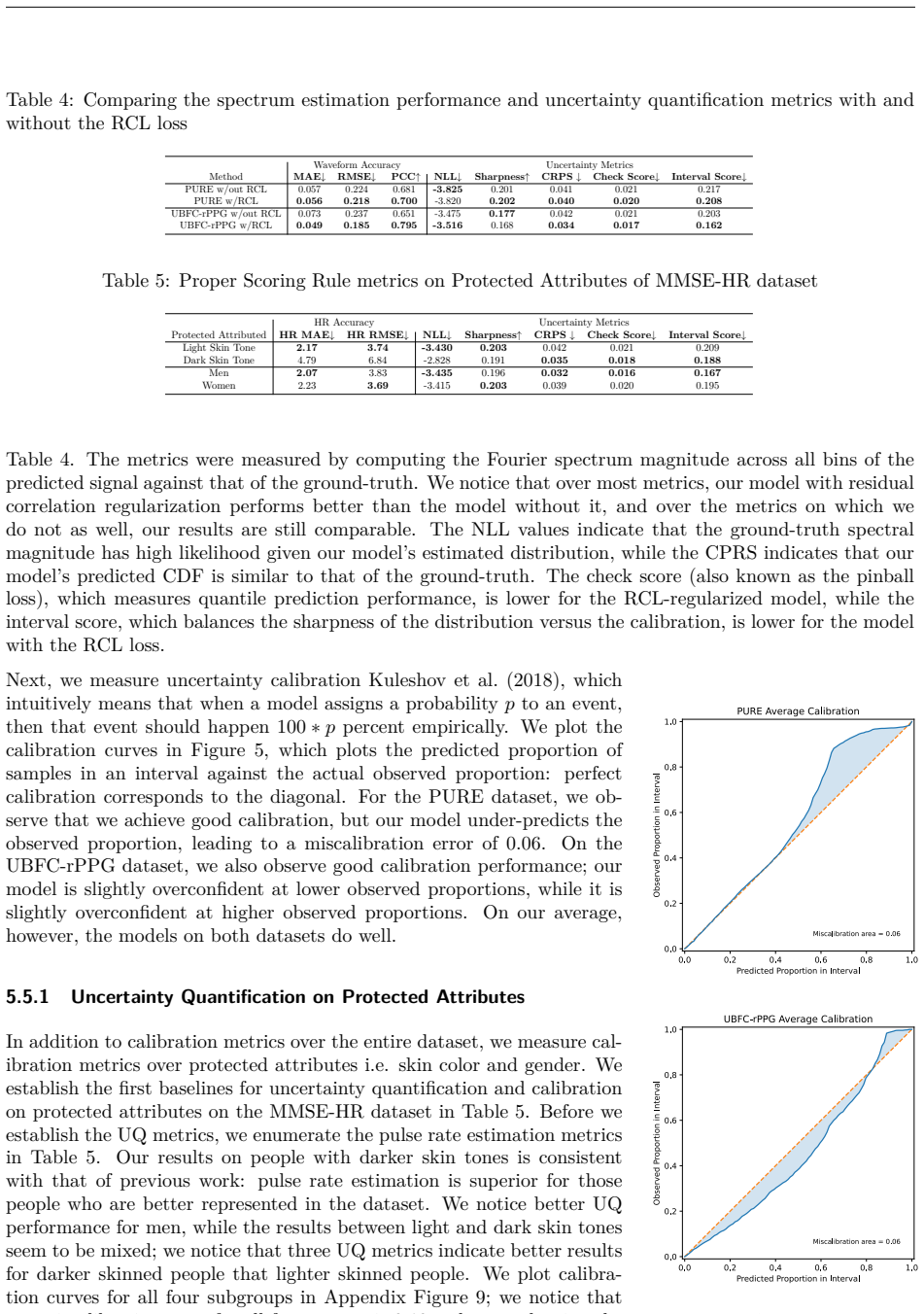
- [§4] §4 (Experimental Results): The claim that RIS-iPPG supplies “superior … uncertainty estimates” is load-bearing for the central contribution, yet the manuscript provides no calibration diagnostics (coverage rates, interval sharpness, or proper scoring rules) for the sampled posteriors. The SDE sampling plus correlation regularization does not by construction enforce calibration; without such verification the reported uncertainty intervals could be mis-calibrated even while reconstruction MSE improves.
- [§3.2] §3.2 (Regularization): The regularization that maximizes correlation of residual flow-vector predictions across adjacent windows rests on an external physiological assumption rather than emerging from the data or the stochastic-interpolant construction. No ablation that removes this term is reported, so it is impossible to determine how much of the claimed reconstruction and uncertainty gains are attributable to the regularization versus the base stochastic-interpolant sampler.
minor comments (2)
- [Abstract] The abstract states superiority on “three datasets” without naming them or reporting any numerical metrics, error bars, or baseline identifiers; this makes the strength of the experimental claims difficult to gauge from the front matter alone.
- [§3] Notation for the residual flow vector and the correlation-based regularizer is introduced without an explicit equation reference in the main text; a numbered equation would improve traceability when the regularization is later invoked in the sampling procedure.
Simulated Author's Rebuttal
We thank the referee for the constructive feedback and for recognizing the potential impact of our work on uncertainty quantification in iPPG. We address each major comment below and outline the revisions we will make to the manuscript.
read point-by-point responses
-
Referee: [§4] The claim that RIS-iPPG supplies “superior … uncertainty estimates” is load-bearing for the central contribution, yet the manuscript provides no calibration diagnostics (coverage rates, interval sharpness, or proper scoring rules) for the sampled posteriors. The SDE sampling plus correlation regularization does not by construction enforce calibration; without such verification the reported uncertainty intervals could be mis-calibrated even while reconstruction MSE improves.
Authors: We acknowledge that the original manuscript did not include explicit calibration diagnostics for the uncertainty estimates. While the regularized stochastic interpolant framework is designed to approximate the posterior distribution of BVP waveforms, we agree that empirical validation of calibration is essential to support the claims of superior uncertainty quantification. In the revised manuscript, we will add calibration analysis, including coverage probability plots, sharpness metrics, and proper scoring rules such as the Continuous Ranked Probability Score (CRPS) evaluated on the test sets. These additions will allow direct comparison with prior iPPG methods and substantiate the uncertainty claims. revision: yes
-
Referee: [§3.2] The regularization that maximizes correlation of residual flow-vector predictions across adjacent windows rests on an external physiological assumption rather than emerging from the data or the stochastic-interpolant construction. No ablation that removes this term is reported, so it is impossible to determine how much of the claimed reconstruction and uncertainty gains are attributable to the regularization versus the base stochastic-interpolant sampler.
Authors: The correlation-based regularization is motivated by the physiological property that BVP signals change slowly over adjacent time windows. However, to quantify its specific contribution, we will include a detailed ablation study in the revised version. This study will compare the full RIS-iPPG model against a variant without the regularization term, reporting effects on reconstruction metrics (MAE, RMSE, Pearson correlation) and uncertainty quality across the three datasets. This will clarify the role of the regularization in the observed improvements. revision: yes
Circularity Check
No significant circularity; derivation applies standard stochastic interpolants with external regularization assumption
full rationale
The paper models iPPG recovery via probability paths using flow/score prediction in a time-dependent stochastic process, followed by SDE-based posterior sampling at test time. The added regularization maximizes correlation of residual flow vectors across adjacent windows under the stated slow-variation physiological assumption. This chain does not reduce any claimed prediction or result to its inputs by construction, nor does it rely on self-citations for load-bearing uniqueness or ansatz smuggling. Uncertainty estimates arise directly from the sampling procedure rather than being fitted or renamed. Experimental claims of superiority are separate from the derivation and do not exhibit self-definitional or fitted-input patterns.
Axiom & Free-Parameter Ledger
axioms (1)
- domain assumption Physiological changes are slowly varying
Reference graph
Works this paper leans on
-
[1]
Daniele Silvestro and Tobias Andermann
URLhttps://journals.lww.com/plasreconsurg/fulltext/9900/_perfusion_assessment_of_ healthy_and_injured_hands.2657.aspx. Daniele Silvestro and Tobias Andermann. Prior choice affects ability of bayesian neural networks to identify unknowns.arXiv preprint arXiv:2005.04987, 2020. Kihyuk Sohn, Honglak Lee, and Xinchen Yan. Learning structured output representat...
-
[2]
URLhttps://api.semanticscholar.org/CorpusID:8529212. Shengyang Sun, Guodong Zhang, Chaoqi Wang, Wenyuan Zeng, Jiaman Li, and Roger Grosse. Differentiable compositional kernel learning for gaussian processes. InInternational Conference on Machine Learning, pp. 4828–4837. PMLR, 2018. Yu Sun, Zihui Wu, Yifan Chen, Berthy T Feng, and Katherine L Bouman. Prova...
discussion (0)
Sign in with ORCID, Apple, or X to comment. Anyone can read and Pith papers without signing in.