Compiler Framework for Directional Transport in Zoned Neutral Atom Systems with AOD Assistance: A Hybrid Remote CZ Approach
Pith reviewed 2026-05-10 16:22 UTC · model grok-4.3
The pith
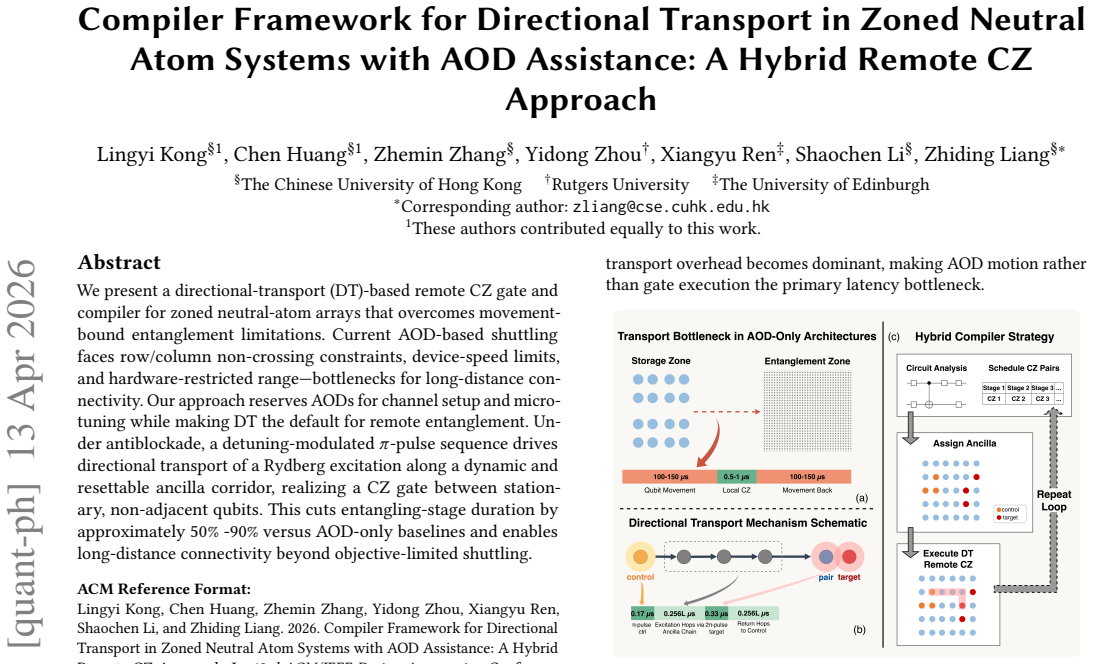
Detuning-modulated pi-pulses transport Rydberg excitations directionally along ancilla corridors to enable remote CZ gates between stationary non-adjacent qubits.
A machine-rendered reading of the paper's core claim, the machinery that carries it, and where it could break.
Core claim
Under antiblockade, a detuning-modulated pi-pulse sequence drives directional transport of a Rydberg excitation along a dynamic and resettable ancilla corridor, realizing a CZ gate between stationary, non-adjacent qubits. This hybrid method uses AOD assistance for channel setup while relying on directional transport for the entanglement step.
What carries the argument
The detuning-modulated pi-pulse sequence under antiblockade conditions, which drives directional transport of Rydberg excitation along a resettable ancilla corridor to realize a remote CZ gate.
If this is right
- Cuts entangling-stage duration by 50 to 90 percent versus AOD-only baselines.
- Enables long-distance connectivity beyond objective-limited shuttling.
- Overcomes row/column non-crossing constraints and device-speed limits of AOD shuttling.
- Makes DT the default for remote entanglement with AODs reserved for setup and micro-tuning.
Where Pith is reading between the lines
- This method might integrate with zoned architectures to support larger-scale quantum algorithms requiring distant qubit interactions.
- It could reduce the need for physical qubit movement, lowering decoherence risks in quantum computations.
- Future work might explore combining this with error mitigation techniques for higher fidelity gates.
Load-bearing premise
The detuning-modulated pi-pulse sequence reliably drives directional transport of the Rydberg excitation along the ancilla corridor under antiblockade without significant decoherence, loss, or errors preventing the CZ gate operation.
What would settle it
Observation of no directional transport or failure to achieve high-fidelity CZ gate when applying the detuning-modulated pi-pulse sequence under antiblockade conditions in an experimental setup.
Figures


read the original abstract
We present a directional-transport (DT)-based remote CZ gate and compiler for zoned neutral-atom arrays that overcomes movement-bound entanglement limitations. Current AOD-based shuttling faces row/column non-crossing constraints, device-speed limits, and hardware-restricted range - bottlenecks for long-distance connectivity. Our approach reserves AODs for channel setup and micro-tuning while making DT the default for remote entanglement. Under antiblockade, a detuning-modulated pi-pulse sequence drives directional transport of a Rydberg excitation along a dynamic and resettable ancilla corridor, realizing a CZ gate between stationary, non-adjacent qubits. This cuts entangling-stage duration by approximately 50 to 90 percent versus AOD-only baselines and enables long-distance connectivity beyond objective-limited shuttling.
Editorial analysis
A structured set of objections, weighed in public.
Referee Report
Summary. The manuscript presents a compiler framework for directional transport (DT) in zoned neutral-atom arrays with AOD assistance. It proposes a hybrid remote CZ gate in which AODs handle channel setup and micro-tuning while a detuning-modulated pi-pulse sequence under antiblockade conditions drives directional Rydberg-excitation transport along a dynamic, resettable ancilla corridor, thereby realizing CZ gates between stationary, non-adjacent qubits and reducing entangling-stage duration by 50–90 % relative to AOD-only baselines.
Significance. If the directional-transport mechanism functions as described, the hybrid DT–AOD approach would directly mitigate row/column non-crossing constraints, device-speed limits, and objective-limited shuttling range that currently constrain long-distance connectivity in neutral-atom processors. The framework could therefore enable more scalable zoned architectures with substantially lower latency for remote entanglement.
major comments (1)
- The central claim that the detuning-modulated pi-pulse sequence realizes a high-fidelity remote CZ without significant loss or decoherence is load-bearing for the entire proposal. The manuscript supplies the pulse sequence and antiblockade conditions but does not present an error model, master-equation simulation, or fidelity estimate under realistic Rydberg lifetimes and laser noise; this omission prevents quantitative assessment of whether the 50–90 % time reduction remains achievable once decoherence is included.
minor comments (2)
- Notation for the ancilla corridor and the detuning modulation parameter should be defined once in the main text and used consistently; several symbols appear only in figures without explicit definition.
- The abstract states the time-reduction range without referencing the specific baseline AOD shuttling times or the DT pulse durations used to obtain the 50–90 % figure; a short table or paragraph in the introduction would improve clarity.
Simulated Author's Rebuttal
We thank the referee for the detailed and constructive review. The comment highlights an important aspect of our proposal that requires strengthening. We address it point-by-point below and will revise the manuscript accordingly.
read point-by-point responses
-
Referee: The central claim that the detuning-modulated pi-pulse sequence realizes a high-fidelity remote CZ without significant loss or decoherence is load-bearing for the entire proposal. The manuscript supplies the pulse sequence and antiblockade conditions but does not present an error model, master-equation simulation, or fidelity estimate under realistic Rydberg lifetimes and laser noise; this omission prevents quantitative assessment of whether the 50–90 % time reduction remains achievable once decoherence is included.
Authors: We agree that the absence of a quantitative error analysis limits the ability to fully evaluate the practical impact of the 50–90% entangling-stage reduction. The manuscript derives the detuning-modulated π-pulse sequence analytically from the antiblockade Hamiltonian to enforce directional transport along the ancilla corridor, and the time savings are computed relative to AOD shuttling durations under the assumption that the resulting remote CZ maintains usable fidelity. To address the referee’s concern, the revised manuscript will add an error model section that includes master-equation simulations incorporating realistic Rydberg lifetimes (∼100 μs) and typical laser intensity/phase noise. These simulations will report gate fidelities for representative distances and thereby quantify whether the hybrid DT–AOD protocol retains a net advantage once decoherence is included. revision: yes
Circularity Check
No significant circularity detected
full rationale
The paper proposes a directional-transport (DT) mechanism for remote CZ gates via a detuning-modulated pi-pulse sequence under antiblockade conditions in zoned neutral-atom arrays. No equations, Hamiltonian derivations, fitted parameters, or self-citations appear in the abstract or summary text. The central claim is presented as a novel technique that reserves AODs for setup while using DT for entanglement, with stated time reductions versus baselines. Without any load-bearing derivations, uniqueness theorems, or renamings of known results visible, the proposal remains self-contained as an engineering framework rather than a circular reduction to its inputs.
Axiom & Free-Parameter Ledger
Reference graph
Works this paper leans on
-
[1]
Jonathan M Baker, Andrew Litteken, Casey Duckering, Henry Hoffmann, Hannes Bernien, and Frederic T Chong. 2021. Exploiting long-distance interactions and tolerating atom loss in neutral atom quantum architectures. In2021 ACM/IEEE 48th Annual International Symposium on Computer Architecture (ISCA). IEEE, 818–831
work page 2021
-
[2]
J. Beugnon, C. Tuchendler, H. Marion, A. Gaetan, Y. Miroshnychenko, Y. R. P. Sortais, A. M. Lance, M. P. A. Jones, G. Messin, A. Browaeys, and P. Grangier
-
[3]
Two-dimensional transport and transfer of individual atomic qubits in optical tweezers, In Quantum-Atom Optics Downunder.Quantum-Atom Optics Downunder, QMA2. doi:10.1364/QAO.2007.QMA2
-
[4]
Dolev Bluvstein, Simon J. Evered, Alexandra A. Geim, Sophie H. Li, Hengyun Zhou, Tom Manovitz, Sepehr Ebadi, Madelyn Cain, Marcin Kalinowski, Dominik Hangleiter, J. Pablo Bonilla Ataides, Nishad Maskara, Iris Cong, Xun Gao, Pe- dro Sales Rodriguez, Thomas Karolyshyn, Giulia Semeghini, Michael J. Gullans, Markus Greiner, Vladan Vuletić, and Mikhail D. Luki...
work page 2024
- [5]
- [6]
-
[7]
S. Ebadi, A. Keesling, M. Cain, T. T. Wang, H. Levine, D. Bluvstein, G. Semegh- ini, A. Omran, J.-G. Liu, R. Samajdar, X.-Z. Luo, B. Nash, X. Gao, B. Barak, E. Farhi, S. Sachdev, N. Gemelke, L. Zhou, S. Choi, H. Pichler, S.-T. Wang, M. Greiner, V. Vuletić, and M. D. Lukin. 2022. Quantum optimization of maximum independent set using Rydberg atom arrays.Sci...
work page 2022
-
[8]
arXiv:https://www.science.org/doi/pdf/10.1126/science.abo6587 doi:10. 1126/science.abo6587
-
[9]
{Simon J.} Evered, Dolev Bluvstein, Marcin Kalinowski, Sepehr Ebadi, Tom Manovitz, Hengyun Zhou, {Sophie H.} Li, {Alexandra A.} Geim, {Tout T.} Wang, Nishad Maskara, Harry Levine, Giulia Semeghini, Markus Greiner, Vladan Vuletić, and {Mikhail D.} Lukin. 2023. High-fidelity parallel entangling gates on a neutral-atom quantum computer.Nature622, 7982 (12 Oc...
-
[10]
TM Graham, Y Song, J Scott, C Poole, L Phuttitarn, K Jooya, P Eichler, X Jiang, A Marra, B Grinkemeyer, et al. 2022. Multi-qubit entanglement and algorithms on a neutral-atom quantum computer.Nature604, 7906 (2022), 457–462
work page 2022
- [11]
-
[12]
L Isenhower, E Urban, XL Zhang, AT Gill, T Henage, Todd A Johnson, TG Walker, and M Saffman. 2010. Demonstration of a neutral atom controlled-NOT quantum gate.Physical review letters104, 1 (2010), 010503
work page 2010
-
[13]
Enhyeok Jang, Youngmin Kim, Hyungseok Kim, Seungwoo Choi, Yipeng Huang, and Won Woo Ro. 2025. Qubit Movement-Optimized Program Generation on Zoned Neutral Atom Processors. InProceedings of the 23rd ACM/IEEE International Symposium on Code Generation and Optimization(Las Vegas, NV, USA)(CGO ’25). Association for Computing Machinery, New York, NY, USA, 459–...
-
[14]
Yongshang Li, Yu Zhang, Mingyu Chen, Xiangyang Li, and Peng Xu. 2023. Timing- Aware Qubit Mapping and Gate Scheduling Adapted to Neutral Atom Quantum Computing.IEEE Transactions on Computer-Aided Design of Integrated Circuits and Systems42, 11 (2023), 3768–3780. doi:10.1109/TCAD.2023.3261244
-
[15]
Wan-Hsuan Lin, Daniel Bochen Tan, and Jason Cong. 2025. Reuse-aware com- pilation for zoned quantum architectures based on neutral atoms. In2025 IEEE International Symposium on High Performance Computer Architecture (HPCA). IEEE, 127–142
work page 2025
-
[16]
Hannah J Manetsch, Gyohei Nomura, Elie Bataille, Xudong Lv, Kon H Leung, and Manuel Endres. 2025. A tweezer array with 6100 highly coherent atomic qubits.Nature(2025), 1–3
work page 2025
-
[17]
M. A. Norcia, H. Kim, W. B. Cairncross, M. Stone, A. Ryou, M. Jaffe, M. O. Brown, K. Barnes, P. Battaglino, T. C. Bohdanowicz, A. Brown, K. Cassella, C.-A. Chen, R. Coxe, D. Crow, J. Epstein, C. Griger, E. Halperin, F. Hummel, A. M. W. Jones, J. M. Kindem, J. King, K. Kotru, J. Lauigan, M. Li, M. Lu, E. Megidish, J. Marjanovic, M. McDonald, T. Mittiga, J....
-
[18]
Natalia Nottingham, Michael A Perlin, Ryan White, Hannes Bernien, Frederic T Chong, and Jonathan M Baker. 2023. Decomposing and routing quantum circuits under constraints for neutral atom architectures.arXiv e-prints(2023), arXiv– 2307
work page 2023
-
[19]
Tirthak Patel, Daniel Silver, and Devesh Tiwari. 2022. Geyser: a compilation framework for quantum computing with neutral atoms. InProceedings of the 49th Annual International Symposium on Computer Architecture(New York, New York) (ISCA ’22). Association for Computing Machinery, New York, NY, USA, 383–395. doi:10.1145/3470496.3527428
-
[20]
Lars Pause, Lukas Sturm, Marcel Mittenbühler, Stephan Amann, Tilman Preuschoff, Dominik Schäffner, Malte Schlosser, and Gerhard Birkl. 2024. Su- percharged two-dimensional tweezer array with more than 1000 atomic qubits. Optica11, 2 (Feb 2024), 222–226. doi:10.1364/OPTICA.513551
-
[21]
Jixuan Ruan, Xiang Fang, Hezi Zhang, Ang Li, Travis Humble, and Yufei Ding
-
[22]
PowerMove: Optimizing Compilation for Neutral Atom Quantum Com- puters with Zoned Architecture. InProceedings of the 30th ACM International Conference on Architectural Support for Programming Languages and Operating Systems, Volume 3(Rotterdam, Netherlands)(ASPLOS ’25). Association for Com- puting Machinery, New York, NY, USA, 163–178. doi:10.1145/3676642.3736128
-
[23]
Ludwig Schmid, David F Locher, Manuel Rispler, Sebastian Blatt, Johannes Zeiher, Markus Müller, and Robert Wille. 2024. Computational capabilities and compiler development for neutral atom quantum processors—connecting tool developers and hardware experts.Quantum Science and Technology9, 3 (April 2024), 033001. doi:10.1088/2058-9565/ad33ac
-
[24]
Ludwig Schmid, Sunghye Park, and Robert Wille. 2024. Hybrid circuit map- ping: Leveraging the full spectrum of computational capabilities of neutral atom quantum computers. InProceedings of the 61st ACM/IEEE Design Automation Conference. 1–6
work page 2024
-
[25]
Yannick Stade, Ludwig Schmid, Lukas Burgholzer, and Robert Wille. 2024. An abstract model and efficient routing for logical entangling gates on zoned neutral atom architectures. In2024 IEEE International Conference on Quantum Computing and Engineering (QCE), Vol. 1. IEEE, 784–795
work page 2024
-
[26]
Bochen Tan, Dolev Bluvstein, Mikhail D. Lukin, and Jason Cong. 2022. Qubit Mapping for Reconfigurable Atom Arrays. InProceedings of the 41st IEEE/ACM International Conference on Computer-Aided Design(San Diego, California)(IC- CAD ’22). Association for Computing Machinery, New York, NY, USA, Article 107, 9 pages. doi:10.1145/3508352.3549331
-
[27]
Daniel Bochen Tan, Dolev Bluvstein, Mikhail D Lukin, and Jason Cong. 2024. Compiling quantum circuits for dynamically field-programmable neutral atoms array processors.Quantum8 (2024), 1281
work page 2024
-
[28]
Daniel Bochen Tan, Wan-Hsuan Lin, and Jason Cong. 2025. Compilation for dynamically field-programmable qubit arrays with efficient and provably near- optimal scheduling. InProceedings of the 30th Asia and South Pacific Design Automation Conference. 921–929
work page 2025
-
[29]
E. Urban, T. A. Johnson, T. Henage, L. Isenhower, D. D. Yavuz, T. G. Walker, and M. Saffman. 2009. Observation of Rydberg blockade between two-atoms.Nature Physics5, 2 (Jan. 2009), 110–114. doi:10.1038/nphys1178
-
[30]
Riccardo J Valencia-Tortora, Nicola Pancotti, Michael Fleischhauer, Hannes Bernien, and Jamir Marino. 2024. Rydberg platform for nonergodic chiral quan- tum dynamics.Physical Review Letters132, 22 (2024), 223201
work page 2024
-
[31]
Llmcompass: Enabling efficient hardware design for large language model inference,
Hanrui Wang, Pengyu Liu, Daniel Bochen Tan, Yilian Liu, Jiaqi Gu, David Z. Pan, Jason Cong, Umut A. Acar, and Song Han. 2025. Atomique: A Quantum Com- piler for Reconfigurable Neutral Atom Arrays. InProceedings of the 51st Annual International Symposium on Computer Architecture(Buenos Aires, Argentina) (ISCA ’24). IEEE Press, 293–309. doi:10.1109/ISCA5907...
-
[32]
Hanrui Wang, Daniel Bochen Tan, Pengyu Liu, Yilian Liu, Jiaqi Gu, Jason Cong, and Song Han. 2024. Q-pilot: Field programmable qubit array compilation with flying ancillas. InProceedings of the 61st ACM/IEEE Design Automation Conference. 1–6
work page 2024
-
[33]
Silverstone, Qihuang Gong, Antonio Acín, Karsten Rottwitt, Leif K
Jianwei Wang, Stefano Paesani, Yunhong Ding, Raffaele Santagati, Paul Skrzypczyk, Alexia Salavrakos, Jordi Tura, Remigiusz Augusiak, Laura Mančin- ska, Davide Bacco, Damien Bonneau, Joshua W. Silverstone, Qihuang Gong, Antonio Acín, Karsten Rottwitt, Leif K. Oxenløwe, Jeremy L. O’Brien, An- thony Laing, and Mark G. Thompson. 2018. Multidimensional quantum...
work page 2018
-
[34]
arXiv:https://www.science.org/doi/pdf/10.1126/science.aar7053 doi:10.1126/ science.aar7053
-
[35]
Yupeng Wang, Junjie Wang, Aishik Panja, Xinghan Wang, and Qi-Yu Liang. 2025. Directional transport in Rydberg atom arrays via kinetic constraints and temporal modulation.Physical Review Research7, 2 (2025), L022035
work page 2025
discussion (0)
Sign in with ORCID, Apple, or X to comment. Anyone can read and Pith papers without signing in.