Structural Consequences of Policy-Based Interventions on the Global Supply Chain Network
Pith reviewed 2026-05-10 15:50 UTC · model grok-4.3
The pith
Friendshoring on the EV supply chain adds more cross-border links among allies instead of fewer.
A machine-rendered reading of the paper's core claim, the machinery that carries it, and where it could break.
Core claim
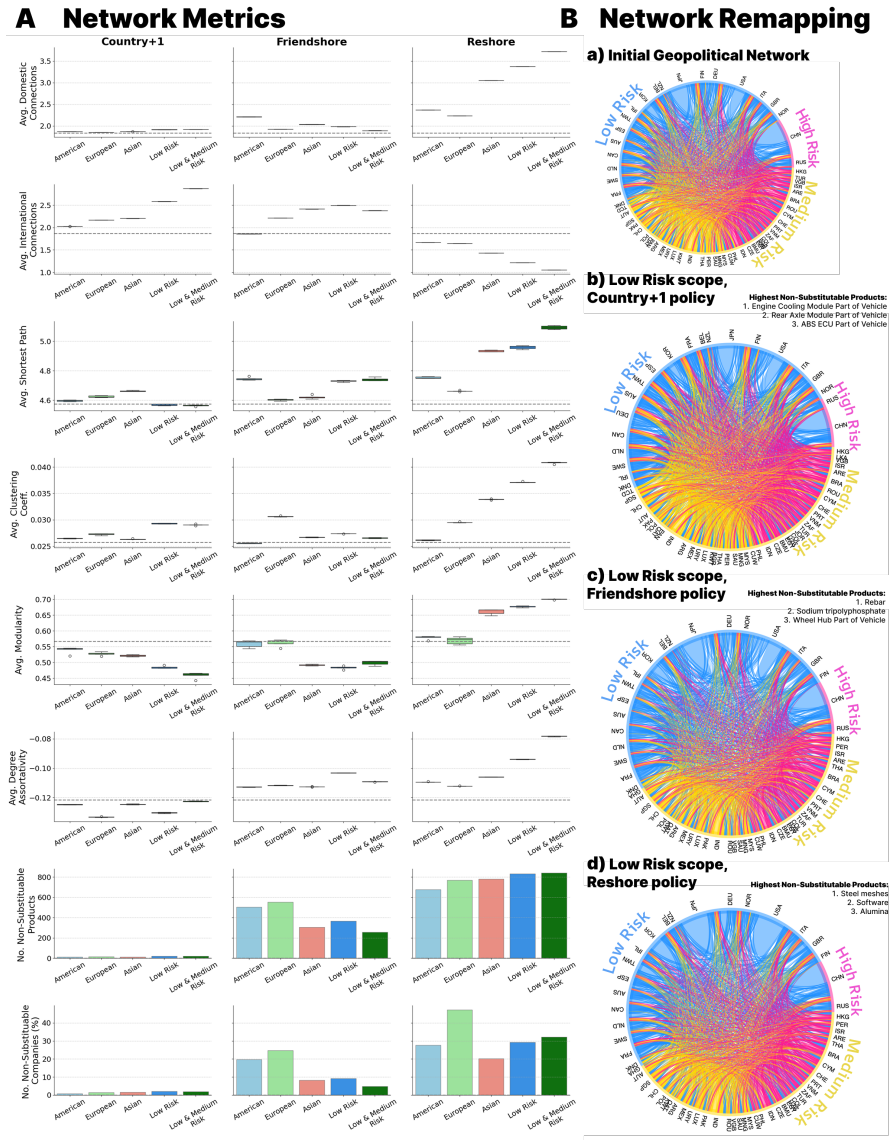
Friendshoring leads to greater globalisation by increasing the number of supply links across friendly countries, potentially raising transaction costs. The Country Plus One policy similarly enhances network density through redundant links, while the Reshoring policy creates challenges in the EV sector due to the high number of irreplaceable products. Effects differ by industry, with mining goods less affected under Country Plus One than under friendshoring.
What carries the argument
A static representation of the current global EV supply chain network built from observed trade links between countries, used to simulate structural changes under each policy.
Load-bearing premise
Current trade links can be treated as fixed and will respond to policy only by the addition or removal of the specific connections the policy targets.
What would settle it
Real-world data after a friendshoring policy is enacted that shows whether the count of supply links between allied countries rises or falls relative to the pre-policy baseline.
Figures
read the original abstract
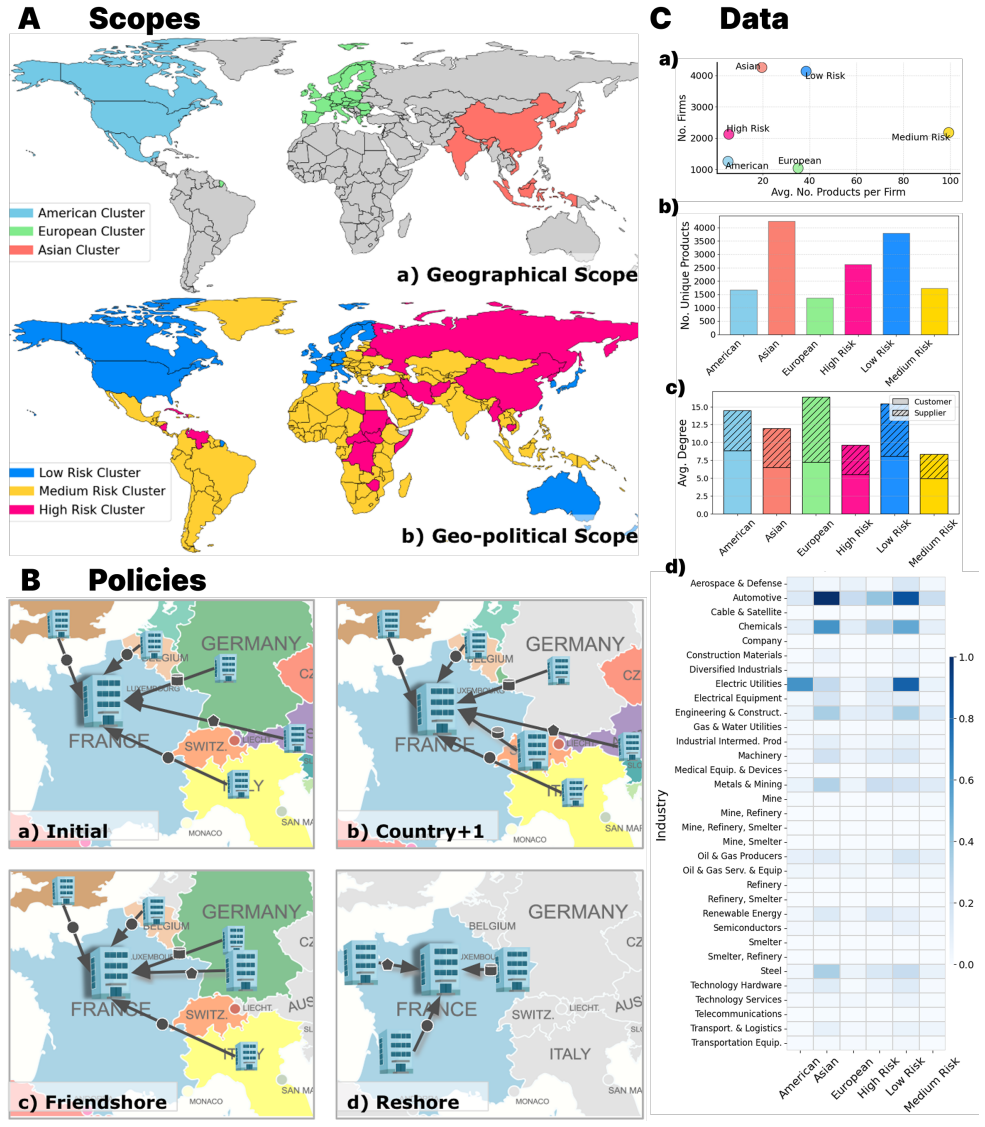
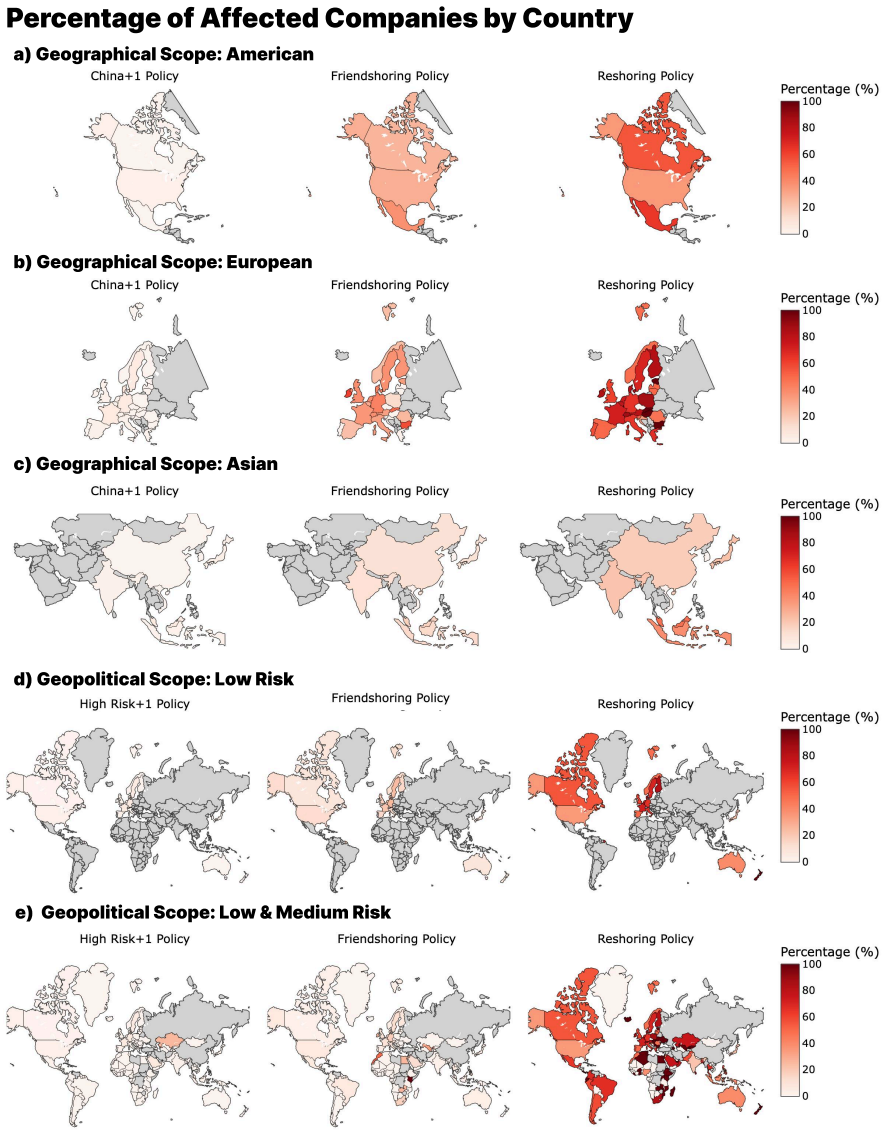
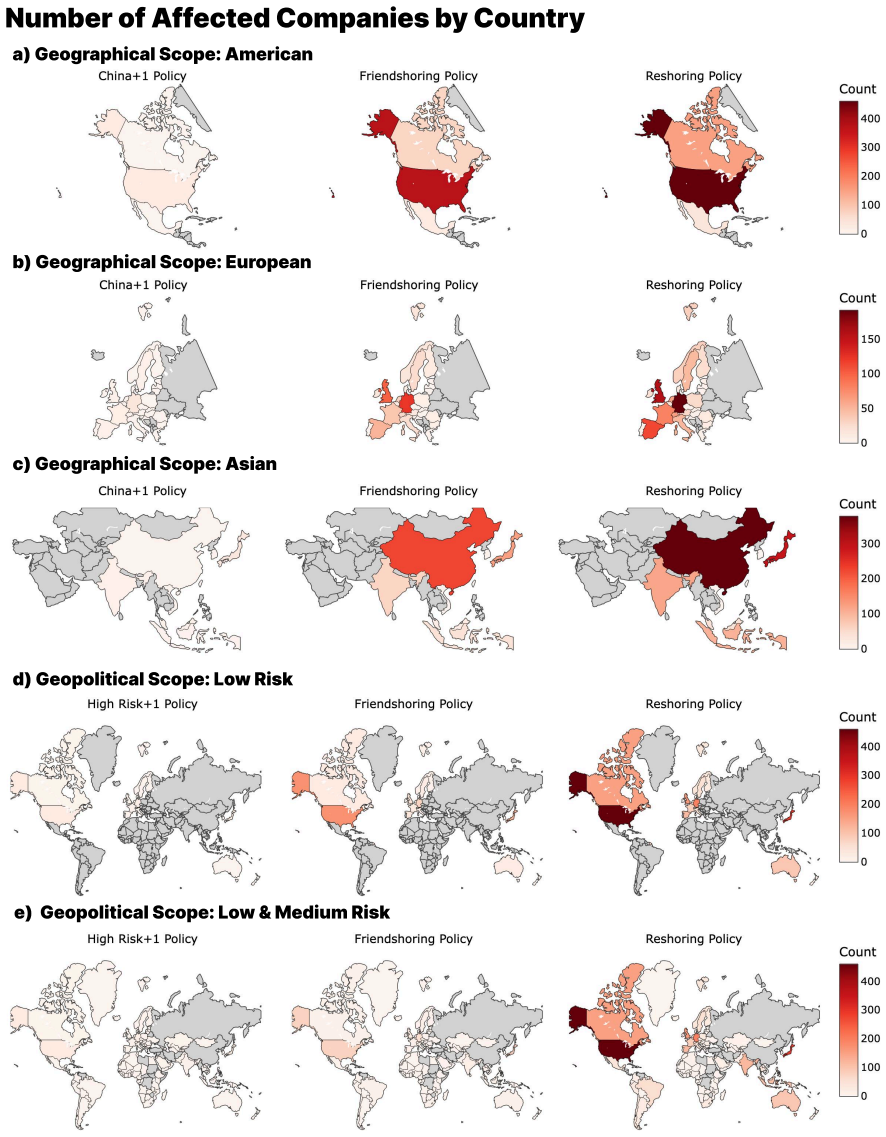
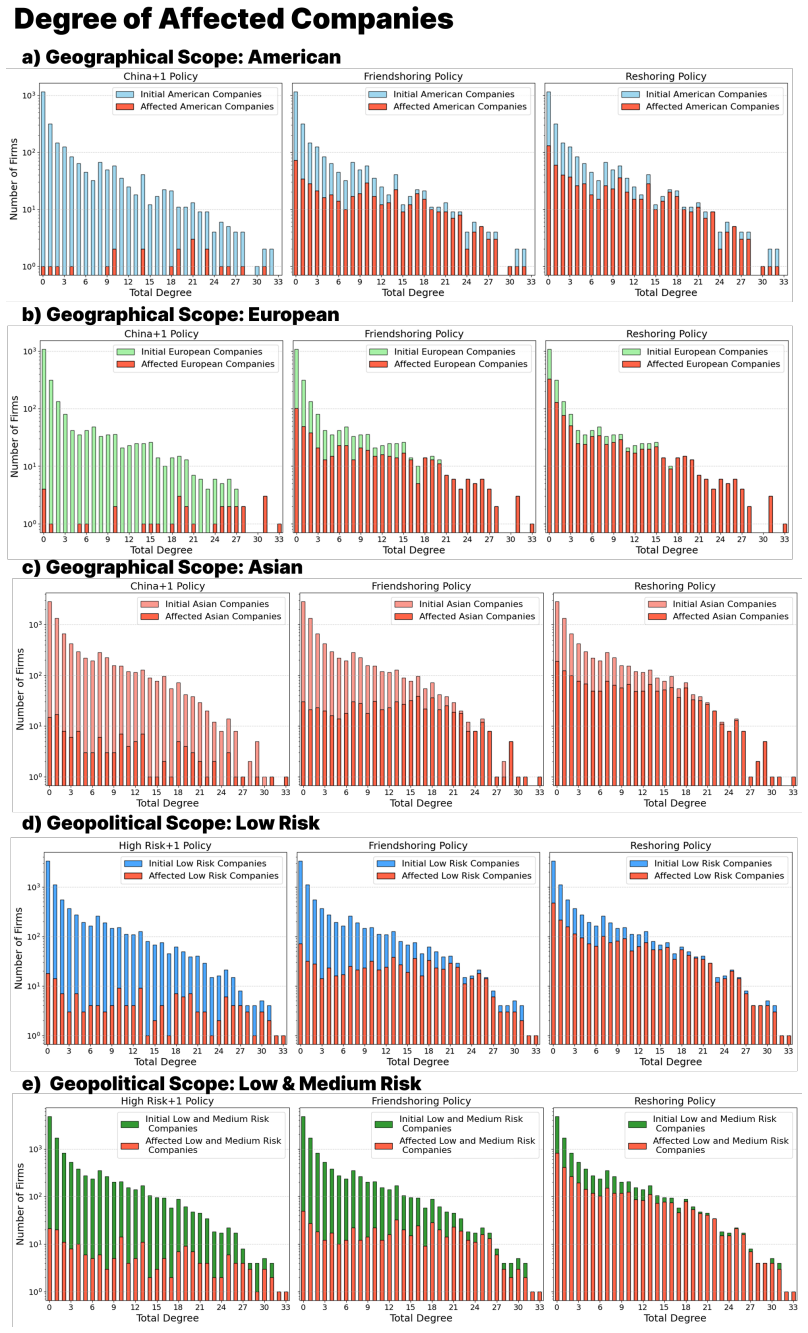
As global political tensions rise and the anticipation of additional tariffs from the United States on international trade increases, the issues of economic independence and supply chain resilience become more prominent. The importance of supply chain resilience has been further underscored by disruptions caused by the COVID-19 pandemic and the ongoing war in Ukraine. In light of these challenges, ranging from geopolitical instability to product supply uncertainties, governments are increasingly focused on adopting new trade policies. This study explores the impact of several of these policies on the global electric vehicle (EV) supply chain network, with a particular focus on their effects on country clusters and the broader structure of international trade. Specifically, we analyse three key policies: Country Plus One, Friendshoring, and Reshoring. Our findings show that Friendshoring, contrary to expectations, leads to greater globalisation by increasing the number of supply links across friendly countries, potentially raising transaction costs. The Country Plus One policy similarly enhances network density through redundant links, while the Reshoring policy creates challenges in the EV sector due to the high number of irreplaceable products. Additionally, the effects of these policies vary across industries; for instance, mining goods being less affected in Country Plus One than the Friendshoring policy.
Editorial analysis
A structured set of objections, weighed in public.
Referee Report
Summary. The manuscript analyzes the structural impacts of three policy interventions—Friendshoring, Country Plus One, and Reshoring—on the global electric vehicle (EV) supply chain network. It claims that Friendshoring unexpectedly increases the number of cross-friendly supply links, enhancing globalization; Country Plus One boosts network density via redundant links; and Reshoring creates difficulties in the EV sector due to numerous irreplaceable products. Effects vary by industry, with mining goods less affected under Country Plus One.
Significance. The topic is timely given geopolitical tensions, COVID-19 disruptions, and supply chain vulnerabilities. If the static network model were properly specified with validated trade data, quantitative metrics, and sensitivity checks, the counterintuitive finding that Friendshoring increases cross-border links could inform policy debates on de-risking strategies. However, the absence of any methodological grounding or empirical validation means the claims currently lack the foundation needed for policy relevance.
major comments (2)
- [Abstract] Abstract: The central claims (increased supply links under Friendshoring, enhanced density under Country Plus One, and EV-sector challenges under Reshoring due to irreplaceable products) are presented with no description of data sources, network construction method, link identification criteria, or any quantitative results/tables. This leaves the reported structural changes unsupported.
- [Abstract] Abstract: The analysis applies policy interventions to a fixed snapshot of current trade links under a static network model. This assumption is load-bearing for all claims, especially the Reshoring result on irreplaceable products, because it excludes endogenous firm responses such as supplier substitution, price adjustments, or product substitutions outside the modeled set.
minor comments (1)
- [Abstract] Abstract: The clause 'mining goods being less affected in Country Plus One than the Friendshoring policy' is grammatically incomplete and should be rephrased for clarity (e.g., 'mining goods are less affected under Country Plus One than under Friendshoring').
Simulated Author's Rebuttal
We thank the referee for their constructive comments on our manuscript examining the structural effects of Friendshoring, Country Plus One, and Reshoring policies on the global EV supply chain network. We address each major comment below, indicating planned revisions where appropriate to improve clarity and transparency.
read point-by-point responses
-
Referee: [Abstract] Abstract: The central claims (increased supply links under Friendshoring, enhanced density under Country Plus One, and EV-sector challenges under Reshoring due to irreplaceable products) are presented with no description of data sources, network construction method, link identification criteria, or any quantitative results/tables. This leaves the reported structural changes unsupported.
Authors: We agree that the abstract as submitted provides insufficient methodological context, which can make the central claims appear unsupported on initial reading. Although the full manuscript details the trade data sources, network construction from bilateral trade flows, link identification based on product-level supply dependencies, and quantitative metrics (including changes in link density and cluster coefficients), we will revise the abstract to concisely incorporate these elements along with references to key tables and figures reporting the structural changes. revision: yes
-
Referee: [Abstract] Abstract: The analysis applies policy interventions to a fixed snapshot of current trade links under a static network model. This assumption is load-bearing for all claims, especially the Reshoring result on irreplaceable products, because it excludes endogenous firm responses such as supplier substitution, price adjustments, or product substitutions outside the modeled set.
Authors: The static network framework is used by design to isolate the direct topological consequences of the policy interventions applied to the observed supply links, providing a clear baseline for structural metrics without introducing assumptions about firm-level adaptations. This choice supports the reported findings on irreplaceable products under Reshoring. We acknowledge that real-world responses could alter outcomes and will add an explicit limitations subsection in the revised manuscript discussing the static assumption, its rationale, and implications for policy interpretation, while noting avenues for future dynamic extensions. revision: partial
Circularity Check
No circularity: static network interventions computed directly from observed links
full rationale
The paper models three policy interventions (Friendshoring, Country Plus One, Reshoring) by adding or removing edges on a fixed snapshot of current trade links in the EV supply chain and then recomputes standard network metrics such as density, clustering, and irreplaceable-product counts. No equations, parameter fitting, or self-citations are referenced that would make any reported structural change equivalent to the input data by construction. The derivation therefore remains a direct, non-self-referential computation on the modified graph and is self-contained against external benchmarks.
Axiom & Free-Parameter Ledger
Reference graph
Works this paper leans on
-
[1]
The network origins of aggregate fluctuations.Econometrica, 80(5):1977–2016,
Daron Acemoglu, Vasco M Carvalho, Asuman Ozdaglar, and Alireza Tahbaz-Salehi. The network origins of aggregate fluctuations.Econometrica, 80(5):1977–2016,
work page 1977
-
[2]
Sara AlMahri, Liming Xu, and Alexandra Brintrup. Enhancing supply chain visibility with knowledge graphs and large language models.arXiv preprint arXiv:2408.07705,
-
[3]
Firm-level production networks: what do we (really) know.INET Oxford Working Paper, 2023,
Andrea Bacilieri, Andr´ as Borsos, Pablo Astudillo-Estevez, and Fran¸ cois Lafond. Firm-level production networks: what do we (really) know.INET Oxford Working Paper, 2023,
work page 2023
-
[4]
URLhttps://www.europarl.europa.eu/RegData/etudes/STUD/2021/653626/ EXPO_STU(2021)653626_EN.pdf. Accessed 07/04/2025. Joseph Galaskiewicz. Studying supply chains from a social network perspective.Journal of Supply Chain Management, 47(1):4–8,
work page 2021
-
[5]
URLhttps://hdl.handle.net/ 2134/24114444.v1. Accessed 07/04/2025. Manfred Hafner and Simone Tagliapietra.The Geopolitics of the Global Energy Transition. Springer Nature, Jan
work page 2025
-
[6]
URLhttps://www.bloomberg.com/news/articles/ 2025-01-08/biden-to-further-limit-nvidia-amd-ai-chip-exports-in-final-push. Ac- cessed 21/03/2025. Yuka Hayashi. Nations aim to secure supply chains by turning offshoring into friend-shoring.The Wall Street Journal,
work page 2025
-
[7]
URLhttps://www.reuters.com/markets/commodities/ china-export-controls-freeze-antimony-shipments-eu-october-2025-03-20/. Accessed 07/04/2025. 14 Simon Jasansky, Mirko Lieber, Stefan Giljum, and Victor Maus. An open database on global coal and metal mine production.Scientific Data, 10(1):52, Jan
work page 2025
-
[8]
URLhttps://www.business-standard.com/world-news/ anything-but-china-us-tech-companies-supply-chain-shift-away-trump-125021700365_ 1.html. Accessed 07/04/2025. Anton Pichler, Christian Diem, Alexandra Brintrup, Fran¸ cois Lafond, Glenn Magerman, Gert Buiten, Thomas Y Choi, Vasco M Carvalho, J Doyne Farmer, and Stefan Thurner. Building an alliance to map gl...
work page 2025
-
[9]
URLhttps://www.congress.gov/crs-product/R47982. Accessed 07/04/2025. Edwin Van Hassel, Thierry Vanelslander, Kris Neyens, Hans Vandeborre, Dominique Kindt, and Stefan Kellens. Reconsidering nearshoring to avoid global crisis impacts: Application and calculation of the total cost of ownership for specific scenarios.Research in Transportation Economics, 93:101089,
work page 2025
-
[10]
URL https://www.fticonsulting.com/~/media/Files/us-files/insights/journal-articles/ china-plus-one.pdf. Accessed 07/04/2025. Efpraxia D. Zamani, Conn Smyth, Samrat Gupta, and Denis Dennehy. Artificial intelligence and big data analytics for supply chain resilience: a systematic literature review.Annals of Operations Research, 327(2):605–632, Aug
work page 2025
discussion (0)
Sign in with ORCID, Apple, or X to comment. Anyone can read and Pith papers without signing in.