Self-Evolving LLM Memory Extraction Across Heterogeneous Tasks
Pith reviewed 2026-05-10 15:33 UTC · model grok-4.3
The pith
CluE improves LLM memory extraction prompts by clustering similar scenarios and synthesizing insights across them.
A machine-rendered reading of the paper's core claim, the machinery that carries it, and where it could break.
Core claim
No single static extraction prompt dominates across all task categories, and prior self-evolving frameworks degrade when training tasks are heterogeneous. CluE groups training examples into clusters by extraction scenario, analyzes each cluster independently, and synthesizes cross-cluster insights to update the extraction prompt, delivering improved generalization on heterogeneous test distributions.
What carries the argument
CluE, the cluster-based self-evolving strategy that isolates analysis by extraction scenario before cross-cluster synthesis of prompt updates.
If this is right
- Prompt evolution becomes more robust to task variety once examples are explicitly clustered rather than treated as a single pool.
- Utility-driven evaluation on repurposed datasets exposes limitations of static or homogeneous self-evolving methods.
- Synthesizing insights across clusters rather than averaging them yields prompts with better transfer to unseen task mixes.
- Memory systems for assistants can be improved by scenario-aware rather than monolithic extraction rules.
Where Pith is reading between the lines
- The same clustering-plus-synthesis pattern could apply to other prompt-optimization settings that encounter diverse user behaviors.
- In deployment, an agent might maintain running clusters of recent interactions and periodically refresh its extraction prompt from them.
- Benchmarks for memory extraction may need to add entirely new domains beyond the current 18 to test whether the clustering benefit holds.
- Holding out entire clusters during evaluation, instead of random splits, could give a stricter test of true generalization.
Load-bearing premise
Training examples can be reliably grouped by extraction scenario and cross-cluster synthesis produces a prompt that generalizes without overfitting to the repurposed datasets or utility metric.
What would settle it
If a fresh set of heterogeneous tasks shows CluE performing no better than a non-clustered self-evolving baseline on the utility metric, the generalization advantage would be refuted.
Figures




read the original abstract
As LLM-based assistants become persistent and personalized, they must extract and retain useful information from past conversations as memory. However, the types of information worth remembering vary considerably across tasks. We formalize the \textit{heterogeneous memory extraction} task and introduce \textbf{BEHEMOTH}, a benchmark that repurposes 18 existing datasets spanning personalization, problem-solving, and agentic tasks, using a downstream utility-driven metric for systematic evaluation. Our empirical analysis confirms that no single static extraction prompt dominates across all task categories, and that existing self-evolving prompt optimization frameworks, originally designed for homogeneous distributions, degrade when training tasks are heterogeneous. To address this, we propose \textbf{CluE}, a cluster-based self-evolving strategy that groups training examples into clusters by extraction scenarios, analyzes each cluster independently, and synthesizes cross-cluster insights to update the extraction prompt. Experiments on BEHEMOTH show that CluE generalizes effectively across heterogeneous tasks ($+$9.04\% relative gain), consistently outperforming prior self-evolving frameworks.
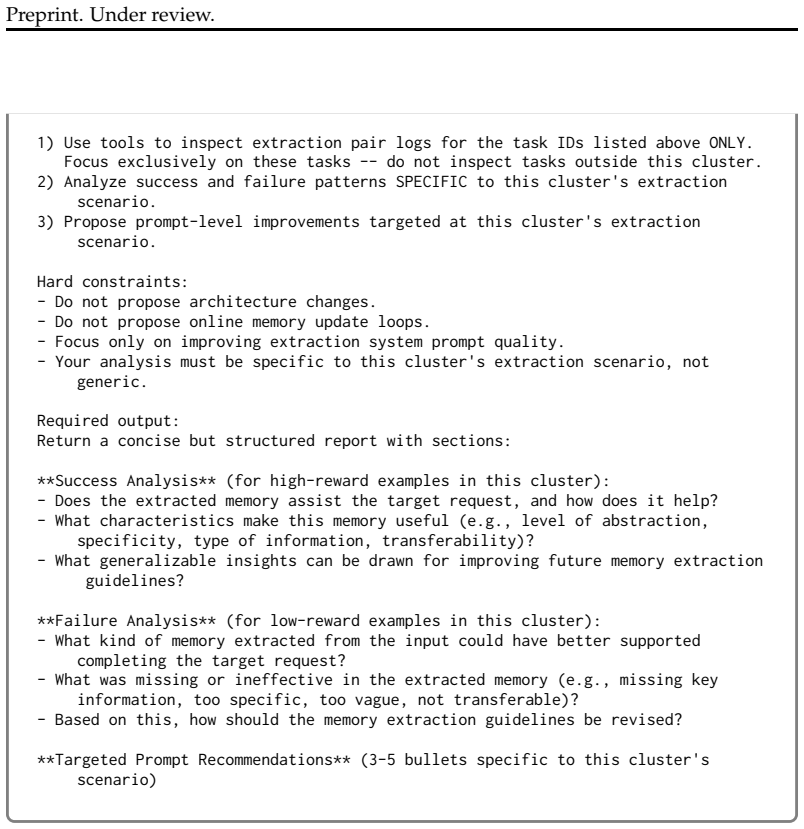
Editorial analysis
A structured set of objections, weighed in public.
Referee Report
Summary. The paper formalizes the heterogeneous memory extraction task for persistent LLM assistants, introduces the BEHEMOTH benchmark by repurposing 18 existing datasets spanning personalization, problem-solving, and agentic tasks evaluated via a downstream utility-driven metric, shows empirically that no single static extraction prompt dominates across categories and that prior self-evolving frameworks degrade under heterogeneity, and proposes CluE, a cluster-based self-evolving method that groups training examples into clusters by extraction scenarios, analyzes each independently, and synthesizes cross-cluster insights to evolve the prompt, reporting a +9.04% relative gain and consistent outperformance on BEHEMOTH.
Significance. If the central claims hold after addressing the noted gaps, the work would be significant for the development of personalized LLM systems by providing a practical strategy for evolving memory extraction prompts that generalize across heterogeneous task distributions, where existing methods fail. The BEHEMOTH benchmark and the empirical demonstration of prompt heterogeneity offer reusable resources and insights for the community, with potential to guide future research on robust self-improvement in LLM agents.
major comments (3)
- [Method] Method section (CluE description): the clustering of training examples by extraction scenarios and the subsequent cross-cluster synthesis step are load-bearing for the claim of effective generalization, yet the manuscript provides no details on the grouping algorithm, features used, or synthesis procedure; this leaves open the possibility that performance gains exploit artifacts in the repurposed BEHEMOTH datasets rather than learning transferable rules.
- [Experiments] Experiments section: the reported +9.04% relative gain and 'consistent outperformance' are presented without specification of the exact utility metric computation, statistical significance testing, number of runs, or ablations isolating benchmark construction biases, which weakens support for the generalization claim across heterogeneous tasks.
- [Benchmark] Benchmark section: while BEHEMOTH repurposes 18 datasets, the paper lacks controls or analysis demonstrating that CluE's clustering and synthesis avoid overfitting to dataset-specific patterns or metric artifacts, which is required to substantiate superiority over prior self-evolving frameworks on truly heterogeneous distributions.
minor comments (1)
- [Abstract] Abstract: the phrase 'consistent outperformance' would benefit from briefly naming the prior frameworks compared to improve immediate clarity.
Simulated Author's Rebuttal
We thank the referee for the constructive feedback and for recognizing the potential significance of our work on heterogeneous memory extraction. We address each major comment below with clarifications and commit to revisions that will strengthen the manuscript without altering its core claims.
read point-by-point responses
-
Referee: [Method] Method section (CluE description): the clustering of training examples by extraction scenarios and the subsequent cross-cluster synthesis step are load-bearing for the claim of effective generalization, yet the manuscript provides no details on the grouping algorithm, features used, or synthesis procedure; this leaves open the possibility that performance gains exploit artifacts in the repurposed BEHEMOTH datasets rather than learning transferable rules.
Authors: We agree that the current description of CluE is insufficiently detailed. In the revised manuscript we will expand the method section to specify the grouping algorithm (k-means on scenario embeddings), the features used (task category labels, memory utility annotations, and sentence-transformer embeddings of example contexts), and the synthesis procedure (per-cluster independent evolution followed by a meta-prompt that extracts and merges cross-cluster rules). We will also add pseudocode and illustrative examples to show that gains derive from transferable principles rather than dataset artifacts. revision: yes
-
Referee: [Experiments] Experiments section: the reported +9.04% relative gain and 'consistent outperformance' are presented without specification of the exact utility metric computation, statistical significance testing, number of runs, or ablations isolating benchmark construction biases, which weakens support for the generalization claim across heterogeneous tasks.
Authors: We acknowledge the need for greater experimental rigor. The revision will explicitly define the utility metric (downstream task accuracy improvement attributable to extracted memory), report results from 5 independent runs with means, standard deviations, and paired t-test p-values, and include ablations that isolate benchmark construction effects (e.g., label permutation and homogeneous-subset baselines). These additions will directly support the generalization claims. revision: yes
-
Referee: [Benchmark] Benchmark section: while BEHEMOTH repurposes 18 datasets, the paper lacks controls or analysis demonstrating that CluE's clustering and synthesis avoid overfitting to dataset-specific patterns or metric artifacts, which is required to substantiate superiority over prior self-evolving frameworks on truly heterogeneous distributions.
Authors: We will add targeted analysis to the Benchmark section showing that clusters mix examples across multiple source datasets (cluster composition tables) and that cross-cluster synthesis contributes measurably beyond single-cluster evolution. We will also report performance on held-out heterogeneous splits and compare against prior frameworks under controlled heterogeneity levels. These controls will substantiate that superiority arises from handling true heterogeneity rather than dataset-specific artifacts. revision: yes
Circularity Check
No circularity: empirical gains measured on external benchmark
full rationale
The paper introduces BEHEMOTH by repurposing 18 existing datasets and evaluates CluE via measured downstream utility on held-out tasks. The +9.04% relative gain is an observed performance difference against prior frameworks, not a quantity defined in terms of itself or obtained by fitting a parameter that is then renamed as a prediction. Clustering by extraction scenario and cross-cluster synthesis are algorithmic steps whose outputs are validated externally rather than tautologically. No self-citations, uniqueness theorems, or ansatzes are invoked as load-bearing premises. The derivation chain is therefore self-contained against independent benchmarks.
Axiom & Free-Parameter Ledger
Reference graph
Works this paper leans on
-
[2]
URLhttps://openreview.net/forum?id=Bb4VGOWELI. 12 Preprint. Under review. Jiayi Ye, Yanbo Wang, Yue Huang, Dongping Chen, Qihui Zhang, Nuno Moniz, Tian Gao, Werner Geyer, Chao Huang, Pin-Yu Chen, Nitesh V . Chawla, and Xiangliang Zhang. Justice or prejudice? quantifying biases in llm-as-a-judge. InThe Thirteenth International Conference on Learning Repres...
work page internal anchor Pith review doi:10.48550/arxiv 2025
-
[3]
URLhttps://openreview.net/forum?id=92gvk82DE-
OpenReview.net, 2023. URLhttps://openreview.net/forum?id=92gvk82DE-. Terry Yue Zhuo, Minh Chien Vu, Jenny Chim, Han Hu, Wenhao Yu, Ratnadira Widyasari, Imam Nur Bani Yusuf, Haolan Zhan, Junda He, Indraneil Paul, Simon Brunner, Chen Gong, James Hoang, Armel Randy Zebaze, Xiaoheng Hong, Wen-Ding Li, Jean Kaddour, Ming Xu, Zhihan Zhang, Prateek Yadav, and et...
work page 2023
-
[4]
User Preferences and Emotional Context (with Translation)
-
[5]
Factual Data Disambiguation and Verification
-
[6]
Procedural Knowledge in Virtual Environments
-
[7]
Technical and Scientific Problem-Solving While this evolution path is dominated by merges, new clusters can also emerge. For instance, in a separate run starting from theSurveyprompt, the system splits out aCode- based Technical Workflowscluster from the broaderTechnical Problem-Solvingcluster at Round 2, recognizing that code-related examples require ext...
-
[8]
Factual Data & Temporal Disambiguation (←cluster 2)
-
[9]
User Preferences & Emotional Context (←cluster 1)
-
[10]
Procedural & Technical Knowledge (←cluster 3)
-
[11]
Logical & Combinatorial Reasoning (←cluster 4)
-
[12]
Translation & Stylistic Requirements (←cluster 1) Notably, cluster 1, which mixes user-preference extraction with translation-style tasks, is split into two taxonomy sections (2 and 5). This decoupled design allows the taxonomy to reorganize cluster-level insights into clean, non-overlapping categories without being constrained by cluster boundaries. B.4 ...
-
[13]
Memory 2 ... Figure 5: TheSimpleprompt. Mem0prompt You are an Memory Extraction Agent, specialized in accurately storing facts, user memories, and preferences. Your primary role is to extract relevant pieces of information from conversations and organize them into distinct, 19 Preprint. Under review. manageable facts. This allows for easy retrieval and pe...
-
[14]
Store Personal Preferences: Keep track of likes, dislikes, and specific preferences in various categories such as food, products, activities, and entertainment
-
[15]
Maintain Important Personal Details: Remember significant personal information like names, relationships, and important dates
-
[16]
Track Plans and Intentions: Note upcoming events, trips, goals, and any plans the user has shared
-
[17]
Remember Activity and Service Preferences: Recall preferences for dining, travel, hobbies, and other services
-
[18]
Monitor Health and Wellness Preferences: Keep a record of dietary restrictions , fitness routines, and other wellness-related information
-
[19]
Store Professional Details: Remember job titles, work habits, career goals, and other professional information
-
[20]
facts" : []} Input: There are branches in trees. Output: {
Miscellaneous Information Management: Keep track of favorite books, movies, brands, and other miscellaneous details that the user shares. Here are some few shot examples: Input: Hi. Output: {"facts" : []} Input: There are branches in trees. Output: {"facts" : []} Input: Hi, I am looking for a restaurant in San Francisco. Output: {"facts" : ["Looking for a...
-
[21]
yesterday I attended a conference
Memory 3 Figure 7: TheReasoningBankprompt. OpenMemoryprompt # Role You are an expert **Memory Extraction Agent**. Your goal is to extract reusable, high-value memories from a single conversation, in order to benefit the assistant in future interactions where this conversation is no longer accessible. # Input Format 21 Preprint. Under review. The conversat...
-
[22]
Memory 2 ... Figure 8: TheOpenMemoryprompt. Surveyprompt # Role You are an expert **Memory Extraction Agent**. Your goal is to extract reusable, high-value memories from a single conversation, in order to benefit the assistant in future interactions where this conversation is no longer accessible. # Input Format The conversation is wrapped inside`<convers...
-
[23]
Memory 2 ... Figure 9: TheSurveyprompt. Prompt for Summarizer You are analyzing a memory extraction example to produce an extraction-targeted summary. Your summary should focus on the EXTRACTION SCENARIO -- NOT on the surface-level topic or dataset. Given the following extraction result, write a concise 2-3 sentence summary that describes:
-
[24]
What type of information needs to be extracted (e.g., factual knowledge, procedural steps, user preferences, causal reasoning, spatial/temporal relations, emotional context, etc.)
-
[25]
Procedural knowledge in lengthy dialogue
What makes this extraction challenging (e.g., long context, implicit information, multi-turn reasoning, noise/irrelevant content, ambiguous boundaries, need for abstraction vs verbatim capture, etc.) source_conversation (first 4096 chars): {source_preview} extracted_memory: {extracted_memory} target_conversation (first 4096 chars): {target_preview} target...
-
[26]
Focus exclusively on these tasks -- do not inspect tasks outside this cluster
Use tools to inspect extraction pair logs for the task IDs listed above ONLY. Focus exclusively on these tasks -- do not inspect tasks outside this cluster
-
[27]
Analyze success and failure patterns SPECIFIC to this cluster's extraction scenario
-
[28]
Hard constraints: - Do not propose architecture changes
Propose prompt-level improvements targeted at this cluster's extraction scenario. Hard constraints: - Do not propose architecture changes. - Do not propose online memory update loops. - Focus only on improving extraction system prompt quality. - Your analysis must be specific to this cluster's extraction scenario, not generic. Required output: Return a co...
-
[29]
General guidelines: Identify recommendations that appear across multiple clusters. Distill these into clear, actionable general extraction guidelines that apply regardless of memory type
-
[30]
For each category, provide a concise definition and category-specific extraction guidelines
Memory taxonomy: Group cluster-specific insights into memory categories. For each category, provide a concise definition and category-specific extraction guidelines. Categories do not need to map 1:1 to clusters -- merge or reorganize as needed to create a clean, non-overlapping taxonomy
-
[31]
Different memory types may require different extraction approaches
Conflict resolution: When cluster recommendations conflict, organize them under the appropriate memory category rather than forcing a single uniform rule. Different memory types may require different extraction approaches
-
[32]
Stability: Make targeted, high-impact changes. Do not rewrite the entire prompt if focused additions or revisions suffice. Prompt quality requirements -- the generated system prompt must be: - Written in clear, direct language that another language model can follow without ambiguity. - Structured with explicit sections and formatting so the extraction mod...
-
[33]
Figure 14: Prompt evolved by CluE fromSimple, using Qwen3-32B
Memory 2 ... Figure 14: Prompt evolved by CluE fromSimple, using Qwen3-32B. 28
discussion (0)
Sign in with ORCID, Apple, or X to comment. Anyone can read and Pith papers without signing in.