Recognition: unknown
Spectrum analysis with quantum dynamical systems. II. Finite-time analysis
Pith reviewed 2026-05-10 15:41 UTC · model grok-4.3
The pith
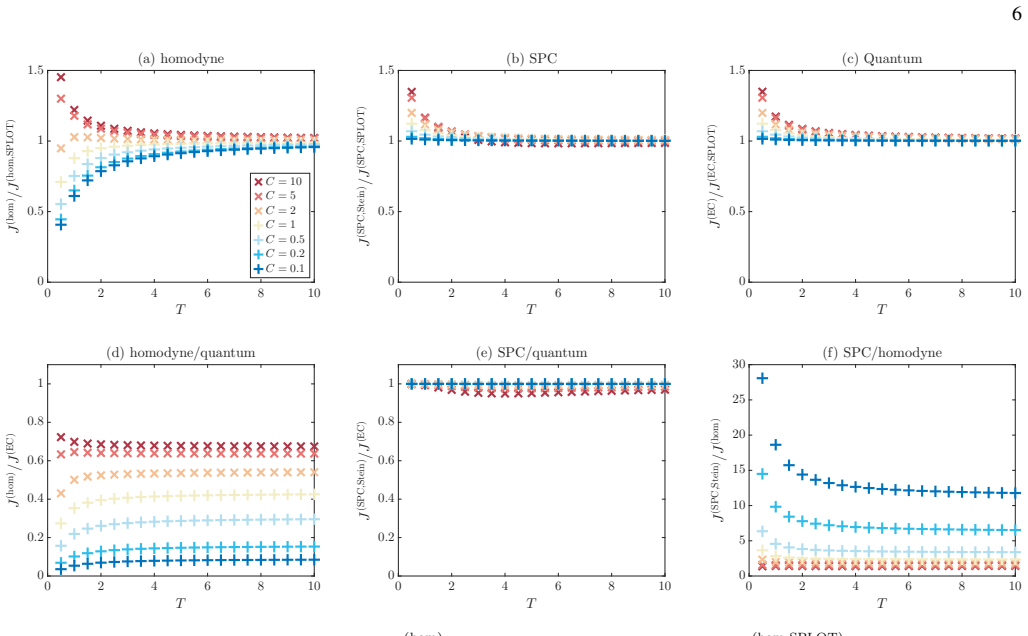
Finite-time numerical analysis shows spectral photon counting retains substantial advantage over homodyne detection for estimating signal variance.
A machine-rendered reading of the paper's core claim, the machinery that carries it, and where it could break.
Core claim
Assuming an Ornstein-Uhlenbeck signal with unknown variance, the Fisher information for homodyne detection, a lower bound for spectral photon counting, and the quantum upper bound, together with the actual root-mean-square errors of the maximum-likelihood estimator obtained via Monte Carlo sampling, all converge smoothly to their previously derived asymptotic limits as observation time increases. The relative advantage of spectral photon counting over homodyne detection therefore remains substantial even when the total measurement time is finite.
What carries the argument
Numerical evaluation of time-dependent Fisher information quantities and Monte Carlo simulation of maximum-likelihood estimation errors for a quantum dynamical system driven by an Ornstein-Uhlenbeck process.
If this is right
- Spectral photon counting remains practically useful for noise spectroscopy without requiring impractically long observation windows.
- Estimation precision improves monotonically with time and tracks the theoretical Fisher bounds at all finite durations examined.
- The performance ordering between spectral photon counting, homodyne detection, and the quantum limit is preserved away from the infinite-time regime.
- Laboratory implementations can target moderate observation times while still capturing most of the predicted gain.
Where Pith is reading between the lines
- The same finite-time numerical approach could be applied to other continuous-time signal models to test whether the advantage persists more generally.
- The smooth convergence suggests that real-time adaptive measurement strategies could be designed to optimize finite-time performance.
- Combining the lower bound with the quantum upper bound at finite times might identify the measurement that saturates the quantum limit in practice.
Load-bearing premise
The signal is an Ornstein-Uhlenbeck process whose only unknown parameter is its variance, and the numerical model of the quantum dynamics contains no additional unmodeled effects.
What would settle it
Monte Carlo runs at intermediate finite times that produce maximum-likelihood errors for spectral photon counting that fail to approach the asymptotic advantage or that violate the computed Fisher-information lower bound would falsify the claim.
Figures

read the original abstract
The prequel to this work [Ng et al., Phys. Rev. A 93, 042121 (2016)] proposes the method of spectral photon counting to enhance noise spectroscopy with an optical interferometer. While the predicted enhancement over homodyne detection is promising, the results there are derived by taking an asymptotic limit of infinite observation time; their validity for a finite time remains unclear. To validate the theory, here we perform a numerical study of a finite-time model. Assuming that the signal is an Ornstein--Uhlenbeck process with an unknown variance parameter, we evaluate the Fisher information for homodyne detection, a lower bound on the Fisher information for spectral photon counting, and a quantum upper bound, all without taking the infinite-time limit. To confirm that the Fisher-information quantities are satisfactory precision measures, we also compute the errors of the maximum-likelihood estimator by Monte-Carlo simulations. The results demonstrate that the Fisher-information quantities and the estimation errors all smoothly approach their asymptotic limits, and the advantage of spectral photon counting over homodyne detection can remain substantial for finite times.
Editorial analysis
A structured set of objections, weighed in public.
Referee Report
Summary. The manuscript presents a finite-time numerical analysis of quantum spectrum estimation for an Ornstein-Uhlenbeck process. It evaluates the Fisher information for homodyne detection, a lower bound for spectral photon counting, and a quantum upper bound without invoking the infinite-time limit. Monte-Carlo simulations of the maximum-likelihood estimator errors are used to validate the Fisher information quantities as precision measures. The results show smooth convergence to asymptotic limits and that the advantage of spectral photon counting over homodyne detection remains substantial at finite times.
Significance. This work is significant as it provides numerical evidence that the asymptotic predictions from the companion paper hold for finite observation times, which is essential for translating theoretical quantum advantages into experimental practice in optical interferometry and noise spectroscopy. The combination of information-theoretic bounds with direct Monte-Carlo validation of estimator performance is a positive aspect that increases confidence in the conclusions.
major comments (1)
- The description of the Monte-Carlo procedure for computing MLE errors (including number of trials, implementation of the estimator, and handling of the unknown variance parameter) is central to validating that Fisher information quantities are satisfactory precision measures; without these details the smooth convergence claim cannot be fully assessed for numerical accuracy.
minor comments (2)
- Figure captions and the main text should explicitly list the numerical values chosen for the Ornstein-Uhlenbeck variance, correlation time, and discrete time steps used in the simulations to enable reproducibility.
- The notation distinguishing the lower bound on the spectral-photon-counting Fisher information from the exact Fisher information (and from the quantum upper bound) should be introduced once and used consistently in all equations and figure legends.
Simulated Author's Rebuttal
We thank the referee for the positive assessment of our work and the constructive comment on the Monte-Carlo validation. We address the point below and will revise the manuscript to include the requested details.
read point-by-point responses
-
Referee: The description of the Monte-Carlo procedure for computing MLE errors (including number of trials, implementation of the estimator, and handling of the unknown variance parameter) is central to validating that Fisher information quantities are satisfactory precision measures; without these details the smooth convergence claim cannot be fully assessed for numerical accuracy.
Authors: We agree that additional details on the Monte-Carlo procedure are needed to allow full assessment of the numerical results. In the revised manuscript we will expand Section IV (or the relevant methods subsection) to specify the number of independent trials performed, the precise implementation of the maximum-likelihood estimator (including the numerical optimization routine and any regularization), and the manner in which the unknown variance parameter is treated during each realization. These additions will make the validation of the Fisher-information quantities as precision measures fully transparent. revision: yes
Circularity Check
No significant circularity
full rationale
The paper performs direct numerical evaluation of Fisher information quantities and Monte-Carlo MLE errors for finite observation times on an Ornstein-Uhlenbeck process model, without taking the infinite-time limit inside those calculations. The results are compared to asymptotic limits from prior work only as an external benchmark for validation; the finite-time quantities are computed independently via simulation and are not obtained by fitting parameters to data then renaming the fit as a prediction. No self-definitional reductions, fitted-input predictions, or load-bearing self-citations appear in the derivation chain. The approach is self-contained against the stated modeling assumptions.
Axiom & Free-Parameter Ledger
free parameters (1)
- variance parameter of Ornstein-Uhlenbeck process
Reference graph
Works this paper leans on
-
[1]
Use the change-of-variable formula to write fη(u|θ) =c M/2fY (√cu|θ,N).(A6)
-
[2]
RegardηasYwith rescaled parameters to write fη(u|θ) =f Y (u|θ/c, cN).(A7) It follows that there are also two ways of writing the maximum- likelihood estimator ˇθ(u)and the MSE givenη=u:
-
[3]
Following Eqs. (A2) and (A6), we obtain ˇθ(u)≡arg max θ fη(u|θ)(A8) = arg max θ cM/2fY (√cu|θ,N)(A9) = ˇθ(√cu,N).(A10) The error becomes MSE(θ)≡ Z ˇθ(u)−θ 2 fη(u|θ)dM u(A11) = Z ˇθ(√cu,N)−θ 2 cM/2fY (√cu|θ,N)d M u (A12) = Z ˇθ(y,N)−θ 2 fY (y|θ,N)d M y(A13) = MSE(hom)(θ,N).(A14) This equality makes sense, as we have simply multiplied the original processYb...
-
[4]
Following Eqs. (A2) and (A7), we obtain ˇθ(u)≡arg max θ fη(u|θ)(A15) = arg max θ fY (u|θ/c, cN)(A16) =carg max ϕ fY (u|ϕ, cN)(A17) =c ˇθ(u, cN).(A18) The error becomes MSE(θ)≡ Z ˇθ(u)−θ 2 fη(u|θ)dM u(A19) = Z cˇθ(u, cN)−θ 2 fY (u|θ/c, cN)d M u(A20) = Z cˇθ(u, cN)−cϕ 2 fY (u|ϕ, cN)d M u(ϕ=θ/c) (A21) =c 2 MSE(hom)(ϕ, cN)(A22) =c 2 MSE(hom)(θ/c, cN).(A23) Th...
-
[5]
Emerging technolo- gies in the field of thermometry,
S. Dedyulin, Z. Ahmed, and G. Machin, “Emerging technolo- gies in the field of thermometry,” Measurement Science and Technology33, 092001 (2022)
2022
-
[6]
Stochastic gravitational wave back- grounds,
Nelson Christensen, “Stochastic gravitational wave back- grounds,” Reports on Progress in Physics82, 016903 (2018)
2018
-
[7]
Optomechanical sensing of spontaneous wave-function collapse,
Stefan Nimmrichter, Klaus Hornberger, and Klemens Ham- merer, “Optomechanical sensing of spontaneous wave-function collapse,” Physical Review Letters113, 020405 (2014)
2014
-
[8]
Single-photon signal sideband detection for high-power Michelson interferometers,
Lee McCuller, “Single-photon signal sideband detection for high-power Michelson interferometers,” ArXiv e-prints (2022), 10.48550/arXiv.2211.04016, 2211.04016
-
[9]
Photon-counting interferometry to detect geontropic space-time fluctuations with gquest,
Sander M. Vermeulen, Torrey Cullen, Daniel Grass, Ian A. O. MacMillan, Alexander J. Ramirez, Jeffrey Wack, Boris Korzh, Vincent S. H. Lee, Kathryn M. Zurek, Chris Stoughton, and Lee McCuller, “Photon-counting interferometry to detect geontropic space-time fluctuations with gquest,” Physical Review X15, 011034 (2025)
2025
-
[10]
Spectrum analysis with quantum dynamical systems,
Shilin Ng, Shan Zheng Ang, Trevor A. Wheatley, Hidehiro Yonezawa, Akira Furusawa, Elanor H. Huntington, and Mankei Tsang, “Spectrum analysis with quantum dynamical systems,” Physical Review A93, 042121 (2016)
2016
-
[11]
Quantum metrology of noisy spreading channels,
Wojciech G ´orecki, Alberto Riccardi, and Lorenzo Maccone, “Quantum metrology of noisy spreading channels,” Physical Review Letters129, 240503 (2022)
2022
-
[12]
Ultimate precision limit of noise sensing and dark matter search,
Haowei Shi and Quntao Zhuang, “Ultimate precision limit of noise sensing and dark matter search,” npj Quantum Information 9, 27 (2023)
2023
-
[13]
Quantum noise spectroscopy as an incoherent imaging problem,
Mankei Tsang, “Quantum noise spectroscopy as an incoherent imaging problem,” Physical Review A107, 012611 (2023)
2023
-
[14]
Stochas- tic waveform estimation at the fundamental quantum limit,
James W. Gardner, Tuvia Gefen, Simon A. Haine, Joseph J. Hope, John Preskill, Yanbei Chen, and Lee McCuller, “Stochas- tic waveform estimation at the fundamental quantum limit,” PRX Quantum6, 030311 (2025)
2025
-
[15]
Shumway and David S
Robert H. Shumway and David S. Stoffer,Time Series Analy- sis and Its Applications, 4th ed. (Springer, Cham, Switzerland, 2017)
2017
-
[16]
Van Trees and Kristine L
Harry L. Van Trees and Kristine L. Bell, eds.,Bayesian Bounds for Parameter Estimation and Nonlinear Filtering/Tracking (Wiley-IEEE, Piscataway, 2007)
2007
-
[17]
Ziv-Zakai Error Bounds for Quantum Parameter Estimation,
Mankei Tsang, “Ziv-Zakai Error Bounds for Quantum Parameter Estimation,” Physical Review Letters108, 230401 (2012)
2012
-
[18]
A. W. van der Vaart,Asymptotic Statistics(Cambridge Univer- sity Press, Cambridge, UK, 1998)
1998
-
[19]
Conservative classical and quantum resolution limits for incoherent imaging,
Mankei Tsang, “Conservative classical and quantum resolution limits for incoherent imaging,” Journal of Modern Optics65, 1385–1391 (2018)
2018
-
[20]
Kay,Fundamentals of Statistical Signal Processing: Estimation Theory(Prentice Hall, Upper Saddle River, 1993)
Steven M. Kay,Fundamentals of Statistical Signal Processing: Estimation Theory(Prentice Hall, Upper Saddle River, 1993)
1993
-
[21]
Walls and Gerard J
Daniel F. Walls and Gerard J. Milburn,Quantum Optics (Springer-Verlag, Berlin, 2008)
2008
-
[22]
Van Trees,Detection, Estimation, and Modulation Theory, Part III: Radar-Sonar Signal Processing and Gaussian Signals in Noise(Wiley, New York, 2001)
Harry L. Van Trees,Detection, Estimation, and Modulation Theory, Part III: Radar-Sonar Signal Processing and Gaussian Signals in Noise(Wiley, New York, 2001)
2001
-
[23]
A Lower Bound for the Fisher Information Measure,
M. Stein, A. Mezghani, and J. A. Nossek, “A Lower Bound for the Fisher Information Measure,” IEEE Signal Processing Letters21, 796–799 (2014)
2014
-
[24]
Leonard Mandel and Emil Wolf,Optical Coherence and Quan- tum Optics(Cambridge University Press, Cambridge, 1995)
1995
-
[25]
Blitzstein and Jessica Hwang,Introduction to Proba- bility, 2nd ed
Joseph K. Blitzstein and Jessica Hwang,Introduction to Proba- bility, 2nd ed. (CRC Press, Boca Raton, 2019)
2019
-
[26]
Extended convexity of quan- tum Fisher information in quantum metrology,
S. Alipour and A. T. Rezakhani, “Extended convexity of quan- tum Fisher information in quantum metrology,” Physical Review A91, 042104 (2015)
2015
-
[27]
Horn and Charles R
Roger A. Horn and Charles R. Johnson,Topics in Matrix Anal- ysis(Cambridge University Press, Cambridge, England, UK, 1991)
1991
-
[28]
Quantum superresolution and noise spectroscopy with quantum computing,
James W. Gardner, Federico Belliardo, Gideon Lee, Tuvia Gefen, and Liang Jiang, “Quantum superresolution and noise spectroscopy with quantum computing,” ArXiv e-prints (2026), 10.48550/arXiv.2602.17862, 2602.17862
discussion (0)
Sign in with ORCID, Apple, or X to comment. Anyone can read and Pith papers without signing in.