Isolating Exciton Dissociation Pathways in ReSe₂
Pith reviewed 2026-05-10 14:56 UTC · model grok-4.3
The pith
TR-ARPES isolates exciton photoionization as the dissociation pathway in ReSe2.
A machine-rendered reading of the paper's core claim, the machinery that carries it, and where it could break.
Core claim
Using TR-ARPES to independently track exciton and band-edge carrier populations under resonant excitation, the fluence dependence and polarization-controlled exciton density dependence of the dissociation process identify exciton photoionization as the microscopic mechanism in bulk ReSe2.
What carries the argument
Time- and angle-resolved photoemission spectroscopy (TR-ARPES) combined with fluence variation and polarization control to monitor exciton versus carrier populations separately and isolate the dissociation channel.
If this is right
- Exciton-to-carrier conversion pathways in strongly excitonic van der Waals materials can be resolved by tracking separate populations rather than integrated optical signals.
- Polarization control of exciton density while holding fluence fixed provides an independent handle that distinguishes photoionization from Auger or other density-dependent processes.
- The same population-resolved strategy applies to other bulk or layered materials where excitons dominate the optical response.
- Resolving the dissociation channel clarifies how free carriers are generated from resonant excitation in these semiconductors.
Where Pith is reading between the lines
- The same TR-ARPES method could be applied to monolayer or few-layer ReSe2 to test whether reduced dimensionality alters the dominant dissociation channel.
- Device models for optoelectronics based on ReSe2 or similar compounds could now incorporate photoionization rates derived from these density-dependent measurements.
- Complementary ultrafast optical probes on the same samples might confirm the carrier generation timing observed in photoemission.
Load-bearing premise
The TR-ARPES signals supply independent, quantitative measures of exciton and band-edge carrier populations without significant cross-talk or unaccounted relaxation channels.
What would settle it
A fluence or polarization scan in which the dissociation rate follows a power law or density dependence inconsistent with photoionization, such as linear scaling with fluence rather than the expected nonlinear form, would falsify the identification.
Figures

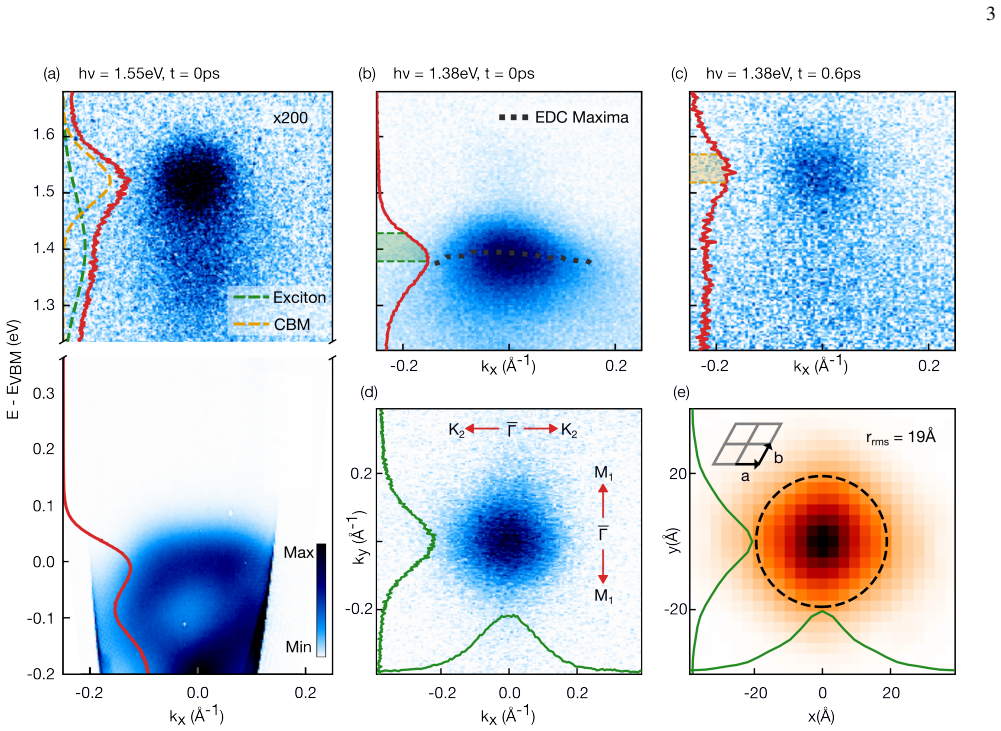

read the original abstract
Strongly bound excitons dominate the optical response in many van der Waals semiconductors, yet distinguishing between the different microscopic processes governing exciton dissociation remains challenging. Using time- and angle-resolved photoemission spectroscopy (TR-ARPES), we independently track exciton and band-edge carrier populations in bulk ReSe$_{\text{2}}$ under resonant excitation. By studying the fluence dependence and polarization-controlled exciton density dependence of the exciton dissociation process, we distinguish between competing processes and identify exciton photoionization as the microscopic dissociation mechanism. These results establish a population-resolved strategy for resolving exciton-to-carrier conversion pathways in strongly excitonic materials.
Editorial analysis
A structured set of objections, weighed in public.
Referee Report
Summary. The manuscript uses time- and angle-resolved photoemission spectroscopy (TR-ARPES) on bulk ReSe₂ to independently track exciton and band-edge carrier populations following resonant optical excitation. Through analysis of fluence dependence and polarization-controlled variations in exciton density, the authors distinguish competing dissociation processes and conclude that exciton photoionization is the dominant microscopic mechanism.
Significance. If the central claim is supported by the data, the work establishes a population-resolved experimental strategy for identifying exciton-to-carrier conversion pathways in strongly excitonic van der Waals materials. The use of polarization control to modulate exciton density independently of total fluence is a clear methodological strength that helps isolate photoionization from alternatives such as Auger or phonon-assisted processes. This contributes usefully to optoelectronics research in 2D semiconductors by providing a concrete way to resolve dissociation channels.
major comments (1)
- The attribution of dissociation to exciton photoionization rests on the TR-ARPES signals providing separable, quantitative measures of exciton and band-edge carrier populations. The manuscript should detail the explicit lineshape model, energy-momentum windowing, or fitting procedure used for decomposition in the data-analysis section and include control experiments or simulations demonstrating that spectral overlap or unmodeled relaxation channels do not produce cross-talk on the measurement timescale.
minor comments (1)
- The abstract states the main conclusion without reference to any quantitative observables (e.g., scaling exponents with fluence or time constants), which would strengthen the summary for readers.
Simulated Author's Rebuttal
We thank the referee for their positive assessment of our work and for the constructive suggestion to strengthen the data-analysis description. We address the major comment below and will revise the manuscript accordingly.
read point-by-point responses
-
Referee: The attribution of dissociation to exciton photoionization rests on the TR-ARPES signals providing separable, quantitative measures of exciton and band-edge carrier populations. The manuscript should detail the explicit lineshape model, energy-momentum windowing, or fitting procedure used for decomposition in the data-analysis section and include control experiments or simulations demonstrating that spectral overlap or unmodeled relaxation channels do not produce cross-talk on the measurement timescale.
Authors: We agree that explicit documentation of the population-extraction procedure is necessary to support our conclusions. In the revised manuscript we will add a dedicated subsection in the Methods/Data Analysis section that specifies: (i) the lineshape model (sum of Lorentzian profiles for the exciton feature and a Fermi-Dirac broadened parabolic dispersion for the band-edge carriers), (ii) the precise energy-momentum integration windows used to obtain the time-dependent populations, and (iii) the global fitting routine applied across the fluence and polarization series. We will also include supplementary simulations of the expected spectral overlap under our experimental resolution together with control traces acquired at negative pump-probe delays and off-resonant excitation; these demonstrate that any residual cross-talk remains below the noise floor on the 100-fs to few-ps timescales relevant to the dissociation dynamics. These additions will make the separability of the two populations fully transparent and reproducible. revision: yes
Circularity Check
No significant circularity in experimental population tracking and mechanism identification
full rationale
The paper is an experimental study that tracks exciton and band-edge carrier populations via TR-ARPES under resonant excitation, then uses observed fluence and polarization-dependent scaling to assign the dissociation mechanism to exciton photoionization. No equations, fitted parameters, or derivations appear in the abstract or description that reduce any prediction to its own inputs by construction. The central claim rests on independent experimental observables (population signals and their density dependencies) rather than self-referential fitting or self-citation chains. The assumption that spectral features are separable is a standard experimental modeling choice subject to external validation or falsification, not a closed loop internal to the paper's logic.
Axiom & Free-Parameter Ledger
Reference graph
Works this paper leans on
-
[1]
A. Chernikov, T. C. Berkelbach, H. M. Hill, A. Rigosi, Y. Li, B. Aslan, D. R. Reichman, M. S. Hybertsen, and T. F. Heinz, Exciton Binding Energy and Nonhydrogenic Rydberg Series in Monolayer WS2, Physical Review Letters113, 076802 (2014)
work page 2014
-
[2]
P. P. Satheesh, H.-S. Jang, B. Pandit, S. Chandramohan, and K. Heo, 2D Rhenium Dichalcogenides: From Fundamental Properties to Recent Advances in Photodetector Technology, Advanced Functional Materials33, 2212167 (2023)
work page 2023
-
[3]
T. Mueller and E. Malic, Exciton physics and device application of two-dimensional transition metal dichalcogenide semicon- ductors, npj 2D Materials and Applications2, 29 (2018)
work page 2018
- [4]
-
[5]
R. Perea-Caus´ın, S. Brem, and E. Malic, Phonon-assisted exciton dissociation in transition metal dichalcogenides, Nanoscale13, 1884 (2021)
work page 2021
-
[6]
H. Wang, J. H. Strait, C. Zhang, W. Chan, C. Manolatou, S. Ti- wari, and F. Rana, Fast exciton annihilation by capture of elec- trons or holes by defects via Auger scattering in monolayer metal dichalcogenides, Physical Review B91, 165411 (2015)
work page 2015
-
[7]
L. Wang, S. Zhang, J. Huang, Y. Mao, N. Dong, X. Zhang, I. M. Kislyakov, H. Wang, Z. Wang, C. Chen, L. Zhang, and J. Wang, Auger-type process in ultrathin ReS2, Optical Materials Express 10, 1092 (2020)
work page 2020
-
[8]
S. Kar, Y. Su, R. R. Nair, and A. K. Sood, Probing Photoexcited Carriers in a Few-Layer MoS2 Laminate by Time-Resolved Op- tical Pump–Terahertz Probe Spectroscopy, ACS Nano9, 12004 (2015)
work page 2015
- [9]
-
[10]
J. Allerbeck, T. Deckert, L. Spitzner, and D. Brida, Probing free-carrier and exciton dynamics in a bulk semiconductor with two-dimensional electronic spectroscopy, Physical Review B 104, L201202 (2021)
work page 2021
-
[11]
D. Sun, Y. Rao, G. A. Reider, G. Chen, Y. You, L. Br´ezin, A. R. Harutyunyan, and T. F. Heinz, Observation of Rapid Exciton– Exciton Annihilation in Monolayer Molybdenum Disulfide, Nano Letters14, 5625 (2014)
work page 2014
-
[12]
L. Yuan and L. Huang, Exciton dynamics and annihilation in WS2 2D semiconductors, Nanoscale7, 7402 (2015)
work page 2015
- [13]
- [14]
-
[15]
X. Meng, Y. Zhou, K. Chen, R. H. Roberts, W. Wu, J.-F. Lin, R. T. Chen, X. Xu, and Y. Wang, Anisotropic Saturable and Excited-State Absorption in Bulk ReS2, Advanced Optical Ma- terials6, 1800137 (2018)
work page 2018
-
[16]
K.-Q. Lin, C. S. Ong, S. Bange, P. E. Faria Junior, B. Peng, J. D. Ziegler, J. Zipfel, C. B ¨auml, N. Paradiso, K. Watanabe, T. Taniguchi, C. Strunk, B. Monserrat, J. Fabian, A. Chernikov, D. Y. Qiu, S. G. Louie, and J. M. Lupton, Narrow-band high- lying excitons with negative-mass electrons in monolayer WSe2, Nature Communications12, 5500 (2021)
work page 2021
- [17]
-
[18]
C. Zenz, G. Lanzani, G. Cerullo, W. Graupner, G. Leising, U. Scherf, and S. DeSilvestri, Femtosecond photo-current ex- citation cross-correlation on a ladder type polymer, Synthetic Metals116, 27 (2001)
work page 2001
-
[19]
F. Boschini, M. Zonno, and A. Damascelli, Time-resolved ARPES studies of quantum materials, Reviews of Modern Physics96, 015003 (2024)
work page 2024
-
[20]
J. Mad ´eo, M. K. L. Man, C. Sahoo, M. Campbell, V. Pareek, E. L. Wong, A. Al-Mahboob, N. S. Chan, A. Karmakar, B. M. K. Mariserla, X. Li, T. F. Heinz, T. Cao, and K. M. Dani, Directly visualizing the momentum-forbidden dark excitons and their dynamics in atomically thin semiconductors, Science370, 1199 (2020)
work page 2020
-
[21]
S. Dong, M. Puppin, T. Pincelli, S. Beaulieu, D. Christiansen, H. H¨ ubener, C. W. Nicholson, R. P. Xian, M. Dendzik, Y. Deng, Y. W. Windsor, M. Selig, E. Malic, A. Rubio, A. Knorr, M. Wolf, L. Rettig, and R. Ernstorfer, Direct measurement of key exciton properties: Energy, dynamics, and spatial distribution of the wave function, Natural Sciences1, e10010 (2021)
work page 2021
-
[22]
M. K. L. Man, J. Mad ´eo, C. Sahoo, K. Xie, M. Campbell, V. Pareek, A. Karmakar, E. L. Wong, A. Al-Mahboob, N. S. Chan, D. R. Bacon, X. Zhu, M. M. M. Abdelrasoul, X. Li, T. F. Heinz, F. H. Da Jornada, T. Cao, and K. M. Dani, Experimental measurement of the intrinsic excitonic wave function, Science Advances7, eabg0192 (2021)
work page 2021
-
[23]
M. Reutzel, G. S. M. Jansen, and S. Mathias, Probing exci- tons with time-resolved momentum microscopy, Advances in Physics: X9, 2378722 (2024)
work page 2024
-
[24]
K. Volckaert, B. K. Choi, H. J. Kim, D. Biswas, D. Puntel, S. Peli, F. Parmigiani, F. Cilento, Y. J. Chang, and S. Ulstrup, External screening and lifetime of exciton population in single- layer ReSe2 probed by time- and angle-resolved photoemission spectroscopy, Physical Review Materials7, L041001 (2023)
work page 2023
-
[25]
V. Gosetti, J. Cervantes-Villanueva, S. Mor, D. Sangalli, A. Garc´ıa-Crist´obal, A. Molina-S´anchez, V. F. Agekyan, M. Tu- niz, D. Puntel, W. Bronsch, F. Cilento, and S. Pagliara, Unveiling the exciton formation in time, energy and momentum domain in layered van der Waals semiconductors, Progress in Surface Science100, 100777 (2025)
work page 2025
-
[26]
S. Emmerich, S. Hedwig, B. Arnoldi, J. St ¨ockl, F. Haag, R. Hemm, M. Cinchetti, S. Mathias, B. Stadtm¨ uller, and M. Aeschlimann, Ultrafast Charge-Transfer Exciton Dynamics in C60 Thin Films, The Journal of Physical Chemistry C124, 23579 (2020)
work page 2020
-
[27]
B. Stadtm¨ uller, S. Emmerich, D. Jungkenn, N. Haag, M. Rollinger, S. Eich, M. Maniraj, M. Aeschlimann, M. Cinchetti, and S. Mathias, Strong modification of the trans- port level alignment in organic materials after optical excitation, Nature Communications10, 1470 (2019)
work page 2019
-
[28]
H. Tanimura, K. Tanimura, and P. H. M. Van Loosdrecht, Dy- namics of incoherent exciton formation in Cu 2O: Time- and angle-resolved photoemission spectroscopy, Physical Review B 100, 115204 (2019)
work page 2019
-
[29]
H. Tanimura, K. Tanimura, and J. Kanasaki, Surface exciton formation on InP ( 110 ) - ( 1×1 ) studied by time- and angle- resolved photoemission spectroscopy, Physical Review B107, 075304 (2023)
work page 2023
-
[30]
R. Greenwood, B. G. Guislain, M. Na, A. B. Tully, S. Zh- danovich, J. I. Dadap, S. K. Y. Dufresne, V. King, J. Yu, G. Levy, 7 A. K. Mills, M. Michiardi, A. Damascelli, S. A. Burke, and D. J. Jones, Exciton Quenching at Grain Boundaries in C 60 Thin Films, The Journal of Physical Chemistry Letters16, 11382 (2025)
work page 2025
-
[31]
O. Karni, E. Barr ´e, V. Pareek, J. D. Georgaras, M. K. L. Man, C. Sahoo, D. R. Bacon, X. Zhu, H. B. Ribeiro, A. L. O’Beirne, J. Hu, A. Al-Mahboob, M. M. M. Abdelrasoul, N. S. Chan, A. Karmakar, A. J. Winchester, B. Kim, K. Watanabe, T. Taniguchi, K. Barmak, J. Mad ´eo, F. H. Da Jornada, T. F. Heinz, and K. M. Dani, Structure of the moir´e exciton capture...
work page 2022
-
[32]
D. Schmitt, J. P. Bange, W. Bennecke, A. AlMutairi, G. Menegh- ini, K. Watanabe, T. Taniguchi, D. Steil, D. R. Luke, R. T. Weitz, S. Steil, G. S. M. Jansen, S. Brem, E. Malic, S. Hofmann, M. Reutzel, and S. Mathias, Formation of moir´e interlayer exci- tons in space and time, Nature608, 499 (2022)
work page 2022
-
[33]
B. Jariwala, D. Voiry, A. Jindal, B. A. Chalke, R. Bapat, A. Thamizhavel, M. Chhowalla, M. Deshmukh, and A. Bhat- tacharya, Synthesis and Characterization of ReS 2 and ReSe 2 Layered Chalcogenide Single Crystals, Chemistry of Materials 28, 3352 (2016)
work page 2016
-
[34]
K. Momma and F. Izumi,VESTA 3for three-dimensional visu- alization of crystal, volumetric and morphology data, Journal of Applied Crystallography44, 1272 (2011)
work page 2011
-
[35]
L. S. Hart, J. L. Webb, S. Dale, S. J. Bending, M. Mucha- Kruczynski, D. Wolverson, C. Chen, J. Avila, and M. C. Asen- sio, Electronic bandstructure and van der Waals coupling of ReSe2 revealed by high-resolution angle-resolved photoemis- sion spectroscopy, Scientific Reports7, 5145 (2017)
work page 2017
-
[36]
B. S. Kim, W. S. Kyung, J. D. Denlinger, C. Kim, and S. R. Park, Strong One-Dimensional Characteristics of Hole-Carriers in ReS2 and ReSe2, Scientific Reports9, 2730 (2019)
work page 2019
-
[37]
A. Arora, J. Noky, M. Dr¨ uppel, B. Jariwala, T. Deilmann, R. Schneider, R. Schmidt, O. Del Pozo-Zamudio, T. Stiehm, A. Bhattacharya, P. Kr¨ uger, S. Michaelis De Vasconcellos, M. Rohlfing, and R. Bratschitsch, Highly Anisotropic in-Plane Excitons in Atomically Thin and Bulklike 1T’-ReSe 2, Nano Letters17, 3202 (2017)
work page 2017
-
[38]
D. Das, A. Thamizhavel, T. Deilmann, and S. Ghosh, Anisotropic excitons in bulk 1T’-ReSe2: Origins, binding en- ergy, and interaction with phonons, Physical Review B111, 075201 (2025)
work page 2025
-
[39]
S. K. Y. Dufresne, S. Zhdanovich, M. Michiardi, B. G. Guis- lain, M. Zonno, V. Mazzotti, L. O’Brien, S. Kung, G. Levy, A. K. Mills, F. Boschini, D. J. Jones, and A. Damascelli, A versatile laser-based apparatus for time-resolved ARPES with micro-scale spatial resolution, Review of Scientific Instruments 95, 033907 (2024)
work page 2024
-
[40]
A. Longa, J.-M. Parent, B. K. Frimpong, D. Armanno, N. Gau- thier, F. L ´egar´e, F. Boschini, and G. Jargot, Time-resolved ARPES with probe energy of 6.0 eV and tunable MIR pump at 250 kHz, Optics Express32, 29549 (2024)
work page 2024
-
[41]
A. Rustagi and A. F. Kemper, Photoemission signature of exci- tons, Physical Review B97, 235310 (2018), arXiv:1802.07270 [cond-mat]
-
[42]
D. Christiansen, M. Selig, E. Malic, R. Ernstorfer, and A. Knorr, Theory of exciton dynamics in time-resolved ARPES: Intra- and intervalley scattering in two-dimensional semiconductors, Physical Review B100, 205401 (2019)
work page 2019
-
[43]
C.-F. Huo, T. Yun, X.-Q. Yan, Z. Liu, X. Zhao, W. Xu, Q. Cui, Z.- B. Liu, and J.-G. Tian, Thickness-dependent exciton relaxation dynamics of few-layer rhenium diselenide, Chinese Physics B 32, 067203 (2023)
work page 2023
- [44]
- [45]
-
[46]
J. He, L. Zhang, D. He, Y. Wang, Z. He, and H. Zhao, Ultrafast transient absorption measurements of photocarrier dynamics in monolayer and bulk ReSe2, Optics Express26, 21501 (2018)
work page 2018
-
[47]
Y. Qin, R. Wang, J. Zhang, Y. Zhang, Y. Wang, X. Li, Y. Gao, L.-Y. Peng, Q. Gong, and Y. Liu, Polarization Anisotropy of Ul- trafast Electronic Dynamics in AB-Stacked Rhenium Disulfide, Advanced Electronic Materials , 2400050 (2024)
work page 2024
discussion (0)
Sign in with ORCID, Apple, or X to comment. Anyone can read and Pith papers without signing in.