Resilience Quantification and its Support for Operational Resilience
Pith reviewed 2026-05-10 15:06 UTC · model grok-4.3
The pith
Resilience capacity is the set of degradation magnitudes where stakeholder-defined requirements still hold, measured by its volume in degradation space.
A machine-rendered reading of the paper's core claim, the machinery that carries it, and where it could break.
Core claim
We define the resilience capacity as the set of degradation magnitudes for which all functional requirements remain satisfied. By representing this set in degradation space we obtain an application-agnostic resilience metric such as its volume. High-dimensional instances are approximated by pairing machine-learning classifiers with entropy-based active sampling that reduces the number of costly feasibility tests. The resulting model supports diagnosis of current health and prognostics that forecast useful life, which can be extended by human-driven reconfiguration.
What carries the argument
Resilience capacity set in degradation space, approximated by machine-learning classifiers paired with entropy-based active sampling.
If this is right
- The volume of the capacity set supplies a single scalar that can be compared across different systems.
- Diagnosis and prognostics of remaining useful life are direct read-outs from the learned capacity model.
- Operators receive forecasts that indicate when reconfiguration actions will extend functionality.
- The number of feasibility evaluations needed for high-dimensional systems is reduced by targeted sampling.
- The same workflow applies to any system whose degradation and requirements can be expressed numerically.
Where Pith is reading between the lines
- The approach could be embedded in digital-twin platforms so that resilience estimates update as sensor data arrives.
- If degradation is stochastic rather than deterministic, the capacity set would become a probabilistic region that the sampling method would need to handle.
- Lower-dimensional problems where exact volume computation is feasible offer a direct test of how much fidelity the classifier retains.
- The emphasis on precise stakeholder input suggests the method is most useful when requirements can be written as clear inequalities.
Load-bearing premise
Stakeholders can precisely define the functional requirements and the classifier with entropy-based sampling can faithfully approximate the high-dimensional capacity set.
What would settle it
In the manufacturing case study, compare the learned capacity volume against an exhaustive or exact computation on a low-dimensional version of the same problem; a large discrepancy would show the approximation has lost critical regions.
Figures
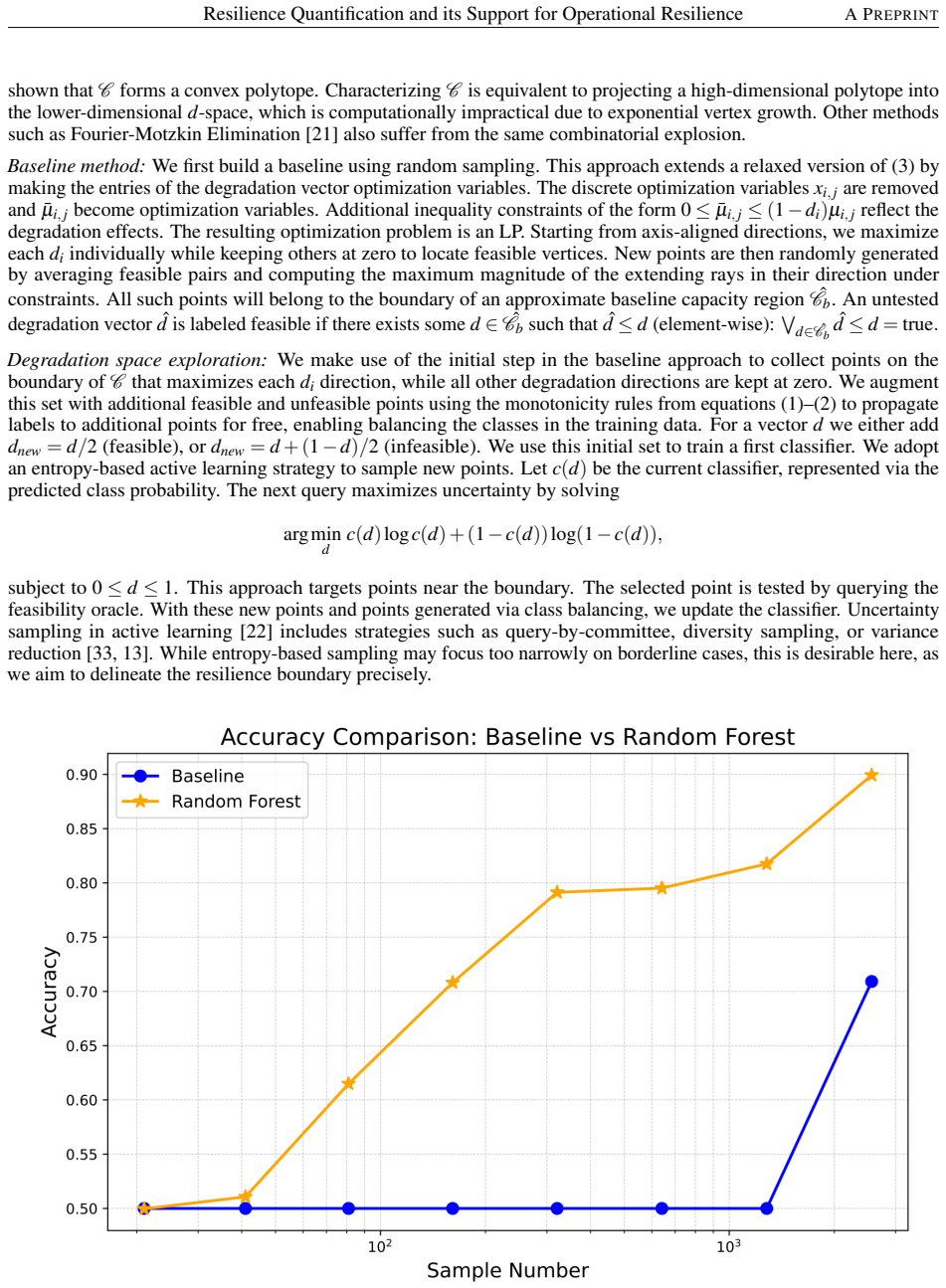

read the original abstract
We present a method to quantify a system's resilience capacity, i.e., the set of degradation magnitudes for which all functional requirements remain satisfied. These requirements come from human stakeholders (e.g., operators, planners) who define the acceptable performance envelope. By representing the resilience capacity in degradation space, we obtain an application -- agnostic resilience metric (e.g., capacity volume). To approximate the capacity efficiently in high-dimensional spaces, we pair machine-learning classifiers with entropy-based active sampling, reducing costly feasibility tests. The learned model then drives diagnosis (current health estimation) and prognostics (health-state forecasting) that estimates useful life. These two steps can be complemented by a reconfiguration step implemented by human operators to prolong the system's functionality. An illustrative case study, i.e., a manufacturing production line meeting weekly human set part demand, demonstrates the proposed workflow.
Editorial analysis
A structured set of objections, weighed in public.
Referee Report
Summary. The paper claims to define resilience capacity as the set of degradation magnitudes in which all stakeholder-specified functional requirements remain satisfied, yielding an application-agnostic metric such as capacity volume. It proposes to approximate this set in high-dimensional degradation space by training machine-learning classifiers with entropy-based active sampling to minimize expensive feasibility queries, then uses the resulting model for diagnosis, prognostics, and operator-driven reconfiguration. An illustrative manufacturing production-line case study is presented to demonstrate the workflow.
Significance. If the approximation were shown to recover the capacity set with quantifiable fidelity, the framework would supply a concrete, stakeholder-grounded scalar (volume) that could be tracked across operational phases. The pairing of active sampling with classification to reduce feasibility tests is a reasonable computational strategy, but the manuscript supplies no evidence that the learned volume is close to the true volume or that the classifier decisions are reliable enough to support the downstream diagnosis and prognostics claims.
major comments (2)
- [Abstract and Case Study] Abstract and Case Study section: the central claim that entropy-based active sampling 'preserves fidelity' while reducing feasibility tests is unsupported; the manufacturing example is labeled 'illustrative' and reports neither Hausdorff distance to the true capacity set, relative volume error, nor classifier false-positive/negative rates on held-out feasibility queries.
- [Workflow description] Workflow description (paragraph beginning 'To approximate the capacity efficiently'): no error bound, convergence guarantee, or cross-validation protocol is stated for the learned classifier, so it is impossible to assess whether the approximated capacity volume can serve as a reliable application-agnostic metric.
minor comments (1)
- [Abstract] The phrase 'application -- agnostic' contains a typographic space before the hyphen.
Simulated Author's Rebuttal
We thank the referee for the constructive comments, which highlight important aspects of validation and reliability for the proposed resilience quantification framework. We address each major comment below and commit to revisions that strengthen the manuscript without altering its core contributions.
read point-by-point responses
-
Referee: [Abstract and Case Study] Abstract and Case Study section: the central claim that entropy-based active sampling 'preserves fidelity' while reducing feasibility tests is unsupported; the manufacturing example is labeled 'illustrative' and reports neither Hausdorff distance to the true capacity set, relative volume error, nor classifier false-positive/negative rates on held-out feasibility queries.
Authors: We agree that the manufacturing production-line example is presented as illustrative to demonstrate the overall workflow rather than to deliver a comprehensive quantitative benchmark. The manuscript does not report Hausdorff distances, relative volume errors, or held-out classifier error rates. In the revised version we will expand the case-study section with an empirical validation subsection that computes the approximated capacity volume against a reference set obtained from exhaustive sampling (where computationally feasible), reports relative volume error, and evaluates classifier performance via cross-validation on additional feasibility queries, including false-positive and false-negative rates. revision: yes
-
Referee: [Workflow description] Workflow description (paragraph beginning 'To approximate the capacity efficiently'): no error bound, convergence guarantee, or cross-validation protocol is stated for the learned classifier, so it is impossible to assess whether the approximated capacity volume can serve as a reliable application-agnostic metric.
Authors: The current text introduces the active-sampling workflow at a conceptual level and does not supply theoretical error bounds or convergence guarantees. We acknowledge that this omission prevents a rigorous assessment of the metric's reliability. In revision we will (i) explicitly describe the cross-validation protocol employed for the classifier, (ii) add a dedicated paragraph discussing the absence of theoretical guarantees and the reliance on empirical fidelity, and (iii) include the quantitative validation results from the expanded case study to provide evidence that the approximated volume remains sufficiently close for the intended diagnostic and prognostic uses. revision: yes
Circularity Check
No significant circularity; derivation is self-contained from external inputs
full rationale
The paper defines resilience capacity explicitly as the set of degradation magnitudes satisfying stakeholder-specified functional requirements, then represents this set in degradation space to derive an application-agnostic metric such as its volume. Approximation proceeds via independent ML classifiers paired with entropy-based active sampling, which are standard external techniques for reducing feasibility queries and are not derived from or fitted to the capacity volume itself. No equations, self-citations, or uniqueness theorems appear in the abstract or workflow that reduce the central claims back to the paper's own outputs or prior author work. The illustrative case study is presented as a demonstration rather than a fitted validation loop. The derivation chain therefore rests on external stakeholder inputs and off-the-shelf computational methods, remaining non-circular.
Axiom & Free-Parameter Ledger
axioms (1)
- domain assumption Functional requirements are defined by human stakeholders and can be used to determine the acceptable performance envelope.
Reference graph
Works this paper leans on
-
[1]
A quantitative approach to resilience in manufacturing systems.Int
Kosmas Alexopoulos, Ioannis Anagiannis, Nikolaos Nikolakis, and George Chryssolouris. A quantitative approach to resilience in manufacturing systems.Int. J. Prod. Res., 60(24):7178–7193, 2022
work page 2022
-
[2]
Christophe Andrieu, Nando de Freitas, Arnaud Doucet, and Michael I. Jordan. An introduction to MCMC for machine learning.Machine Learning, 50:5–43, 2003
work page 2003
-
[3]
J. F. Archard. Contact and rubbing of flat surfaces.Journal of Applied Physics, 24(8):981–988, 1953
work page 1953
-
[4]
N. Arshad and D. Heimbigner. A comparison of planning based models for component reconfiguration. Technical Report CU-CS-995-05, Colorado University, 2005
work page 2005
-
[5]
T. Aruväli, M. De Marchi, and E. Rauch. Analysis of quantitative metrics for assessing resilience of human- centered CPPS workstations.Scientific Reports, 13(1):2914, 2023
work page 2023
-
[6]
Islem Bejaoui, Dario Bruneo, and Maria Gabriella Xibilia. A data-driven prognostics technique and RUL prediction of rotating machines using an exponential degradation model. In7th International Conference on Control, Decision and Information Technologies, volume 1, pages 703–708, 2020
work page 2020
-
[7]
O. Bektas and J. A. Jones. NARX time series model for remaining useful life estimation of gas turbine engines. In PHM Society European Conference, volume 3, 2016
work page 2016
- [8]
-
[9]
The price of robustness.Operations Research, 52(1):35–53, 2004
Dimitris Bertsimas and Melvyn Sim. The price of robustness.Operations Research, 52(1):35–53, 2004
work page 2004
-
[10]
Birge and Franois Louveaux.Introduction to Stochastic Programming
John R. Birge and Franois Louveaux.Introduction to Stochastic Programming. Springer Publishing Company, Incorporated, 2nd edition, 2011
work page 2011
-
[11]
Quantitative resilience of linear systems
Jean-Baptiste Bouvier and Melkior Ornik. Quantitative resilience of linear systems. InEuropean Control Conference (ECC), pages 485–490, 2022
work page 2022
-
[12]
Antonio C. Caputo, Pacifico M. Pelagagge, and Paolo Salini. A methodology to estimate resilience of manufactur- ing plants.IFAC-PapersOnLine, 52(13):808–813, 2019
work page 2019
-
[13]
Cohn, Zoubin Ghahramani, and Michael I
David A. Cohn, Zoubin Ghahramani, and Michael I. Jordan. Active learning with statistical models.J. Artif. Int. Res., 4(1):129–145, 1996
work page 1996
-
[14]
Faster Deterministic V olume Estimation in the Oracle Model via Thin Lattice Coverings
Daniel Dadush. Faster Deterministic V olume Estimation in the Oracle Model via Thin Lattice Coverings. In Lars Arge and János Pach, editors,31st International Symposium on Computational Geometry (SoCG 2015), volume 34 ofLeibniz International Proceedings in Informatics (LIPIcs), pages 704–718, Dagstuhl, Germany,
work page 2015
-
[15]
Schloss Dagstuhl – Leibniz-Zentrum für Informatik
-
[16]
S. Davis, S. Cremaschi, and M. Eden. Efficient surrogate model development: Optimum model form based on input function characteristics. In27th European Symposium on Computer Aided Process Engineering, volume 40 ofComputer Aided Chemical Engineering, pages 457–462. Elsevier, 2017
work page 2017
-
[17]
Fundamentals of model-based diagnosis.IFAC Proceedings Volumes, 36(5):25 – 36, 2003
Johan de Kleer and James Kurien. Fundamentals of model-based diagnosis.IFAC Proceedings Volumes, 36(5):25 – 36, 2003. 5th IFAC Symposium on Fault Detection, Supervision and Safety of Technical Processes 2003, Washington DC, 9-11 June 1997
work page 2003
-
[18]
M. E. Dyer and A. M. Frieze. On the complexity of computing the volume of a polyhedron.SIAM Journal on Computing, 17(5):967–974, 1988. 8 Resilience Quantification and its Support for Operational ResilienceA PREPRINT
work page 1988
-
[19]
A random polynomial-time algorithm for approximating the volume of convex bodies.J
Martin Dyer, Alan Frieze, and Ravi Kannan. A random polynomial-time algorithm for approximating the volume of convex bodies.J. ACM, 38(1):1–17, January 1991
work page 1991
- [20]
-
[21]
Abebe Geletu, Michael Klöppel, Hui Zhang, and Pu Li. Advances and applications of chance-constrained approaches to systems optimisation under uncertainty.Int. J. Syst. Sci., 44(7):1209–1232, 2013
work page 2013
-
[22]
Fourier–Motzkin elimination method
Leonid Khachiyan. Fourier–Motzkin elimination method. In Christodoulos A. Floudas and Panos M. Pardalos, editors,Encyclopedia of Optimization, pages 1074–1077. Springer US, Boston, MA, 2009
work page 2009
-
[23]
David D. Lewis and William A. Gale. A sequential algorithm for training text classifiers. In Bruce W. Croft and C. J. van Rijsbergen, editors,SIGIR ’94, pages 3–12, London, 1994. Springer London
work page 1994
-
[24]
Ruiying Li, Xiaoyu Tian, Li Yu, and Rui Kang. A systematic disturbance analysis method for resilience evaluation: A case study in material handling systems.Sustainability, 11(5), 2019
work page 2019
- [25]
-
[26]
System resilience through health monitoring and reconfiguration.ACM Trans
Ion Matei and et al. System resilience through health monitoring and reconfiguration.ACM Trans. Cyber-Phys. Syst., 8(1), 2024
work page 2024
-
[27]
Maxwell, Johan de Kleer, Ion Matei, and Maksym Zhenirovsky
John T. Maxwell, Johan de Kleer, Ion Matei, and Maksym Zhenirovsky. Preliminary experiments using LLMs for design. In36th International Workshop on Qualitative Reasoning, pages 97–104, 2023
work page 2023
-
[28]
R. Minhas and et al. Using fault augmented Modelica models for diagnostics. InInternational Modelica Conference, pages 437–445, 2014
work page 2014
-
[29]
Supply chain resilience during the COVID-19 pandemic.Technology in Society, 68:101847, 2022
Dilek Ozdemir, Mahak Sharma, Amandeep Dhir, and Tugrul Daim. Supply chain resilience during the COVID-19 pandemic.Technology in Society, 68:101847, 2022
work page 2022
-
[30]
M. Panteli, P. Mancarella, D. N. Trakas, E. Kyriakides, and N. D. Hatziargyriou. Metrics and quantification of operational and infrastructure resilience in power systems.IEEE Trans. Power Syst., 32(6):4732–4742, 2017
work page 2017
-
[31]
F. Pedregosa and et al. Scikit-learn: Machine learning in Python.J. Mach. Learn. Res., 12:2825–2830, 2011
work page 2011
-
[32]
B. Saha and et al. Model-based approach for optimal maintenance strategy. InEuropean Conference of the Prognostics and Health Management Society, August, 2014
work page 2014
-
[33]
Rodolphe Sepulchre. Robust performance? resilient safety! [from the editor].IEEE Control Systems Magazine, 43(3):3–4, 2023
work page 2023
-
[34]
H. S. Seung, M. Opper, and H. Sompolinsky. Query by committee. InProceedings of the Fifth Annual Workshop on Computational Learning Theory, COLT ’92, page 287–294, New York, NY , USA, 1992. Association for Computing Machinery
work page 1992
-
[35]
Hao Song, Xiaonong Lu, Xu Zhang, Xiaoan Tang, and Qiang Zhang. A HRGO approach for resilience en- hancement service composition and optimal selection in cloud manufacturing.Mathematical Biosciences and Engineering, 17(6):6838–6872, 2020
work page 2020
-
[36]
Daria Terekhov, Tony T. Tran, Douglas G. Down, and J. Christopher Beck. Integrating queueing theory and scheduling for dynamic scheduling problems.J. Artif. Intell., 50(1):535–572, 2014
work page 2014
-
[37]
Ding Zhang, Min Xie, Hong Yan, and Qiang Liu. Resilience dynamics modeling and control for a reconfigurable electronic assembly line under spatio-temporal disruptions.Int. J. Manuf. Syst., 60:852–863, 2021. 9
work page 2021
discussion (0)
Sign in with ORCID, Apple, or X to comment. Anyone can read and Pith papers without signing in.