Recurrent bifurcations of stability spectra for steep Stokes waves in a deep fluid
Pith reviewed 2026-05-10 15:47 UTC · model grok-4.3
The pith
Stokes waves exhibit four recurrent bifurcations in their stability spectra as steepness increases to the limiting peaked wave.
A machine-rendered reading of the paper's core claim, the machinery that carries it, and where it could break.
Core claim
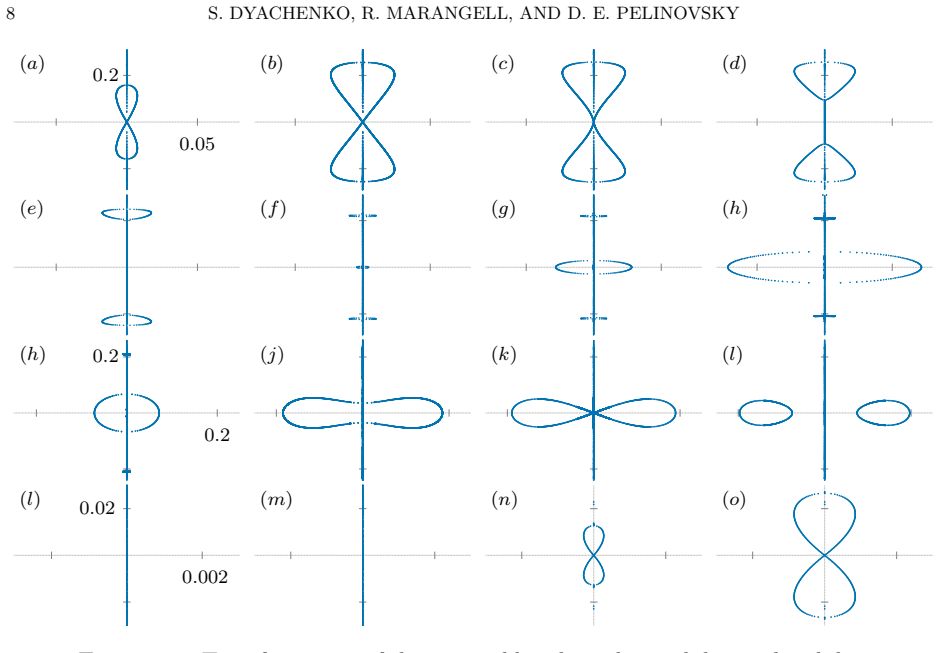
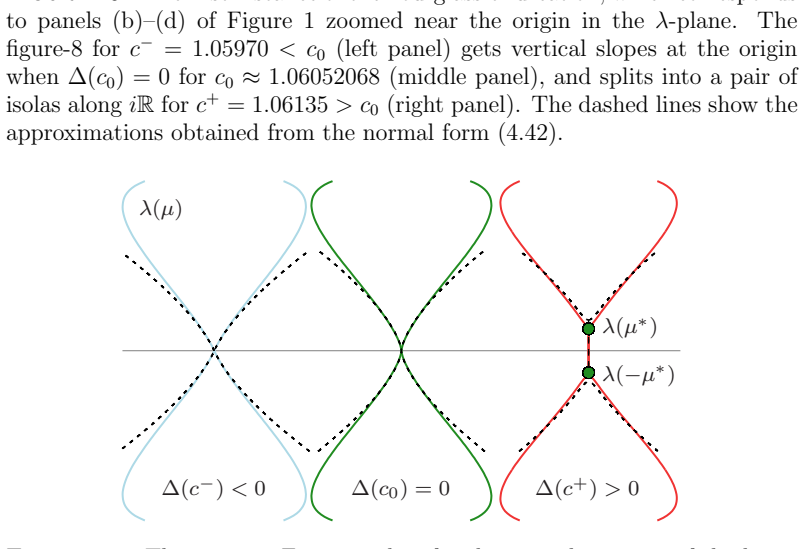
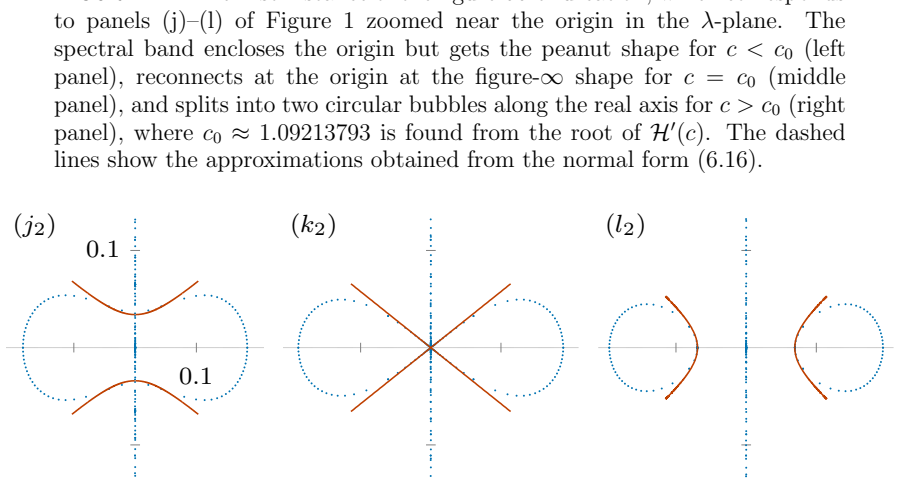
We derive the criteria and the normal forms for four bifurcations which are repeated recurrently when the steepness of the Stokes wave is increased towards the highest wave with the peaked profile. The four bifurcations are observed in the following order: (a) new figure-8 bands appearing at each extremal point of speed, (b) degeneration of figure-8 bands resulting in vertical slopes, (c) new circular bands around the origin appearing at each period-doubling bifurcation, and (d) reconnection of figure-∞ bands at each extremal point of energy.
What carries the argument
The analytic extension of the modulational stability problem for singular pseudo-differential operators in terms of the Floquet parameter, which allows derivation of normal forms for the recurrent bifurcations.
If this is right
- The stability spectra of Stokes waves change predictably at specific steepness values corresponding to extrema of speed and energy.
- Numerical approximations of the spectral bands agree excellently with the normal form theory for the first and second bifurcation cycles.
- The criteria for bifurcations can be used to predict the onset of instabilities as waves become steeper.
- Structural assumptions known for Stokes waves enable the analytic treatment of the stability problem.
Where Pith is reading between the lines
- If the normal forms hold, one could predict the stability near the highest wave without full numerical computation of the spectrum.
- These bifurcations might relate to the mechanism of wave breaking or the formation of rogue waves in deep water.
- Extending this to finite depth or other wave types could reveal similar recurrent patterns.
Load-bearing premise
The structural assumptions used in the normal form derivation hold true for the Stokes waves under consideration.
What would settle it
Numerical computation of the stability spectrum at the predicted steepness values for higher bifurcation cycles would falsify the normal forms if the observed band structures deviate from the predicted shapes and slopes.
Figures







read the original abstract
We study the modulational stability problem for the traveling periodic waves (called Stokes waves) in an infinitely deep fluid by using pseudo-differential operators in conformal variables. We derive the criteria and the normal forms for four bifurcations which are repeated recurrently when the steepness of the Stokes wave is increased towards the highest wave with the peaked profile. The four bifurcations are observed in the following order: (a) new figure-8 bands appearing at each extremal point of speed, (b) degeneration of figure-8 bands resulting in vertical slopes, (c) new circular bands around the origin appearing at each period-doubling bifurcation, and (d) reconnection of figure-$\infty$ bands at each extremal point of energy. Our work uses the analytic theory of Stokes waves developed previously for Babenko's equation. The novelty of our work is the analytic extension of the modulational stability problem for singular pseudo-differential operators in terms of the Floquet parameter. The derivation of the normal form uses some structural assumptions which are known to be true for the Stokes waves. For the first and second bifurcation cycles, we compute numerically with a higher-order accuracy the actual values of wave steepness for which the structural assumptions are satisfied and the numerical coefficients of the normal forms to show the excellent agreement between the normal form theory and the numerical approximations of the spectral bands.
Editorial analysis
A structured set of objections, weighed in public.
Referee Report
Summary. The manuscript derives criteria and normal forms for four recurrent bifurcations in the modulational stability spectra of steep Stokes waves in deep fluid, using pseudo-differential operators in conformal variables and the analytic theory of Babenko's equation. The bifurcations occur in sequence as steepness increases toward the limiting peaked wave: (a) new figure-8 bands at speed extrema, (b) degeneration of figure-8 bands to vertical slopes, (c) new circular bands at period-doubling points, and (d) reconnection of figure-∞ bands at energy extrema. High-order numerical computations confirm the steepness values and normal-form coefficients only for the first two cycles, with excellent agreement to the analytic predictions.
Significance. If the structural assumptions hold throughout the steepness range and the analytic extension to singular operators is rigorous, the work offers a systematic normal-form description of recurrent stability changes approaching the highest wave, with potential implications for extreme wave dynamics and breaking. Credit is due for the high-order numerical checks on the first two cycles and for grounding the results in prior Stokes-wave theory.
major comments (2)
- [Abstract and numerical results section] The central claim that the four bifurcations recur recurrently up to the highest wave rests on the analytic extension and structural assumptions holding at each cycle. However, the abstract and numerical results section state that high-order computations of steepness values and normal-form coefficients are supplied only for the first and second cycles; no equivalent verification is described for the third or fourth cycles nearer the peaked limit, where operator singularity strengthens. This leaves the recurrence assertion dependent on pattern continuation rather than direct confirmation that assumptions remain valid.
- [Derivation of normal forms] § on derivation of normal forms: the criteria and normal forms for bifurcations (a)–(d) are derived under structural assumptions stated to be known for Stokes waves. It is not shown whether these assumptions are proven to persist at higher cycles or merely extrapolated; given that the modulational stability problem involves singular pseudo-differential operators whose properties may degrade near the peaked profile, an explicit check or continuation argument for the third and fourth cycles is load-bearing for the recurrent claim.
minor comments (2)
- [Analytic extension section] The presentation of the Floquet-parameter extension for singular operators would benefit from an explicit statement of the domain of analyticity or a reference to the precise theorem in the prior Babenko theory that is being extended.
- [Figures] Figure captions for the spectral bands should include the specific steepness values and the order of numerical accuracy used, to allow direct comparison with the normal-form predictions.
Simulated Author's Rebuttal
We thank the referee for the careful reading of our manuscript and for the constructive comments on the scope of our analytic and numerical results. We address each major comment below.
read point-by-point responses
-
Referee: [Abstract and numerical results section] The central claim that the four bifurcations recur recurrently up to the highest wave rests on the analytic extension and structural assumptions holding at each cycle. However, the abstract and numerical results section state that high-order computations of steepness values and normal-form coefficients are supplied only for the first and second cycles; no equivalent verification is described for the third or fourth cycles nearer the peaked limit, where operator singularity strengthens. This leaves the recurrence assertion dependent on pattern continuation rather than direct confirmation that assumptions remain valid.
Authors: We agree that the manuscript provides high-order numerical verification of steepness values and normal-form coefficients only for the first two bifurcation cycles. The claim of recurrence for subsequent cycles rests on the analytic theory of Babenko's equation and the structural assumptions for Stokes waves, which are known to hold throughout the steepness range up to the limiting wave. The analytic extension of the modulational stability problem is formulated to apply uniformly. We will revise the abstract and numerical results section to state explicitly that numerical confirmation is limited to the first two cycles and that recurrence beyond this is supported by the analytic framework rather than additional direct computations. revision: partial
-
Referee: [Derivation of normal forms] § on derivation of normal forms: the criteria and normal forms for bifurcations (a)–(d) are derived under structural assumptions stated to be known for Stokes waves. It is not shown whether these assumptions are proven to persist at higher cycles or merely extrapolated; given that the modulational stability problem involves singular pseudo-differential operators whose properties may degrade near the peaked profile, an explicit check or continuation argument for the third and fourth cycles is load-bearing for the recurrent claim.
Authors: The structural assumptions used in the derivation are established properties of Stokes waves obtained from the analytic theory of Babenko's equation, which applies for the entire family of waves up to the peaked profile. The normal forms are derived under these assumptions via the pseudo-differential operator formulation in conformal variables, with the analytic extension in the Floquet parameter designed to capture the recurrent behavior. We do not supply a separate continuation proof or numerical check for each higher cycle, as the framework is constructed to hold uniformly. We will add a clarifying paragraph in the derivation section noting that persistence of the assumptions at higher cycles follows from the known analytic properties of the Stokes waves rather than case-by-case verification. revision: yes
- High-order numerical verification of steepness values and normal-form coefficients for the third and fourth bifurcation cycles, which is computationally prohibitive due to operator singularity near the peaked wave.
Circularity Check
No significant circularity; analytic derivation with numerical validation for initial cycles
full rationale
The paper derives criteria and normal forms for the four recurrent bifurcations via analytic extension of the modulational stability problem for singular pseudo-differential operators in conformal variables, relying on structural assumptions stated as known for Stokes waves and prior analytic theory for Babenko's equation. It supplies independent high-order numerical verification of steepness values where assumptions hold and of normal-form coefficients, with explicit agreement checks only for the first and second cycles. No step reduces by construction to a fitted parameter renamed as prediction, a self-definitional loop, or a load-bearing self-citation chain whose content is unverified outside the present work; the recurrence claim follows from the analytic continuation rather than from re-labeling inputs. The derivation chain is therefore self-contained against the provided external benchmarks.
Axiom & Free-Parameter Ledger
axioms (1)
- domain assumption Structural assumptions known to be true for the Stokes waves
Reference graph
Works this paper leans on
-
[1]
C. J. Amick, L. E. Fraenkel, and J. F. Toland. On the Stokes conjecture for the wave of extreme form. Acta Mathematica, 148(1):193–214, 1982
work page 1982
-
[2]
K. I. Babenko. Some remarks on the theory of surface waves of finite amplitude. InDoklady Akademii Nauk, volume 294, pages 1033–1037. Russian Academy of Sciences, 1987
work page 1987
-
[3]
A. M. Balk. A Lagrangian for water waves.Physics of Fluids, 8:416–420, 1996
work page 1996
-
[4]
T. B. Benjamin and J. E. Feir. The disintegration of wave trains on deep water.Journal of Fluid Mechanics, 27(3):417–430, 1967
work page 1967
-
[5]
T. B. Benjamin and P. J. Olver. Hamiltonian structure, symmetries and conservation laws for water waves.Journal of Fluid Mechanics, 125:137–185, 1982
work page 1982
- [6]
- [7]
-
[8]
T. Bridges and A. Mielke. A proof of the Benjamin-Feir instability.Archive for rational mechanics and analysis, 133:145–198, 1995
work page 1995
-
[9]
J. C. Bronski, V. M. Hur, and R. Marangell. Floquet theory and stability analysis for Hamiltonian PDEs.Nonlinearity, 37:125010 (42 pages), 2024. 62 S. DYACHENKO, R. MARANGELL, AND D. E. PELINOVSKY
work page 2024
-
[10]
B. Buffoni, E. N. Dancer, and J. F. Toland. The regularity and local bifurcation of steady periodic water waves.Arch. Rational Mech. Anal., 152:207–240, 2000
work page 2000
-
[11]
B. Buffoni, E. N. Dancer, and J. F. Toland. The sub-harmonic bifurcations of Stokes waves.Arch. Rational Mech. Anal., 152:241–271, 2000
work page 2000
-
[12]
R. Creedon, B. Deconinck, and O. Trichtchenko. High-frequency instabilities of a Boussinesq–Whitham system: a perturbative approach.Fluids, 6(4):136, 2021
work page 2021
-
[13]
R. P. Creedon and B. Deconinck. A high-order asymptotic analysis of the Benjamin–Feir instability spectrum in arbitrary depth.Journal of Fluid Mechanics, 956:A29, 2023
work page 2023
- [14]
-
[15]
B. Deconinck, S. A. Dyachenko, P. M. Lushnikov, and A. Semenova. The dominant instability of near- extreme Stokes waves.Proceedings of the National Academy of Sciences, 120(32):e2308935120, 2023
work page 2023
-
[16]
B. Deconinck, S. A. Dyachenko, and A. Semenova. Self-similarity and recurrence in stability spectra of near-extreme Stokes waves.Journal of Fluid Mechanics, 995:A2, 2024
work page 2024
-
[17]
B. Deconinck and K. Oliveras. The instability of periodic surface gravity waves.Journal of Fluid Me- chanics, 675:141–167, 2011
work page 2011
-
[18]
A. I. Dyachenko, E. A. Kuznetsov, M. D. Spector, and V. E. Zakharov. Analytical description of the free surface dynamics of an ideal fluid (canonical formalism and conformal mapping).Physics Letters A, 221(1-2):73–79, 1996
work page 1996
-
[19]
S. Dyachenko and D. E. Pelinovsky. Bifurcations of unstable eigenvalues for Stokes waves derived from conserved energy.Physica D, 483:134925, 2025
work page 2025
-
[20]
S. A. Dyachenko, V. M. Hur, and D. A. Silantyev. Almost extreme waves.Journal of Fluid Mechanics, 955:A17, 2023
work page 2023
-
[21]
S. A. Dyachenko, P. M. Lushnikov, and A. O. Korotkevich. Branch cuts of Stokes wave on deep water. Part I: numerical solution and Pad´ e approximation.Studies in Applied Mathematics, 137(4):419–472, 2016
work page 2016
-
[22]
S. A. Dyachenko and A. Semenova. Canonical conformal variables based method for stability of Stokes waves.Studies in Applied Mathematics, 150(3):705–715, 2023
work page 2023
-
[23]
S. A. Dyachenko and A. Semenova. Quasiperiodic perturbations of Stokes waves: Secondary bifurcations and stability.Journal of Computational Physics, 492:112411, 2023
work page 2023
-
[24]
E. J. Hinch.Perturbation Methods. Cambridge Texts in Applied Mathematics. Cambridge University Press, Cambridge, UK, 1991
work page 1991
-
[25]
Hormander.An introduction to complex analysis in several variables
L. Hormander.An introduction to complex analysis in several variables. Elsevier, 1973
work page 1973
-
[26]
V. M. Hur and Z. Yang. Unstable Stokes waves.Arch. Rational Mech. Anal., 247:62, 2023
work page 2023
-
[27]
F. C. Kirwan.Complex algebraic curves. Cambridge University Press, 1992
work page 1992
-
[28]
A. O. Korotkevich, P. M. Lushnikov, A. Semenova, and S. A. Dyachenko. Superharmonic instability of Stokes waves.Studies in Applied Mathematics, 150(1):119–134, 2023
work page 2023
-
[29]
T. Levi-Civita. D´ etermination rigoureuse des ondes permanentes d’ampleur finie.Mathematische An- nalen, 93(1):264–314, 1925
work page 1925
-
[30]
S. Locke and D. E. Pelinovsky. On smooth and peaked traveling waves in a local model for shallow water waves.Journal of Fluid Mechanics, 1004:A1, 2025
work page 2025
-
[31]
S. Locke and D. E. Pelinovsky. Peaked Stokes waves as solutions of Babenko’s equation.Applied Math- ematics Letters, 161:109359, 2025
work page 2025
-
[32]
M. Longuet-Higgins and M. Tanaka. On the crest instabilities of steep surface waves.Journal of Fluid Mechanics, 336:51–68, 1997
work page 1997
-
[33]
M. S. Longuet-Higgins. The instabilities of gravity waves of finite amplitude in deep water I. Su- perharmonics.Proceedings of the Royal Society of London. A. Mathematical and Physical Sciences, 360(1703):471–488, 1978. BIFURCATIONS OF STABILITY SPECTRA FOR STEEP STOKES W A VES 63
work page 1978
-
[34]
M. S. Longuet-Higgins and M. J. H. Fox. Theory of the almost–highest wave. Part 2. Matching and analytic extension.Journal of Fluid Mechanics, 85:769–786, 1978
work page 1978
- [35]
-
[36]
J. Moro, J. V. Burke, and M. L. Overton. On the Lidskii–Vishik–Lyusternik perturbation theory for eigenvalues of matrices with arbitrary Jordan structure.SIAM Journal on Matrix Analysis and Appli- cations, 18(4):793–817, 1997
work page 1997
-
[37]
S. Murashige and W. Choi. Stability analysis of deep-water waves on a linear shear current using unsteady conformal mapping.Journal of Fluid Mechanics, 885, 2020
work page 2020
-
[38]
A. I. Nekrasov. On waves of permanent type.Izv. Ivanovo-Voznesensk. Polite. Inst., 3:52–65, 1921
work page 1921
-
[39]
H. Q. Nguyen and W. A. Strauss. Proof of modulational instability of Stokes waves in deep water. Communications on Pure and Applied Mathematics, 76(5):1035–1084, 2023
work page 2023
-
[40]
P. I. Plotnikov. Nonuniqueness of solutions of the problem of solitary waves and bifurcation of critical points of smooth functionals.Math USSR Izvestiya, 38:333–357, 1992
work page 1992
-
[41]
P. I. Plotnikov. A proof of the Stokes conjecture in the theory of surface waves.Studies in Applied Mathematics, 108(2):217–244, 2002
work page 2002
-
[42]
P. G. Saffman. The superharmonic instability of finite-amplitude water waves.J. Fluid Mech., 159:169– 174, 1985
work page 1985
-
[43]
Two-crested Stokes waves.Applied Mathematics Letters, 167:109560, 2025
A Semenova. Two-crested Stokes waves.Applied Mathematics Letters, 167:109560, 2025
work page 2025
-
[44]
G. G. Stokes. On the theory of oscillatory waves.Transactions of the Cambridge Philosophical Society, 8:441, 1847
-
[45]
G. G. Stokes. On the theory of oscillatory waves.Mathematical and Physical Papers, 1:197, 1880
-
[46]
D. Struik. D´ etermination rigoureuse des ondes irrotationelles p´ eriodiques dans un canal ¨ a profondeur finie.Math. Ann., 95:595–634, 1926
work page 1926
-
[47]
M. Tanaka. The stability of steep gravity waves.Journal of the physical society of Japan, 52(9):3047– 3055, 1983
work page 1983
-
[48]
M. Tanaka. The stability of steep gravity waves. ii.J. Fluid Mech., 156:281–289, 1985
work page 1985
-
[49]
J. F. Toland. On the existence of a wave of greatest height and Stokes’s conjecture.Proceedings of the Royal Society of London. A. Mathematical and Physical Sciences, 363(1715):469–485, 1978
work page 1978
-
[50]
V. E. Zakharov. Stability of periodic waves of finite amplitude on the surface of a deep fluid.Journal of Applied Mechanics and Technical Physics, 9(2):190–194, 1968. (S. Dyachenko)Department of Mathematics, State University of New York at Buffalo, Buffalo, New York, USA, 14260 Email address:sergeydy@buffalo.edu (R. Marangell)School of Mathematics and Sta...
work page 1968
discussion (0)
Sign in with ORCID, Apple, or X to comment. Anyone can read and Pith papers without signing in.