Recognition: unknown
Fine-tuning Factor Augmented Neural Lasso for Heterogeneous Environments
Pith reviewed 2026-05-10 15:41 UTC · model grok-4.3
The pith
Fine-tuning the factor-augmented neural Lasso yields minimax-optimal excess risk bounds and statistical acceleration over single-task learning when relative sample sizes and function complexities align in high-dimensional nonparametric reg
A machine-rendered reading of the paper's core claim, the machinery that carries it, and where it could break.
Core claim
The fine-tuning FAN-Lasso expresses the target regression function as a transformation of a frozen source function plus other variables, augments the design matrix with low-rank factors to accommodate high-dimensional dependent covariates, and establishes minimax-optimal excess risk bounds that characterize the precise relative sample sizes and function complexities under which fine-tuning produces statistical acceleration over single-task learning.
What carries the argument
Residual fine-tuning decomposition that writes the target function as a transformation of the frozen source predictor together with additional variables, enabling knowledge transfer while supporting nonparametric variable selection in the presence of low-rank covariate factors.
If this is right
- When source samples are sufficiently larger than target samples and function complexities satisfy the stated relations, the fine-tuned estimator attains strictly lower excess risk than single-task learning.
- The same framework simultaneously manages covariate shifts and posterior shifts without separate handling mechanisms.
- The derived bounds supply a theoretical justification for parameter-efficient fine-tuning strategies in nonparametric high-dimensional problems.
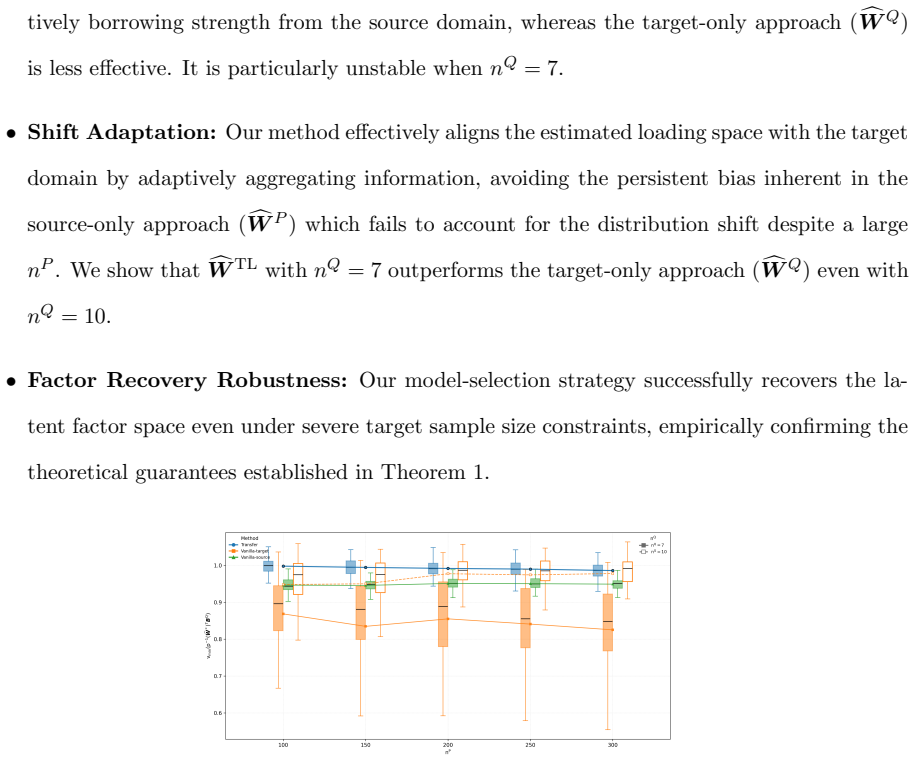
- Numerical experiments confirm near-oracle performance is reached even under severe constraints on the target sample size.
Where Pith is reading between the lines
- The sample-size conditions implied by the bounds could guide experimental design when deciding how much source data to gather before fine-tuning.
- If the low-rank factor structure holds in applications with correlated features, the method may effectively reduce dimensionality without explicit variable screening.
- Analogous residual decompositions might be explored for fine-tuning in other nonparametric or semiparametric models beyond the neural Lasso.
- Controlled simulations that systematically vary the source-to-target sample ratio would directly test the boundary between acceleration and no-gain regimes.
Load-bearing premise
The target function admits a decomposition as a transformation of a frozen source function plus other variables, and the high-dimensional covariates are adequately captured by a low-rank factor structure.
What would settle it
Run a simulation or real-data experiment in which source and target sample sizes are equal and function complexities are matched, then compare the excess risk of fine-tuning FAN-Lasso against single-task learning; failure to observe lower risk for the fine-tuned estimator would falsify the acceleration claim.
Figures

read the original abstract
Fine-tuning is a widely used strategy for adapting pre-trained models to new tasks, yet its methodology and theoretical properties in high-dimensional nonparametric settings with variable selection have not yet been developed. This paper introduces the fine-tuning factor augmented neural Lasso (FAN-Lasso), a transfer learning framework for high-dimensional nonparametric regression with variable selection that simultaneously handles covariate and posterior shifts. We use a low-rank factor structure to manage high-dimensional dependent covariates and propose a novel residual fine-tuning decomposition in which the target function is expressed as a transformation of a frozen source function and other variables to achieve transfer learning and nonparametric variable selection. This augmented feature from the source predictor allows for the transfer of knowledge to the target domain and reduces model complexity there. We derive minimax-optimal excess risk bounds for the fine-tuning FAN-Lasso, characterizing the precise conditions, in terms of relative sample sizes and function complexities, under which fine-tuning yields statistical acceleration over single-task learning. The proposed framework also provides a theoretical perspective on parameter-efficient fine-tuning methods. Extensive numerical experiments across diverse covariate- and posterior-shift scenarios demonstrate that the fine-tuning FAN-Lasso consistently outperforms standard baselines and achieves near-oracle performance even under severe target sample size constraints, empirically validating the derived rates.
Editorial analysis
A structured set of objections, weighed in public.
Referee Report
Summary. The manuscript proposes the Fine-tuning Factor Augmented Neural Lasso (FAN-Lasso) as a transfer learning framework for high-dimensional nonparametric regression with variable selection under covariate and posterior shifts. It employs a low-rank factor structure to address dependent covariates and introduces a residual fine-tuning decomposition expressing the target function as a transformation of a frozen source function plus additional variables. The central theoretical contribution is the derivation of minimax-optimal excess risk bounds that characterize precise conditions (in terms of relative sample sizes and function complexities) under which fine-tuning yields statistical acceleration over single-task learning. The work also provides a theoretical perspective on parameter-efficient fine-tuning methods and includes extensive numerical experiments across diverse shift scenarios demonstrating consistent outperformance and near-oracle performance.
Significance. If the derived bounds hold under the modeling assumptions, this provides a valuable theoretical characterization of the conditions for beneficial fine-tuning in high-dimensional nonparametric settings, which is currently underdeveloped. The explicit minimax-optimal rates and the link to parameter-efficient methods represent a solid advance, strengthened by the empirical validation under severe target-sample constraints. The combination of structural assumptions enabling dimension reduction and transfer with reproducible experimental support is a positive feature of the work.
minor comments (2)
- The abstract is dense with technical terminology; consider breaking the description of the method, decomposition, and theoretical results into shorter sentences or bullet points for improved readability.
- In the experimental section, more explicit details on how the low-rank factors are estimated from data and the sensitivity of results to the choice of neural network architecture would strengthen reproducibility.
Simulated Author's Rebuttal
We thank the referee for their thorough summary and positive assessment of our work on FAN-Lasso. The recommendation for minor revision is noted, and we appreciate the recognition of the theoretical contributions and empirical validation. No specific major comments were listed in the report, so we have no point-by-point rebuttals to provide at this stage. We remain available to address any additional queries or implement minor clarifications as needed.
Circularity Check
No circularity: bounds derived conditionally from explicit modeling assumptions
full rationale
The paper defines the FAN-Lasso via a residual fine-tuning decomposition (target as transformation of frozen source plus other terms) and low-rank factor model for covariates, then derives minimax excess-risk bounds that characterize acceleration conditions under those assumptions. This is a standard conditional theoretical derivation; the bounds hold precisely when the decomposition and factor structure are correctly specified, with no reduction to self-definition, renamed fits, or load-bearing self-citations. The abstract and skeptic summary confirm the rates revert to single-task learning without the structure, but that is an explicit limitation rather than circularity. No quoted equations or steps in the provided text exhibit any of the enumerated circular patterns.
Axiom & Free-Parameter Ledger
Reference graph
Works this paper leans on
-
[1]
Given the definition ofϕ, we haveϕ◦L 0(x, s(x)) =L 0(x, s(x)) givenM≥r(b+1)≥ ∥x J ∥∞
ForL 0 :R p+1 →R r+|J|+1 , let L0(x, s(x)) = (p−1x⊤W,x ⊤eΘ, s(x))⊤ = (ef ⊤,x ⊤ J , s(x))⊤, eΘij =1{i≤ |J|, j=l i}. Given the definition ofϕ, we haveϕ◦L 0(x, s(x)) =L 0(x, s(x)) givenM≥r(b+1)≥ ∥x J ∥∞. Moreover, it is trivial that∥ eΘ∥0 =|J|
-
[2]
ForL 1 :R r+|J|+1 →R 2(r+|J|+1) , let L1 ef xJ s(x) = H † 0 0 −[BJ,: ]H † I0 −H † 0 0 [BJ,: ]H † −I0 0 0 1 0 0−1 ef xJ s(x) + 0 = H †ef xJ −[B J,: ]H †ef −H †ef −(xJ −[B J,: ]H †ef) s(x) −s(x)
-
[3]
Suppose that the weightsL g 2 areW g 2 andb g
-
[4]
It follows from the above construction that m(x) =g σ(H †ef)−σ(−H †ef), σ(x J −[B J,: ]H †ef)−σ(−(x J −[B J,: ]H †ef)), σ(s(x))−σ(−s(x)) =g(H †ef,x J −[B J,: ]H †ef, s(x))
ForL 2 :R 2(r+|J|+1) →R N, givenu∈R r,v∈ R|J| , let L2 u v = W g 2 −W g 2 u v +b g 2. It follows from the above construction that m(x) =g σ(H †ef)−σ(−H †ef), σ(x J −[B J,: ]H †ef)−σ(−(x J −[B J,: ]H †ef)), σ(s(x))−σ(−s(x)) =g(H †ef,x J −[B J,: ]H †ef, s(x)). Moreover, all weights ofL 1,L 2, . . . ,LL+1 is bounded byT∨(C 1 |J|r νmin(H) ...
2024
discussion (0)
Sign in with ORCID, Apple, or X to comment. Anyone can read and Pith papers without signing in.