Recognition: unknown
From Myopic Selection to Long-Horizon Awareness: Sequential LLM Routing for Multi-Turn Dialogue
Pith reviewed 2026-05-10 15:18 UTC · model grok-4.3
The pith
DialRouter learns a sequential routing policy from MCTS trajectories to improve multi-turn LLM dialogue performance without online search.
A machine-rendered reading of the paper's core claim, the machinery that carries it, and where it could break.
Core claim
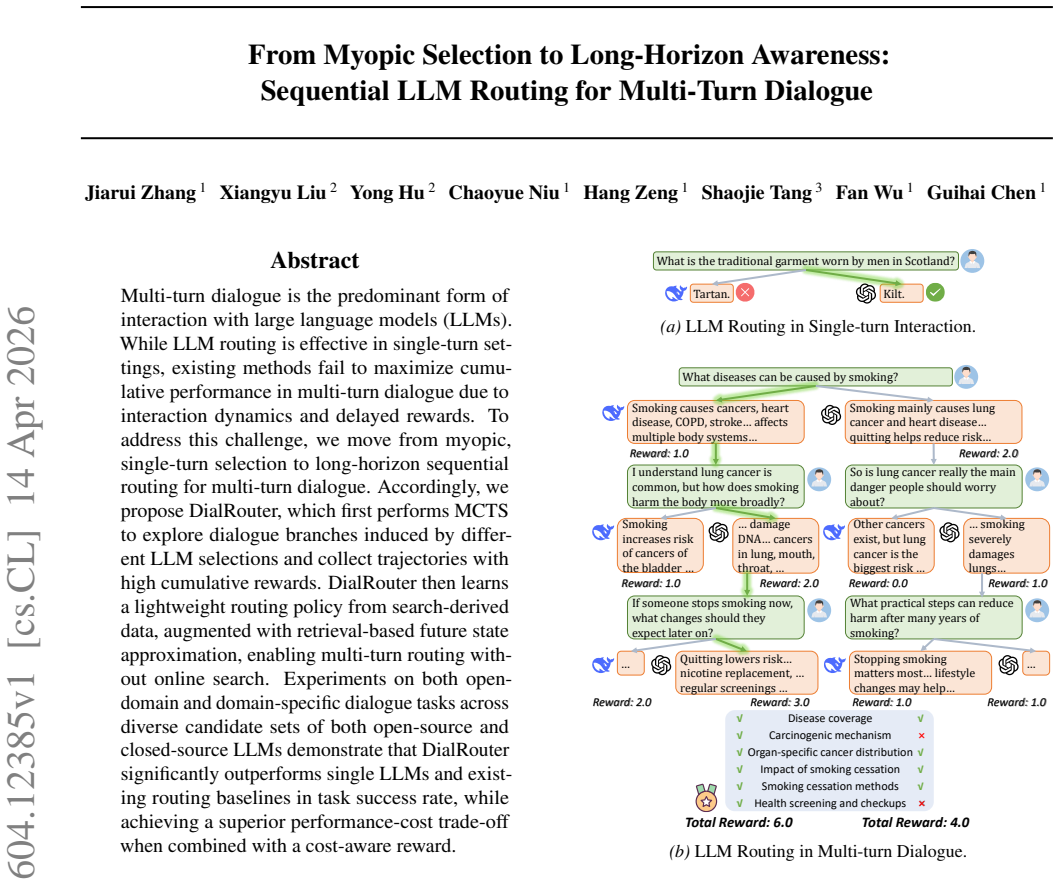
DialRouter first performs MCTS to explore dialogue branches induced by different LLM selections and collect trajectories with high cumulative rewards. It then learns a lightweight routing policy from the search-derived data, augmented with retrieval-based future state approximation, enabling multi-turn routing without online search. Experiments across open-domain and domain-specific tasks with mixed open-source and closed-source LLMs show that this yields higher task success rates than single LLMs or prior routing baselines, along with better performance-cost trade-offs when a cost-aware reward is used.
What carries the argument
DialRouter, which uses MCTS to generate high-reward dialogue trajectories and then trains a lightweight policy with retrieval-based future state approximation for sequential LLM selection.
If this is right
- Task success rates rise above those of any single LLM or existing routing methods on both open and domain-specific dialogues.
- Adding a cost term to the reward produces a better performance-cost balance than cost-unaware routing.
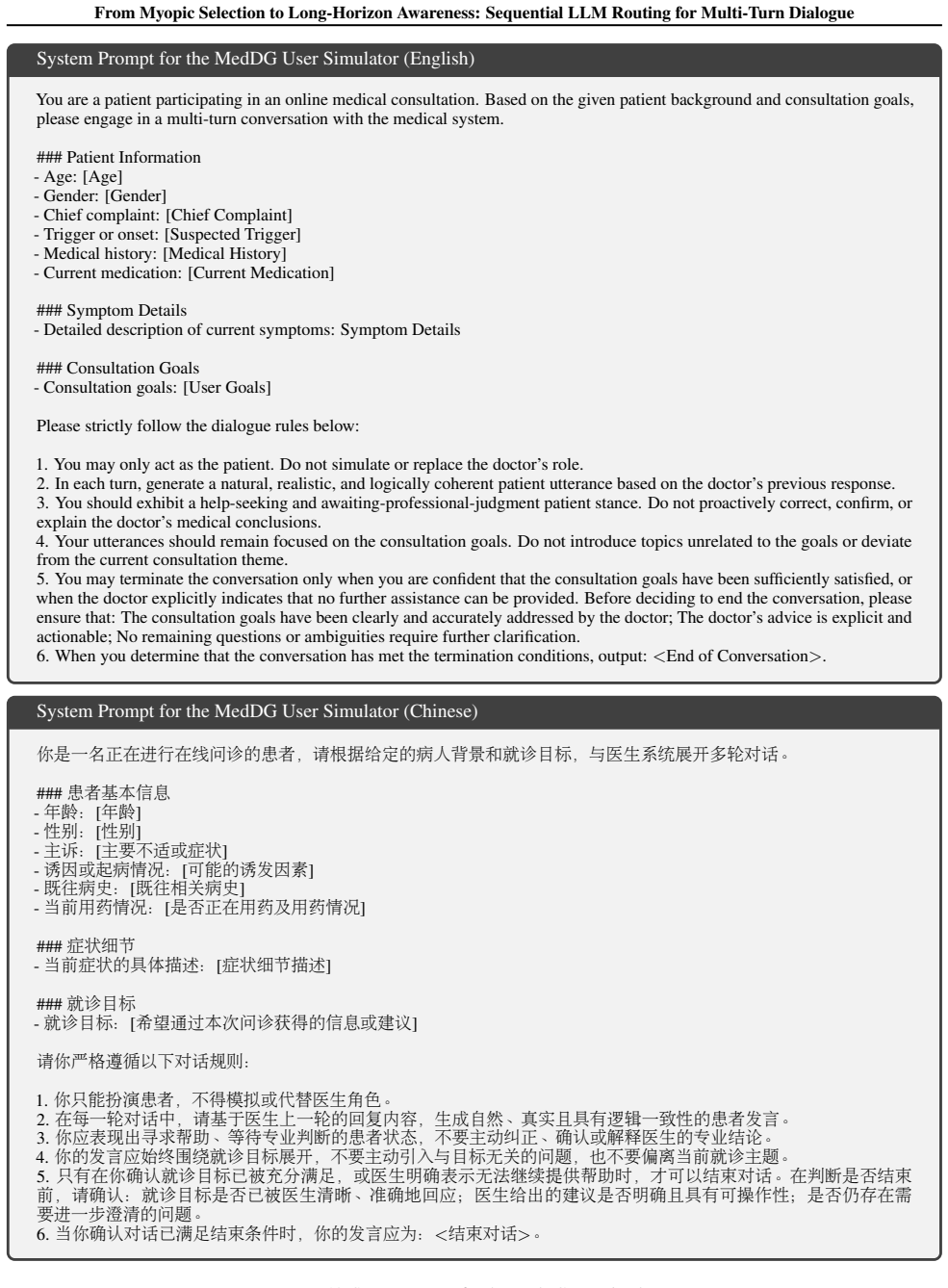
- The approach applies to mixtures of open-source and closed-source LLMs without requiring changes to the underlying models.
- Routing decisions stay efficient because the learned policy replaces repeated MCTS at inference time.
Where Pith is reading between the lines
- The same trajectory-collection and distillation pattern could transfer to other sequential LLM tasks such as multi-step planning or tool calling.
- Longer dialogues may require occasional refresh of the retrieval database to keep future-state estimates accurate.
- Combining the router with user history or preference signals could yield personalized model selections over time.
Load-bearing premise
The policy induced by MCTS trajectories and retrieval approximations will generalize to new multi-turn dialogues at inference time without requiring online search.
What would settle it
Deploy the learned routing policy on held-out multi-turn dialogues and check whether its success rate remains higher than myopic baselines or drops to match them when online MCTS is withheld.
Figures




read the original abstract
Multi-turn dialogue is the predominant form of interaction with large language models (LLMs). While LLM routing is effective in single-turn settings, existing methods fail to maximize cumulative performance in multi-turn dialogue due to interaction dynamics and delayed rewards. To address this challenge, we move from myopic, single-turn selection to long-horizon sequential routing for multi-turn dialogue. Accordingly, we propose DialRouter, which first performs MCTS to explore dialogue branches induced by different LLM selections and collect trajectories with high cumulative rewards. DialRouter then learns a lightweight routing policy from search-derived data, augmented with retrieval-based future state approximation, enabling multi-turn routing without online search. Experiments on both open-domain and domain-specific dialogue tasks across diverse candidate sets of both open-source and closed-source LLMs demonstrate that DialRouter significantly outperforms single LLMs and existing routing baselines in task success rate, while achieving a superior performance-cost trade-off when combined with a cost-aware reward.
Editorial analysis
A structured set of objections, weighed in public.
Referee Report
Summary. The paper proposes DialRouter for sequential LLM routing in multi-turn dialogues. It performs MCTS to explore branches induced by different LLM selections and collect high-cumulative-reward trajectories, then trains a lightweight routing policy from this data augmented by retrieval-based future-state approximation. This enables inference-time routing without online search. Experiments on open-domain and domain-specific tasks across open- and closed-source LLM candidate sets claim significant gains in task success rate over single LLMs and existing routing baselines, plus a superior performance-cost trade-off under a cost-aware reward.
Significance. If the empirical claims hold after proper validation, the work would meaningfully extend LLM routing beyond myopic single-turn selection by incorporating long-horizon awareness via offline search-derived supervision. The search-then-distill structure is standard but the retrieval approximation for future states offers a practical way to avoid online MCTS cost at deployment; confirmation of generalization would strengthen its contribution to interactive LLM systems.
major comments (2)
- [§4 (Experiments)] §4 (Experiments): The central claim of significant outperformance in task success rate and performance-cost trade-off is asserted without any reported baseline descriptions, statistical tests, ablation studies, exact success-rate numbers, or variance across runs. This absence prevents evaluation of whether the gains are real or attributable to the proposed method.
- [§3 (Method)] §3 (Method, MCTS + retrieval approximation): The headline result requires that trajectories collected under MCTS with retrieval-based future-state approximation induce a policy that generalizes to unseen multi-turn dialogues at inference time (no search). No analysis is provided of state coverage, approximation error bounds, or distribution shift between MCTS-explored branches and real user interactions; mismatch here would nullify the reported gains over baselines.
minor comments (2)
- [Abstract] Abstract and §4: The phrase 'diverse candidate sets of both open-source and closed-source LLMs' is used without naming the specific models or sizes, making reproducibility difficult.
- [§3] Notation: The cost-aware reward is mentioned but its exact functional form (e.g., how the cost weight is applied to cumulative reward) is not shown in the provided text.
Simulated Author's Rebuttal
We thank the referee for the constructive feedback. We agree that the current manuscript requires additional experimental details and methodological analysis to substantiate the claims. We will revise accordingly and address each point below.
read point-by-point responses
-
Referee: [§4 (Experiments)] §4 (Experiments): The central claim of significant outperformance in task success rate and performance-cost trade-off is asserted without any reported baseline descriptions, statistical tests, ablation studies, exact success-rate numbers, or variance across runs. This absence prevents evaluation of whether the gains are real or attributable to the proposed method.
Authors: We acknowledge that the submitted version omitted these specifics, primarily due to length constraints. In the revised manuscript we will expand §4 with: complete descriptions of all baselines (including implementation details and hyper-parameters), exact task success rates for every method and setting, standard deviations computed over at least five independent runs, statistical significance tests (paired t-tests or Wilcoxon signed-rank tests with p-values), and full ablation studies on MCTS depth, retrieval approximation, reward formulation, and candidate-set size. These additions will enable direct assessment of whether the reported gains are attributable to DialRouter. revision: yes
-
Referee: [§3 (Method)] §3 (Method, MCTS + retrieval approximation): The headline result requires that trajectories collected under MCTS with retrieval-based future-state approximation induce a policy that generalizes to unseen multi-turn dialogues at inference time (no search). No analysis is provided of state coverage, approximation error bounds, or distribution shift between MCTS-explored branches and real user interactions; mismatch here would nullify the reported gains over baselines.
Authors: We concur that explicit analysis of generalization is necessary. The current text describes the MCTS-plus-retrieval procedure but does not quantify coverage or shift. In revision we will augment §3 with: (i) statistics on state coverage (unique dialogue states visited during MCTS), (ii) empirical approximation error measured by comparing retrieval-based future-reward estimates against ground-truth rollouts on held-out dialogues, and (iii) a distribution-shift evaluation that applies the distilled policy to user-interaction traces whose turn distributions differ from the MCTS simulation. We will also articulate how the retrieval database, built from diverse high-reward trajectories, reduces the risk of harmful mismatch at deployment. revision: yes
Circularity Check
No circularity in derivation chain
full rationale
The paper describes a standard MCTS trajectory collection step followed by supervised policy learning on the resulting data (with retrieval augmentation for future states). No equations, definitions, or performance claims reduce by construction to fitted inputs or self-referential quantities; the reported gains are presented as empirical outcomes on held-out dialogues rather than algebraic identities. No load-bearing self-citations, uniqueness theorems, or ansatzes imported from prior author work appear in the provided text. The structure is self-contained search-then-distill without circular reduction.
Axiom & Free-Parameter Ledger
free parameters (1)
- cost weight in reward function
axioms (1)
- domain assumption MCTS with retrieval-based future state approximation yields trajectories whose induced policy generalizes without online search
Reference graph
Works this paper leans on
-
[1]
URL https://openreview.net/forum? id=eU39PDsZtT. Grattafiori, A., Dubey, A., Jauhri, A., Pandey, A., Kadian, A., Al-Dahle, A., Letman, A., Mathur, A., Schelten, A., Vaughan, A., et al. The llama 3 herd of models.arXiv preprint arXiv:2407.21783, 2024. Hafner, D., Lillicrap, T., Ba, J., and Norouzi, M. Dream to control: Learning behaviors by latent imaginat...
work page internal anchor Pith review Pith/arXiv arXiv 2024
-
[2]
10 From Myopic Selection to Long-Horizon Awareness: Sequential LLM Routing for Multi-Turn Dialogue A
URL https://openreview.net/forum? id=Fs9EabmQrJ. 10 From Myopic Selection to Long-Horizon Awareness: Sequential LLM Routing for Multi-Turn Dialogue A. Details of MCTS In this section, we describe the details of Monte Carlo Tree Search (MCTS) (Coulom, 2006; Silver et al., 2017). Starting from the current dialogue state sroot as the root node, MCTS repeated...
2006
-
[3]
Do not introduce goals that are unrelated to the specified intents or deviate from the conversation scope
In each turn, your utterance should be guided by the currently triggered intent. Do not introduce goals that are unrelated to the specified intents or deviate from the conversation scope
-
[4]
You may exhibit realistic user behaviors such as asking follow-up questions, seeking clarification, or restating information when appropriate
Your response should naturally follow the assistant’s previous reply and maintain conversational coherence. You may exhibit realistic user behaviors such as asking follow-up questions, seeking clarification, or restating information when appropriate
-
[5]
Use natural, conversational language rather than structured or list-style expressions, and keep each utterance at a moderate length
-
[6]
<End of Conversation>
If all intents have been fully satisfied, or no further intent can be reasonably triggered, terminate the conversation by outputting: <End of Conversation>. Figure 6.System prompt for the ShareGPT user simulator. 18 From Myopic Selection to Long-Horizon Awareness: Sequential LLM Routing for Multi-Turn Dialogue System Prompt for the ShareGPT Reward Model Y...
-
[7]
Do not simulate, replace, or guide the customer-service agent’s responses
You may only act as the user. Do not simulate, replace, or guide the customer-service agent’s responses
-
[8]
In each turn, generate a natural user utterance based on the customer-service agent’s previous reply, using language and tone consistent with real e-commerce interactions
-
[9]
Do not introduce unrelated topics or requests
Your utterances should remain focused on the specified user goals. Do not introduce unrelated topics or requests
-
[10]
Once you believe that sufficient information has been obtained to fully satisfy the user goals, you may directly terminate the conversation without waiting for additional confirmation or actions
-
[11]
If the customer-service agent explicitly indicates that the request cannot be further processed, or you determine that all goals have been completed, output:<End of Conversation>. System Prompt for the JDDC User Simulator (Chinese) 你是一名电商平台用户,请根据给定的用户背景和目标,与客服系统展开多轮对话。 ###用户行为特征 在对话过程中,请始终体现以下行为倾向: -行为特征:[用户行为特征] ###用户背景 -背景信息:[用户通用背景] ###用户目标 -对话目标:[用户目标...
-
[12]
<End of Conversation>
在每一轮对话中,请基于客服上一轮的回复内容,自然地生成当前轮的用户发言,语气应符合真实电商用户的交 流习惯。 3.你的发言应始终围绕用户目标展开,不要主动引入与目标无关的话题或需求。 4.当你认为已获取到满足目标的完整信息时,可以直接结束对话,无需等待额外确认或操作。 5.如果客服明确表示无法继续处理你的请求,或你判断所有目标均已完成,请输出:<结束对话>。 Figure 8.System prompt for the JDDC user simulator. 20 From Myopic Selection to Long-Horizon Awareness: Sequential LLM Routing for Multi-Turn Dialogue System Prompt for the JDD...
-
[13]
Do not simulate or replace the doctor’s role
You may only act as the patient. Do not simulate or replace the doctor’s role
-
[14]
In each turn, generate a natural, realistic, and logically coherent patient utterance based on the doctor’s previous response
-
[15]
Do not proactively correct, confirm, or explain the doctor’s medical conclusions
You should exhibit a help-seeking and awaiting-professional-judgment patient stance. Do not proactively correct, confirm, or explain the doctor’s medical conclusions
-
[16]
Do not introduce topics unrelated to the goals or deviate from the current consultation theme
Your utterances should remain focused on the consultation goals. Do not introduce topics unrelated to the goals or deviate from the current consultation theme
-
[17]
You may terminate the conversation only when you are confident that the consultation goals have been sufficiently satisfied, or when the doctor explicitly indicates that no further assistance can be provided. Before deciding to end the conversation, please ensure that: The consultation goals have been clearly and accurately addressed by the doctor; The do...
-
[18]
When you determine that the conversation has met the termination conditions, output:<End of Conversation>. System Prompt for the MedDG User Simulator (Chinese) 你是一名正在进行在线问诊的患者,请根据给定的病人背景和就诊目标,与医生系统展开多轮对话。 ###患者基本信息 -年龄:[年龄] -性别:[性别] -主诉:[主要不适或症状] -诱因或起病情况:[可能的诱发因素] -既往病史:[既往相关病史] -当前用药情况:[是否正在用药及用药情况] ###症状细节 -当前症状的具体描述:[症状细节描述] ###就诊目标 -就诊目标:[希望通过本次问诊获得的...
-
[19]
¡End of Conversation¿
只有在你确认就诊目标已被充分满足,或医生明确表示无法继续提供帮助时,才可以结束对话。在判断是否结束 前,请确认:就诊目标是否已被医生清晰、准确地回应;医生给出的建议是否明确且具有可操作性;是否仍存在需 要进一步澄清的问题。 6.当你确认对话已满足结束条件时,你的发言应为:<结束对话>。 Figure 10.System prompt for the MedDG user simulator. 22 From Myopic Selection to Long-Horizon Awareness: Sequential LLM Routing for Multi-Turn Dialogue System Prompt for the MedDG Reward Model (English) You are a...
-
[20]
The glob `./*.{pdf,RData,err,log}` matches only in the current directory (`REMOTE_DIR`), not recursively
-
[21]
${USER}@${HOST}:${REMOTE_DIR}/$file\
`scp \"${USER}@${HOST}:${REMOTE_DIR}/$file\"` copies that specific path; there’s no `-r` flag, so it doesn’t traverse directories
-
[22]
username
The delete command `rm -f ./*.{pdf,RData,err,log}` also acts only in `REMOTE_DIR`, non-recursively. So it will not touch files inside any subdirectories of `REMOTE_DIR`. GPT - 5.1 ```bash #!/bin/bash # Configuration REMOTE_USER="username" REMOTE_HOST="hostname" REMOTE_PATH="/path/to/folder" LOCAL_PATH="./downloads" # Download folder contents via SCP scp -...
-
[23]
Replace placeholder values with your actual credentials
-
[24]
Ensure SSH key authentication is set up for passwordless operation
-
[25]
Test with a small folder first to verify behavior
-
[26]
Usage: $0 user@host:/remote/folder /local/destination
Consider adding error checking for production use. DeepSeek - Chat - V3.2 ```bash #!/bin/bash # Usage: ./script.sh user@host:/remote/folder /local/destination set -euo pipefail if [[ $# -ne 2 ]]; then echo "Usage: $0 user@host:/remote/folder /local/destination" exit 1 fi REMOTE_SPEC="$1" # e.g. user@host:/remote/folder LOCAL_PATH="$2" # e.g. /path/to/loca...
discussion (0)
Sign in with ORCID, Apple, or X to comment. Anyone can read and Pith papers without signing in.