Kinetic Arrest of a First Order Phase Transition
Pith reviewed 2026-05-10 14:58 UTC · model grok-4.3
The pith
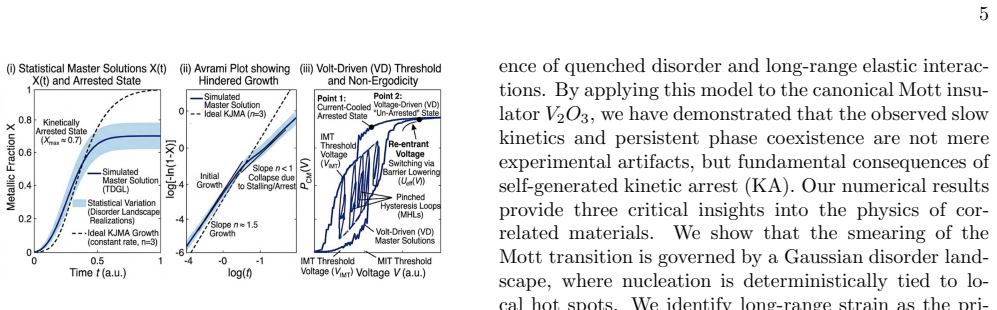
Mapping the monoclinic order parameter's TDGL dynamics onto a disorder-influenced Imry-Wortis landscape produces a universal transcendental condition that kinetically arrests the first-order Mott transition in V2O3.
A machine-rendered reading of the paper's core claim, the machinery that carries it, and where it could break.
Core claim
The authors show that kinetic arrest occurs when the effective activation barriers in the mapped landscape exceed the available thermal energy, so that the high-symmetry metallic phase cannot convert to the low-temperature monoclinic insulator. They define the order parameter φ from the monoclinic lattice distortion, write its TDGL equation of motion, and recast the problem as motion on a disorder-broadened Imry-Wortis potential; the resulting transcendental condition fixes the arrest temperature and barrier height. Applied to (001) V2O3 films, epitaxial clamping increases those barriers sufficiently that the metallic phase persists to 4.2 K. The same framework accounts for the hysteretic V–
What carries the argument
The order parameter φ (monoclinic distortion of the metallic phase) whose Time-Dependent Ginzburg-Landau evolution is mapped onto a disorder-influenced Imry-Wortis landscape, yielding the universal transcendental condition that governs kinetic arrest.
If this is right
- Epitaxial substrate clamping in (001) V2O3 films raises the barriers enough to trap the high-symmetry corundum phase down to 4.2 K.
- The arrested transition produces the hysteretic V–I characteristics that mark memristive switching.
- The trapped state is identified as a structurally arrested non-equilibrium Mott-Glass.
- The transcendental condition supplies a predictive route for strain-tuning neuromorphic synapses based on this material.
Where Pith is reading between the lines
- The same mapping procedure could be tried on other first-order structural transitions that possess a clear order parameter and measurable disorder, such as in VO2 or certain perovskites.
- Different substrate lattices would shift the arrest temperature in a calculable way, offering a design knob for devices that need a stable metallic phase at room temperature.
- If the transcendental condition proves general, kinetic arrest becomes a tunable feature rather than an accident of sample history.
Load-bearing premise
The TDGL equation for the monoclinic order parameter can be mapped directly onto the Imry-Wortis landscape without extra system-specific terms that would change the form of the transcendental condition.
What would settle it
Measure the temperature dependence of the elastic activation barriers in clamped versus free-standing V2O3 films and test whether the barriers rise exactly as required to prevent the metal-insulator transition below the temperature predicted by the transcendental equation.
Figures


read the original abstract
We report a phenomenological theory for the kinetic arrest (KA) of a first-order phase transition, taking the Mott metal-insulator transition in $V_2O_3$ as a test case. By defining a order parameter $\phi$ related to the monoclinic distortion of the high temperature metallic and mapping its Time-Dependent Ginzburg-Landau (TDGL) dynamics onto a disorder-influenced Imry-Wortis landscape, we derive a universal transcendental condition for the mechanism of the kinetic arrest. We demonstrate that epitaxial substrate-induced clamping in (001)-oriented $V_2O_3$ thin films elevates the elastic activation barriers, trapping the high-symmetry corundum phase down to 4.2~K. This structural suppression of the insulating state robustly explains the observed hysteretic $V$-$I$ switching a hallmark of memristive behaviour. Our work identifies a "Mott-Glass" as a structurally arrested non-equilibrium state in the strained thin-film of V$_2$O$_3$. Our work provides a predictive framework for engineering strain-tuned neuromorphic synapses.
Editorial analysis
A structured set of objections, weighed in public.
Referee Report
Summary. The manuscript develops a phenomenological theory for kinetic arrest of the first-order Mott metal-insulator transition in V2O3, defining an order parameter φ tied to monoclinic distortion of the high-temperature metallic phase. It maps the TDGL dynamics of φ onto a disorder-influenced Imry-Wortis random-field landscape to derive a universal transcendental condition for arrest, then applies this to explain how epitaxial substrate clamping in (001) V2O3 films raises elastic barriers and suppresses the insulating state down to 4.2 K, producing a structurally arrested 'Mott-Glass' state that accounts for observed hysteretic V-I switching.
Significance. If the TDGL-to-Imry-Wortis mapping can be shown to hold without material-specific corrections, the work would supply a predictive, strain-based framework for kinetic arrest and neuromorphic applications in correlated oxides. At present the absence of explicit mapping steps, parameter fixing, or direct experimental comparisons leaves the claimed universality and explanatory power unverified.
major comments (3)
- [Derivation of the universal transcendental condition] The central derivation (mapping TDGL equation for φ to the disorder-influenced Imry-Wortis landscape and extraction of the transcendental condition) is presented only at the level of the abstract and summary statements; no explicit steps, effective potential, noise terms, or pinning contributions are shown. Without these it is impossible to confirm that long-range elastic interactions and electronic-Mott coupling known to be strong in V2O3 are absorbed without altering the claimed universality.
- [Application to (001) V2O3 thin films and experimental interpretation] The claim that substrate-induced clamping elevates activation barriers sufficiently to trap the corundum phase to 4.2 K rests on the phenomenological mapping but supplies neither numerical estimates of the barrier heights, comparison to measured transition temperatures in clamped vs. unclamped films, nor error bounds on the transcendental condition.
- [Definition and discussion of the Mott-Glass state] The introduction of the 'Mott-Glass' as a structurally arrested non-equilibrium state is defined solely by the outcome of the mapping; no independent order-parameter signature or falsifiable prediction is given that would distinguish it from a conventional supercooled or pinned metallic phase.
minor comments (2)
- [Introduction and model setup] Notation for the order parameter φ and the Imry-Wortis disorder strength should be introduced with explicit definitions and units before the mapping is invoked.
- [Abstract and model construction] The abstract states that the mapping yields a 'universal' condition, yet the subsequent text does not clarify which parameters remain free versus fixed by external benchmarks; this ambiguity should be resolved.
Simulated Author's Rebuttal
We thank the referee for the careful reading and constructive feedback on our manuscript. The points raised identify opportunities to enhance the clarity of the derivation, provide more quantitative context for the thin-film application, and strengthen the discussion of the Mott-Glass state. We address each major comment below and will incorporate revisions to improve the manuscript.
read point-by-point responses
-
Referee: [Derivation of the universal transcendental condition] The central derivation (mapping TDGL equation for φ to the disorder-influenced Imry-Wortis landscape and extraction of the transcendental condition) is presented only at the level of the abstract and summary statements; no explicit steps, effective potential, noise terms, or pinning contributions are shown. Without these it is impossible to confirm that long-range elastic interactions and electronic-Mott coupling known to be strong in V2O3 are absorbed without altering the claimed universality.
Authors: We appreciate the referee highlighting the need for greater explicitness. The mapping from the TDGL dynamics of φ to the effective Imry-Wortis landscape is presented in Section II, including the incorporation of disorder and pinning. However, we agree that intermediate steps, the explicit form of the effective potential, and how elastic and electronic couplings are absorbed into the phenomenological parameters could be shown more transparently. In the revised version we will add a dedicated subsection that walks through the derivation step by step, demonstrating that the universality of the resulting transcendental condition is preserved within the model assumptions. revision: yes
-
Referee: [Application to (001) V2O3 thin films and experimental interpretation] The claim that substrate-induced clamping elevates activation barriers sufficiently to trap the corundum phase to 4.2 K rests on the phenomenological mapping but supplies neither numerical estimates of the barrier heights, comparison to measured transition temperatures in clamped vs. unclamped films, nor error bounds on the transcendental condition.
Authors: The manuscript is primarily a phenomenological theory paper whose central result is the universal condition; the thin-film example serves to illustrate its implications using existing experimental reports of suppression to 4.2 K. We will revise to include order-of-magnitude estimates of the elastic barrier heights based on literature values for the relevant moduli and epitaxial strain in (001) V2O3, together with a brief comparison to reported transition temperatures in bulk versus clamped samples. Error bounds on the transcendental condition will be discussed in terms of the range of disorder strengths consistent with the model. revision: partial
-
Referee: [Definition and discussion of the Mott-Glass state] The introduction of the 'Mott-Glass' as a structurally arrested non-equilibrium state is defined solely by the outcome of the mapping; no independent order-parameter signature or falsifiable prediction is given that would distinguish it from a conventional supercooled or pinned metallic phase.
Authors: The Mott-Glass is defined by the kinetic arrest of the structural (monoclinic) order parameter φ due to clamping-induced barriers, resulting in persistence of the high-symmetry metallic phase to low temperature. This is distinct from rate-dependent supercooling because the arrest is strain-controlled and temperature-independent below a threshold. A key falsifiable signature is the hysteretic V-I switching that arises from the arrested state, which matches reported memristive behavior in the films. In revision we will add a short paragraph clarifying the order-parameter signature (suppressed monoclinic distortion) and suggesting structural probes such as temperature-dependent XRD that could distinguish it experimentally. revision: yes
Circularity Check
No circularity: phenomenological mapping presented as independent step
full rationale
The paper defines an order parameter φ tied to monoclinic distortion and states that its TDGL dynamics are mapped onto a disorder-influenced Imry-Wortis landscape to obtain a transcendental condition for kinetic arrest. This is framed as a derivation within a phenomenological theory for V2O3 thin films, with the mapping justified by substrate clamping and elastic barriers. No equations or self-citations are shown that reduce the final condition to a fitted parameter or prior result by construction; the central claim retains independent content as a proposed framework rather than a tautology. The derivation chain is therefore self-contained against external benchmarks.
Axiom & Free-Parameter Ledger
axioms (2)
- domain assumption The time evolution of the structural order parameter follows Time-Dependent Ginzburg-Landau dynamics.
- ad hoc to paper The effective energy landscape can be represented by a disorder-influenced Imry-Wortis model.
invented entities (1)
-
Mott-Glass
no independent evidence
Reference graph
Works this paper leans on
- [1]
-
[2]
S. B. Roy, Condens. Matter 25 183201 (2013)
work page 2013
-
[3]
J. C. Leiner et al, Phys. Rev. Lett. 9 011035 (2019)
work page 2019
-
[4]
M. J. Yethiraj, J. Solid State Chem. 88, 53 (1990)
work page 1990
-
[5]
M. J. Rozenberg et al, Phys. Rev. Lett. 75, 105 (1995)
work page 1995
-
[6]
M. K. Stewart et al, Phys. Rev. B 85, 205113 (2012)
work page 2012
- [7]
-
[8]
B. A. Frandsen et al. Nat. Commun. 7, 12519 (2016)
work page 2016
-
[9]
A. S. McLeood et al, Nature Physics 13, 80 (2016)
work page 2016
- [10]
-
[11]
Y. Kalchem et al, Adv. Funct. Mater. 2005939 (2020); DOI: 10.1002/adfm.202005939
-
[12]
B. K. De, V. G. Sathe and S. B. Roy, J. Elect. Mat. 53 5546 (2024)
work page 2024
- [13]
-
[14]
S. B. Roy and P. Chaddah, Phys. Stat. Sol. B 1–9 (2014) / DOI 10.1002/pssb.201451004
- [15]
-
[16]
D. K. Mishra et al, Appl. Phys. Lett. 106, 072401 (2015)
work page 2015
discussion (0)
Sign in with ORCID, Apple, or X to comment. Anyone can read and Pith papers without signing in.