Ternary Quantum Eraser Cryptography
Pith reviewed 2026-05-10 15:26 UTC · model grok-4.3
The pith
A ternary quantum eraser protocol using three 120-degree polarization states in randomized three-photon groups limits an eavesdropper's success probability to 54 percent against individual attacks.
A machine-rendered reading of the paper's core claim, the machinery that carries it, and where it could break.
Core claim
The central claim is that the ternary quantum eraser protocol, which encodes information using three polarization states at 120 degree angular separation and transmits them in three-photon groups with randomized temporal ordering, establishes that an eavesdropper's maximum success probability against individual attacks is bounded at 54 percent within the four-dimensional path-polarization Hilbert space, thereby providing substantially improved security over binary quantum eraser implementations while preserving automatic interference-based basis identification and a binary-equivalent efficiency of 0.30 bits per photon.
What carries the argument
The three polarization states with 120 degree separation transmitted in three-photon groups with randomized temporal ordering, operating inside the four-dimensional path-polarization Hilbert space, which simultaneously reduces single-photon distinguishability and imposes combinatorial uncertainty on multi-photon eavesdropping.
If this is right
- An individual eavesdropper's maximum success probability is limited to 54 percent.
- The protocol achieves a sifted efficiency of 0.30 bits per photon.
- Automatic identification of matching and mismatching encoding choices occurs through interference, eliminating basis reconciliation.
- Security improvement arises from both reduced state distinguishability and the added complexity of unknown photon ordering.
Where Pith is reading between the lines
- The randomized ordering technique could be adapted to other multi-photon quantum key distribution protocols to increase uncertainty for eavesdroppers.
- Practical implementations would need to verify that real-world noise and detection imperfections do not allow the eavesdropper success rate to exceed the calculated bound.
- Extending the state symmetry to four or more angles might produce even tighter bounds on information leakage in similar interference-based schemes.
Load-bearing premise
The 54 percent security bound holds only for individual eavesdropping attacks and assumes that the 120 degree state symmetry together with the randomized three-photon ordering behave exactly as idealized without collective or coherent attacks.
What would settle it
An experiment that lets an eavesdropper attempt to discriminate the three 120-degree polarization states from individual photons or small groups drawn from randomized three-photon sequences and measures whether the actual guessing probability stays at or below 54 percent.
Figures




read the original abstract
Quantum key distribution protocols based on the quantum eraser phenomenon offer an operational advantage: automatic identification of matching and mismatching encoding choices through interference, eliminating basis reconciliation. However, binary quantum eraser implementations permit an eavesdropper to recover Alice's encoded bit with $85\%$ probability. To overcome this constraint, we introduce a ternary quantum eraser protocol employing three polarization states with $120^\circ$ angular separation, transmitted in three-photon groups with randomized temporal ordering. This extension achieves enhanced security through two complementary mechanisms. First, the reduced distinguishability of symmetrically-arranged quantum states limits single-photon discrimination. Second, the combinatorial complexity of unknown photon ordering constrains multi-photon eavesdropping strategies. Security analysis against individual eavesdropping attacks within the four-dimensional path-polarization Hilbert space establishes that an eavesdropper's maximum success probability is bounded at $54\%$, substantially below the binary discrimination bound. The protocol maintains a binary-equivalent efficiency of 0.30 bits per photon, comparable to established binary QKD protocols at the sifted-rate level, while preserving the operational simplicity inherent to quantum eraser cryptography.
Editorial analysis
A structured set of objections, weighed in public.
Referee Report
Summary. The paper proposes a ternary quantum eraser QKD protocol that encodes information in three polarization states separated by 120° and transmits them in randomized three-photon groups. It claims that this construction reduces single-photon distinguishability and adds combinatorial protection against multi-photon strategies, yielding a 54% upper bound on an individual eavesdropper’s success probability inside the four-dimensional path-polarization Hilbert space while achieving a sifted efficiency of 0.30 bits per photon—substantially better than the 85% bound reported for binary quantum-eraser schemes.
Significance. If the 54% bound is rigorously derived, the protocol would constitute a concrete improvement in the security-efficiency trade-off for quantum-eraser cryptography, preserving the operational advantage of automatic basis matching while lowering information leakage to individual attacks. The symmetry-based and ordering-based mechanisms are conceptually appealing and could be of interest to the QKD community if the analysis is made fully explicit and reproducible.
major comments (1)
- [Security analysis] Security analysis (the section presenting the 54% bound): the manuscript asserts that the eavesdropper’s maximum success probability is bounded at 54% from Hilbert-space distinguishability of the three 120°-separated states, yet neither the explicit overlap integrals, the POVM used for the individual attack, nor the precise incorporation of the randomized temporal ordering appear in the provided text. Because this calculation is the sole quantitative support for the central security claim, its absence prevents verification that the bound is parameter-free and independent of post-hoc choices.
minor comments (1)
- The efficiency figure of 0.30 bits per photon is stated as binary-equivalent; a short derivation or table showing how the three-photon grouping and sifting map onto this rate would improve clarity.
Simulated Author's Rebuttal
We thank the referee for the constructive feedback and for highlighting the need for greater explicitness in the security analysis. We address the major comment below and will incorporate the requested details in the revised manuscript.
read point-by-point responses
-
Referee: Security analysis (the section presenting the 54% bound): the manuscript asserts that the eavesdropper’s maximum success probability is bounded at 54% from Hilbert-space distinguishability of the three 120°-separated states, yet neither the explicit overlap integrals, the POVM used for the individual attack, nor the precise incorporation of the randomized temporal ordering appear in the provided text. Because this calculation is the sole quantitative support for the central security claim, its absence prevents verification that the bound is parameter-free and independent of post-hoc choices.
Authors: We agree that the explicit derivation must be provided for independent verification. The 54% bound follows from the pairwise overlaps of the three 120°-separated polarization states (inner product -1/2) in the four-dimensional path-polarization space, together with the uniform randomization over the six possible temporal orderings of the three-photon group. In the revised manuscript we will add a self-contained subsection that (i) states the three state vectors and their overlap integrals, (ii) specifies the optimal POVM for an individual attack that maximizes the success probability, and (iii) shows the combinatorial averaging over the unknown ordering that yields the final 54% figure. The calculation is parameter-free once the 120° symmetry and the three-photon randomization are fixed; no post-hoc tuning is involved. revision: yes
Circularity Check
No significant circularity; security bound follows from standard state discrimination
full rationale
The paper's central result is a 54% upper bound on individual eavesdropper success probability, obtained by analyzing distinguishability of three 120°-separated polarization states in a four-dimensional path-polarization Hilbert space together with the combinatorial effect of randomized three-photon ordering. No equation or step reduces this bound to a fitted parameter, a self-defined quantity, or a load-bearing self-citation. The derivation relies on ordinary quantum state discrimination calculations whose inputs are the protocol's explicitly stated symmetry and ordering rules; these inputs are not themselves outputs of the security analysis. The protocol description and efficiency claim (0.30 bits/photon) are likewise independent of the bound. Within the explicitly scoped domain of individual attacks the chain is self-contained.
Axiom & Free-Parameter Ledger
axioms (2)
- standard math Quantum mechanics in four-dimensional path-polarization Hilbert space
- domain assumption Security considered only against individual eavesdropping attacks
Reference graph
Works this paper leans on
-
[1]
Efficiency Analysis for Method I In Method I, Alice encodes each key symbol using a group ofm= 2 photons prepared in two of the three available polarization states. A valid key symbol is es- tablished when Bob’s measurement yields|V⟩detections for both photons, which occurs only when Alice and Bob selected different encoding operations. The sifting probab...
-
[2]
Efficiency Analysis for Method II Method II achieves higher efficiency by transmitting all three polarization states in each group ofm= 3 photons. The sifting criterion requires exactly two|V⟩detections, which uniquely identifies Bob’s measurement choice to Alice. For any valid key generation event, exactly one photon in the group has polarization matchin...
-
[3]
|U⟩ −1 2 |H⟩+ √ 3 2 |V⟩ ! +|L⟩ −1 2 |H⟩ − √ 3 2 |V⟩ !# , |ψ−⟩= 1√ 2
Security Analysis for Method II The security of Method II depends on both the quan- tum indistinguishability of the trine states and the se- crecy ofσ. Even if Eve could perfectly identify each pho- ton’s polarization state, she would still face uncertainty about Alice’s chosen ordering. To illustrate why this ordering information is crucial, consider wha...
-
[4]
The maximum value of 0.4 occurs atλ 12 = 0
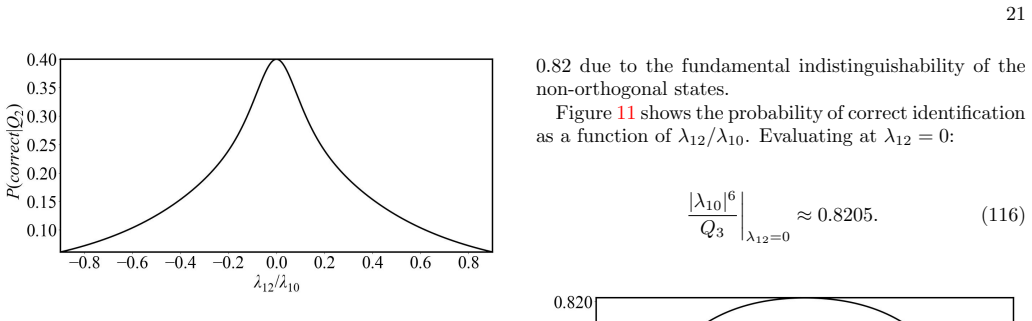
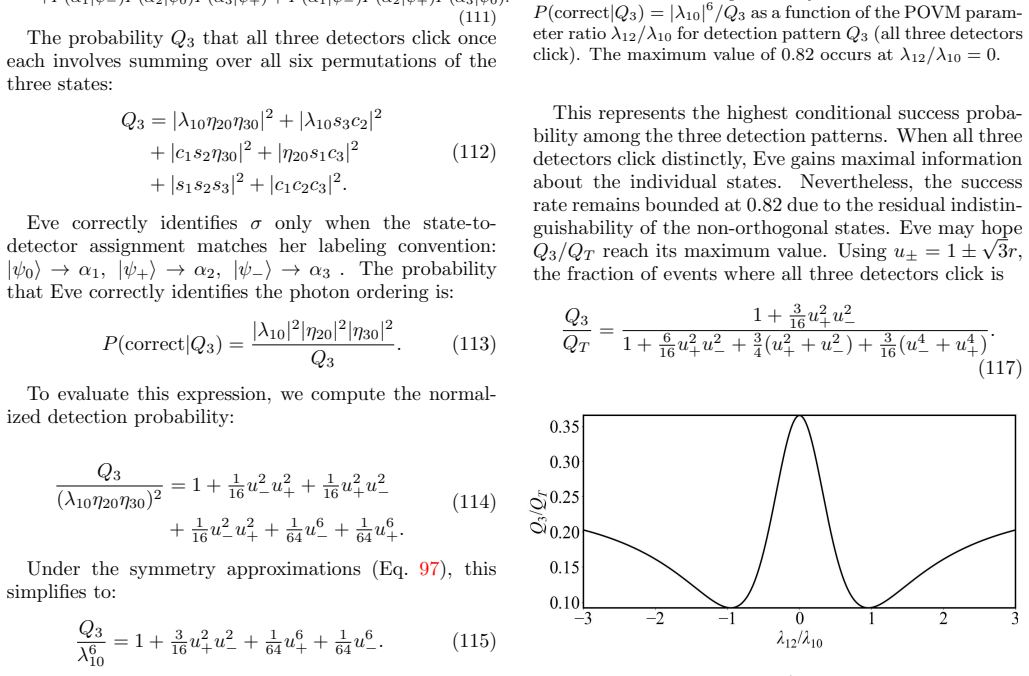
This optimization is illustrated in Figure 10, which shows the probability of correct identification rate as a function ofλ 12/λ10 when two similar detectors click. The maximum value of 0.4 occurs atλ 12 = 0. c. Case 3: Each detector clicks once (Q 3: permuta- tions of(i, j, k))The most informative scenario for Eve occurs when each photon triggers a diffe...
-
[5]
Role of the Fourth Detector and Completeness A complete measurement in the four-dimensional Hilbert space requires four orthogonal measurement op- erators{|α 1⟩,|α 2⟩,|α 3⟩,|α 4⟩}. Since Alice’s three states lie in a two-dimensional subspace spanned by{|ϕ0⟩,|ϕ 2⟩}, two important questions arise: can Eve gain additional information by using multiple detect...
-
[6]
This represents a substantial reduction from the binary discrimination bound
Final Security Bound and Comparison Eve’s maximum success probability of 54%, the ternary discrimination bound, cannot be exceeded regardless of computational resources or measurement technology. This represents a substantial reduction from the binary discrimination bound. Appendix C corroborates this bound through an independent POVM/permutation- uncerta...
-
[7]
Correct Derivation forT A andT B With Non-Ideal Angles a. Cancellation of the which-path tags in the ideal case In the ideal version of the protocol, Alice and Bob use polarization rotatorsT A andT B that apply opposite ro- tations of equal magnitude, TA =R(θ), T B =R(−θ), (A1) 25 hence that the combined action on the two interferometer arms is: (TB ⊗T A)...
-
[8]
Revised No-Cloning Derivation a. No-cloning constraint for nonorthogonal channel states Let{|ϕ i⟩}be the four channel states of the binary quantum eraser protocol. If a perfect cloning machine existed, it would implement a unitaryUsuch that: U(|ϕ i⟩ ⊗ |0⟩) =|ϕ i⟩ ⊗ |ϕi⟩, (A14) for alli. Taking the inner product between the outputs for two different states...
-
[9]
Trine-state structure of the ternary encoding In the ternary quantum eraser protocol, Alice encodes each logical symbol using one of the three symmetric po- larization states: |A1⟩,|A 2⟩,|A 3⟩, (C1) separated by 120 ◦ in the equatorial plane of the Bloch sphere, with pairwise overlap⟨A i|Aj⟩=− 1 2 fori̸=j (Eq. 60), forming a trine ensemble. Because the in...
-
[10]
Optimal POVM for three symmetric states (Helstrom solution) ForKequally likely symmetric pure states forming a representation of a cyclic group, the optimal measure- ment is known to be the square-root measurement (SRM) or equivalently the Helstrom measurement, which pre- serves the symmetry of the ensemble. For three trine states|ψ i⟩with prior probabili...
-
[11]
Eve’s access to three photons and the role of temporal ordering In the ternary protocol, Alice does not send a single photon corresponding to a single trine state. Instead, she sends a group of three photons, each prepared in one of the three non-orthogonal states|A 1⟩,|A 2⟩,|A 3⟩, arranged in a secret temporal ordering. Let the temporal ordering for logi...
-
[12]
C5) with the permutation uncertainty aris- ing from Alice’s randomized ordering (Eqs
Final bound Combining the POVM discrimination limit for each photon (Eq. C5) with the permutation uncertainty aris- ing from Alice’s randomized ordering (Eqs. C8–C11), we obtain the security bound stated in the main text: PEvemax ≈0.54.Thus the ternary quantum eraser pro- tocol reduces Eve’s maximum information gain from the binary-eraser ceiling of 0.85 ...
-
[13]
Beam-splitter The ideal beam splitter transformation, characterized by the mixing angleθ=π/4 for a 50:50 splitting ra- tio, becomes in practice subject to small deviations. We parameterize the imperfection of the first beam splitter BS1 through a deviationδ 1 such thatθ 1 = π 4 +δ 1.Simi- larly, for the second beam splitter BS2 with deviationδ 2: θ2 = π 4...
-
[14]
Decoherence Decoherence represents a more fundamental imperfec- tion arising from environmental interactions that destroy the coherent superposition between the interferometer paths. We model this effect by allowing the photon in each path to decay into orthogonal states that no longer participate in interference. After the first beam split- ter, the quan...
-
[15]
Polarization rotators The polarization rotators employed by Alice and Bob also exhibit imperfections, deviating from the ideal 45◦ rotation angles. We characterize these deviations through four independent parameters:β A andµ A for Alice’s rotators in the upper and lower paths, andβ B andµ B for Bob’s corresponding rotators. The imperfect rotator operator...
-
[16]
For simplicity, we assume symmetric decoher- enceσ u =σ l ≡σthroughout
Analysis of imperfections We now analyze how these imperfections modify the detection statistics for each of the four encoding config- urations. For simplicity, we assume symmetric decoher- enceσ u =σ l ≡σthroughout. When neither Alice nor Bob activates their rotators, the initial state of Eq. (D1) propagates through the sec- ond beam splitter to yield: c...
-
[17]
C. H. Bennett and G. Brassard, Quantum cryptography: Public key distribution and coin tossing, Theor. Comput. Sci.560, 7 (2014)
work page 2014
-
[18]
A. K. Ekert, Quantum cryptography based on bell’s the- orem, Phys. Rev. Lett.67, 661 (1991)
work page 1991
- [19]
-
[20]
F. Xu, X. Ma, Q. Zhang, H.-K. Lo, and J.-W. Pan, Se- cure quantum key distribution with realistic devices, Rev. Mod. Phys.92, 025002 (2020)
work page 2020
-
[21]
S. Pirandola, U. L. Andersen, L. Banchi, M. Berta, D. Bunandar, R. Colbeck, D. Englund, T. Gehring, C. Lupo, C. Ottaviani, J. L. Pereira, M. Razavi, J. Sham- sul Shaari, M. Tomamichel, V. C. Usenko, G. Vallone, P. Villoresi, and P. Wallden, Advances in quantum cryp- tography, Adv. Opt. Photon.12, 1012 (2020)
work page 2020
-
[22]
Y.-L. Tang, H.-L. Yin, S.-J. Chen, Y. Liu, W.-J. Zhang, X. Jiang, L. Zhang, J. Wang, L.-X. You, J.-Y. Guan, D.- X. Yang, Z. Wang, H. Liang, Z. Zhang, N. Zhou, X. Ma, T.-Y. Chen, Q. Zhang, and J.-W. Pan, Measurement- device-independent quantum key distribution over 200 km, Phys. Rev. Lett.113, 190501 (2014)
work page 2014
- [23]
-
[24]
J. Yin, Y. Cao, Y.-H. Li, S.-K. Liao, L. Zhang, J.-G. Ren, W.-Q. Cai, W.-Y. Liu, B. Li, H. Dai, G.-B. Li, Q.-M. Lu, Y.-H. Gong, Y. Xu, S.-L. Li, F.-Z. Li, Y.-Y. Yin, Z.-Q. Jiang, M. Li, J.-J. Jia, G. Ren, D. He, Y.-L. Zhou, X.-X. Zhang, N. Wang, X. Chang, Z.-C. Zhu, N.-L. Liu, Y.-A. Chen, C.-Y. Lu, R. Shu, C.-Z. Peng, J.-Y. Wang, and J.- W. Pan, Satellite...
work page 2017
-
[25]
Z. Cao, L. Wang, K. Liang, G. Chai, and J. Peng, Continuous-variable quantum secure direct communica- tion based on gaussian mapping, Phys. Rev. Appl.16, 024012 (2021)
work page 2021
-
[26]
W. K. Wootters and W. H. Zurek, A single quantum cannot be cloned, Nature299, 802 (1982)
work page 1982
-
[27]
Dieks, Communication by epr devices, Phys
D. Dieks, Communication by epr devices, Phys. Lett. A 31 92, 271 (1982)
work page 1982
-
[28]
V. Scarani, H. Bechmann-Pasquinucci, N. J. Cerf, M. Duˇ sek, N. L¨ utkenhaus, and M. Peev, The security of practical quantum key distribution, Rev. Mod. Phys. 81, 1301 (2009)
work page 2009
- [29]
-
[30]
M. Pereira, M. Curty, and K. Tamaki, Quantum key distribution with flawed and leaky sources (2019), arXiv:1902.02126 [quant-ph]
- [31]
-
[32]
N. Jain, E. Anisimova, I. Khan, V. Makarov, C. Mar- quardt, and G. Leuchs, Trojan-horse attacks threaten the security of practical quantum cryptography, New J. Phys. 16, 123030 (2014)
work page 2014
- [33]
-
[34]
Salih, Quantum erasure cryptography, Front
H. Salih, Quantum erasure cryptography, Front. Phys.4, 16 (2016)
work page 2016
-
[35]
M. O. Scully and K. Dr¨ uhl, Quantum eraser: A pro- posed photon correlation experiment concerning observa- tion and “delayed choice” in quantum mechanics, Phys. Rev. A25, 2208 (1982)
work page 1982
-
[36]
Y.-H. Kim, R. Yu, S. P. Kulik, Y. Shih, and M. O. Scully, Delayed “choice” quantum eraser, Phys. Rev. Lett.84, 1 (2000)
work page 2000
-
[37]
Y. Aharonov and M. S. Zubairy, Time and the quantum: Erasing the past and impacting the future, Science307, 875 (2005)
work page 2005
- [38]
-
[39]
C. W. Helstrom, Quantum detection and estimation the- ory, J. Stat. Phys.1, 231 (1969)
work page 1969
-
[40]
H. Bechmann-Pasquinucci and A. Peres, Quantum cryp- tography with 3-state systems, Phys. Rev. Lett.85, 3313 (2000)
work page 2000
-
[41]
G.-L. Long and X.-S. Liu, Theoretically efficient high- capacity quantum-key-distribution scheme, Phys. Rev. A 65, 032302 (2002)
work page 2002
-
[42]
F.-G. Deng, G. L. Long, and X.-S. Liu, Two-step quan- tum direct communication protocol using the Einstein- Podolsky-Rosen pair block, Phys. Rev. A68, 042317 (2003)
work page 2003
-
[43]
K. Br´ adler and C. Weedbrook, Security proof of continuous-variable quantum key distribution using three coherent states, Phys. Rev. A97, 022310 (2018)
work page 2018
-
[44]
G. Chen, Y. Wang, L. Jian, Y. Zhou, and S. Liu, Ternary quantum key distribution protocol based on hadamard gate, Int. J. Theor. Phys.61, 26 (2022)
work page 2022
-
[45]
S. M. Barnett and S. Croke, Quantum state discrimina- tion, Adv. Opt. Photon.1, 238 (2009)
work page 2009
-
[46]
Bruß, Optimal eavesdropping in quantum cryptogra- phy with six states, Phys
D. Bruß, Optimal eavesdropping in quantum cryptogra- phy with six states, Phys. Rev. Lett.81, 3018 (1998)
work page 1998
- [47]
-
[48]
R. Fickler and S. Prabhakar, Quantum communication with structured photons, inStructured Light for Opti- cal Communication, Nanophotonics, edited by M. D. Al- Amri, D. L. Andrews, and M. Babiker (Elsevier, Amster- dam, The Netherlands, 2021) Chap. 8, pp. 205–236
work page 2021
-
[49]
Bebrov, Novel encoding–decoding procedure for quan- tum key distribution, Quantum Inf
G. Bebrov, Novel encoding–decoding procedure for quan- tum key distribution, Quantum Inf. Process.20, 325 (2021)
work page 2021
-
[50]
Qureshi, The delayed-choice quantum eraser leaves no choice, Int
T. Qureshi, The delayed-choice quantum eraser leaves no choice, Int. J. Theor. Phys.60, 3076 (2021)
work page 2021
-
[51]
B.-G. Englert, M. O. Scully, and H. Walther, Quantum erasure in double-slit interferometers with which-way de- tectors, Am. J. Phys.67, 325 (1999)
work page 1999
-
[52]
M. Violaris, Counterfactuals in macroscopic quantum physics: Irreversibility, measurement and locality (2025), arXiv:2505.22834 [quant-ph]
-
[53]
J. A. Wheeler, The “past” and the “delayed-choice” double-slit experiment, inMathematical Foundations of Quantum Theory, edited by A. R. Marlow (Academic Press, 1978)
work page 1978
-
[54]
J. A. Wheeler and W. H. Zurek, eds.,Quantum Theory and Measurement(Princeton University Press, 1983)
work page 1983
-
[55]
C. A. Fuchs, N. Gisin, R. B. Griffiths, C.-S. Niu, and A. Peres, Optimal eavesdropping in quantum cryptogra- phy. I. Information bound and optimal strategy, Phys. Rev. A56, 1163 (1997)
work page 1997
-
[56]
C. W. Helstrom,Quantum Detection and Estimation Theory(Academic Press, 1976)
work page 1976
-
[57]
A. Halawaniet al., Information-theoretic security bounds for the ternary quantum eraser protocol (2026), manuscript in preparation
work page 2026
discussion (0)
Sign in with ORCID, Apple, or X to comment. Anyone can read and Pith papers without signing in.