Mutual information harvesting for circularly accelerated detectors
Pith reviewed 2026-05-10 15:19 UTC · model grok-4.3
The pith
Circularly accelerated detectors harvest mutual information that oscillates with separation near reflecting boundaries.
A machine-rendered reading of the paper's core claim, the machinery that carries it, and where it could break.
Core claim
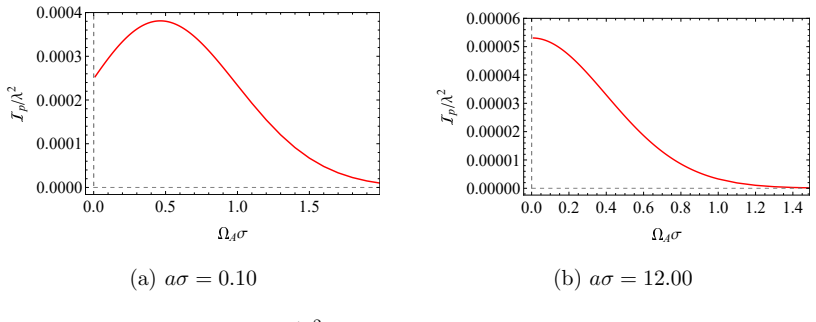
The mutual information harvested by two circularly accelerated detectors coupled to a massless scalar field near a reflecting boundary exhibits oscillatory behavior as interdetector separation increases when acceleration is large and trajectory radius is small. The oscillations intensify near the boundary owing to coherent superposition of reflections. For fixed radius, larger acceleration produces larger peak mutual information. With rising acceleration, mutual information for small separations first increases then decreases while intermediate separations show oscillations. At large acceleration and small radius, mutual information with increasing energy gap first decreases, then oscillates
What carries the argument
The two-point correlation functions of the massless scalar field, used to compute the mutual information extracted by the pair of Unruh-DeWitt detectors.
If this is right
- For a fixed radius, increasing acceleration raises the peak value of the mutual information.
- Mutual information for small separations first rises then falls as acceleration grows.
- Oscillations appear in mutual information for intermediate separations with rising acceleration.
- Near the boundary the mutual information reaches its largest values and oscillates most strongly.
Where Pith is reading between the lines
- Acceleration and radius could serve as tunable parameters to control the amount and variability of harvested information.
- The role of boundary reflections suggests similar oscillatory patterns may appear in other bounded geometries or analog systems.
- Fast rotation modifies vacuum fluctuations in a way that might link linear Unruh effects to rotational analogs in quantum information extraction.
Load-bearing premise
The mutual information can be reliably obtained from the field's two-point functions under the standard weak-coupling perturbative treatment of the detectors without significant back-reaction.
What would settle it
A calculation or measurement showing strictly monotonic mutual information without oscillations when acceleration is increased at small radii and near the boundary would falsify the central claim.
Figures


read the original abstract
We investigate the mutual information harvesting of two circularly accelerated detectors that interact with the massless scalar fields near a reflecting boundary. We consider that the two detectors share a common rotational axis with the same acceleration and trajectory radius. As the interdetector separation increases, the mutual information may exhibit oscillatory behavior at large acceleration and small radius. For a fixed radius, a larger acceleration leads to a larger peak value of the mutual information. Near the boundary, the mutual information may oscillate and the maximum can be obtained. As the acceleration increases, the mutual information in a small interdetector separation first increases and then decreases. For an intermediate interdetector separation, the mutual information may oscillate with the increase of acceleration. For a not large interdetector separation, when we take large acceleration and small radius, as the energy gap increases, the mutual information first decreases, then oscillates, and finally goes to zero. The combination of large acceleration and small radius corresponds to the fast rotation, which significantly modifies the vacuum fluctuations of the field, leading to the oscillatory behavior. Furthermore, the oscillation intensifies near the boundary, which indicates that it is related to the coherent superposition of boundary reflections.
Editorial analysis
A structured set of objections, weighed in public.
Referee Report
Summary. The manuscript studies mutual information harvesting by two Unruh-DeWitt detectors undergoing identical circular acceleration around a common axis while interacting with a massless scalar field near a reflecting boundary. The authors report that the mutual information exhibits oscillatory behavior as a function of inter-detector separation for large accelerations and small radii (corresponding to fast rotation), with oscillations intensifying near the boundary due to modified vacuum fluctuations and coherent boundary reflections. They further describe parameter dependencies, including how mutual information varies with acceleration (initial increase then decrease for small separations), energy gap (decrease then oscillation then zero for large a and small R), and other regimes.
Significance. If the results hold under a controlled approximation, this would extend entanglement harvesting literature to mutual information in circular accelerated trajectories with boundaries, illustrating how non-inertial motion can induce oscillatory quantum correlations. It adds to studies of the Unruh effect and relativistic quantum information by highlighting boundary and rotation effects on field correlators. The work could interest researchers in quantum field theory with boundaries and detector models, though the qualitative abstract and potential perturbative limitations reduce immediate impact.
major comments (1)
- [Computational method section] The central claim of oscillatory mutual information for large acceleration a and small radius R rests on the second-order perturbative calculation of the reduced density matrix using the two-point Wightman function. However, as the correlations are enhanced in this regime (due to acceleration and boundary reflections via method of images), the dimensionless quantity λ² times the integrated correlator may approach or exceed O(1), rendering higher-order terms important. This undermines the reliability of the reported oscillations without additional validation such as error estimates or non-perturbative checks. (Computational method section)
minor comments (3)
- [Abstract] The abstract describes qualitative behaviors but does not include any equations, numerical methods, or error estimates, contrary to standard practice for computational papers in this field.
- Notation for parameters such as acceleration a, radius R, energy gap Ω, and separation d should be consistently defined early in the paper with clear dimensionless combinations used in the analysis.
- Figure captions should clearly indicate the specific parameter values (a, R, Ω, d) used for each plot to allow reproducibility and direct comparison with the described regimes.
Simulated Author's Rebuttal
We thank the referee for the careful reading and constructive feedback on our manuscript. We address the major comment point by point below, with a commitment to revise the manuscript where appropriate to strengthen the presentation of our results.
read point-by-point responses
-
Referee: [Computational method section] The central claim of oscillatory mutual information for large acceleration a and small radius R rests on the second-order perturbative calculation of the reduced density matrix using the two-point Wightman function. However, as the correlations are enhanced in this regime (due to acceleration and boundary reflections via method of images), the dimensionless quantity λ² times the integrated correlator may approach or exceed O(1), rendering higher-order terms important. This undermines the reliability of the reported oscillations without additional validation such as error estimates or non-perturbative checks. (Computational method section)
Authors: We appreciate the referee highlighting this critical point on the validity of the perturbative approximation. Our calculations are performed in the weak-coupling regime, where we select the detector-field coupling λ sufficiently small that the second-order contribution to the reduced density matrix remains the leading term. For the specific parameter values reported (including large a and small R), we have ensured through direct numerical evaluation that λ² times the integrated Wightman correlator stays well below unity (typically ≪ 0.1), consistent with the perturbative expansion. That said, we agree that explicit validation would improve the manuscript's rigor. We will revise the Computational method section (and add an appendix if needed) to include error estimates, such as plots or tables of the magnitude of λ² ∫ W(τ,τ') dτ dτ' across the relevant parameter space, particularly in the regimes exhibiting oscillations. This will confirm that higher-order terms do not alter the qualitative features reported. No non-perturbative methods are employed in the current work, but the added estimates will address the concern directly. revision: yes
Circularity Check
No circularity: direct perturbative computation from field correlators
full rationale
The paper computes mutual information harvesting via the standard second-order perturbative expansion of the Unruh-DeWitt detector interaction with the massless scalar field, extracting I(A:B) from the two-point Wightman functions along the circular trajectories (including method-of-images boundary contributions). No parameters are fitted to the target mutual information, no self-definitional loops appear in the derivation, and the oscillatory behavior is reported as an output of the explicit integrals rather than an input assumption. The central claims rest on direct evaluation of the reduced density matrix elements without reducing to self-citation chains or renamed empirical patterns. This is a self-contained numerical/analytic result within the weak-coupling framework.
Axiom & Free-Parameter Ledger
free parameters (4)
- acceleration a
- trajectory radius R
- energy gap Omega
- inter-detector separation d
axioms (3)
- domain assumption Massless scalar field in Minkowski spacetime with Dirichlet (reflecting) boundary conditions
- domain assumption Unruh-DeWitt detector model with linear coupling to the field
- domain assumption Weak-coupling, first-order perturbation theory for the interaction
Reference graph
Works this paper leans on
-
[1]
10, we can observe strong oscillation due to the superposition of C1 and C2. For a large 10 0 1 2 3 4 0.00 0.02 0.04 0.06 0.08 0.10 z / p/ 2 /ΩA=0 /ΩA=10.00 /ΩA= 0 1 2 3 0.000000 5 × 10⁻⁶ 0.000010 0.000015 0.000020 0.000025 0.000030 /σ p/λ2 ΔΩ/ΩA=0 ΔΩ/ΩA=10.00 ΔΩ/ΩA=15.00 (a) aσ = 0. 10, L/σ = 0. 10 (b) aσ = 0. 10, L/σ = 10. 00 0.0 0.5 1.0 1.5 0.00 0.01 0...
-
[2]
× 10-6 0.000010 0.000015 0.000020 Aσ p/λ2 (a) aσ = 0. 10, R/σ = 0. 02 (b) aσ = 5. 00, R/σ = 0. 02 0.0 0.5 1.0 1.5 0.00 0.01 0.02 0.03 0.04 0.05 0.06 Aσ p/λ2 0.0 0.5 1.0 1.5 2.0 2.5 0.000 0.002 0.004 0.006 0.008 0.010 Aσ p/λ2 (c) aσ = 0. 10, R/σ = 10. 00 (d) aσ = 5. 00, R/σ = 10. 00 FIG. 11: The mutual information Ip/λ 2 as a function of Ω Aσ is plotted fo...
work page 2023
-
[3]
J. von Neumann, Thermodynamik quantenmechanischer ges amtheiten, Nachrichten von Der Gesellschaft Der Wissenschaften Zu G¨ ottingen, Mathematisch-Physikalische Klasse 1927, 273 (1927)
work page 1927
-
[4]
C. E. Shannon, A mathematical theory of communication, B ell Syst. Tech. J. 27, 379 (1948)
work page 1948
-
[5]
R. M. Fano, Transmission of Information: A Statistical T heory of Communications (The MIT Press, 1961)
work page 1961
-
[6]
Wehrl, General properties of entropy, Rev
A. Wehrl, General properties of entropy, Rev. Mod. Phys. 50, 221 (1978)
work page 1978
-
[7]
N. J. Cerf and C. Adami, Negative Entropy and Information in Quantum Mechanics, Phys. Rev. Lett. 79, 5194 (1997)
work page 1997
- [8]
-
[9]
W. G. Unruh, Notes on black-hole evaporation, Phys. Rev. D 14, 870 (1976)
work page 1976
-
[10]
P. M. Alsing and G. J. Milburn, Teleportation with a Unifo rmly Accelerated Partner, Phys. Rev. Lett. 91, 180404 (2003)
work page 2003
-
[11]
A. Peres and D. R. Terno, Quantum information and relativ ity theory, Rev. Mod. Phys. 76, 93 (2004). 17
work page 2004
-
[12]
I. Fuentes-Schuller and R. B. Mann, Alice Falls into a Bl ack Hole: Entanglement in Noninertial Frames, Phys. Rev. Lett. 95, 120404 (2005)
work page 2005
-
[13]
A. G. S. Landulfo and G. E. A. Matsas, Sudden death of enta nglement and teleportation fidelity loss via the Unruh effect, Phys. Rev. A 80, 032315 (2009)
work page 2009
-
[14]
R. B. Mann and T. C. Ralph, Relativistic quantum informa tion, Classical Quantum Gravity 29, 220301 (2012)
work page 2012
-
[15]
S. J. Summers and R. Werner, The vacuum violates Bell’s i nequalities, Phys. Lett. A 110, 257 (1985)
work page 1985
-
[16]
Valentini, Non-local correlations in quantum elect rodynamics, Phys
A. Valentini, Non-local correlations in quantum elect rodynamics, Phys. Lett. A 153, 321 (1991)
work page 1991
-
[17]
Reznik, Entanglement from the Vacuum, Found
B. Reznik, Entanglement from the Vacuum, Found. Phys. 33, 167 (2003)
work page 2003
- [18]
-
[19]
E. Mart ´ ın-Mart ´ ınez and B. C. Sanders, Precise space-time positioning for entanglement har- vesting, New J. Phys. 18, 043031 (2016)
work page 2016
-
[20]
S. Kukita and Y. Nambu, Harvesting Large Scale Entangle ment in de Sitter Space with Multiple Detectors, Entropy 19, 449 (2017)
work page 2017
-
[21]
L. J. Henderson, R. A. Hennigar, R. B. Mann, A. R. H. Smith , and J. Zhang, Harvesting entanglement from the black hole vacuum, Classical Quantum Gravity 35, 21LT02 (2018)
work page 2018
-
[22]
L. J. Henderson, R. A. Hennigar, R. B. Mann, A. R. H. Smith , and J. Zhang, Entangling detectors in anti-de Sitter space, J. High Energy Phys. 2019, 178 (2019)
work page 2019
-
[23]
W. Cong, E. Tjoa, and R. B. Mann, Entanglement harvestin g with moving mirrors, J. High Energy Phys. 2019, 021 (2019)
work page 2019
-
[24]
J. Koga, K. Maeda, and G. Kimura, Entanglement extracte d from vacuum into accelerated Unruh-DeWitt detectors and energy conservation, Phys. Rev . D 100, 065013 (2019)
work page 2019
-
[25]
J. Zhang and H. Yu, Entanglement harvesting for Unruh-D eWitt detectors in circular motion, Phys. Rev. D 102, 065013 (2020)
work page 2020
-
[26]
Z. Liu, J. Zhang, and H. Yu, Entanglement harvesting in t he presence of a reflecting boundary, J. High Energy Phys. 2021, 020 (2021)
work page 2021
-
[27]
Z. Liu, J. Zhang, R. B. Mann, and H. Yu, Does acceleration assist entanglement harvesting?, Phys. Rev. D 105, 085012 (2022). 18
work page 2022
-
[28]
H. Hu, J. Zhang, and H. Yu, Harvesting entanglement by no n-identical detectors with different energy gaps, J. High Energy Phys. 2022, 112 (2022)
work page 2022
-
[29]
C. Suryaatmadja, R. B. Mann, and W. Cong, Entanglement h arvesting of inertially moving Unruh-DeWitt detectors in Minkowski spacetime, Phys. Rev. D 106, 076002 (2022)
work page 2022
- [30]
-
[31]
E. G. Brown, Thermal amplification of field-correlation harvesting, Phys. Rev. A 88, 062336 (2013)
work page 2013
-
[32]
A. Pozas-Kerstjens and E. Mart ´ ın-Mart ´ ınez, Harvesting correlations from the quantum vac- uum, Phys. Rev. D 92, 064042 (2015)
work page 2015
-
[33]
P. Simidzija and E. Mart ´ ın-Mart ´ ınez, Harvesting correlations from thermal and squeezed coherent states, Phys. Rev. D 98, 085007 (2018)
work page 2018
-
[34]
K. Gallock-Yoshimura and R. B. Mann, Entangled detecto rs nonperturbatively harvest mutual information, Phys. Rev. D 104, 125017 (2021)
work page 2021
-
[35]
A. Sahu, I. Melgarejo-Lermas, and E. Mart ´ ın-Mart ´ ınez, Sabotaging the harvesting of correla- tions from quantum fields, Phys. Rev. D 105, 065011 (2022)
work page 2022
- [36]
-
[37]
Z. Liu, J. Zhang, and H. Yu, Harvesting correlations fro m vacuum quantum fields in the presence of a reflecting boundary, J. High Energy Phys. 2023, 184 (2023)
work page 2023
- [38]
-
[39]
L. Bozanic, M. Naeem, K. Gallock-Yoshimura, and R. B. Ma nn, Correlation harvesting be- tween particle detectors in uniform motion, Phys. Rev. D 108, 105017 (2023)
work page 2023
-
[40]
S. Wang, M. R. Preciado-Rivas, and R. B. Mann, Harvestin g information across the horizon, J. High Energy Phys. 2025, 254 (2025)
work page 2025
-
[41]
S. Liu, X. Huang, and S. Wu, The influence of gravitationa l wave on tripartite quantum mutual information harvesting, Eur. Phys. J. C 85, 861 (2025)
work page 2025
-
[42]
N.D. Birrell and P.C.W. Davies, Quantum Fields in Curve d Space (Cambridge University Press, Cambridge, 1982). 19
work page 1982
discussion (0)
Sign in with ORCID, Apple, or X to comment. Anyone can read and Pith papers without signing in.