Robust topological surface states in skyrmion-host magnets Eu(Ga,Al)4: evidence for dual topology
Pith reviewed 2026-05-10 14:19 UTC · model grok-4.3
The pith
Eu(Ga,Al)4 compounds host both skyrmions and robust topological surface states from bulk Dirac nodal lines, establishing dual topology.
A machine-rendered reading of the paper's core claim, the machinery that carries it, and where it could break.
Core claim
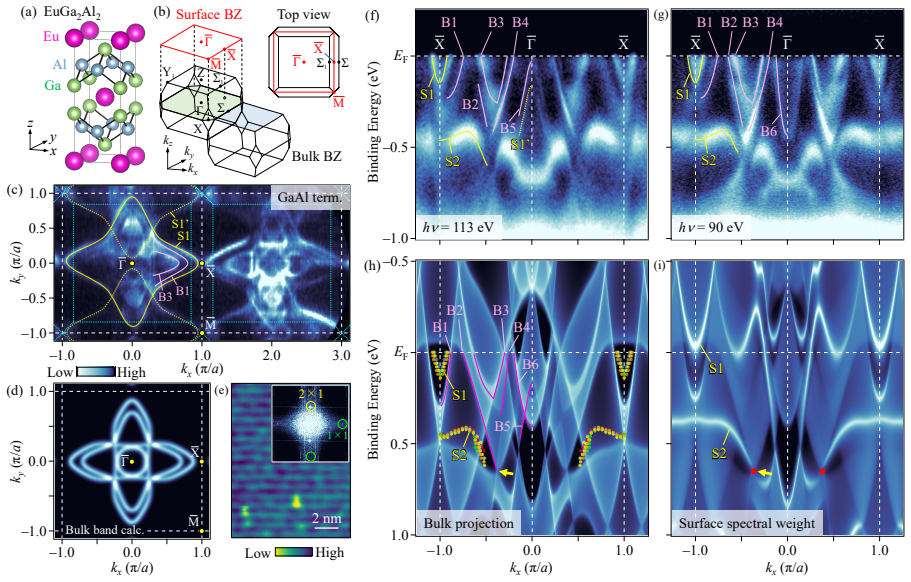
Direct ARPES measurements show topological surface states stemming from bulk Dirac nodal lines in Eu(Ga,Al)4. These states remain stable against a 2×1 surface reconstruction, changes in crystal surface termination, and the onset of helical antiferromagnetic order. Below the Néel temperature, magnetic ordering produces replica bands whose appearance exhibits clear surface-termination dependence, demonstrating magneto-topological coupling.
What carries the argument
Topological surface states originating from bulk Dirac nodal lines, observed to persist through multiple surface and magnetic perturbations.
If this is right
- The dual topology supplies a platform for exploring interactions between skyrmions and topological surface states.
- Magnetic ordering below the Néel temperature generates replica bands in the surface states.
- Surface termination can be used to tune the strength of the magneto-topological coupling.
- The family Eu(Ga,Al)4 realizes coexistence of real-space and momentum-space topology in one material.
Where Pith is reading between the lines
- The observed robustness may permit studies of topological states across magnetic phase boundaries without loss of protection.
- Analogous dual-topology behavior could be tested in other skyrmion-hosting compounds to identify a wider class.
- Tuning the helical order might offer a route to modulate the properties of the Dirac nodal lines themselves.
Load-bearing premise
The detected bands must be topological surface states from bulk Dirac nodal lines rather than trivial surface states or bulk projections, and the replica bands must arise specifically from the magnetic order.
What would settle it
If the photoemission spectra lack the expected linear dispersion protected against the listed perturbations, or if replica bands appear without the onset of antiferromagnetic order, the assignment of dual topology would be ruled out.
Figures


read the original abstract
The interplay between real-space topology such as magnetic skyrmions and momentum-space topology characterized by topological surface states (TSSs) is predicted to realize novel phenomena and functionalities, yet materials hosting both topologies are scarce. Skyrmion-hosting helimagnet family EuGa$_2$Al$_2$ and EuAl$_4$ has been a prime candidate for such a dual-topology system, but conclusive evidence for its momentum-space topology has remained elusive. We provide this evidence by directly observing TSSs that stem from bulk Dirac nodal lines using high-resolution angle-resolved photoemission spectroscopy. These TSSs are exceptionally robust against various perturbations such as a 2$\times$1 surface reconstruction, a chemical change in the termination of the crystal surface, and the onset of helical antiferromagnetic order. Crucially, below the Neel temperature, we observe replica bands driven by the magnetic ordering. Moreover, we demonstrate clear surface-termination dependence of this magneto-topological coupling. Our findings establish Eu(Ga$_{1-x}$Al$_x$)$_4$ as a dual-topology material and offer a rare platform to explore and control the interaction between the two fundamental topological realms.
Editorial analysis
A structured set of objections, weighed in public.
Referee Report
Summary. The manuscript reports high-resolution ARPES measurements on Eu(Ga,Al)4 compounds, claiming direct observation of topological surface states (TSSs) that originate from bulk Dirac nodal lines. It asserts that these TSSs remain robust against 2×1 surface reconstruction, changes in surface termination, and the onset of helical antiferromagnetic order below the Néel temperature, with additional observation of magnetic replica bands whose appearance depends on surface termination, thereby establishing the material family as a dual-topology platform combining skyrmion real-space topology with momentum-space topology.
Significance. If the band assignments and robustness claims hold, the work would establish a rare experimental platform for studying the interplay between skyrmions and topological surface states, with potential implications for magneto-topological phenomena. The reported termination-dependent magneto-topological coupling and persistence of TSSs through magnetic ordering would be notable additions to the literature on dual-topology materials.
major comments (3)
- [ARPES data analysis] ARPES data analysis (likely §3 or equivalent): the central claim that the observed dispersions are TSSs stemming from bulk Dirac nodal lines requires explicit photon-energy-dependent measurements or k_z mapping to demonstrate surface localization and to exclude projected bulk states or trivial surface resonances; the current assignment appears to rest primarily on visual similarity to expected nodal-line projections without such direct correspondence.
- [Magnetic ordering section] Magnetic ordering section (below T_N): the attribution of replica bands specifically to helical antiferromagnetic order (rather than matrix-element effects, residual reconstruction, or other perturbations) is load-bearing for the magneto-topological coupling claim, yet lacks quantitative modeling of the magnetic Brillouin zone folding or direct comparison to calculated surface states under the AF structure.
- [Robustness claims] Robustness claims: while checks against 2×1 reconstruction and termination change are presented, the absence of a calculated surface-projected band structure from the bulk Dirac nodal lines means the observed features could still be unrelated to the nodal lines, weakening the evidence for dual topology.
minor comments (2)
- [Figures] Figure captions and labels could more clearly indicate the expected positions of Dirac nodal line projections versus observed TSS dispersions for easier reader verification.
- [Methods] The manuscript would benefit from an explicit statement of the bulk band-structure calculation method (DFT parameters, etc.) used to identify the Dirac nodal lines.
Simulated Author's Rebuttal
We thank the referee for their thorough review and valuable suggestions. We have carefully considered each comment and revised the manuscript accordingly to strengthen the presentation of our ARPES results and the evidence for dual topology in Eu(Ga,Al)4. Below we address the major comments point by point.
read point-by-point responses
-
Referee: [ARPES data analysis] ARPES data analysis (likely §3 or equivalent): the central claim that the observed dispersions are TSSs stemming from bulk Dirac nodal lines requires explicit photon-energy-dependent measurements or k_z mapping to demonstrate surface localization and to exclude projected bulk states or trivial surface resonances; the current assignment appears to rest primarily on visual similarity to expected nodal-line projections without such direct correspondence.
Authors: We agree that demonstrating surface localization through kz dependence is important for confirming the topological surface states. In the original manuscript, we relied on the consistency of the observed bands with the projected bulk Dirac nodal lines across different surface conditions. To address this, we have added photon-energy-dependent ARPES data in the revised version (new Supplementary Figure S1), which shows that the candidate TSS dispersions exhibit minimal variation with photon energy, indicating negligible kz dispersion characteristic of surface states. We have also updated the text in Section 3 to explicitly discuss this evidence and rule out bulk projections. revision: yes
-
Referee: [Magnetic ordering section] Magnetic ordering section (below T_N): the attribution of replica bands specifically to helical antiferromagnetic order (rather than matrix-element effects, residual reconstruction, or other perturbations) is load-bearing for the magneto-topological coupling claim, yet lacks quantitative modeling of the magnetic Brillouin zone folding or direct comparison to calculated surface states under the AF structure.
Authors: The appearance of replica bands exclusively below the Néel temperature, with wavevector matching the helical magnetic ordering, provides strong evidence for their magnetic origin. We have revised the magnetic ordering section to include a quantitative comparison of the replica band positions to the expected folding from the magnetic Brillouin zone based on the known propagation vector of the helical AF order. While a full first-principles calculation of surface states under the AF structure is computationally intensive and not included in the current work, the observed termination dependence of the replicas supports the magneto-topological coupling interpretation. We have added this discussion to the manuscript. revision: partial
-
Referee: [Robustness claims] Robustness claims: while checks against 2×1 reconstruction and termination change are presented, the absence of a calculated surface-projected band structure from the bulk Dirac nodal lines means the observed features could still be unrelated to the nodal lines, weakening the evidence for dual topology.
Authors: We acknowledge that an explicit calculated surface-projected band structure would provide additional support. However, the manuscript includes DFT calculations of the bulk band structure showing the Dirac nodal lines, and the surface states are assigned based on their location in the surface Brillouin zone matching the projections of these nodal lines. The experimental robustness to surface perturbations, including reconstruction and termination changes, is difficult to explain for trivial resonances and supports the topological assignment. In the revised manuscript, we have expanded the discussion in the robustness section to better link the observations to the bulk nodal line projections. revision: partial
Circularity Check
No circularity: claims rest on direct ARPES observations without self-referential derivations
full rationale
The manuscript presents experimental evidence from high-resolution ARPES for topological surface states linked to bulk Dirac nodal lines in Eu(Ga,Al)4, with robustness tested against surface reconstructions, terminations, and magnetic order. No load-bearing steps involve equations, fitted parameters renamed as predictions, or self-citations that reduce the central claim to its own inputs by construction. The abstract and described observations are self-contained spectroscopic assignments and checks, independent of any prior fitted results or uniqueness theorems from the same authors. This is the expected outcome for a direct-observation paper with no theoretical derivation chain.
Axiom & Free-Parameter Ledger
axioms (1)
- domain assumption Standard ARPES interpretation rules for identifying topological surface states from bulk band crossings
Reference graph
Works this paper leans on
-
[1]
U. K. R¨ ossler, A. N. Bogdanov, and C. Pfleiderer, Nature442, 797 (2006)
work page 2006
-
[2]
S. M¨ uhlbauer, B. Binz, F. Jonietz, C. Pfleiderer, A. Rosch, A. Neubauer, R. Georgii, and P. B¨ oni, Science323, 1166767 (2009)
work page 2009
- [3]
-
[4]
M. Lee, N. Kang, Y. Onose, Y. Tokura, and N. P. Ong, Phys. Rev. Lett.102, 186601 (2009)
work page 2009
-
[5]
A. Neubauer, C. Pfleiderer, B. Binz, A. Rosch, R. Ritz, P. G. Niklowitz, and P. B¨ oni, Phys. Rev. Lett.102, 186602 (2009)
work page 2009
- [6]
-
[7]
A. Fert, V. Cros, and J. Sampaio, Nat. Nanotech.8, 152 (2013)
work page 2013
-
[8]
J. Sampaio, V. Cros, S. Rohart, A. Thiaville, and A. Fert, Nat. Nanotech.8, 839 (2013)
work page 2013
- [9]
-
[10]
C. L. Kane and E. J. Mele, Phys. Rev. Lett.95, 146802 (2005)
work page 2005
-
[11]
C. L. Kane and E. J. Mele, Phys. Rev. Lett.95, 226801 (2005)
work page 2005
-
[12]
B. A. Bernevig and S.-C. Zhang, Phys. Rev. Lett.96, 106802 (2006)
work page 2006
-
[13]
Y. Xia, D. Qian, D. Hsieh, L. Wray, A. Pal, H. Lin, A. Bansil, D. Grauer, Y. S. Hor, R. J. Cava, and M. Z. Hasan, Nat. Phys.5, 398 (2009)
work page 2009
-
[14]
Y. L. Chen, J. G. Analytis, J.-H. Chu, Z. K. Liu, S.-K. Mo, X. L. Qi, H. J. Zhang, D. H. Lu, X. Dai, Z. Fang, S. C. Zhang, I. R. Fisher, Z. Hussain, and Z.-X. Shen, Science325, 178 (2009)
work page 2009
-
[15]
M. Z. Hasan and C. L. Kane, Rev. Mod. Phys.82, 3045 (2010)
work page 2010
- [16]
-
[17]
Y. Ando, J. Phys. Soc. Jpn.82, 102001 (2013)
work page 2013
-
[18]
N. P. Armitage, E. J. Mele, and Ashvin Vishwanath, Rev. Mod. Phys.90, 015001 (2018)
work page 2018
- [19]
-
[20]
H. M. Hurst, D. K. Efimkin, J. Zang, and V. Galitski, Phys. Rev. B91, 060401(R) (2015)
work page 2015
-
[21]
D. Andrikopoulos, B. Sore, and J. De Boeck, J. Appl. Phys.119, 193903 (2016)
work page 2016
-
[22]
D. Kurebayashi and O. A. Tretiakov, Phys. Rev. Research4, 043105 (2022)
work page 2022
-
[23]
H. Wu, F. Groß, B. Dai, D. Lujan, S. A. Razavi, P. Zhang, Y. Liu, K. Sobotkiewich, J. F¨ orster, M. Weigand, G. Sch¨ utz, X. Li, J. Gr¨ afe, and K. L. Wang, Adv. Funct. Mater.32, 2003380 (2020)
work page 2020
-
[24]
J. M. Moya, J. Huang, S. Lei, K. Allen, Y. Gao, Y. Sun, M. Yi, and E. Morosan, Phys. Rev. B108, 064436 (2023)
work page 2023
-
[25]
A. Nakamura, T. Uejo, F. Honda, T. Takeuchi, H. Harima, E. Yamamoto, Y. Haga, K. Matsubayashi, Y. Uwatoko, M. Hedo, T. Nakama, and Y. Onuki, J. Phys. Soc. Jpn.84, 9 124711 (2015)
work page 2015
- [26]
-
[27]
S. Lei, K. Allen, J. Huang, J. M. Moya, T. C. Wu, B. Casas, Y. Zhang, J. S. Oh, M. Hashimoto, D. Lu, J. Denlinger, C. Jozwiak, A. Bostwick, E. Rotenberg, L. Balicas, R. Birgeneau, M. S. Foster, M. Yi, Y. Sun, and E. Morosan, Nat. Commun.14, 5812 (2023)
work page 2023
- [28]
- [29]
-
[30]
Y. Arai, K. Nakayama, A. Honma, S. Souma, D. Shiga, H. Kumigashira, T. Takahashi, K. Segawa, and T. Sato, Nat. Commun.17, 3162 (2026)
work page 2026
- [31]
- [32]
-
[33]
M. Kobata,, S.-i. Fujimori, Y. Takeda, T. Okane, Y. Saitoh, K. Kobayashi, H. Yamagami, A. Nakamura, M. Hedo, T. Nakama, and Y. Onuki, J. Phys. Soc. Jpn.85, 094703 (2016)
work page 2016
-
[34]
A.Eaton, B. Kuthanazhi, P. C. Canfield, B. Schrunk, N. H. Jo, Y. Kushnirenko, E. O’Leary, L.-L. Wang, and A. Kaminski, Phys. Rev. B110, 125150 (2024)
work page 2024
-
[35]
H. Miao, J. Bouaziz, G. Fabbris, W. R. Meier, F. Z. Yang, H. X. Li, C. Nelson, E. Vescovo, S. Zhang, A. D. Christianson, H. N. Lee, Y. Zhang, C. D. Batista, and S. Bl¨ ugel, Phys. Rev. X14, 011053 (2024)
work page 2024
- [36]
-
[37]
See Supplemental Material at (URL), which includes Refs. [30, 38, 47–53], for details of the experimental conditions, mesh grid noise reduction, band calculations, photon energy depen- dence of ARPES spectra, calculated FS, roles of SOC and magnetism, core level spectra, additional STM data, and magnetic band folding
-
[38]
M. Stavinoha, J. A. Cooley, S. G. Minasian, T. M. McQueen, S. M. Kauzlarich, C.-L. Huang, and E. Morosan, Phys. Rev. B97, 195146 (2018)
work page 2018
-
[39]
J. M. Moya, S. Lei, E. M. Clements, C. S. Kengle, S. Sun, K. Allen, Q. Li, Y. Y. Peng, and 10 A. A. Husain, Phys. Rev. Mater.6, 074201 (2022)
work page 2022
-
[40]
A. M. Vibhakar, D. D. Khalyavin, J. M. Moya, P. Manuel, F. Orlandi, S. Lei, E. Morosan, and A. Bombardi, Phys. Rev. B108, L100404 (2023)
work page 2023
-
[41]
L. M. Schoop, M. N. Ali, C. Straßer, A. Topp, A. Varykhalov, D. Marchenko, V. Duppel, S. S. P. Parkin, B. V. Lotsch, and C. R. Ast, Nat. Commun.7, 11696 (2016)
work page 2016
- [42]
-
[43]
D. W. Boukhvalov, R. Edla, A. Cupolillo, V. Fabio, R. Sankar, Y. Zhu, Z. Mao, J. Hu, P. Torelli, G. Chiarello, L. Ottaviano, and A. Politano, Adv. Funct. Mater.29, 1900438 (2019)
work page 2019
-
[44]
G. Chang, S.-Y. Xu, X. Zhou, S.-M. Huang, B. Singh, B. Wang, I. Belopolski, J. Yin, S. Zhang, A. Bansil, H. Lin, and M. Z. Hasan, Phys. Rev. Lett.119, 156401 (2017)
work page 2017
-
[45]
I. Belopolski, K. Manna, D. S. Sanchez, G. Chang, B. Ernst, J. Yin, S. S. Zhang, T. Cochran, N. Shumiya, H. Zheng, B. Singh, G. Bian, D. Multer, M. Litskevich, X. Zhou, S.-M. Huang, B. Wang, T.-R. Chang, S.-Y. Xu, A. Bansil, C. Felser, H. Lin, and M. Z. Hasan, Science365, 1278 (2019)
work page 2019
-
[46]
X. P. Yang, Y.-T. Yao, P. Zheng, S. Guan, H. Zhou, T. A. Cochran, C.-M. Lin, J.-X. Yin, X. Zhou, Z.-J. Cheng, Z. Li, T. Shi, M. S. Hossain, S. Chi, I. Belopolski, Y.-X. Jiang, M. Litskevich, G. Xu, Z. Tian, A. Bansil, Z. Yin, S. Jia, T.-R. Chang, and M. Z. Hasan, Nat. Commun.15, 7052 (2024)
work page 2024
-
[47]
M. Kitamura, S. Souma, A. Honma, D. Wakabayashi, H. Tanaka, A. Toyoshima, K. Amemiya, T. Kawakami, K. Sugawara, K. Nakayama, K. Yoshimatsu, H. Kumigashira, T. Sato, and K. Horiba, Rev. Sci. Instrum.93, 033906 (2022)
work page 2022
-
[48]
P. Giannozzi, S. Baroni, N. Bonini, M. Calandra, R. Car, C. Cavazzoni, D. Ceresoli, G. L. Chiarotti, M. Cococcioni, I. Dabo, A. D. Corso, S. Gironcoli, S. Fabris, G. Fratesi, R. Gebauer, U. Gerstmann, C. Gougoussis, A. Kokalj, M. Lazzeri, L. Martin-Samos, N. Marzari, F. Mauri, R. Mazzarello, S. Paolini, A. Pasquarello, L. Paulatto, C. Sbraccia, S. Scandol...
work page 2009
-
[49]
P. Giannozzi, O. Andreussi, T. Brumme, O. Bunau, M. B. Nardelli, M. Calandra, R. Car, C. Cavazzoni, D. Ceresoli, M. Cococcioni, N. Colonna, I. Carnimeo, A. D. Corso, S. Gironcoli, P. Delugas, R. A. DiStasio Jr, A. Ferretti, A. Floris, G. Fratesi, G. Fugallo, R. Gebauer, U. 11 Gerstmann, F. Giustino, T. Gorni, J. Jia, M. Kawamura, H.-Y. Ko, A. Kokalj, E. K...
work page 2017
- [50]
-
[51]
A. A. Mostofi, J. R. Yates, G. Pizzi, Y.-S. Lee, I. Souza, D. Vanderbilt, and N. Marzari, Comput. Phys. Commun.185, 2309 (2014)
work page 2014
-
[52]
Q. S. Wu, S. N. Zhang, H. F. Song, M. Troyer, and A. A. Soluyanov, Comput. Phys. Commun. 224, 405 (2018)
work page 2018
-
[53]
K. Momma and F. Izumi, J. Appl. Crystallogr.44, 1272 (2011). 12 –1.0–0.5 EF 2 nm –1.00.01.0–1.00.01.0 –1.0–0.50.00.51.0 3.02.01.00.0–1.0 –1.00.01.01.00.5 EF –0.5(c)ky(π/a) kx(π/a) ky(π/a) kx(π/a) –1.00.01.01.00.5EF HighLow(d) (e) S1 B1B3 2 nm HighLow S1’ Y1 X MΓΣΣ1ZXΓ kxkykz Bulk band calc. (a)EuGaAl xyz EuGa2Al2 X 2×11×1 Γ M Binding Energy (eV) –1.00.01....
work page 2011
discussion (0)
Sign in with ORCID, Apple, or X to comment. Anyone can read and Pith papers without signing in.