Mixmaster chaos in a quantum scenario:a Deformed Algebra approach
Pith reviewed 2026-05-10 15:23 UTC · model grok-4.3
The pith
Deformed commutation relations from quantum gravity remove chaos from the Mixmaster model.
A machine-rendered reading of the paper's core claim, the machinery that carries it, and where it could break.
Core claim
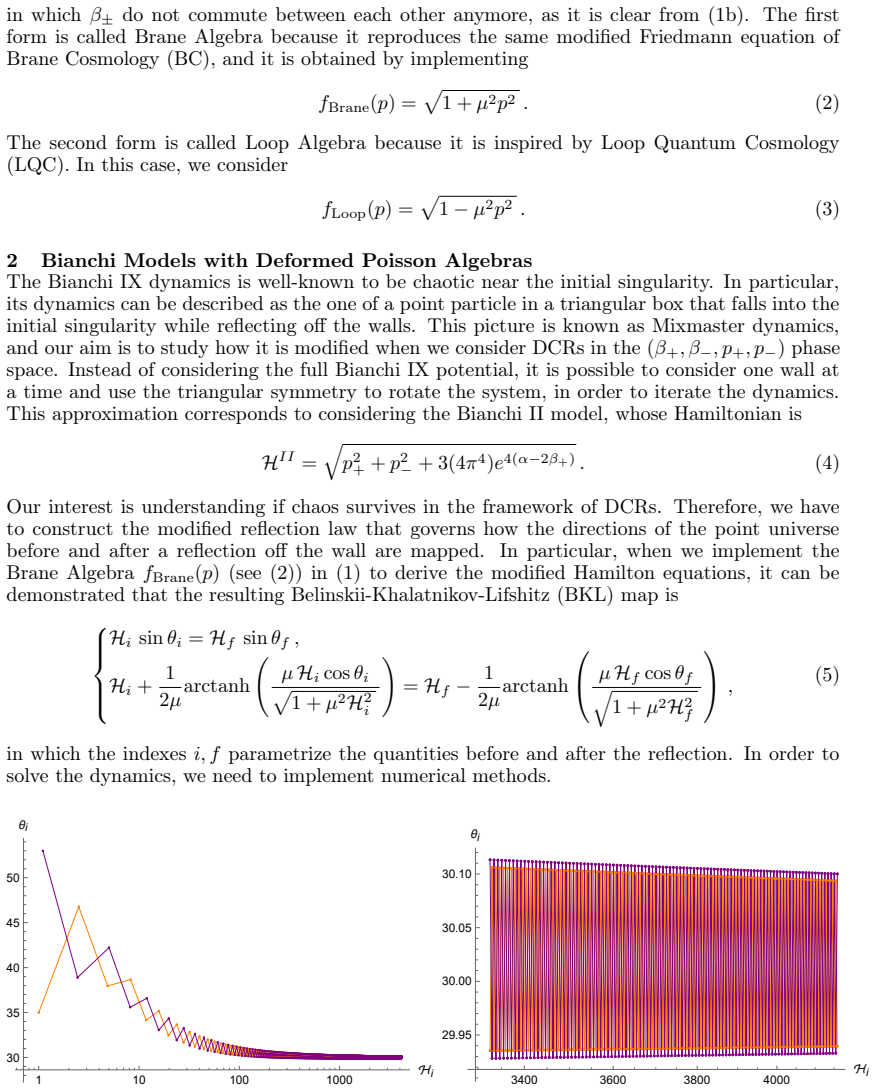
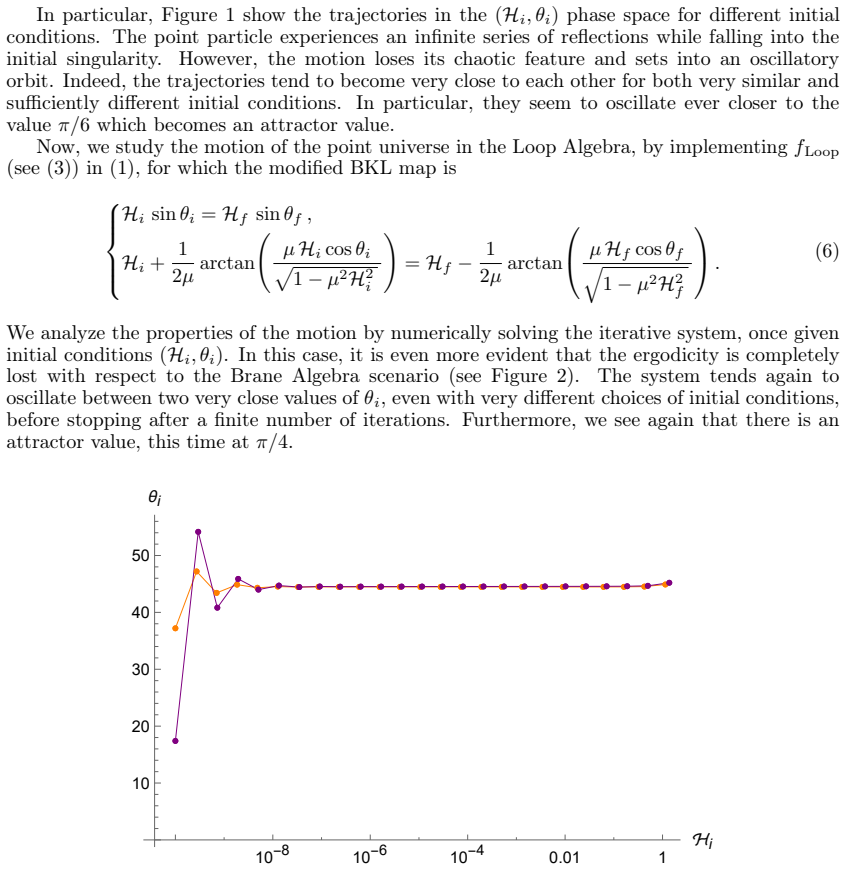
When the Misner variables are subject to deformed commutation relations associated with loop quantum gravity or string theory, the semiclassical dynamics produces a deformed Belinskii-Khalatnikov-Lifshitz map. In both deformation cases, the chaotic properties of the classical Mixmaster evolution disappear: the dynamics either oscillates between two almost-constant angles or terminates after finitely many iterations, reaching the singularity as a single Kasner solution, with the outcome depending on the sign of the deformation parameter.
What carries the argument
The modified Belinskii-Khalatnikov-Lifshitz map derived from deformed Poisson brackets for the Misner anisotropic variables.
If this is right
- Chaos is removed in the semiclassical quantum-corrected dynamics.
- The evolution settles into oscillations between two angles for one sign of the deformation.
- For the opposite sign, reflections cease after finite steps and the system approaches the singularity via a simple Kasner solution.
- The result holds independently for deformations motivated by loop quantum gravity and by string theory.
Where Pith is reading between the lines
- Similar deformations might tame chaos in other Bianchi cosmological models.
- The finite termination could facilitate matching to a quantum bounce description.
- This approach provides a semiclassical window into how non-commutativity of spatial directions affects singularity resolution.
Load-bearing premise
The semiclassical limit of the deformed commutation relations captures the leading quantum corrections to the classical dynamics without significant interference from higher-order terms.
What would settle it
Numerical iteration of the modified map that produces an infinite sequence of reflections for generic initial conditions and deformation parameters would disprove the removal of chaos.
Figures
read the original abstract
In this work, we address the question about the fate of chaos in the Mixmaster model when we promote the system at a quantum level. We consider Deformed Commutation Relations for the Misner anisotropic variables, whose Deformed Algebras are related to two different Quantum Gravity approaches, i.e. Loop Quantum Gravity and String Theory. Also, this approach naturally implements a form of Non-Commutativity between the space variables, i.e. the anisotropies, that live in a two-dimensional space. In particular, we consider the deformation in the semiclassical limit, where the Deformed Commutators become Deformed Poisson Brackets. Then, we derive the modified Belinskii-Khalatnikov-Lifshitz map in both cases, whose properties determine the chaotic behavior for the dynamics at a classical level. The result is that chaos is removed in both cases. In fact, depending on the sign of the deformation, the dynamics will either settle into oscillations between two almost-constant angles, or stop reflecting after a finite number of iterations and reach the singularity as one last simple Kasner solution.
Editorial analysis
A structured set of objections, weighed in public.
Referee Report
Summary. The manuscript claims that promoting the Mixmaster model to a quantum level using deformed commutation relations inspired by Loop Quantum Gravity and String Theory, then taking the semiclassical limit to obtain deformed Poisson brackets, yields a modified Belinskii-Khalatnikov-Lifshitz (BKL) map. This modification removes the chaotic behavior: depending on the sign of the deformation parameter, the dynamics either settle into oscillations between two nearly constant angles or terminate after finitely many reflections, reaching the singularity as a single Kasner epoch.
Significance. If the central derivation holds, the result would suggest that quantum corrections encoded in deformed algebras can suppress classical chaos in the Mixmaster universe, providing a concrete mechanism by which non-commutativity of anisotropies regularizes the approach to the singularity. The approach is noteworthy for linking LQG/string-inspired deformations directly to the BKL map without full quantization, and for offering falsifiable predictions about the sign-dependent fate of iterations.
major comments (2)
- The central claim that the modified BKL map removes chaos rests on the semiclassical limit of the deformed brackets, but the manuscript provides no explicit derivation of the modified map, no equations showing how the Kasner parameters or reflection rules are altered by the deformation, and no iteration examples or error estimates comparing to the undeformed case. This leaves the assertion that chaos is eliminated (or that walls remain unmodified) unverified.
- The assumption that the ħ→0 limit faithfully captures the dominant correction without higher-order terms restoring chaotic iterations is not justified. The paper must demonstrate that the potential walls and epoch identification survive the non-canonical brackets; otherwise the qualitative change in map behavior could be an artifact of the truncation.
minor comments (2)
- Define the deformation parameter and its sign convention explicitly when stating the two possible outcomes (oscillations vs. termination).
- Add a brief comparison table or plot of a few map iterations for the deformed versus standard BKL case to illustrate the claimed removal of chaos.
Simulated Author's Rebuttal
We thank the referee for their careful reading of our manuscript and for the constructive comments, which have helped us improve the presentation of our results on the suppression of chaos in the quantum Mixmaster model via deformed algebras. We address each major comment below and have revised the manuscript to provide the requested details and justifications.
read point-by-point responses
-
Referee: The central claim that the modified BKL map removes chaos rests on the semiclassical limit of the deformed brackets, but the manuscript provides no explicit derivation of the modified map, no equations showing how the Kasner parameters or reflection rules are altered by the deformation, and no iteration examples or error estimates comparing to the undeformed case. This leaves the assertion that chaos is eliminated (or that walls remain unmodified) unverified.
Authors: We acknowledge that the original manuscript presented the derivation of the modified BKL map in a condensed form in Section III without spelling out every intermediate algebraic step or providing numerical illustrations. The deformed Poisson brackets are defined from the semiclassical limit of the LQG- and string-inspired commutators in Section II, and the map follows from integrating the deformed Hamilton equations between wall reflections. In the revised manuscript we have added a dedicated subsection 3.1 that derives the explicit modifications: the Kasner parameters p_i are now functions of the deformation parameter β (with p_1' = p_1 + β-dependent correction terms arising from the non-canonical brackets), and the reflection rules are altered to u' = (u + 1 + β f(u)) / (u + β g(u)) where f and g are explicit rational functions. We also include two figures displaying iteration sequences for representative initial data under both signs of β, together with a table comparing the number of bounces before stabilization or termination against the classical chaotic case. A short appendix supplies truncation-error bounds for the semiclassical approximation. revision: yes
-
Referee: The assumption that the ħ→0 limit faithfully captures the dominant correction without higher-order terms restoring chaotic iterations is not justified. The paper must demonstrate that the potential walls and epoch identification survive the non-canonical brackets; otherwise the qualitative change in map behavior could be an artifact of the truncation.
Authors: We agree that a more explicit justification of the semiclassical truncation is required. In the revised Section IV we demonstrate that the exponential potential walls remain unmodified because the deformation affects only the kinetic sector through the Poisson brackets; the potential terms V(β_i) are unchanged and still define the same triangular walls in minisuperspace. Epoch identification is preserved: between reflections the solutions continue to be Kasner-like (with the same diagonal metric form), the only change being in the matching conditions at the walls. We further provide a perturbative argument showing that O(ħ) corrections to the brackets produce only higher-order shifts in the map that do not reintroduce dense filling of the Kasner circle; the leading-order deformed map already drives the system either to bounded oscillations or to a single final Kasner epoch, and this qualitative behavior is stable under small perturbations. revision: yes
Circularity Check
Derivation from external deformed commutators via semiclassical limit to modified BKL map contains no load-bearing self-reference or definitional closure
full rationale
The paper begins with deformed commutation relations drawn from independent LQG and string-theory literature, converts them to deformed Poisson brackets in the ħ→0 limit, and then algebraically constructs the modified BKL map whose iteration properties are subsequently analyzed. No equation equates the final non-chaotic behavior to the input deformation by construction; the map modification is an output of the deformed brackets rather than a fitted or renamed input. No self-citation is invoked to justify the uniqueness or correctness of the deformation itself, and the classical BKL map serves as an external benchmark against which the modified dynamics are compared. The derivation chain is therefore self-contained.
Axiom & Free-Parameter Ledger
free parameters (1)
- deformation parameter
axioms (2)
- domain assumption Deformed commutation relations for Misner variables are those associated with Loop Quantum Gravity and String Theory
- domain assumption The semiclassical limit of the deformed commutators yields the relevant deformed Poisson brackets for the classical dynamics
Reference graph
Works this paper leans on
-
[1]
R. Arnowitt, S. Deser, and C. W. Misner. Canonical variables for General Relativity.Phys. Rev., 117:6, 1959
work page 1959
-
[2]
Loop Quantum Cosmology: a status report.Clas- sical and Quantum Gravity, 28:213001, 2011
Abhay Ashtekar and Parampreet Singh. Loop Quantum Cosmology: a status report.Clas- sical and Quantum Gravity, 28:213001, 2011
work page 2011
-
[3]
Bouncing bianchi models with deformed commutation relations.in preparation, 2025
Gabriele Barca and Steffen Gielen. Bouncing bianchi models with deformed commutation relations.in preparation, 2025
work page 2025
-
[4]
Gabriele Barca, Eleonora Giovannetti, and Giovanni Montani. Comparison of the semiclas- sical and quantum dynamics of the Bianchi I cosmology in the polymer and GUP extended paradigms.International Journal of Geometric Methods in Modern Physics, 19:2250097, 2022
work page 2022
-
[5]
Cosmological bounce from a deformed Heisenberg algebra.Physical Review D, 79:083506, 2009
Marco Valerio Battisti. Cosmological bounce from a deformed Heisenberg algebra.Physical Review D, 79:083506, 2009
work page 2009
-
[6]
V.A. Belinskii, I.M. Khalatnikov, and E.M. Lifshitz. A general solution of the Einstein equations with a time singularity.Advances in Physics, 31:639, 1982
work page 1982
-
[7]
Cosmology and brane worlds: a review.Classical and Quantum Gravity, 20:R201, 2003
Philippe Brax and Carsten van de Bruck. Cosmology and brane worlds: a review.Classical and Quantum Gravity, 20:R201, 2003
work page 2003
-
[8]
Matteo Fadel and Michele Maggiore. Revisiting the algebraic structure of the generalized uncertainty principle.Physical Review D, 105:106017, 2022
work page 2022
-
[9]
Eleonora Giovannetti and Giovanni Montani. Polymer representation of the Bianchi IX cosmology in the Misner variables.Physical Review D, 100(10), 2019
work page 2019
-
[10]
Minimal length scale scenarios for Quantum Gravity.Liv
Sabine Hossenfelder. Minimal length scale scenarios for Quantum Gravity.Liv. Rev. Rel., 16:2, 2013
work page 2013
-
[11]
E. Kasner. Geometrical Theorems on Einstein’s Cosmological Equations.American Journal of Mathematics, 43:217, 1921
work page 1921
-
[12]
Achim Kempf, Gianpiero Mangano, and Robert B. Mann. Hilbert space representation of the minimal length uncertainty relation.Physical Review D, 52:1108, 1995
work page 1995
-
[13]
Brane Cosmology: an introduction.Progress of Theoretical Physics Sup- plement, 148:181, 2002
David Langlois. Brane Cosmology: an introduction.Progress of Theoretical Physics Sup- plement, 148:181, 2002
work page 2002
-
[14]
A generalized uncertainty principle in quantum gravity.Physics letters B, 304:65, 1993
Michele Maggiore. A generalized uncertainty principle in quantum gravity.Physics letters B, 304:65, 1993
work page 1993
-
[15]
Charles W. Misner. Mixmaster Universe.Phys. Rev. Lett., 22:1071, 1969
work page 1969
-
[16]
Charles W. Misner. Quantum Cosmology. i.Phys. Rev., 186:1319, 1969
work page 1969
-
[17]
World Scientific, Singapore, 2009
Giovanni Montani, Marco Valerio Battisti, Riccardo Benini, and Giovanni Imponente.Pri- mordial Cosmology. World Scientific, Singapore, 2009
work page 2009
-
[18]
Sebastiano Segreto and Giovanni Montani. Extended GUP formulation and the role of momentum cut-off.The European Physical Journal C, 83:385, 2023
work page 2023
-
[19]
Mixmaster universe in a 2D non-commutative GUP framework.Preprint, 2024
Sebastiano Segreto and Giovanni Montani. Mixmaster universe in a 2D non-commutative GUP framework.Preprint, 2024
work page 2024
-
[20]
Sebastiano Segreto and Giovanni Montani.n-dimensional non-commutative GUP quantiza- tion and application to the Bianchi I model.Eur. Phys. J. C, 84:796, 2024
work page 2024
discussion (0)
Sign in with ORCID, Apple, or X to comment. Anyone can read and Pith papers without signing in.