Probabilistic Feature Imputation and Uncertainty-Aware Multimodal Federated Aggregation
Pith reviewed 2026-05-10 14:00 UTC · model grok-4.3
The pith
Probabilistic feature imputation with calibrated uncertainty estimates enhances multimodal federated learning for chest X-ray classification.
A machine-rendered reading of the paper's core claim, the machinery that carries it, and where it could break.
Core claim
The central claim is that incorporating calibrated uncertainty into feature imputation networks enables safer and more effective handling of modality heterogeneity in federated medical imaging tasks. Specifically, P-FIN produces uncertainty estimates that are used via sigmoid gating to attenuate unreliable feature dimensions locally and through a weighted aggregation called Fed-UQ-Avg that prioritizes reliable clients globally, leading to improved AUC scores on CheXpert, NIH Open-I, and PadChest datasets with a maximum gain of 5.36% over deterministic baselines.
What carries the argument
The Probabilistic Feature Imputation Network (P-FIN) that outputs uncertainty estimates, combined with sigmoid gating for local use and Fed-UQ-Avg for global aggregation.
If this is right
- Imputed features receive dimension-specific reliability weights instead of uniform treatment.
- Federated model updates are aggregated with preference for clients showing reliable imputation.
- Classification performance improves consistently across multiple chest X-ray datasets.
- Up to 5.36 percent AUC increase is observed in the most challenging multimodal federated configurations.
Where Pith is reading between the lines
- This method may extend to other domains with incomplete multimodal data, such as combining different sensor types in autonomous systems.
- Future work could explore how the uncertainty calibration affects long-term model stability in ongoing federated training.
- Similar uncertainty mechanisms might be applied to other imputation strategies beyond neural networks in privacy-preserving settings.
Load-bearing premise
That the uncertainty estimates produced by P-FIN are well-calibrated and that using them for gating and weighting leads to better performance without introducing new biases.
What would settle it
Demonstrating that the uncertainty estimates are miscalibrated on held-out data or that the proposed gating and aggregation yield no performance gain or degrade accuracy compared to standard imputation on the same datasets.
Figures



read the original abstract
Multimodal federated learning enables privacy-preserving collaborative model training across healthcare institutions. However, a fundamental challenge arises from modality heterogeneity: many clinical sites possess only a subset of modalities due to resource constraints or workflow variations. Existing approaches address this through feature imputation networks that synthesize missing modality representations, yet these methods produce point estimates without reliability measures, forcing downstream classifiers to treat all imputed features as equally trustworthy. In safety-critical medical applications, this limitation poses significant risks. We propose the Probabilistic Feature Imputation Network (P-FIN), which outputs calibrated uncertainty estimates alongside imputed features. This uncertainty is leveraged at two levels: (1) locally, through sigmoid gating that attenuates unreliable feature dimensions before classification, and (2) globally, through Fed-UQ-Avg, an aggregation strategy that prioritizes updates from clients with reliable imputation. Experiments on federated chest X-ray classification using CheXpert, NIH Open-I, and PadChest demonstrate consistent improvements over deterministic baselines, with +5.36% AUC gain in the most challenging configuration.
Editorial analysis
A structured set of objections, weighed in public.
Referee Report
Summary. The manuscript proposes the Probabilistic Feature Imputation Network (P-FIN) for multimodal federated learning under modality heterogeneity in medical imaging. P-FIN produces imputed features together with uncertainty estimates that are asserted to be calibrated; these estimates are applied locally via sigmoid gating to down-weight unreliable feature dimensions and globally via the Fed-UQ-Avg aggregation rule that re-weights client updates according to imputation reliability. Experiments on federated chest X-ray classification across CheXpert, NIH Open-I, and PadChest report consistent AUC gains over deterministic baselines, reaching +5.36% in the most challenging setting.
Significance. If the uncertainty estimates prove to be well-calibrated and the gating/aggregation mechanisms demonstrably improve performance without introducing new biases or instability, the work would offer a practical advance for privacy-preserving multimodal training in heterogeneous clinical environments. The two-level use of uncertainty is a coherent idea that directly targets a recognized limitation of existing imputation-based federated methods.
major comments (2)
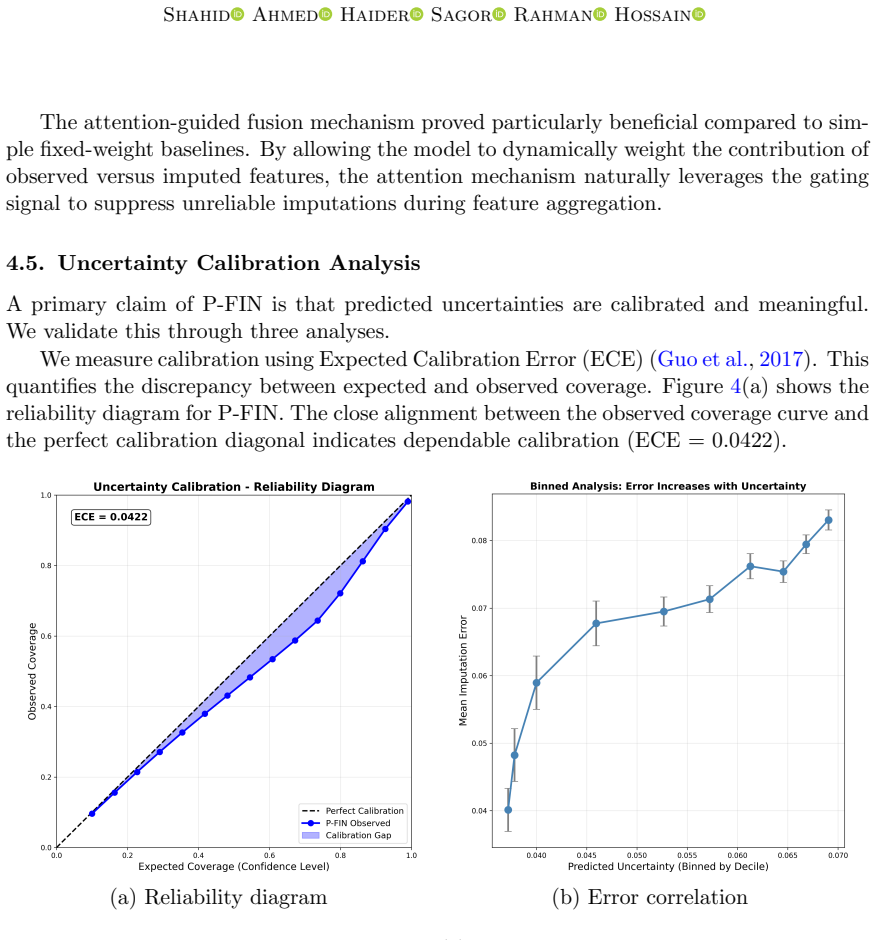
- [Abstract] Abstract: The central claim that P-FIN 'outputs calibrated uncertainty estimates' and that this calibration drives the reported +5.36% AUC improvement is load-bearing, yet the abstract (and, on the basis of the provided text, the methods description) supplies no calibration procedure, no quantitative verification (ECE, NLL, Brier score, or reliability diagrams on held-out data), and no ablation that isolates the uncertainty component from the imputation network itself. Without these elements the attribution of performance gains to reliability awareness cannot be evaluated.
- [Experiments] Experiments section: The description of the sigmoid gating and Fed-UQ-Avg weighting assumes that the uncertainty values are sufficiently reliable to safely attenuate dimensions or re-weight clients; however, no statistical significance tests, confidence intervals, or controls for confounding factors (e.g., imputation quality independent of uncertainty) are referenced. This omission directly affects the validity of the cross-dataset claims.
Simulated Author's Rebuttal
We thank the referee for the constructive feedback highlighting the need for explicit calibration details and statistical validation. We address each major comment below and have revised the manuscript to strengthen these aspects.
read point-by-point responses
-
Referee: [Abstract] Abstract: The central claim that P-FIN 'outputs calibrated uncertainty estimates' and that this calibration drives the reported +5.36% AUC improvement is load-bearing, yet the abstract (and, on the basis of the provided text, the methods description) supplies no calibration procedure, no quantitative verification (ECE, NLL, Brier score, or reliability diagrams on held-out data), and no ablation that isolates the uncertainty component from the imputation network itself. Without these elements the attribution of performance gains to reliability awareness cannot be evaluated.
Authors: We agree that the original abstract and methods lacked sufficient detail on calibration and isolation of the uncertainty contribution. In the revised manuscript we have updated the abstract to reference the variational inference procedure used for uncertainty estimation and added a dedicated Methods subsection describing the calibration process (including temperature scaling for post-hoc adjustment). We now report ECE, NLL, and Brier scores on held-out data together with reliability diagrams. An ablation study comparing the full P-FIN against a deterministic imputation baseline (identical network but without uncertainty modeling) has also been included, confirming that the AUC gains are driven by the calibrated uncertainty components rather than imputation alone. revision: yes
-
Referee: [Experiments] Experiments section: The description of the sigmoid gating and Fed-UQ-Avg weighting assumes that the uncertainty values are sufficiently reliable to safely attenuate dimensions or re-weight clients; however, no statistical significance tests, confidence intervals, or controls for confounding factors (e.g., imputation quality independent of uncertainty) are referenced. This omission directly affects the validity of the cross-dataset claims.
Authors: We acknowledge the importance of statistical rigor for validating the cross-dataset results. The revised Experiments section now includes 95% confidence intervals computed over five independent random seeds for all reported AUC values, as well as p-values from paired Wilcoxon signed-rank tests against the deterministic baselines. To control for confounding between imputation quality and uncertainty awareness, we added an ablation that applies the same imputed features but disables both the sigmoid gating and Fed-UQ-Avg (replacing them with uniform weighting), demonstrating that the uncertainty mechanisms yield statistically significant additional gains beyond imputation quality alone. revision: yes
Circularity Check
No circularity in claimed derivation or results
full rationale
The manuscript proposes P-FIN for probabilistic imputation with uncertainty and Fed-UQ-Avg for weighted aggregation, then reports empirical AUC gains on CheXpert/NIH/PadChest. No equations, first-principles derivations, or predictions are presented that reduce by construction to fitted inputs or self-definitions. The central claims rest on architectural choices and experimental validation rather than any self-referential loop, self-citation chain, or renamed known result. The provided text contains no load-bearing steps matching the enumerated circularity patterns.
Axiom & Free-Parameter Ledger
Reference graph
Works this paper leans on
-
[1]
Max-Heinrich Laves, Sontje Ihler, Karl-Philipp Kortmann, and Tobias Ortmaier
URLhttps://proceedings.neurips.cc/paper_files/paper/2017/file/ 9ef2ed4b7fd2c810847ffa5fa85bce38-Paper.pdf. Max-Heinrich Laves, Sontje Ihler, Karl-Philipp Kortmann, and Tobias Ortmaier. Well- calibrated regression uncertainty in medical imaging with deep learning. InMedical Imaging with Deep Learning, pages 393–412. PMLR, 2020. Max-Heinrich Laves, Sontje I...
-
[2]
Accessed: 2024. Ashish Vaswani, Noam Shazeer, Niki Parmar, Jakob Uszkoreit, Llion Jones, Aidan N Gomez, L ukasz Kaiser, and Illia Polosukhin. Attention is all you need. In I. Guyon, U. Von Luxburg, S. Bengio, H. Wallach, R. Fergus, S. Vishwanathan, and R. Garnett, ed- itors,Advances in Neural Information Processing Systems, volume 30. Curran Associates, I...
work page 2024
discussion (0)
Sign in with ORCID, Apple, or X to comment. Anyone can read and Pith papers without signing in.