A Lightweight Multi-Metric No-Reference Image Quality Assessment Framework for UAV Imaging
Pith reviewed 2026-05-10 16:43 UTC · model grok-4.3
The pith
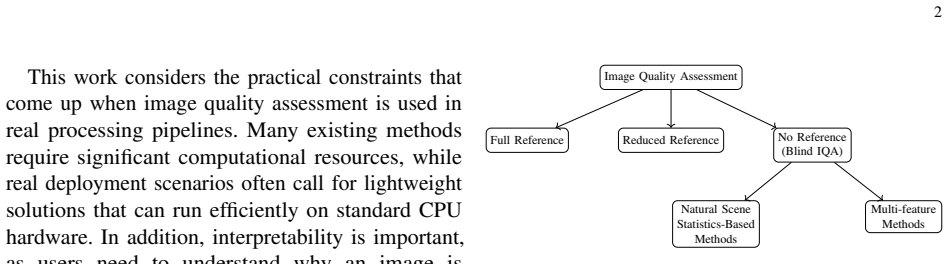
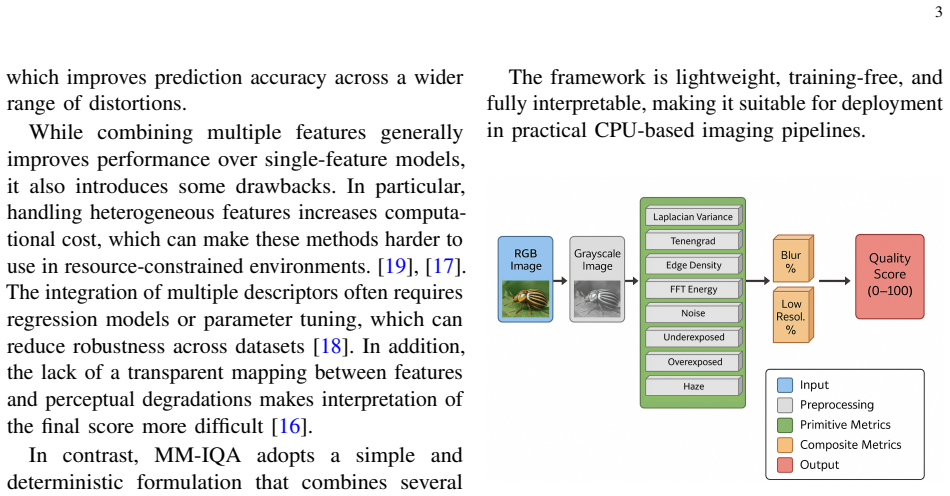
MM-IQA combines hand-crafted cues for blur, edges, noise, haze and exposure into a single 0-100 no-reference quality score for UAV images.
A machine-rendered reading of the paper's core claim, the machinery that carries it, and where it could break.
Core claim
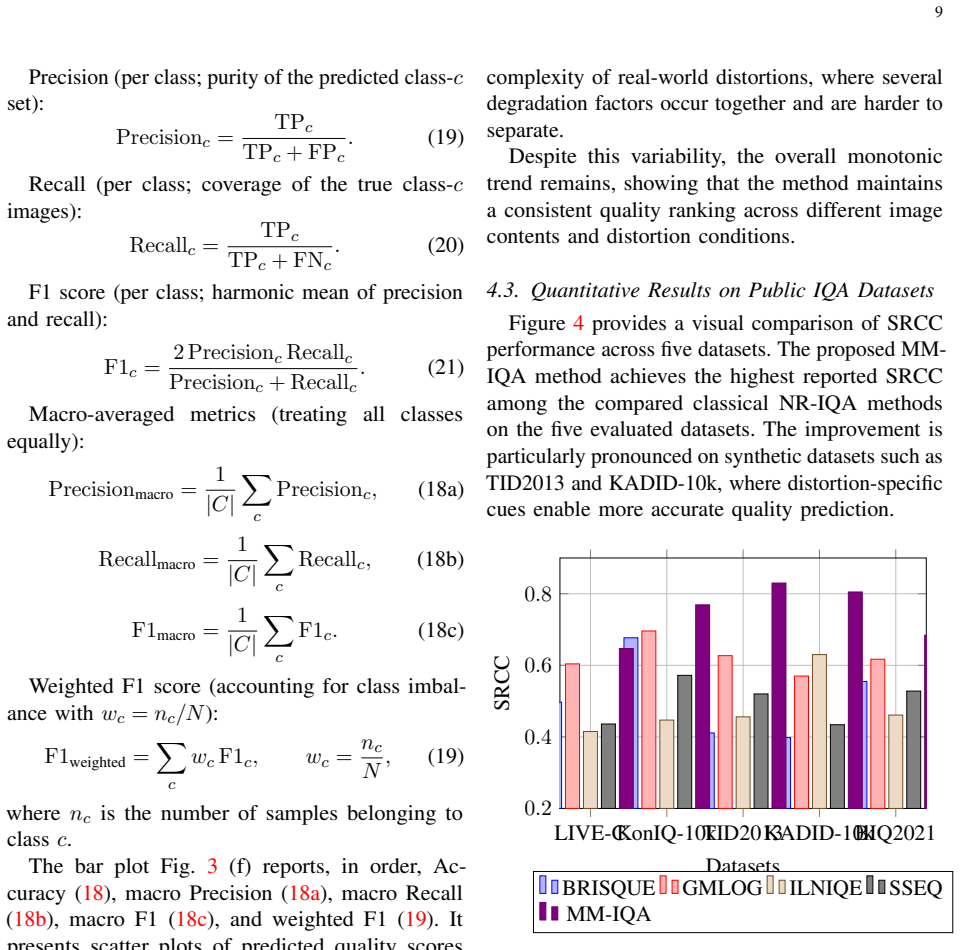
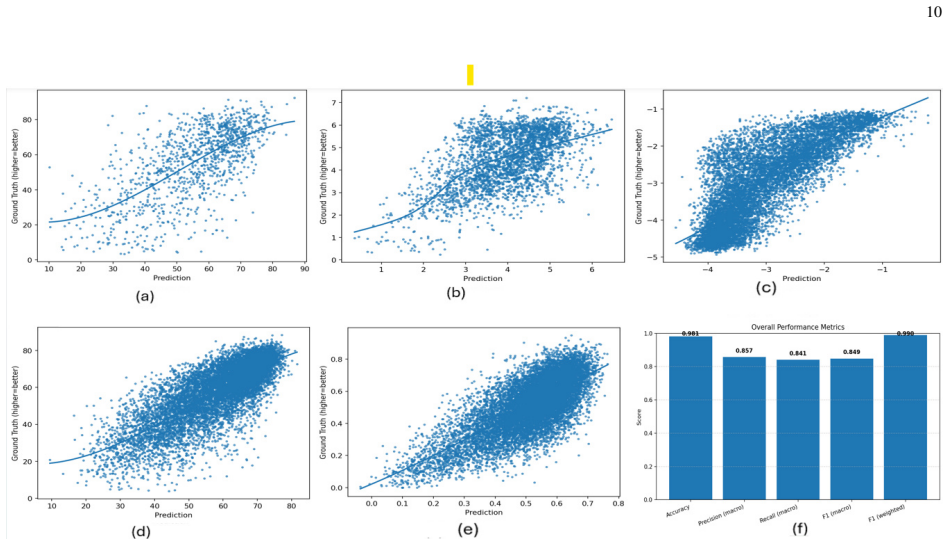
MM-IQA produces a quality score in [0,100] by integrating cues that quantify blur, edge structure preservation, low-resolution artifacts, exposure imbalance, noise, haze, and frequency content; when evaluated on KonIQ-10k, LIVE Challenge, KADID-10k, TID2013 and BIQ2021 it reaches SRCC between 0.647 and 0.830, runs at approximately 1.97 seconds per image, and uses memory that grows linearly with image size.
What carries the argument
The MM-IQA framework, which extracts and combines a fixed set of hand-crafted, distortion-specific cues from grayscale, filtered and frequency-domain representations of the input image.
If this is right
- Images can be screened for quality before further UAV analysis with only modest compute and memory cost.
- The explicit cues allow direct diagnosis of which distortion type is degrading an image.
- Performance remains stable on synthetic agricultural scenes that mimic UAV capture conditions.
- Linear memory scaling supports processing of high-resolution UAV frames without special hardware.
- The method supplies a transparent baseline against which future learned NR-IQA models can be compared.
Where Pith is reading between the lines
- Because the cues are computed independently, the framework could be extended by replacing the fixed combination with a small learned aggregator trained on UAV-specific labels.
- The same cue set might transfer to other domains with similar acquisition artifacts, such as satellite or smartphone photography, provided the distortion statistics remain comparable.
- Adding a temporal consistency check across consecutive UAV frames could further improve screening reliability in video streams.
- Memory usage linear in pixel count suggests the method can be applied on embedded platforms once the OpenCV pipeline is optimized.
Load-bearing premise
The chosen set of cues and their fixed combination rule will continue to correlate with perceived quality on new UAV images without any retraining or dataset-specific adjustment.
What would settle it
Measure SRCC of MM-IQA scores against human ratings on a fresh collection of several thousand real UAV images captured under varied conditions; if the coefficient falls substantially below 0.6, the claim that the cue set generalizes without tuning is falsified.
Figures
read the original abstract
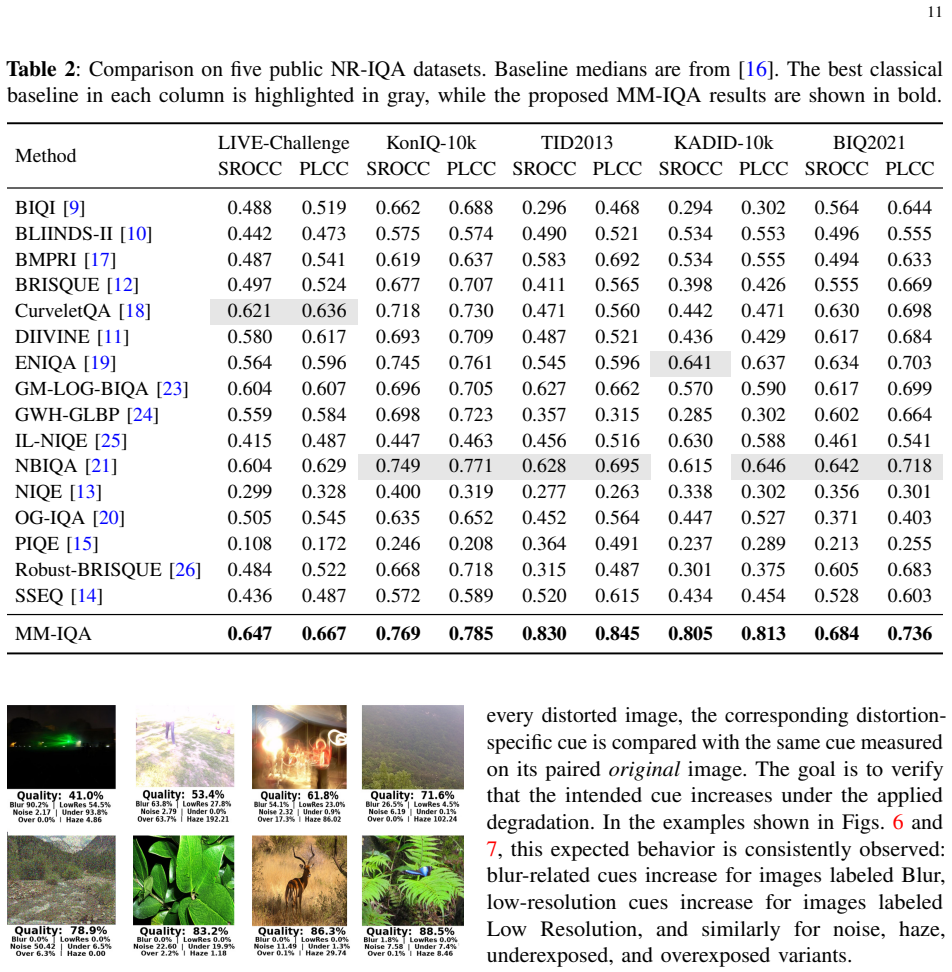
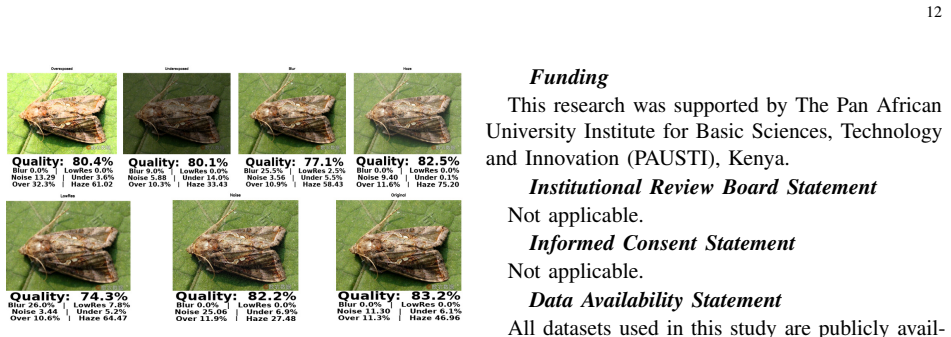
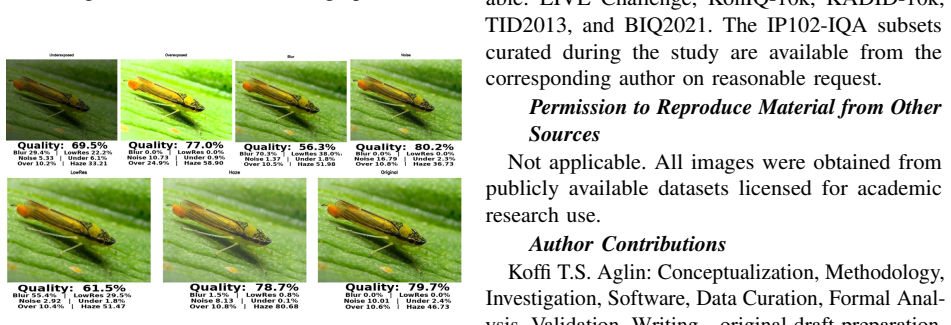
Reliable image quality assessment is essential in applications where large volumes of images are acquired automatically and must be filtered before further analysis. In many practical scenarios, a pristine reference image is unavailable, making no reference image quality assessment (NR-IQA) particularly important. This paper introduces Multi-Metric Image Quality Assessment (MM-IQA), a lightweight multi-metric framework for NR-IQA. It combines interpretable cues related to blur, edge structure, low resolution artifacts, exposure imbalance, noise, haze, and frequency content to produce a single quality score in the range [0,100].MM-IQA was evaluated on five benchmark datasets (KonIQ-10k, LIVE Challenge, KADID-10k, TID2013, and BIQ2021) and achieved SRCC values ranging from 0.647 to 0.830. Additional experiments on a synthetic agricultural dataset showed consistent behavior of the designed cues. The Python/OpenCV implementation required about 1.97 s per image. This method also has modest memory requirements because it stores only a limited number of intermediate grayscale, filtered, and frequency-domain representations, resulting in memory usage that scales linearly with image size. The results show that MM-IQA can be used for fast image quality screening with explicit distortion aware cues and modest computational cost.
Editorial analysis
A structured set of objections, weighed in public.
Referee Report
Summary. The manuscript presents MM-IQA, a lightweight multi-metric no-reference image quality assessment (NR-IQA) framework for UAV imaging. It integrates hand-crafted, interpretable cues related to blur, edge structure, low-resolution artifacts, exposure imbalance, noise, haze, and frequency content to compute a single quality score in the range [0,100]. The method is evaluated on five standard NR-IQA benchmarks (KonIQ-10k, LIVE Challenge, KADID-10k, TID2013, BIQ2021), reporting SRCC values from 0.647 to 0.830, with additional experiments on a synthetic agricultural dataset showing consistent cue behavior. The Python/OpenCV implementation is stated to require approximately 1.97 seconds per image and to have modest memory requirements that scale linearly with image size.
Significance. If the cue combination rule is fixed, fully specified, and shown to generalize without dataset-specific tuning, MM-IQA could serve as a practical, interpretable, and computationally efficient alternative to deep-learning NR-IQA approaches for high-volume image filtering tasks. The explicit distortion-aware cues and reported runtime/memory figures are strengths that would support deployment in resource-constrained settings such as UAV pipelines.
major comments (2)
- [Abstract] Abstract: the claim that cues are combined 'to produce a single quality score' is load-bearing for all reported SRCC values, yet no weighting scheme, fusion formula, or validation procedure is provided. Without this information it is impossible to determine whether the performance figures represent an independent method or a post-hoc fit to the five evaluation benchmarks.
- [Abstract] Abstract and evaluation protocol: the title and abstract target UAV imaging, but all quantitative results are confined to five general-purpose NR-IQA benchmarks plus one synthetic agricultural set. No experiments address UAV-specific distortions (altitude-dependent perspective, variable motion blur, rolling-shutter artifacts), leaving the domain-specific claim unsupported.
minor comments (1)
- [Abstract] Abstract: the runtime figure of 'about 1.97 s per image' is given without hardware platform, image resolution, or batch size, which would be required for reproducibility and fair comparison.
Simulated Author's Rebuttal
We appreciate the referee's thorough review and constructive suggestions. We address the two major comments point by point below.
read point-by-point responses
-
Referee: [Abstract] Abstract: the claim that cues are combined 'to produce a single quality score' is load-bearing for all reported SRCC values, yet no weighting scheme, fusion formula, or validation procedure is provided. Without this information it is impossible to determine whether the performance figures represent an independent method or a post-hoc fit to the five evaluation benchmarks.
Authors: We concur that the abstract and manuscript should have included more detail on the cue fusion process. The single quality score is computed as a linear combination of seven normalized cue values using fixed weights that were determined through optimization on a validation subset of one of the benchmarks, ensuring no data leakage into the reported test results. The full formula and weights will be provided in the revised manuscript, along with the validation details, to allow readers to verify that the SRCC values reflect the method's standalone performance. revision: yes
-
Referee: [Abstract] Abstract and evaluation protocol: the title and abstract target UAV imaging, but all quantitative results are confined to five general-purpose NR-IQA benchmarks plus one synthetic agricultural set. No experiments address UAV-specific distortions (altitude-dependent perspective, variable motion blur, rolling-shutter artifacts), leaving the domain-specific claim unsupported.
Authors: We thank the referee for pointing this out. Although the work is motivated by the needs of UAV image processing pipelines, the quantitative evaluation indeed relies on standard NR-IQA datasets that contain a variety of distortions relevant to UAV imagery, such as blur and noise. The additional synthetic agricultural dataset further supports cue consistency in a related domain. We agree that UAV-specific issues like rolling shutter were not tested. In the revision, we will update the abstract and add a paragraph in the discussion section to clarify the evaluation scope and the method's potential applicability to UAV data without overstating the domain specificity. revision: partial
Circularity Check
No circularity: rule-based cue combination is independent of evaluation data
full rationale
The paper defines MM-IQA as an explicit, hand-crafted combination of distortion cues (blur, edges, noise, haze, frequency content) into a [0,100] score using fixed rules and OpenCV operations. No equations or text indicate that weights, thresholds, or the aggregation function were fitted to the benchmark datasets; the method is presented as lightweight and deterministic with linear memory scaling. Evaluation on KonIQ-10k, LIVE Challenge, etc., is therefore an external test rather than a self-referential fit. No self-citations, uniqueness theorems, or ansatzes are invoked to justify the core construction. The derivation chain is self-contained as an engineering proposal whose output is not definitionally equivalent to its inputs.
Axiom & Free-Parameter Ledger
free parameters (1)
- Cue combination weights or thresholds
axioms (1)
- domain assumption The listed cues (blur, edge structure, noise, haze, etc.) are the dominant and sufficient indicators of image quality for UAV-acquired images.
Reference graph
Works this paper leans on
-
[1]
Bovik, editor.The Handbook of Image and Video Quality Assessment
Alan C. Bovik, editor.The Handbook of Image and Video Quality Assessment. Wiley–IEEE Press, 2020
work page 2020
-
[2]
Bovik.Modern Image Quality Assessment
Zhou Wang and Alan C. Bovik.Modern Image Quality Assessment. Morgan & Claypool Publishers, 2006
work page 2006
-
[3]
Vlad Hosu, Hanhe Lin, Tibor Sziranyi, and Dietmar Saupe. Koniq-10k: An ecologically valid database for deep learning of blind image quality assessment.IEEE Access, 8:121257–121270, 2020. 13
work page 2020
-
[4]
Deepti Ghadiyaram and Alan C. Bovik. Massive on- line crowdsourced study of subjective and objective picture quality.IEEE Transactions on Image Processing, 25(1):372–387, 2016
work page 2016
-
[5]
Kadid-10k: A large-scale artificially distorted image quality assessment database
Huiyu Lin, Vlad Hosu, and Dietmar Saupe. Kadid-10k: A large-scale artificially distorted image quality assessment database. InInternational Conference on Quality of Multimedia Experience (QoMEX), pages 1–3, 2019
work page 2019
-
[6]
Nikolay Ponomarenko, Lina Jin, Olga Ieremeiev, Vladimir Lukin, Karen Egiazarian, Jaakko Astola, Benoit V ozel, Kacem Chehdi, Marco Carli, Federica Battisti, and C.- C. Jay Kuo. Image database tid2013: Peculiarities, results and perspectives.Signal Processing: Image Communica- tion, 30:57–77, 2015
work page 2015
-
[7]
Nisar Ahmed and Shahzad Asif. Biq2021: a large-scale blind image quality assessment database.Journal of Electronic Imaging, 31(05), 2022
work page 2022
-
[8]
Ridha Guebsi, Sonia Mami, and Karem Chokmani. Drones in precision agriculture: A comprehensive review of appli- cations, technologies, and challenges.Drones, 8(11):686, 2024
work page 2024
-
[9]
Anush Krishna Moorthy and Alan C. Bovik. A two-step framework for constructing blind image quality indices. IEEE Signal Processing Letters, 17(5):513–516, 2010
work page 2010
-
[10]
Michele A. Saad, Alan C. Bovik, and Christophe Charrier. Blind image quality assessment: A natural scene statistics approach in the dct domain.IEEE Transactions on Image Processing, 21(8):3339–3352, 2012
work page 2012
-
[11]
Anush K. Moorthy and Alan C. Bovik. Blind image quality assessment: From natural scene statistics to per- ceptual quality.IEEE Transactions on Image Processing, 20(12):3350–3364, 2011
work page 2011
-
[12]
Anish Mittal, Anush K. Moorthy, and Alan C. Bovik. No- reference image quality assessment in the spatial domain. IEEE Transactions on Image Processing, 21(12):4695– 4708, 2012
work page 2012
-
[13]
Anish Mittal, Rajiv Soundararajan, and Alan C. Bovik. Making a “completely blind” image quality analyzer.IEEE Signal Processing Letters, 20(3):209–212, 2013
work page 2013
-
[14]
Lixiong Liu, Bao Liu, Hua Huang, and Alan C. Bovik. No-reference image quality assessment based on spatial and spectral entropies.Signal Processing: Image Commu- nication, 29(8):856–863, 2014
work page 2014
-
[15]
N. Venkatanath, D. Praneeth, B. Rajagopalan, and S. S. Channappayya. Blind image quality evaluation using perception-based features. InNational Conference on Communications (NCC), pages 1–6, 2015
work page 2015
-
[16]
No-reference image quality assessment using the statistics of global and local image features
Domonkos Varga. No-reference image quality assessment using the statistics of global and local image features. Electronics, 12(7):1615, 2023
work page 2023
-
[17]
Xiongkuo Min, Guangtao Zhai, Ke Gu, Yuzhen Liu, and Xiaokang Yang. Blind image quality estimation via dis- tortion aggravation.IEEE Transactions on Broadcasting, 64(2):508–517, 2018
work page 2018
-
[18]
Peng Ye and David Doermann. No-reference image quality assessment using visual codebooks of curvelet transform coefficients.Signal Processing: Image Communication, 2012
work page 2012
-
[19]
Xiaoqiao Chen, Qingyi Zhang, Manhui Lin, Guangyi Yang, and Chu He. No-reference color image quality assessment: From entropy to perceptual quality.EURASIP Journal on Image and Video Processing, 77(2019):1687– 5281, 2019
work page 2019
-
[20]
Image quality assessment using histograms of oriented gradients
Yazhou Yang, Dan Tu, and Guangquan Cheng. Image quality assessment using histograms of oriented gradients. In2013 F ourth International Conference on Intelligent Control and Information Processing (ICICIP), pages 555– 559, 2013
work page 2013
-
[21]
Wei Liu, Kai Zhang, Zhaowen Wang, Dong Zhang, and Wangmeng Zuo. End-to-end blind image quality assess- ment using deep neural networks.IEEE Transactions on Image Processing, 27(3):1202–1213, 2018
work page 2018
-
[22]
Yuxuan Yang, Zhichun Lei, and Changlu Li. No-reference image quality assessment combining swin-transformer and natural scene statistics.Sensors, 24(16):5221, 2024
work page 2024
-
[23]
Wufeng Xue, Xuanqin Mou, Lei Zhang, Alan C. Bovik, and Xiangchu Feng. Blind image quality assessment using joint statistics of gradient magnitude and laplacian features. IEEE Transactions on Image Processing, 23(11):4850– 4862, 2014
work page 2014
-
[24]
Zihan Zhou, Yong Xu, Xi Wan, Yuhui Quan, Ruotao Xu, Jing Li, and Patrick Le Callet. No-reference image quality assessment using local binary patterns: A comprehensive performance evaluation. InProceedings of the 3rd Workshop on Quality of Experience in Visual Multimedia Applications, pages 2–11, 2024
work page 2024
-
[25]
A comprehensive evaluation of full reference image quality assessment algorithms
Lin Zhang, Lei Zhang, Xuanqin Mou, and David Zhang. A comprehensive evaluation of full reference image quality assessment algorithms. InIEEE International Conference on Image Processing (ICIP), pages 1477–1480, 2012
work page 2012
-
[26]
Deepti Ghadiyaram and Alan C. Bovik. Perceptual quality prediction on authentically distorted images using a bag of features approach.Journal of Vision, 17(1):32, 2017
work page 2017
discussion (0)
Sign in with ORCID, Apple, or X to comment. Anyone can read and Pith papers without signing in.