Chromospheric dynamics and turbulence regulate the solar FIP effect
Pith reviewed 2026-05-10 13:44 UTC · model grok-4.3
The pith
Chromospheric turbulence and acoustic flux regulate solar elemental fractionation via the ponderomotive force.
A machine-rendered reading of the paper's core claim, the machinery that carries it, and where it could break.
Core claim
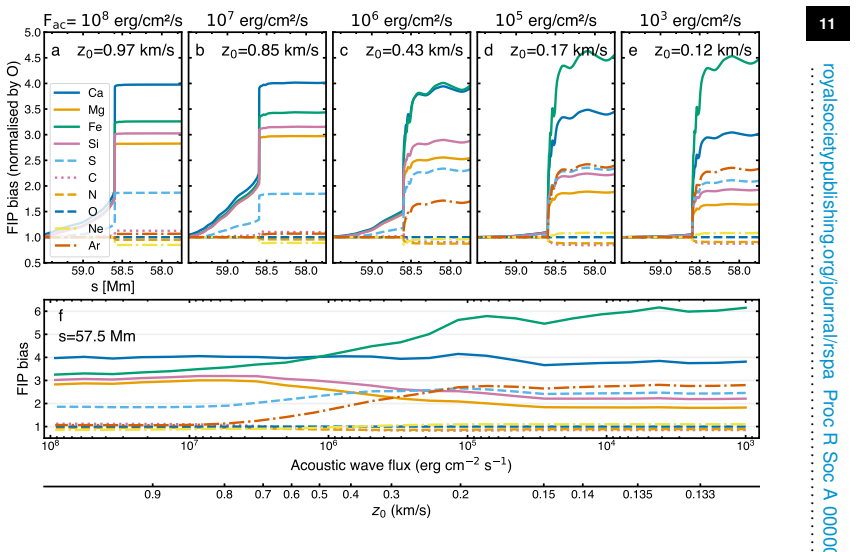
The ponderomotive force model for FIP fractionation holds under dynamic chromospheric conditions produced by nanoflare-like heating. However, fractionation depends critically on acoustic wave flux: below roughly 5×10^6 erg cm^{-2} s^{-1}, mass-dependent thermal velocities dominate and create counterintuitive patterns in which Fe exceeds Ca in FIP bias while high-FIP Ar also fractionates. Any chromospheric turbulence acts to suppress fractionation overall, so that flares, with their elevated turbulence, are predicted to show reduced FIP bias. Coronal composition therefore records the ratio of ponderomotive acceleration to turbulent velocity.
What carries the argument
The ponderomotive force on ions in a time-dependent chromosphere, computed by coupling HYDRAD hydrodynamic simulations of impulsive heating to FIPpy force calculations.
If this is right
- Low acoustic flux below 5×10^6 erg cm^{-2} s^{-1} produces reversed FIP patterns with Fe bias exceeding Ca and fractionation of high-FIP elements such as Ar.
- Any source of chromospheric turbulence reduces or eliminates FIP fractionation.
- Flares exhibit suppressed FIP bias because of increased turbulence from impulsive heating.
- Observed coronal abundances encode the instantaneous ratio of ponderomotive acceleration to turbulent velocity.
Where Pith is reading between the lines
- The same turbulence-suppression mechanism could govern abundance patterns in stellar coronae of stars with varying activity levels.
- Mapping element ratios against local acoustic flux measurements could provide a new remote diagnostic of chromospheric turbulence.
- Time-resolved abundance observations during flare onset and decay could test whether fractionation recovers as turbulence subsides.
Load-bearing premise
The chosen nanoflare-like heating events and acoustic flux values in the simulations accurately represent real solar chromospheric dynamics without other unmodeled fractionation processes.
What would settle it
Direct measurement of Fe/Ca abundance ratios exceeding unity in quiet-Sun regions where independent observations show acoustic wave flux below 5×10^6 erg cm^{-2} s^{-1} would confirm the low-flux regime, while ratios remaining below unity across such regions would contradict it.
Figures




read the original abstract
Elemental abundance variations in the solar corona, commonly characterised by First Ionisation Potential (FIP) bias, provide crucial diagnostics of chromospheric processes. The ponderomotive force model, which attributes fractionation to Alfv\'en wave propagation, has successfully reproduced observed abundance and fractionation patterns in various solar features. However, existing theoretical implementations rely on a static quiet Sun chromosphere, leaving the influence of chromospheric dynamics largely unexplored. We address this limitation by combining hydrodynamic simulations from HYDRAD with ponderomotive force calculations through FIPpy, a new open-source code. Comparing predictions between an initial VAL-C chromosphere and a heated chromosphere following impulsive nanoflare-like events, we show that the ponderomotive force model remains consistent under dynamic chromospheric conditions, while stronger changes in fractionation behaviour arise from variations in acoustic flux and turbulence. Most significantly, when acoustic wave flux drops below $\sim5\times10^6$ erg cm$^{-2}$ s$^{-1}$, mass-dependent thermal velocities dominate the fractionation process, producing counterintuitive patterns where Fe exceeds Ca in FIP bias, while high-FIP Ar shows fractionation. We demonstrate that any source of chromospheric turbulence will act to suppress fractionation. For flares, our results predict that the increased turbulence will suppress FIP bias, potentially explaining the observed abundance variations during flares. These findings suggest that coronal abundances and composition encode a sensitive balance between dominant mechanisms, determined by the ratio of ponderomotive acceleration to turbulent velocity.
Editorial analysis
A structured set of objections, weighed in public.
Referee Report
Summary. The paper investigates the influence of chromospheric dynamics and turbulence on the solar First Ionization Potential (FIP) effect by coupling hydrodynamic simulations from the HYDRAD code with ponderomotive force calculations using a new open-source code called FIPpy. It finds that the ponderomotive force model remains consistent under dynamic conditions, but variations in acoustic flux and turbulence significantly affect fractionation. Specifically, below an acoustic wave flux of about 5×10^6 erg cm^{-2} s^{-1}, mass-dependent thermal velocities dominate, leading to counterintuitive FIP bias patterns such as Fe exceeding Ca and fractionation of high-FIP Ar. Turbulence is shown to suppress fractionation, with implications for explaining abundance variations during solar flares.
Significance. If the central claims hold, this study is significant for solar physics as it extends the ponderomotive force model to dynamic chromospheres, providing a framework to understand how acoustic flux and turbulence regulate coronal abundances. The open-source release of FIPpy enhances reproducibility and allows further testing. The prediction that increased turbulence in flares suppresses FIP bias offers a testable hypothesis against observations. The use of external hydrodynamic code and new FIPpy implementation for testing an existing model is a strength for transparency.
major comments (2)
- [Abstract] Abstract: the reported transition at acoustic flux ∼5×10^6 erg cm^{-2} s^{-1} where mass-dependent thermal velocities dominate (producing Fe > Ca FIP bias and high-FIP Ar fractionation) is presented without error bars, convergence tests, or sensitivity analysis to the nanoflare-like heating parameters or acoustic flux values in the HYDRAD runs; this threshold is load-bearing for the claim that thermal velocities overtake ponderomotive fractionation below this value.
- [Abstract] Abstract (coupling description): the central result that any source of chromospheric turbulence suppresses fractionation rests on the unvalidated assumption that the specific HYDRAD impulsive heating events, chosen acoustic flux values, and FIPpy implementation of wave propagation plus thermal velocities fully capture the relevant physics without missing terms (e.g., time-dependent ionization, additional wave damping, or non-thermal particle effects) that could shift the threshold or alter the reported patterns.
minor comments (1)
- The abstract would benefit from a brief statement of the number of HYDRAD simulations performed and the range of parameters explored to support the generality of the turbulence suppression conclusion.
Simulated Author's Rebuttal
We thank the referee for their constructive and positive review, which highlights key areas for strengthening the presentation of our results. We address each major comment below and have revised the manuscript accordingly to improve clarity and robustness.
read point-by-point responses
-
Referee: [Abstract] Abstract: the reported transition at acoustic flux ∼5×10^6 erg cm^{-2} s^{-1} where mass-dependent thermal velocities dominate (producing Fe > Ca FIP bias and high-FIP Ar fractionation) is presented without error bars, convergence tests, or sensitivity analysis to the nanoflare-like heating parameters or acoustic flux values in the HYDRAD runs; this threshold is load-bearing for the claim that thermal velocities overtake ponderomotive fractionation below this value.
Authors: We agree that additional supporting analysis strengthens the presentation of the transition threshold. In the revised manuscript we have added a dedicated subsection describing sensitivity tests performed by varying acoustic flux values in steps around 5×10^6 erg cm^{-2} s^{-1} and by altering the nanoflare-like heating parameters within the HYDRAD runs. These tests confirm that the shift to mass-dependent dominance occurs consistently near the reported value, although the precise location exhibits modest dependence on the specific heating profile. While a full statistical error-bar analysis was not computationally feasible, we now report qualitative bounds derived from the tested parameter space and have updated the abstract to reference this added analysis. revision: yes
-
Referee: [Abstract] Abstract (coupling description): the central result that any source of chromospheric turbulence suppresses fractionation rests on the unvalidated assumption that the specific HYDRAD impulsive heating events, chosen acoustic flux values, and FIPpy implementation of wave propagation plus thermal velocities fully capture the relevant physics without missing terms (e.g., time-dependent ionization, additional wave damping, or non-thermal particle effects) that could shift the threshold or alter the reported patterns.
Authors: Our approach couples standard hydrodynamic simulations from HYDRAD with the established ponderomotive-force formulation implemented in the new open-source FIPpy code, and we explicitly compare dynamic and static chromospheric cases to demonstrate consistency of the model under time-dependent conditions. We acknowledge that the framework does not incorporate every possible physical process. In the revised manuscript we have expanded the discussion section to address the potential influence of omitted terms such as time-dependent ionization, additional wave damping, and non-thermal particles, noting that these could in principle modify quantitative thresholds while the qualitative finding that turbulence suppresses fractionation remains robust within the adopted physics. revision: yes
- Whether unmodeled physical processes (time-dependent ionization, additional wave damping, or non-thermal particle effects) would quantitatively shift the reported acoustic-flux threshold or alter the detailed fractionation patterns, as testing these would require substantial extensions to the current simulation framework.
Circularity Check
Derivation chain is self-contained with no circular reductions
full rationale
The paper combines external HYDRAD hydrodynamic simulations with a newly introduced open-source FIPpy code that implements the existing ponderomotive force model. Reported fractionation patterns, the acoustic flux threshold of ~5e6 erg cm^{-2} s^{-1}, and turbulence suppression emerge as simulation outputs under varying chromospheric conditions rather than being defined by the inputs, fitted parameters, or self-citations. No load-bearing self-citation chains, uniqueness theorems, or ansatzes smuggled via prior work are invoked; the central claims remain independent predictions from the coupled codes.
Axiom & Free-Parameter Ledger
axioms (2)
- domain assumption The ponderomotive force model attributes fractionation to Alfvén wave propagation in the chromosphere
- domain assumption VAL-C represents a suitable initial quiet-Sun chromosphere and impulsive nanoflare-like events can be modeled by HYDRAD
Reference graph
Works this paper leans on
-
[1]
" write newline "" before.all 'output.state := FUNCTION fin.entry doi empty add.period 'skip if write newline FUNCTION new.block output.state before.all = 'skip after.block 'output.state := if FUNCTION new.sentence output.state after.block = 'skip output.state before.all = 'skip after.sentence 'output.state := if if FUNCTION not #0 #1 if FUNCTION and 'ski...
-
[2]
2011 Sustainable materials: with both eyes open
Allwood JM, Cullen JM. 2011 Sustainable materials: with both eyes open
work page 2011
-
[3]
2008 Sustainable energy: without the hot air
MacKay DJC. 2008 Sustainable energy: without the hot air
work page 2008
-
[4]
2011 Green alternatives and national energy strategy: the facts
Gallman PG. 2011 Green alternatives and national energy strategy: the facts
work page 2011
-
[5]
MacKay DJC. 2013. Solar energy in the context of energy use, energy transportation, and
work page 2013
discussion (0)
Sign in with ORCID, Apple, or X to comment. Anyone can read and Pith papers without signing in.