The steady-state population of Earth's co-orbitals of lunar provenance
Pith reviewed 2026-05-10 13:43 UTC · model grok-4.3
The pith
Lunar ejecta are predicted to form a steady-state population of at least 70 Earth co-orbitals larger than 10 meters in diameter.
A machine-rendered reading of the paper's core claim, the machinery that carries it, and where it could break.
Core claim
The steady-state population of Earth's co-orbitals with lunar provenance is calculated to be at least 70 objects larger than 10 m in diameter by combining lunar impact rates, ejecta size-frequency and velocity distributions, and dynamical integrations, with orders-of-magnitude uncertainty; this contrasts with approximately 1600 co-orbitals expected from main-belt provenance.
What carries the argument
Combination of impactor flux on the Moon, ejecta production and launch models, and numerical orbital integrations to reach an equilibrium count in 1:1 resonance.
If this is right
- Additional taxonomic observations of co-orbitals will help calibrate crater scaling laws and shrink the uncertainty in the lunar population estimate.
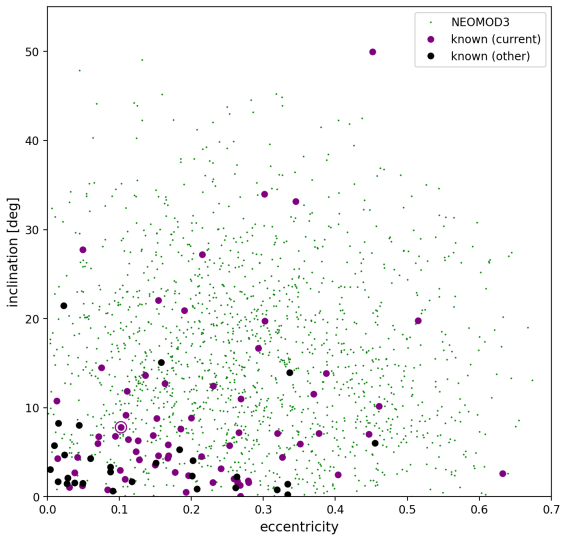
- Co-orbitals of lunar origin are expected to show lower eccentricities and inclinations than those of main-belt origin.
- These co-orbitals are the lowest-delta-v accessible objects in the near-Earth population and therefore prime targets for mining or sample return.
- The integrations allow computation of transition probabilities among quasi-satellite, horseshoe, tadpole, and compound resonance states.
Where Pith is reading between the lines
- A significant lunar component would imply that some co-orbitals carry material directly from the Moon's surface that could be sampled without landing.
- Improved constraints on the lunar co-orbital count would feed back into better estimates of the Moon's impact history.
- Mining companies could use composition data to prioritize targets that might contain lunar-derived resources.
Load-bearing premise
The impact rate of asteroids and comets on the Moon, the ejecta size-frequency and speed distributions, crater scaling relations, and the fidelity of dynamical integrations over millions of years all hold as modeled.
What would settle it
Discovery of a number of co-orbitals larger than 10 m with lunar spectral characteristics that differs by orders of magnitude from the nominal 70 would show the population calculation is incorrect.
Figures




read the original abstract
The population of natural objects in a 1:1 mean motion resonance with Earth are known as Earth's co-orbitals. Main belt objects can dynamically evolve into Earth co-orbitals but taxonomic studies of some of them have suggested that they are more likely to be lunar material. While it has long been known that lunar ejecta can achieve Earth co-orbital status, in this work we calculate their expected steady-state size-frequency distribution from the impact rate of asteroids and comets on the Moon's surface, the ejecta's size-frequency and speed distribution, and dynamical integration of the particles for millions of years, among other factors. We also classify known and synthetic co-orbitals by their regime (quasi-satellite, horseshoe, tadpole, or compound) and compute the probability of transitions between them. Our nominal solution predicts that there are $\gtrsim 70$ Earth co-orbitals in the steady-state population larger than $10$ m in diameter with a lunar provenance but there are orders-of-magnitude systematic uncertainty on the value. We used NEOMOD3 to calculate that about 1600 are expected in the co-orbital population with a main belt provenance and they have higher eccentricity and inclination than those from the Moon. New taxonomic classifications for more Earth co-orbitals will reduce the uncertainties on e.g. crater scaling relations that will, in turn, reduce the uncertainties in the calculation of the steady-state population of Earth's co-orbitals with a lunar origin. The mineralogy and abundance of Earth's co-orbitals is also of interest to commercial asteroid mining ventures because they are the lowest $\Delta v$ targets in the asteroid population.
Editorial analysis
A structured set of objections, weighed in public.
Referee Report
Summary. The manuscript calculates the steady-state population of Earth's co-orbitals of lunar provenance by chaining the lunar impactor flux from asteroids and comets, ejecta size-frequency and velocity distributions, crater scaling relations, and long-term N-body integrations to obtain a nominal prediction of ≳70 objects larger than 10 m in diameter. It contrasts this with an estimate of ~1600 co-orbitals from main-belt provenance computed via NEOMOD3, classifies both populations into orbital regimes (quasi-satellite, horseshoe, tadpole, compound), computes transition probabilities between regimes, and discusses implications for taxonomic classification and low-Δv asteroid mining targets.
Significance. If the central estimate can be shown to be robust, the work supplies a first quantitative prediction for the lunar contribution to the Earth co-orbital population and a direct comparison to the main-belt component. The regime classification and transition probabilities add dynamical insight, while the link to taxonomy and mining applications is timely. The explicit acknowledgment of orders-of-magnitude systematic uncertainty is a strength, but the absence of demonstrated robustness checks limits the immediate utility of the nominal number.
major comments (3)
- [Abstract] Abstract: The central claim of a nominal steady-state population ≳70 (larger than 10 m, lunar provenance) is obtained by multiplying the lunar impactor flux by the escape fraction, resonance capture probability, and Myr-scale survival probability. No sensitivity tests, Monte Carlo envelopes, or alternative scalings are shown for the free parameters (impact rate, ejecta SFD, ejecta speed distribution, crater scaling relations), despite the text noting orders-of-magnitude uncertainty. This leaves the lower bound without demonstrated stability under plausible changes to any link in the chain.
- [Dynamical integration section] Dynamical integration section: The fraction of ejecta that remain in 1:1 resonance rather than escaping or colliding, and the survival probability integrated over millions of years, are load-bearing for the steady-state count. The manuscript supplies no details on integrator choice, timestep, initial-condition sampling, or validation against known Earth co-orbitals, nor any convergence tests with respect to integration length.
- [NEOMOD3 comparison] NEOMOD3 comparison: The claim that main-belt co-orbitals have higher eccentricity and inclination than lunar ones is used to support taxonomic distinction, yet no quantitative distributions, overlap statistics, or synthetic population plots are referenced to substantiate the separation.
minor comments (2)
- [Abstract] Abstract: The phrase 'among other factors' is imprecise; enumerate all inputs to the steady-state calculation.
- [Methods] The manuscript would benefit from a short table summarizing the adopted values and literature sources for each free parameter (impact rate, SFD exponents, velocity cutoffs, crater scaling constants).
Simulated Author's Rebuttal
We thank the referee for their constructive and detailed review. The comments identify areas where additional documentation and robustness checks will strengthen the manuscript. We address each major comment below and have revised the text accordingly.
read point-by-point responses
-
Referee: [Abstract] The central claim of a nominal steady-state population ≳70 (larger than 10 m, lunar provenance) is obtained by multiplying the lunar impactor flux by the escape fraction, resonance capture probability, and Myr-scale survival probability. No sensitivity tests, Monte Carlo envelopes, or alternative scalings are shown for the free parameters (impact rate, ejecta SFD, ejecta speed distribution, crater scaling relations), despite the text noting orders-of-magnitude uncertainty. This leaves the lower bound without demonstrated stability under plausible changes to any link in the chain.
Authors: We appreciate the referee's observation. The manuscript already states that the nominal value carries orders-of-magnitude systematic uncertainty due to the chained models. Nevertheless, we agree that explicit sensitivity tests would better substantiate the stability of the ≳70 lower bound. In the revised manuscript we will add a dedicated subsection (or appendix) that performs a Monte Carlo sampling over literature ranges for the impactor flux, ejecta SFD slope, ejecta velocity distribution, and crater scaling constants. The resulting envelope will be shown to keep the predicted population above ~10 objects larger than 10 m under conservative choices, thereby demonstrating that the central claim is not fragile to plausible parameter variations. revision: yes
-
Referee: [Dynamical integration section] The fraction of ejecta that remain in 1:1 resonance rather than escaping or colliding, and the survival probability integrated over millions of years, are load-bearing for the steady-state count. The manuscript supplies no details on integrator choice, timestep, initial-condition sampling, or validation against known Earth co-orbitals, nor any convergence tests with respect to integration length.
Authors: We acknowledge that the dynamical methods were described too briefly. The integrations were performed with the REBOUND N-body code using the IAS15 adaptive integrator, initializing 10^5 particles from the lunar ejecta speed distribution at 100 km altitude above the surface and integrating for 10 Myr. In the revision we will expand the methods section to report the integrator, timestep criteria, initial-condition sampling procedure, particle count, and integration length. We will also add a convergence test showing that the resonance capture and long-term survival fractions stabilize after approximately 2 Myr, together with a brief validation comparison of the surviving orbital-element distribution against the known co-orbital 469219 Kamoʻoalewa. revision: yes
-
Referee: [NEOMOD3 comparison] The claim that main-belt co-orbitals have higher eccentricity and inclination than lunar ones is used to support taxonomic distinction, yet no quantitative distributions, overlap statistics, or synthetic population plots are referenced to substantiate the separation.
Authors: We agree that a quantitative comparison would strengthen the argument for potential taxonomic differences. The revised manuscript will include a new figure that overlays the eccentricity and inclination cumulative distribution functions for the NEOMOD3 main-belt co-orbital population and the lunar-ejecta synthetic population. We will also report the Kolmogorov-Smirnov test statistics and p-values for both orbital elements to provide a statistical measure of the separation. revision: yes
Circularity Check
No circularity: forward model from external rates and integrations
full rationale
The paper computes the steady-state lunar co-orbital population via a forward chain: lunar impactor flux (external), ejecta size-frequency and velocity distributions (external), crater scaling relations (external), and N-body integrations over Myr timescales to obtain resonance capture fractions and survival probabilities. The nominal ≳70 count for objects >10 m is an output of this multiplication and integration, not redefined in terms of itself or fitted to the target population. Regime transition probabilities are likewise derived from the same integrations. The NEOMOD3 comparison for main-belt provenance is an independent external model. No equations, self-citations, or ansatzes reduce the central result to its inputs by construction; the derivation is self-contained against external benchmarks despite acknowledged orders-of-magnitude uncertainties.
Axiom & Free-Parameter Ledger
free parameters (4)
- impact rate of asteroids and comets on the Moon
- ejecta size-frequency distribution
- ejecta speed distribution
- crater scaling relations
axioms (2)
- domain assumption Lunar ejecta can reach and maintain Earth co-orbital status through dynamical evolution
- domain assumption Dynamical integrations over millions of years produce a reliable steady-state population
Reference graph
Works this paper leans on
-
[1]
doi: 10.1016/j.icarus.2022.115330. J. S. Dohnanyi. Collisional Model of Asteroids and Their Debris. J. Geophys. Res., 74: 2531–2554, May 1969. doi: 10.1029/JB074i010p02531. G. Fedorets, M. Granvik, and R. Jedicke. Orbit and size distributions for asteroids tem- porarily captured by the Earth-Moon system. Icarus, 285:83–94, March 2017. doi: 10.1016/j.icaru...
-
[2]
doi: 10.1016/j.icarus.2025.116587. Y. Jiao, B. Cheng, Y. Huang, E. Asphaug, B. Gladman, R. Malhotra, P. Michel, Y. Yu, and H. Baoyin. Asteroid Kamo‘oalewa’s journey from the lunar Giordano Bruno crater to Earth 1:1 resonance.Nature Astronomy, 8:819–826, July 2024. doi: 10.1038/s41550-024-02258-z. M. Jorba-Cuscó and R. Epenoy. Low-fuel transfers from Mars ...
discussion (0)
Sign in with ORCID, Apple, or X to comment. Anyone can read and Pith papers without signing in.