Universal Scaling of Freezing Morphodynamics in Polymer Solution Droplets
Pith reviewed 2026-05-10 12:47 UTC · model grok-4.3
The pith
The Capillary-Lewis number alone governs how polymer solution droplets freeze and change shape.
A machine-rendered reading of the paper's core claim, the machinery that carries it, and where it could break.
Core claim
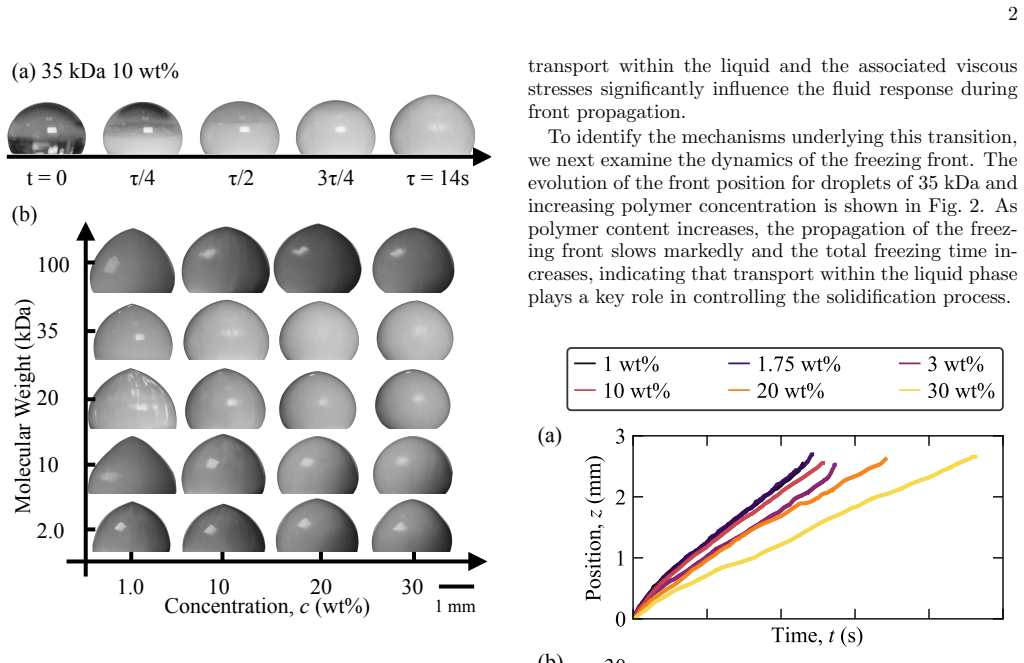
Droplet morphology and freezing dynamics in viscous solutions are governed by a single dimensionless parameter, the Capillary-Lewis number, which captures the competition between viscous stresses, capillarity, and solute transport. Circularity, radial deformation, and freezing time collapse onto a master curve spanning nine orders of magnitude, revealing a transition near unity corresponding to the point at which solute diffusion can no longer relax concentration gradients ahead of the freezing interface. This collapse holds across distinct polymer chemistries within the viscous fluid regime, while deviations emerge when the material exhibits elastic-dominated response.
What carries the argument
The Capillary-Lewis number, a dimensionless ratio of viscous stresses to the product of capillary forces and solute diffusion rate, which unifies morphology and timing data across scales and chemistries.
Load-bearing premise
The droplets remain in a purely viscous regime where only viscous stresses, capillarity, and solute transport matter, with no significant elastic or other effects.
What would settle it
A viscous polymer droplet whose measured circularity, deformation, or freezing time deviates strongly from the master curve at its calculated Capillary-Lewis number, or the same collapse failing for a new viscous polymer chemistry.
Figures


read the original abstract
Freezing of complex fluids is central to a wide range of natural and technological processes, where the interplay between heat transport, solute redistribution, and interfacial deformation gives rise to complex morphologies. Unlike simple liquids, polymer solutions exhibit strongly coupled transport and rheological properties that evolve dynamically during solidification, making their freezing behavior difficult to predict. Here, we examine the freezing of polymer solution droplets spanning dilute to entangled regimes. We find that droplet morphology and freezing dynamics in viscous solutions are governed by a single dimensionless parameter, the Capillary--Lewis number, which captures the competition between viscous stresses, capillarity, and solute transport. Circularity, radial deformation, and freezing time collapse onto a master curve spanning nine orders of magnitude, revealing a transition near unity corresponding to the point at which solute diffusion can no longer relax concentration gradients ahead of the freezing interface. This collapse holds across distinct polymer chemistries within the viscous fluid regime, while deviations emerge when the material exhibits elastic-dominated response ($G' > G''$), indicating the breakdown of purely transport--capillary control. These results establish a minimal transport--mechanics framework linking solute redistribution to interfacial deformation during freezing polymer solutions.
Editorial analysis
A structured set of objections, weighed in public.
Referee Report
Summary. The manuscript examines freezing of polymer solution droplets from dilute to entangled regimes and claims that morphology and dynamics in the viscous regime are governed by a single dimensionless parameter, the Capillary-Lewis number (CaLe), which encodes competition among viscous stresses, capillarity, and solute transport. Circularity, radial deformation, and freezing time are reported to collapse onto a master curve spanning nine orders of magnitude, with a transition near CaLe = 1 marking the point where solute diffusion fails to relax gradients ahead of the interface. The collapse is stated to hold across polymer chemistries within the viscous regime (G'' > G'') but to break down when elastic response dominates (G' > G'').
Significance. If the reported collapse is robust and CaLe is shown to be independent of other groups, the work would supply a compact transport-mechanics framework for predicting interfacial evolution during freezing of complex fluids. The nine-order span and cross-chemistry consistency would be a notable empirical result for the field, with implications for materials processing and cryobiology. The identification of a clear viscous-to-elastic crossover further strengthens the minimal-model interpretation.
major comments (3)
- [Abstract] Abstract: the central claim of a universal master curve and transition at unity rests on an asserted data collapse, yet the abstract (and, by extension, the methods/results sections) supplies no information on experimental protocols, droplet generation, temperature control, imaging analysis, data selection criteria, error bars, or the precise normalization procedure used to construct the master curve. Without these, independent verification of the collapse is impossible.
- [Results] Results/Discussion: the assertion that CaLe alone controls behavior within the viscous regime requires explicit demonstration that other dimensionless groups (thermal Lewis number, Deborah number, concentration-dependent viscosity scaling) remain constant or irrelevant across the polymer set. The manuscript must show the experimental matrix decouples CaLe from these quantities rather than allowing correlated variation that could artifactually produce the observed collapse.
- [Results] Results: the transition is stated to occur 'near unity' and to correspond to the point where solute diffusion can no longer relax gradients. The manuscript should provide the quantitative criterion used to locate this transition (e.g., a specific threshold in the normalized deformation or time data) and test its sensitivity to the precise definition of CaLe.
minor comments (2)
- [Introduction] The explicit algebraic definition of the Capillary-Lewis number and its derivation from the competing time scales should appear in the main text (not only in supplementary material) to allow readers to reproduce the scaling.
- [Figures] Figure captions should state the number of independent droplets per polymer type and the range of concentrations examined so that the span of nine orders of magnitude can be assessed directly.
Simulated Author's Rebuttal
We thank the referee for their constructive and positive assessment of our manuscript. We address each major comment point by point below, providing clarifications and indicating revisions where the manuscript will be strengthened for clarity and verifiability.
read point-by-point responses
-
Referee: [Abstract] Abstract: the central claim of a universal master curve and transition at unity rests on an asserted data collapse, yet the abstract (and, by extension, the methods/results sections) supplies no information on experimental protocols, droplet generation, temperature control, imaging analysis, data selection criteria, error bars, or the precise normalization procedure used to construct the master curve. Without these, independent verification of the collapse is impossible.
Authors: We agree that the abstract is concise and that explicit pointers to experimental details strengthen verifiability. The full Methods section and Supplementary Information already contain the requested information on droplet generation (via microfluidics with controlled flow rates), temperature control (cryostage with calibrated cooling rates), imaging (high-speed bright-field microscopy with automated edge detection), data selection (exclusion of droplets with visible defects or evaporation artifacts), error bars (standard deviation across n=5–10 replicates per condition), and normalization (scaling circularity and deformation by their low-CaLe asymptotes and time by the diffusion time scale). To improve accessibility, we have added a single sentence in the revised abstract directing readers to these sections and expanded the Methods with a dedicated subsection on master-curve construction, including the exact normalization formulas and statistical criteria. revision: yes
-
Referee: [Results] Results/Discussion: the assertion that CaLe alone controls behavior within the viscous regime requires explicit demonstration that other dimensionless groups (thermal Lewis number, Deborah number, concentration-dependent viscosity scaling) remain constant or irrelevant across the polymer set. The manuscript must show the experimental matrix decouples CaLe from these quantities rather than allowing correlated variation that could artifactually produce the observed collapse.
Authors: We have added a new supplementary figure and accompanying text that explicitly maps the experimental matrix in the space of CaLe versus the thermal Lewis number, Deborah number, and viscosity scaling exponent. Across the nine-order CaLe range, the other groups vary by less than one order of magnitude and show no systematic correlation with the observed morphological or temporal collapse; the data remain collapsed when binned by fixed values of these secondary groups. This decoupling is achieved by independently varying polymer molecular weight, concentration, and solvent quality while holding droplet size and cooling rate within narrow ranges. The revised Results section now includes this analysis to demonstrate that CaLe is the dominant parameter within the viscous regime. revision: yes
-
Referee: [Results] Results: the transition is stated to occur 'near unity' and to correspond to the point where solute diffusion can no longer relax gradients. The manuscript should provide the quantitative criterion used to locate this transition (e.g., a specific threshold in the normalized deformation or time data) and test its sensitivity to the precise definition of CaLe.
Authors: We have inserted a precise operational definition in the revised Results: the transition is identified as the CaLe value at which the normalized radial deformation deviates from the low-CaLe master-curve power-law fit by more than two standard deviations of the replicate scatter, corresponding to CaLe ≈ 0.8–1.2 depending on polymer. We have also performed a sensitivity analysis by recomputing CaLe with alternative length scales (droplet radius versus interface thickness) and diffusion coefficients (concentration-dependent versus dilute-limit); in all cases the crossover remains within a factor of two of unity. These tests and the quantitative threshold are now reported in the main text with an accompanying supplementary plot. revision: yes
Circularity Check
No significant circularity; scaling is empirical observation from physical parameter
full rationale
The paper defines the Capillary-Lewis number from the physical competition between viscous stresses, capillarity, and solute transport, then reports an experimental collapse of morphology, deformation, and freezing time onto a master curve across polymer chemistries in the viscous regime. No derivation chain reduces a claimed prediction to a fitted input by construction, no self-citation is invoked as a uniqueness theorem or load-bearing premise, and no ansatz is smuggled in. The result is presented as an observed universality within the stated regime, with explicit note of breakdown when elasticity dominates, making the central claim self-contained against external experimental benchmarks rather than tautological.
Axiom & Free-Parameter Ledger
axioms (1)
- domain assumption Freezing morphology and dynamics in viscous polymer solutions are governed by competition between viscous stresses, capillarity, and solute transport
Reference graph
Works this paper leans on
-
[1]
S. Wildeman, S. Sterl, C. Sun, and D. Lohse, Fast dy- namics of water droplets freezing from the outside in, Physical review letters118, 084101 (2017)
work page 2017
-
[2]
G. Kuznetsov, S. Misyura, R. Volkov, and V. Morozov, Marangoni flow and free convection during crystalliza- tion of a salt solution droplet, Colloids and Surfaces A: Physicochemical and Engineering Aspects572, 37 (2019)
work page 2019
-
[3]
H. A. Khawaja, S. Keshavarzi, A. Yousuf, M. Muhammed, M. S. Virk, D. Harvey, and G. Momen, Exploring heat transfer in freezing supercooled water droplet through high-speed infrared thermography, Cold Regions Science and Technology229, 104358 (2025)
work page 2025
-
[4]
L. Karlsson, H. Lycksam, A.-L. Ljung, P. Gren, and T. S. Lundstr¨ om, Experimental study of the internal flow in freezing water droplets on a cold surface, Experiments in Fluids60, 182 (2019)
work page 2019
-
[5]
J. H. Snoeijer and P. Brunet, Pointy ice-drops: How wa- ter freezes into a singular shape, American Journal of Physics80, 764 (2012)
work page 2012
-
[6]
E. Jambon-Puillet, N. Shahidzadeh, and D. Bonn, Sin- gular sublimation of ice and snow crystals, Nature com- munications9, 4191 (2018)
work page 2018
- [7]
-
[8]
L. S´ eguy, S. Proti` ere, and A. Huerre, Role of geometry and adhesion in droplet freezing dynamics, Physical Re- view Fluids8, 033601 (2023)
work page 2023
-
[9]
A. G. Marin, O. R. Enriquez, P. Brunet, P. Colinet, and J. H. Snoeijer, Universality of tip singularity formation in freezing water drops, Physical review letters113, 054301 (2014)
work page 2014
- [10]
-
[11]
F. Chu, S. Li, C. Zhao, Y. Feng, Y. Lin, X. Wu, X. Yan, and N. Miljkovic, Interfacial ice sprouting during salty water droplet freezing, Nature communications15, 2249 (2024)
work page 2024
- [12]
-
[13]
N. G. Ulrich and J.-F. Louf, Interfacial mechanisms in the freezing of polymer solutions, Nanoscale (2026)
work page 2026
-
[14]
A. V. Dobrynin, R. Sayko, and R. H. Colby, Viscosity of polymer solutions and molecular weight characterization, ACS Macro Letters12, 773 (2023)
work page 2023
- [15]
-
[16]
J. You, J. Wang, L. Wang, Z. Wang, J. Li, X. Lin, and Y. Zhu, Interactions between nanoparticles and polymers in the diffusion boundary layer during freezing colloidal suspensions, Langmuir35, 10446 (2019)
work page 2019
-
[17]
U. G. Wegst, M. Schecter, A. E. Donius, and P. M. Hunger, Biomaterials by freeze casting, Philosophical Transactions of the Royal Society A: Mathematical, Physical and Engineering Sciences368, 2099 (2010)
work page 2099
- [18]
-
[19]
L. Wang, J. You, Z. Wang, J. Wang, and X. Lin, Inter- face instability modes in freezing colloidal suspensions: revealed from onset of planar instability, Scientific re- ports6, 23358 (2016)
work page 2016
-
[20]
J. Wu, Q. Zhao, J. Sun, and Q. Zhou, Preparation of poly (ethylene glycol) aligned porous cryogels using a unidi- rectional freezing technique, Soft Matter8, 3620 (2012)
work page 2012
-
[21]
K. Yin, K. Ji, L. S. Littles, R. Trivedi, A. Karma, and U. G. Wegst, Hierarchical structure formation by crystal growth-front instabilities during ice templating, Proceedings of the National Academy of Sciences120, e2210242120 (2023)
work page 2023
-
[22]
F. Wang, Y. Sun, W. Liang, H. He, B. Yang, and A. O. Bonsu, The three-line synergistic icephobicity of conduc- tive cnts/pdms nanocomposite with bio-inspired hierar- chical surface, Surfaces and Interfaces26, 101424 (2021)
work page 2021
-
[23]
S. P. Kharal and J.-F. Louf, Unidirectional freezing of polymer solution droplets, Langmuir40, 118 (2023)
work page 2023
-
[24]
P. M. Naullage, Y. Qiu, and V. Molinero, What controls the limit of supercooling and superheating of pinned ice surfaces?, The journal of physical chemistry letters9, 1712 (2018)
work page 2018
-
[25]
P. M. Naullage and V. Molinero, Slow propagation of ice binding limits the ice-recrystallization inhibition effi- ciency of pva and other flexible polymers, Journal of the American Chemical Society142, 4356 (2020)
work page 2020
-
[26]
M. R. Kim, H. J. Park, K. H. Cheon, C. K. Yeom, and K. Y. Lee, Novel behavior in a polymer solution: the disappearance of the melting temperature (tm) and en- thalpy change (δhm) of the solvent, Scientific Reports10, 13348 (2020)
work page 2020
-
[27]
L. M. Sander and A. V. Tkachenko, Kinetic pinning and biological antifreezes, Physical review letters93, 128102 (2004)
work page 2004
-
[28]
M. Chasnitsky and I. Braslavsky, Ice-binding proteins and the applicability and limitations of the kinetic pin- ning model, Philosophical Transactions of the Royal Soci- ety A: Mathematical, Physical and Engineering Sciences 377(2019)
work page 2019
-
[29]
M. S. Hahn, L. J. Taite, J. J. Moon, M. C. Rowland, K. A. Ruffino, and J. L. West, Photolithographic patterning of polyethylene glycol hydrogels, Biomaterials27, 2519 (2006)
work page 2006
-
[30]
W. W. Graessley, Polymer chain dimensions and the dependence of viscoelastic properties on concentration, molecular weight and solvent power, Polymer21, 258 (1980)
work page 1980
-
[31]
De Gennes,Scaling concepts in polymer physics (Cornell university press, 1979)
P.-G. De Gennes,Scaling concepts in polymer physics (Cornell university press, 1979)
work page 1979
-
[32]
G. Ram, R. Guha, and N. Bachhar, Enhanced transport 6 behavior of small molecules in polymer solutions, Soft Matter21, 8468 (2025)
work page 2025
-
[33]
R. Holyst, A. Bielejewska, J. Szyma´ nski, A. Wilk, A. Patkowski, J. Gapi´ nski, A. ˙Zywoci´ nski, T. Kalwar- czyk, E. Kalwarczyk, M. Tabaka,et al., Scaling form of viscosity at all length-scales in poly (ethylene glycol) so- lutions studied by fluorescence correlation spectroscopy and capillary electrophoresis, Physical Chemistry Chem- ical Physics11, 90...
work page 2009
-
[34]
D. G. Mintis, M. Dompe, M. Kamperman, and V. G. Mavrantzas, Effect of polymer concentration on the structure and dynamics of short poly (n, n- dimethylaminoethyl methacrylate) in aqueous solution: A combined experimental and molecular dynamics study, The Journal of Physical Chemistry B124, 240 (2019)
work page 2019
-
[35]
Y. Zhao, C. Yang, and P. Cheng, Freezing of a nanofluid droplet: From a pointy tip to flat plateau, Applied Physics Letters118(2021)
work page 2021
-
[36]
L. S´ eguy, A. Huerre, and S. Proti` ere, Freezing-induced deformation in water and hydrogel droplets, Physical Re- view Letters135, 208201 (2025)
work page 2025
-
[37]
P.-D. Hong, C.-M. Chou, and C.-H. He, Solvent effects on aggregation behavior of polyvinyl alcohol solutions, Polymer42, 6105 (2001)
work page 2001
-
[38]
S. Banitabaei and A. Amirfazli, Pneumatic drop genera- tor: Liquid pinch-off and velocity of single droplets, Col- loids and Surfaces A: Physicochemical and Engineering Aspects505, 204 (2016)
work page 2016
-
[39]
A. Rothert, R. Richter, and I. Rehberg, Formation of a drop: viscosity dependence of three flow regimes, New Journal of Physics5, 59 (2003)
work page 2003
-
[40]
J. Schindelin, I. Arganda-Carreras, E. Frise, V. Kaynig, M. Longair, T. Pietzsch, S. Preibisch, C. Rueden, S. Saalfeld, B. Schmid,et al., Fiji: an open-source plat- form for biological-image analysis, Nature methods9, 676 (2012)
work page 2012
discussion (0)
Sign in with ORCID, Apple, or X to comment. Anyone can read and Pith papers without signing in.