Recognition: unknown
Coherent Rydberg excitation of single atoms using a pulsed fiber amplifier
Pith reviewed 2026-05-10 13:35 UTC · model grok-4.3
The pith
Pulsed fiber amplifiers enable coherent Rydberg excitation of single atoms at levels matching continuous-wave lasers.
A machine-rendered reading of the paper's core claim, the machinery that carries it, and where it could break.
Core claim
The central discovery is the successful implementation of a pulsed fiber master-oscillator power-amplifier system for coherent Rydberg excitation, which overcomes previous limitations and achieves efficient excitation of single atoms in a rubidium array comparable to continuous-wave methods.
What carries the argument
The fiber-based master-oscillator power-amplifier system, which amplifies pulses while maintaining synchronization and narrow spectral linewidth for coherent atomic transitions.
If this is right
- Enables higher peak powers for Rydberg driving in expanding atom arrays.
- Resolves synchronization and broadening issues that previously limited pulsed sources.
- Supports scaling of neutral-atom quantum simulation and computation.
- Provides an alternative technical path when continuous-wave power is insufficient.
Where Pith is reading between the lines
- The approach may allow integration with ultrafast pulse techniques for advanced control protocols.
- Larger arrays could benefit from this power scaling without coherence loss.
- Similar methods might extend to other quantum platforms using atomic arrays.
Load-bearing premise
Synchronization of the pulsed system with excitation sequences and sufficient control over spectral linewidth broadening are possible to maintain coherence.
What would settle it
An experiment in the same setup where the pulsed amplifier yields lower excitation probability or shorter coherence times than a continuous-wave laser would disprove the comparability claim.
Figures
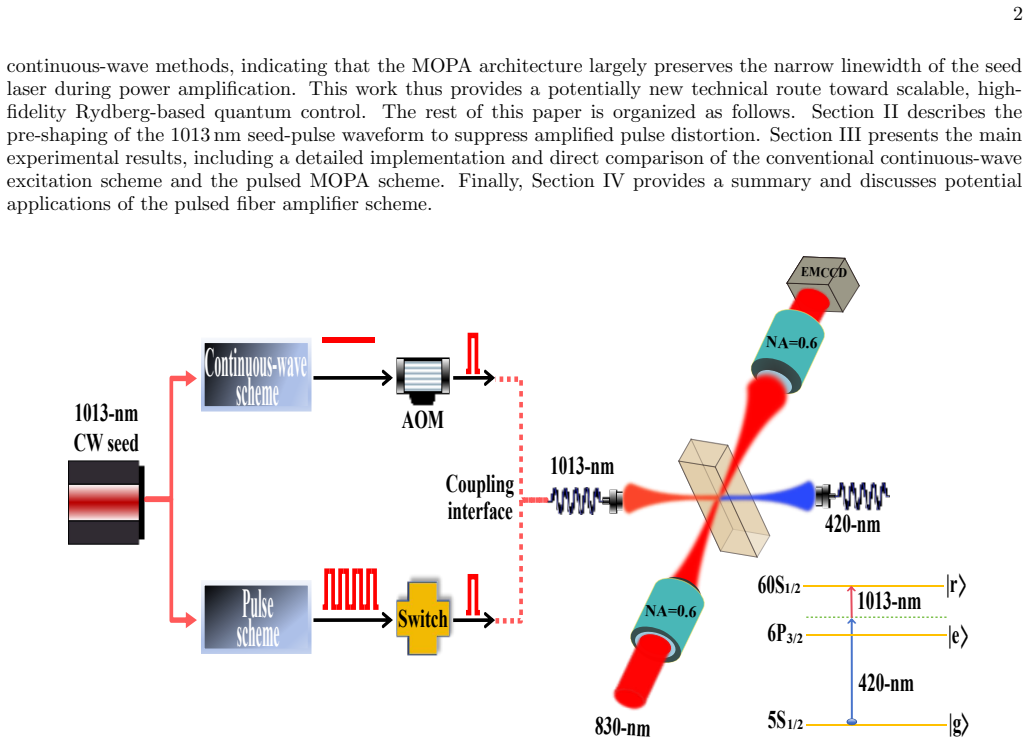


read the original abstract
In recent years, the growing scale of programmable neutral-atom arrays has led to an increasing demand for higher-power Rydberg excitation light. Although pulsed amplifiers deliver higher peak power than continuous-wave lasers, their use for efficient coherent Rydberg excitation of single atoms in arrays has been limited by challenges such as pulse distortion, synchronization with excitation sequences, and spectral linewidth broadening. Here, we address these issues using a fiber-based master-oscillator power-amplifier system. We demonstrate efficient coherent Rydberg excitation of single atoms in a rubidium atom array, achieving performance comparable to continuous-wave methods. This study provides a potentially new technical pathway toward future large-scale quantum simulation and computation with Rydberg atom arrays.
Editorial analysis
A structured set of objections, weighed in public.
Referee Report
Summary. The manuscript reports the development of a fiber-based master-oscillator power-amplifier (MOPA) system for pulsed coherent Rydberg excitation of single rubidium atoms in a neutral-atom array. It addresses challenges including pulse distortion, synchronization with excitation sequences, and spectral linewidth broadening, and demonstrates efficient excitation achieving performance comparable to continuous-wave methods, offering a technical route to higher-power Rydberg lasers for large-scale quantum simulation and computation.
Significance. If the experimental results hold, the work is significant for neutral-atom quantum information platforms, where scaling array size increases the demand for high-power Rydberg excitation while preserving coherence. The fiber MOPA approach provides a practical means to deliver higher peak powers than typical CW sources. The authors receive credit for an experimental validation performed directly on single atoms in an array, which supplies concrete evidence that synchronization and linewidth control can be achieved in this architecture.
minor comments (2)
- [Abstract] The abstract asserts 'performance comparable to continuous-wave methods' without quantitative benchmarks (e.g., Rabi frequency, excitation probability, or coherence time ratios); adding one or two such metrics would allow readers to evaluate the claim immediately.
- [Results] A direct side-by-side comparison (table or overlaid figure) of key observables between the pulsed fiber system and a CW reference would strengthen the central experimental claim.
Simulated Author's Rebuttal
We thank the referee for their positive assessment of our manuscript on the fiber-based MOPA system for coherent Rydberg excitation of single atoms. We appreciate the recognition of its significance for scaling neutral-atom platforms and the recommendation for minor revision. No major comments were provided in the report.
Circularity Check
No significant circularity: experimental demonstration only
full rationale
The manuscript is a pure experimental report describing a fiber-based MOPA system for Rydberg excitation in a rubidium atom array. It contains no equations, derivations, fitted parameters, or theoretical predictions that could reduce to their own inputs. Claims of comparable performance to CW methods rest on reported measurements of synchronization, pulse shaping, and linewidth, which are presented as direct experimental outcomes rather than self-referential constructs. No self-citations function as load-bearing premises, and the argument is self-contained against external benchmarks.
Axiom & Free-Parameter Ledger
axioms (1)
- domain assumption Rydberg states in rubidium can be coherently excited by laser light with controlled pulse properties
Reference graph
Works this paper leans on
-
[1]
J. H. Yang, X. D. He, R. J. Guo, P. Xu, K. P. Wang, C. Sheng, M. Liu, J. Wang, A. Derevianko, and M. S. Zhan, Phys. Rev. Lett.117, 123201 (2016)
2016
-
[2]
R. J. Guo, X. D. He, C. Sheng, J. H. Yang, P. Xu, K. P. Wang, J. Q. Zhong, M. Liu, J. Wang, and M. S. Zhan, Phys. Rev. Lett.124, 153201 (2020)
2020
-
[3]
H. J. Manetsch, G. Nomura, E. Bataille, X. Lv, K. H. Leung, and M. Endres, Nature647, 60 (2025)
2025
-
[4]
Y. Q. Wang, Y. X. Liao, T. Zhang, Y. Tian, Y. J. Wu, W. J. Zhang, W. Zhang, Y. D. Huang, H. Zhai, W. L. Chen, X. Feng, and Z. C. Zhang, Chin. Phys. Lett.43, 010606 (2026)
2026
-
[5]
Bluvstein, H
D. Bluvstein, H. Levine, G. Semeghini, T. T. Wang, S. Ebadi, M. Kalinowski, A. Keesling, N. Maskara, H. Pichler, M. Greiner, V. Vuleti´ c, and M. D. Lukin, Nature604, 451 (2022)
2022
-
[6]
I. S. Madjarov, J. P. Covey, A. L. Shaw, J. Choi, A. Kale, A. Cooper, H. Pichler, V. Schkolnik, J. R. Williams, and M. Endres, Nat. Phys.16, 857 (2020)
2020
-
[7]
Z. Fu, P. Xu, Y. Sun, Y. Y. Liu, X. D. He, X. Li, M. Liu, R. B. Li, J. Wang, L. Liu, and M. S. Zhan, Phys. Rev. A105, 042430 (2022)
2022
-
[8]
S. J. Evered, D. Bluvstein, M. Kalinowski, S. Ebadi, T. Manovitz, H. Y. Zhou, H. L. Sophie, A. G. Alexandra, T. T. Wang, N. Maskara, H. Levine, G. Semeghini, M. Greiner, V. Vuleti´ c, and M. D. Lukin, Nature622, 268 (2023)
2023
-
[9]
A. G. Radnaev, W. C. Chung, and D. C. Cole, PRX Quantum6, 030334 (2025)
2025
-
[10]
Scholl, M
P. Scholl, M. Schuler, H. J. Williams, A. A. Eberharter, D. Barredo, K. N. Schymik, V. Lienhard, L. P. Henry, T. C. Lang, T. Lahaye, A. M. L¨ auchli, and A. Browaeys, Nature595, 233 (2021)
2021
-
[11]
Ebadi, T
S. Ebadi, T. T. Wang, H. Levine, A. Keesling, G. Semeghini, A. Omran, D. Bluvstein, R. Samajdar, H. Pichler, W. W. Ho, S. Choi, S. Sachdev, M. Greiner, V. Vuleti´ c, and M. D. Lukin, Nature595, 227 (2021)
2021
-
[12]
Semeghini, H
G. Semeghini, H. Levine, A. Keesling, S. Ebadi, T. T. Wang, D. Bluvstein, R. Verresen, H. Pichler, M. Kalinowski, R. Samajdar, A. Omran, S. Sachdev, A. Vishwanath, M. Greiner, V. Vuleti´ c, and M. D. Lukin, Science374, 1242 (2021)
2021
-
[13]
Bluvstein, S
D. Bluvstein, S. J. Evered, and A. A. Geim, Nature626, 58 (2024). 10
2024
-
[14]
Bluvstein, A
D. Bluvstein, A. A. Geim, and S. H. Li, Nature649, 39 (2026)
2026
-
[15]
Preskill, Quantum2, 79 (2018)
J. Preskill, Quantum2, 79 (2018)
2018
-
[16]
Fan, Acta Phys
H. Fan, Acta Phys. Sin.67, 120301 (2018), in Chinese
2018
-
[17]
M. N. Zervas and C. A. Codemard, IEEE J. Sel. Top. Quantum Electron.20, 219 (2014)
2014
-
[18]
C. Y. Li, L. Ye, C. Li, Q. S. Li, Z. Q. Zhang, X. P. Sun, Y. N. Zang, S. Han, L. Xu, and J. F. Shi, Optik223, 165415 (2020)
2020
-
[19]
G. L. Yu, J. Y. Ding, C. Q. Fang, B. B. Li, Y. Qian, J. Zhou, W. B. Chen, and X. L. Zhu, Opt. Commun.545, 129718 (2023)
2023
-
[20]
T. P. Mahesh, T. Matsubara, Y. T. Chew, T. Tomita, S. D. L´ es´ eleuc, and K. Ohmori, Opt. Lett.50, 403 (2025)
2025
-
[21]
T. Cai, J. He, Z. H. Liu, Y. Liu, N. Su, P. F. Shi, G. Jin, Y. J. Cheng, and J. M. Wang, Acta Phys. Sin.74, 013201 (2025)
2025
-
[22]
Paschotta, J
R. Paschotta, J. Nilsson, A. C. Tropper, and D. C. Hanna, IEEE J. Quantum Electron.33, 1049 (1997)
1997
-
[23]
L. M. Frantz and J. S. Nodvik, J. Appl. Phys.34, 2346 (1963)
1963
-
[24]
X. Luo, Y. T. Tang, F. L. Dong, J. C. Wang, L. P. Yu, P. G. Yan, J. Z. Wang, Q. T. Lue, C. Y. Guo, and S. C. Ruan, Opt. Lett.48, 1790 (2023)
2023
-
[25]
D. N. Schimpf, C. Ruchert, D. Nodop, J. Limpert, A. T¨ unnermann, and F. Salin, Opt. Express16, 17637 (2008)
2008
-
[26]
K. T. Vu, A. Malinowski, D. J. Richardson, F. Ghiringhelli, L. M. B. Hickey, and M. N. Zervas, Opt. Express14, 10996 (2006)
2006
-
[27]
S. Xu, S. Z. Zou, H. J. Yu, J. X. Zuo, C. Y. Ning, X. C. Chen, X. Y. Li, W. J. Wu, and X. C. Lin, Opt. Express32, 9397 (2024)
2024
-
[28]
R. H. Stolen, E. P. Ippen, and A. R. Tynes, Appl. Phys. Lett.20, 62 (1972)
1972
-
[29]
Kobyakov, M
A. Kobyakov, M. Sauer, and D. Chowdhury, Adv. Opt. Photonics2, 1 (2010)
2010
-
[30]
S. D. L´ es´ eleuc, D. Barredo, V. Lienhard, A. Browaeys, and T. Lahaye, Phys. Rev. A97, 053803 (2018)
2018
-
[31]
Y. Y. Liu, Y. Sun, Z. Fu, P. Xu, X. Wang, X. D. He, J. Wang, and M. S. Zhan, Phys. Rev. Appl.15, 054020 (2021)
2021
-
[32]
Oliveira, S
P. Oliveira, S. Addis, J. Gay, K. Ertel, M. Galimberti, and I. Musgrave, Opt. Express27, 6607 (2019)
2019
-
[33]
S. Z. Yang, G. Masella, V. Moeini, A. Bellahsene, C. Li, T. Bienaim´ e, and S. Whitlock, Phys. Rev. Appl.23, 054009 (2025)
2025
-
[34]
Sun, Phys
Y. Sun, Phys. Rev. Appl.20, L061002 (2023)
2023
-
[35]
Y. Sun, P. Xu, P. X. Chen, and L. Liu, Phys. Rev. Appl.13, 024059 (2020)
2020
-
[36]
Jandura and G
S. Jandura and G. Pupillo, Quantum6, 712 (2022)
2022
-
[37]
O. D. Vries, M. Pl¨ otner, F. Christaller, H. Zhang, A. Belz, B. Heinrich, H. K¨ ubler, R. L¨ ow, T. Pfau, T. Walbaum, T. Schreiber, and A. T¨ unnermann, Opt. Express28, 17362 (2020)
2020
-
[38]
Sheng, M
Q. Sheng, M. Wang, C. D. Shi, H. Tian, J. X. Zhang, J. J. Liu, W. Shi, and J. Q. Yao, Acta Phys. Sin.70, 214202 (2021)
2021
-
[39]
C. H. Fan, D. Rossini, H. X. Zhang, J. H. Wu, M. Artoni, and G. C. L. La Rocca, Phys. Rev. A101, 013417 (2020)
2020
-
[40]
J. J. Wang, L. Z. Tang, Y. X. Du, and D. W. Zhang, Phys. Lett. A558, 130896 (2025)
2025
discussion (0)
Sign in with ORCID, Apple, or X to comment. Anyone can read and Pith papers without signing in.