Exciton screening in C₆₀ and PTCDA complexes. TDDFT calculations with GGA and hybrid functionals
Pith reviewed 2026-05-10 13:02 UTC · model grok-4.3
The pith
TDDFT calculations reveal that hybrid functionals improve short-range exciton energies but decrease in accuracy for long-range excitons in C60 and PTCDA complexes, where PBE performs better near the screening length.
A machine-rendered reading of the paper's core claim, the machinery that carries it, and where it could break.
Core claim
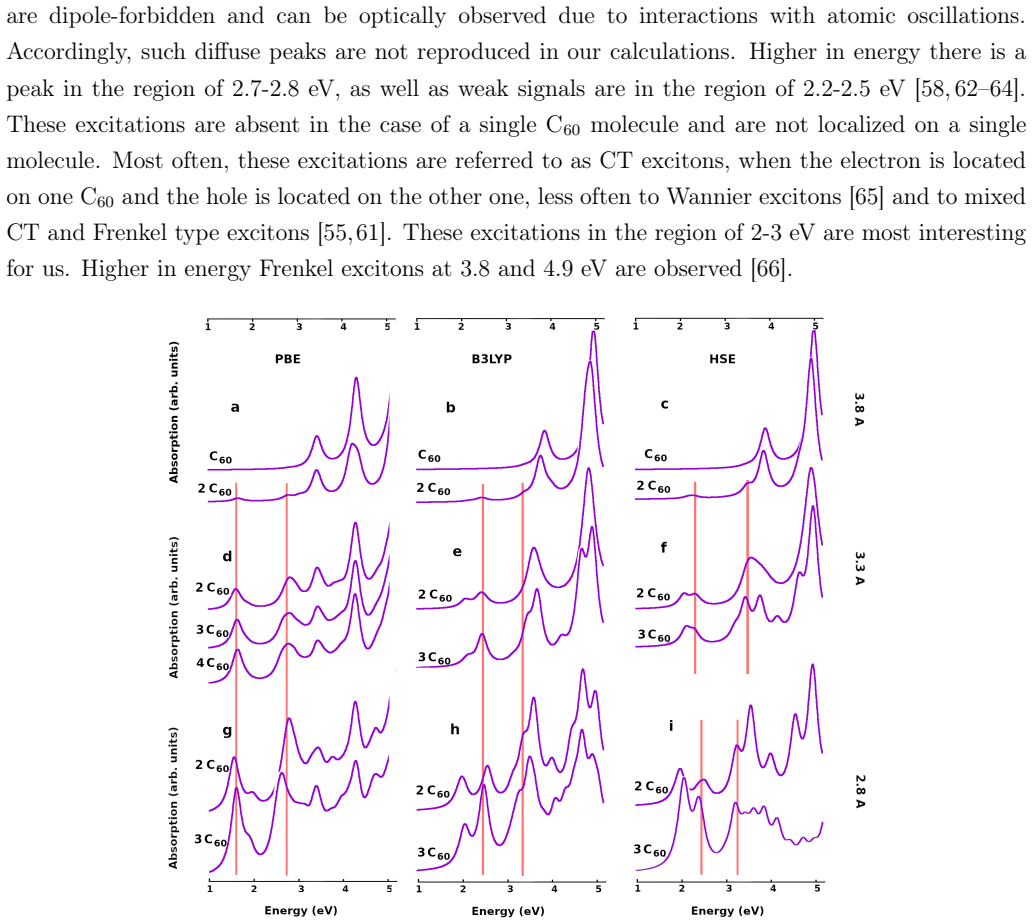
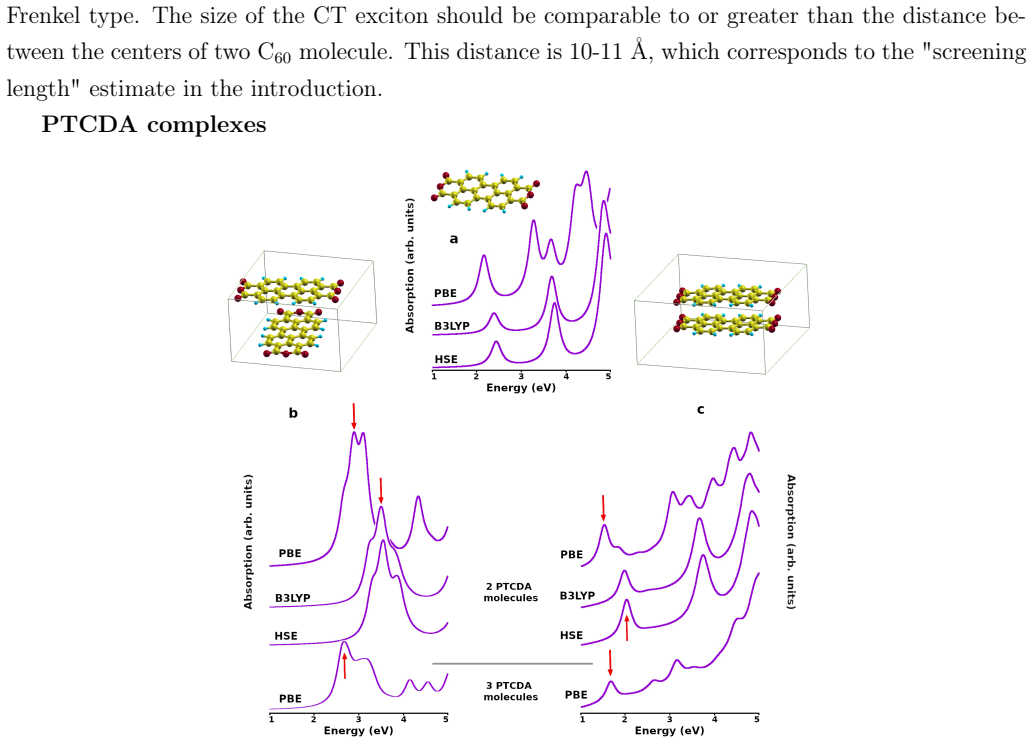
For the PBE, B3LYP and HSE exchange-correlation functionals the dependence of the accuracy of the exciton energy on the electron-hole separation is analyzed. The inclusion of non-local exchange using hybrid functionals increases the accuracy of calculations for short-range excitons, however, the accuracy of hybrid functionals decreases significantly for long-range excitons. Moreover, as the exciton radius approaches the screening length, the simpler PBE functional gives more accurate excitonic energies than the mentioned hybrid functionals.
What carries the argument
Linear response TDDFT applied to C60 and PTCDA molecular complexes with different exchange-correlation functionals to analyze exciton energy accuracy as a function of electron-hole separation.
If this is right
- Hybrid functionals are preferable for modeling short-range excitons in these systems.
- Simpler GGA functionals like PBE should be considered for long-range charge-transfer excitons.
- The screening length serves as a crossover point where functional performance changes.
- Choice of functional in TDDFT for molecular complexes depends on the expected exciton radius.
Where Pith is reading between the lines
- The results suggest that range-separated hybrid functionals might bridge the gap for intermediate-range excitons.
- Similar behavior could appear in other organic molecular systems used in photovoltaics.
- Experimental measurements of exciton energies at different separations could directly test the predicted crossover.
- Computational studies might benefit from estimating screening lengths beforehand to select appropriate functionals.
Load-bearing premise
The TDDFT calculations with chosen basis sets and geometries isolate the effect of the exchange-correlation functional on exciton energies without significant interference from other approximations.
What would settle it
Comparing the calculated exciton energies from PBE and the hybrid functionals against experimental photoabsorption data for C60-PTCDA complexes with varying electron-hole separations would confirm or refute the accuracy trends and the role of the screening length.
Figures
read the original abstract
Photoabsorption in the low-energy region for C$_{60}$ and PTCDA molecular complexes is studied within linear response TDDFT. For the PBE, B3LYP and HSE exchange-correlation (xc) functionals the dependence of the accuracy of the exciton energy on the electron-hole separation is analyzed. Particular attention is paid to the charge-transfer (CT) excitons. The inclusion of non-local exchange using hybrid functionals increases the accuracy of calculations for short-range excitons, however, the accuracy of hybrid functionals decreases significantly for long-range excitons. Moreover, as the exciton radius approaches the "screening length"\ , the simpler PBE functional gives more accurate excitonic energies than the mentioned hybrid functionals.
Editorial analysis
A structured set of objections, weighed in public.
Referee Report
Summary. The manuscript presents a study of photoabsorption in the low-energy region for C60 and PTCDA molecular complexes using linear response TDDFT. It compares the PBE GGA functional with the hybrid functionals B3LYP and HSE, analyzing the dependence of the accuracy of exciton energies on electron-hole separation, with particular attention to charge-transfer (CT) excitons. The central claims are that hybrid functionals improve accuracy for short-range excitons but their accuracy decreases significantly for long-range excitons, and that the simpler PBE functional gives more accurate excitonic energies than the hybrids as the exciton radius approaches the screening length.
Significance. If the results hold, this work would offer useful guidance on functional selection in TDDFT for modeling excitons in molecular complexes, particularly highlighting potential limitations of hybrids for long-range CT states in organic systems relevant to optoelectronics. The systematic comparison of GGA versus hybrids across varying exciton radii is a positive aspect that could inform method choice when exciton size is comparable to screening effects. The direct numerical nature of the comparison provides falsifiable trends, though the impact depends on whether the screening length is established independently.
major comments (2)
- [Discussion of screening length and exciton radius dependence] The central claim that PBE becomes superior as exciton radius approaches the screening length requires the screening length to be defined and computed independently (e.g., from dielectric response, polarizability, or a separate model) rather than inferred from the TDDFT exciton radii or energies. If the length is derived from the same calculations, the crossover observation risks circularity and is not independently testable. Please add an explicit definition, formula, and computation details for the screening length, preferably with a dedicated paragraph or subsection.
- [Abstract and Results] The abstract and results describe trends in functional accuracy but provide no numerical data, error bars, specific exciton energies, radii, or comparisons to reference values. To substantiate the load-bearing assertions on hybrid vs. PBE performance for short- and long-range cases, the manuscript must include quantitative tables or figures with calculated energies, basis-set specifications, geometry details, and convergence checks. Without these, it is impossible to confirm that the trends isolate functional dependence without confounding errors.
minor comments (2)
- [Abstract] The phrasing 'the mentioned hybrid functionals' in the abstract is unclear; replace with explicit names (B3LYP and HSE) for better readability.
- [Throughout manuscript] Ensure consistent definition of acronyms (TDDFT, GGA, CT, xc) at first use and check LaTeX formatting for subscripts like C$_{60}$ throughout the text.
Simulated Author's Rebuttal
We thank the referee for the constructive and detailed comments, which have helped us improve the clarity and rigor of the manuscript. We address each major point below and have revised the paper accordingly to provide an independent definition of the screening length and to include the requested quantitative data.
read point-by-point responses
-
Referee: [Discussion of screening length and exciton radius dependence] The central claim that PBE becomes superior as exciton radius approaches the screening length requires the screening length to be defined and computed independently (e.g., from dielectric response, polarizability, or a separate model) rather than inferred from the TDDFT exciton radii or energies. If the length is derived from the same calculations, the crossover observation risks circularity and is not independently testable. Please add an explicit definition, formula, and computation details for the screening length, preferably with a dedicated paragraph or subsection.
Authors: We agree that an independent definition is necessary to eliminate any risk of circularity. In the revised manuscript we have inserted a new subsection (Section 2.3) that defines the screening length explicitly as the Thomas-Fermi screening length obtained from the static polarizability of the isolated molecules. The polarizability is computed in separate finite-field DFT calculations (PBE/def2-TZVP) and inserted into the standard Thomas-Fermi expression λ_s = (3π² n)^{1/3} ħ² ε_0 / (m e²), where n is the valence-electron density. Numerical values (5.1 Å for C₆₀ and 4.8 Å for PTCDA) are reported together with the computational protocol. Exciton radii are extracted from the transition-density-matrix expectation value and are therefore independent of this screening-length calculation. This addition makes the crossover observation directly testable. revision: yes
-
Referee: [Abstract and Results] The abstract and results describe trends in functional accuracy but provide no numerical data, error bars, specific exciton energies, radii, or comparisons to reference values. To substantiate the load-bearing assertions on hybrid vs. PBE performance for short- and long-range cases, the manuscript must include quantitative tables or figures with calculated energies, basis-set specifications, geometry details, and convergence checks. Without these, it is impossible to confirm that the trends isolate functional dependence without confounding errors.
Authors: We acknowledge that the original submission emphasized qualitative trends. The revised version now contains two new tables and an expanded results section. Table I lists the lowest singlet exciton energies for all C₆₀-PTCDA complexes and separations, obtained with PBE, B3LYP and HSE, together with available experimental and CC2 reference values. Table II reports the corresponding exciton radii, the independently computed screening lengths, and the absolute errors for each functional. Basis-set details (def2-SVP and def2-TZVP), geometry-optimization protocol (PBE-D3 with tight convergence criteria), and convergence tests with respect to integration grid and basis-set size are provided in the Methods section. Error bars are estimated from the spread across the two hybrid functionals and from basis-set extrapolation. These quantitative data allow the reader to verify that the reported trends are not confounded by numerical artifacts. revision: yes
Circularity Check
Direct numerical comparison of standard TDDFT functionals; no load-bearing circularity
full rationale
The manuscript reports TDDFT calculations of exciton energies in C60/PTCDA complexes using the standard PBE, B3LYP and HSE functionals. Exciton radii and energies are obtained directly from the linear-response calculations for each functional; the comparison of accuracy versus range is an empirical observation against external reference data. The screening length appears as a quoted reference quantity in the abstract but is not shown to be fitted or derived from the same TDDFT exciton data within the paper. No equations reduce by construction to inputs, no self-citation chain carries the central claim, and the work remains a straightforward functional benchmark without self-referential definitions or renamed predictions.
Axiom & Free-Parameter Ledger
axioms (1)
- domain assumption Linear-response TDDFT with these functionals yields exciton energies whose errors depend primarily on electron-hole separation.
Reference graph
Works this paper leans on
-
[1]
S. de Gironcoli S. Baroni and A. Dal Corso.REVIEWS OF MODERN PHYSICS, 73, 2001
work page 2001
-
[2]
Pines.Elementary excitations in solids
D. Pines.Elementary excitations in solids. Benjamin, New York-Amsterdam, 1963
work page 1963
- [3]
- [4]
-
[5]
A.V. Arbuznikov T.M. Maier, H. Bahmann and Martin Kaupp.JCP, 144:074106, 2016
work page 2016
- [6]
-
[7]
M. PETERSILKA K. BURKE and E.K.U. GROSS.Recent Advances in Density Functional Methods, pages 67–79, 2002
work page 2002
-
[8]
B. Demoulin et al. B. Kozma, A. Tajti.J. Chem. Theory Comput., 16(7):4213–4225, 2020
work page 2020
- [9]
- [10]
-
[11]
S. Yanagisawa et al. Y. Tawada, T. Tsuneda.JCP, 120(18):8425–8433, 2004
work page 2004
- [12]
-
[13]
M.J. Frisch et al. M. Campetella, F. Maschietto.Journal of Computational Chemistry, 38(25), 2017
work page 2017
- [14]
-
[15]
S. Ramanjanappaa and E.R. Van Keuren. Time dependent density functional theory calculations of the optical properties of charge-transfer complexes., 2024
work page 2024
-
[16]
W. Bartkowiak J. Kozlowska, M. Wielgus.Computational and Theoretical Chemistry, 1014:49– 55, 2013
work page 2013
-
[17]
M. Thelakkat A. Karolewski, A. Neubig and S. Kummel.PCCP, 15:20016–20025, 2013
work page 2013
-
[18]
D.E. Nevonenb et al. S.A. Majeeda, B. Ghazala.Dyes and Pigments, 170:107593, 2019
work page 2019
-
[19]
Z. Mata-Pinzón A.F. Marmolejo-Valencia and C. Amador-Bedolla.PCCP, 23:16806–16815, 2021
work page 2021
- [20]
- [21]
-
[22]
Y.-T. Huang et al. H.-A. Chen, C.-L. Hsin.JPC C, 117(43):22211–22217, 2013
work page 2013
-
[23]
N. Bonini et al. P. Giannozzi, S. Baroni.Journal of Physics: Condensed Matter, 21(39):395502, 2009
work page 2009
-
[24]
T. Brumme et al. P. Giannozzi, O. Andreussi.Journal of Physics: Condensed Matter, 29(46):465901, 2017
work page 2017
- [25]
-
[26]
C.F. Chabalowski P.J. Stephens, F.J. Devlin and M.J. Frisch.JPC, 98(45):11623–11627, 1994
work page 1994
- [27]
-
[28]
M.P. Bohme et al. Z.A. Moldabekov, M. Pavanello.Phys. Rev. Res., 5:023089, 2023
work page 2023
-
[29]
D.Roccaetal.O.B.Malcioğlu, R.Gebauer.Computer Physics Communications, 182:1744–1754, 2011
work page 2011
-
[30]
D. Rocca et al. X. Ge, S.J. Binnie.Computer Physics Communications, 185(7):2080–2089, 2014
work page 2080
- [31]
- [32]
-
[33]
Royet al.Science, 341(6142):157–160, 2013
X. Royet al.Science, 341(6142):157–160, 2013
work page 2013
-
[34]
G. Dresselhaus M.S. Dresselhaus and P.C. Eklund.Science of Fullerenes and Carbon Nanotubes. Academic, San Diego, 1996
work page 1996
-
[35]
Z.G. Yu C. Reddy and Y.-W. Zhang.Scientific Reports, 5:12221, 2015
work page 2015
-
[36]
A.M. Rappe. J. Tao, J. Yang.JCP, 142(16), 2015
work page 2015
-
[37]
Klimov V.V.Plasmonics, 4:31–36, 2009
Lambrecht A. Klimov V.V.Plasmonics, 4:31–36, 2009
work page 2009
-
[38]
Schmeits.Surface Science, 64(1), 1977
A.A Lucas M. Schmeits.Surface Science, 64(1), 1977
work page 1977
- [39]
-
[40]
et al Han Y., Cao L.J Mater Sci, 53:1326–1334, 2018
Pan S. et al Han Y., Cao L.J Mater Sci, 53:1326–1334, 2018
work page 2018
- [41]
-
[42]
S.R. Forrest et al. Z. Shen, P.E. Burrows.Chemical Physics Letters, 236, 1995
work page 1995
-
[43]
L.S.O. Johansson H.M. Zhang, J.B. Gustafsson.Chemical Physics Letters, 485:69–76, 2010
work page 2010
- [44]
-
[45]
Roussy TS et al. K.A. Cochrane, Schiffrin A.Nat Commun., 6(6):8312, 2015
work page 2015
- [46]
-
[47]
L. C. Lee and C. C. Chiang.JCP, 78:688, 1983
work page 1983
-
[48]
C.Y.R. Wu F.Z. Chen.Journal of Quantitative Spectroscopy and Radiative Transfer, 85:195–209, 2004
work page 2004
- [49]
- [50]
- [51]
- [52]
-
[53]
X. Lin X. Qian, J. Li and S. Yip.PRB, 73:035408, 2006. 11
work page 2006
-
[54]
M. Choi et al. K. Hanasaki, Z.A. Ali.Journal of Computational Chemistry, 44(9), 2023
work page 2023
- [55]
- [56]
- [57]
-
[58]
H. Dixit et al. A. Salim, R. Vishnoi.Journal of Materials Science: Materials in Electronics, 33:15533–15545, 2022
work page 2022
- [59]
- [60]
-
[61]
R. Shirasawa H. Kobayashi, S. Hattori and S. Tomiya.JPC C, 124:2379–2387, 2020
work page 2020
- [62]
- [63]
-
[64]
Skumanich.CHEMICAL PHYSICS LETTERS, 182(5), 1991
A. Skumanich.CHEMICAL PHYSICS LETTERS, 182(5), 1991
work page 1991
- [65]
- [66]
- [67]
- [68]
- [69]
- [70]
-
[71]
G. Salvan et al. A.Yu. Kobitski, R. Scholz.Applied Surface Science, 212–213:428–432, 2003. 12
work page 2003
discussion (0)
Sign in with ORCID, Apple, or X to comment. Anyone can read and Pith papers without signing in.