Block-Based Pathfinding: A Minecraft System for Visualizing Graph Algorithms
Pith reviewed 2026-05-10 12:30 UTC · model grok-4.3
The pith
Minecraft lets students physically build and alter graphs to learn traversal and shortest-path algorithms.
A machine-rendered reading of the paper's core claim, the machinery that carries it, and where it could break.
Core claim
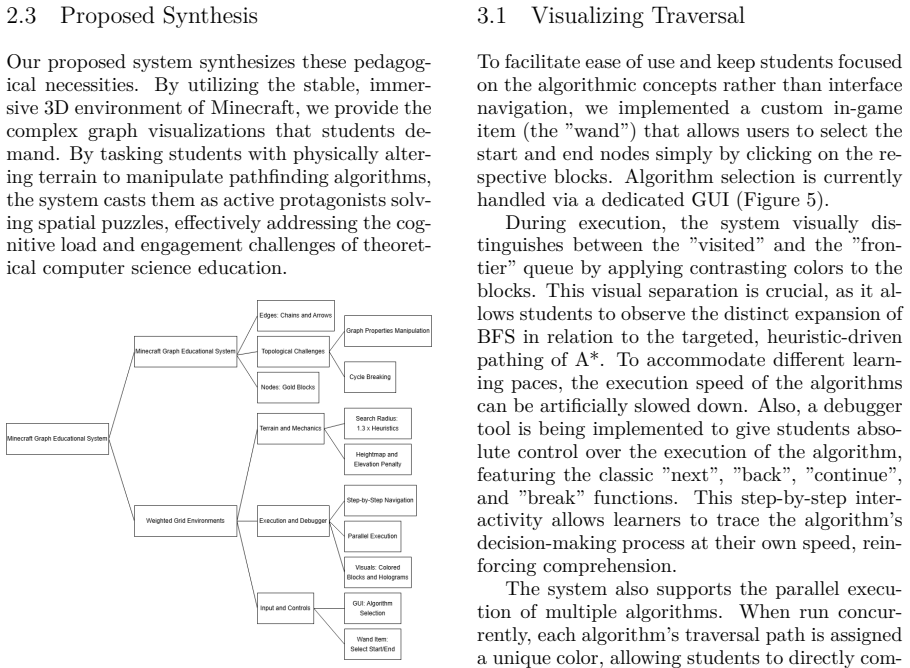
The authors present a three-layer Minecraft system in which terrain blocks act as weighted edges for grid traversal and shortest-path tasks, a sky layer supports free 3D construction of directed and undirected graphs, and in-game books deliver lessons plus quizzes, all intended to let students become active manipulators of algorithmic behavior.
What carries the argument
The three-layer system that uses terrain types to encode edge weights for path algorithms, allows 3D interactive graph building, and integrates lessons through books to support hands-on construction of algorithmic understanding.
If this is right
- Students can explore shortest-path algorithms by selecting terrain blocks that carry different movement costs.
- Players gain direct control over building and editing both directed and undirected graphs in three dimensions.
- Quizzes delivered inside the game environment let learners check their grasp of traversal concepts without leaving the world.
- The design shifts learners from watching algorithms to changing them, which the authors expect to strengthen conceptual links.
Where Pith is reading between the lines
- The same block-manipulation style could be applied to visualize other algorithms such as sorting or searching by repurposing existing game mechanics.
- Telemetry data collected during play could later support adaptive lessons that adjust graph complexity in real time.
- The approach suggests a route for bringing network-routing or robotics path-planning ideas into classrooms through familiar game interfaces.
Load-bearing premise
The three proposed Minecraft modules will actually improve how well students understand graph algorithms, since the planned tests with workload surveys and game telemetry have not yet been carried out.
What would settle it
A comparison study in which students using the Minecraft system show no measurable gain in solving graph algorithm problems compared with students using standard diagrams or code examples would show the approach does not deliver the intended learning benefit.
Figures


read the original abstract
Graph theory is a cornerstone of Computer Science education, yet entry-level students often struggle to map abstract node-edge relationships to practical applications. This paper presents the design and architecture of a Minecraft-based educational tool specifically built to visualize graph traversal and shortest-path algorithms. We propose a three-layer system: (1) a Grid Traversal module where terrain types (e.g., soul sand, ice) represent edge weights, allowing for the gamified study of shortest path algorithms; (2) a "Sky Graph" module for interactive 3D manipulation of both directed and undirected graphs; and (3) lessons and quizzes available through books. The system grounds its design in Constructionist learning theory, transitioning students from passive observers to active protagonists who physically manipulate algorithmic behavior. We additionally present a planned empirical evaluation using NASA-TLX and in-game telemetry to validate the system's pedagogical efficacy.
Editorial analysis
A structured set of objections, weighed in public.
Referee Report
Summary. The paper presents the design and architecture of a Minecraft-based educational tool to visualize graph traversal and shortest-path algorithms. It proposes a three-layer system consisting of a Grid Traversal module (using terrain types like soul sand and ice to represent edge weights), a Sky Graph module for 3D interactive manipulation of directed and undirected graphs, and lessons/quizzes delivered through in-game books. The design is grounded in Constructionist learning theory to transition students to active participants who manipulate algorithmic behavior, and it describes a planned empirical evaluation using NASA-TLX and in-game telemetry to assess pedagogical efficacy.
Significance. If implemented and validated by the planned study, this work could meaningfully advance computer science education by providing a gamified, interactive platform that helps entry-level students connect abstract graph concepts to practical applications. The explicit connection to Constructionist theory and the falsifiable evaluation plan using established metrics are positive aspects that strengthen the proposal.
major comments (1)
- [Title and Abstract] The title describes 'A Minecraft System' which suggests a completed and functional implementation, yet the abstract and body text consistently refer to a 'proposed' design and 'planned' evaluation. This mismatch is load-bearing for accurately conveying the manuscript's contribution as a design proposal rather than a deployed system.
minor comments (1)
- The manuscript would benefit from the inclusion of illustrative figures or diagrams depicting the three-layer architecture and example in-game scenarios to enhance clarity for readers unfamiliar with Minecraft.
Simulated Author's Rebuttal
We thank the referee for their positive assessment of the work and for the constructive comment on title and abstract clarity. We address the point below.
read point-by-point responses
-
Referee: [Title and Abstract] The title describes 'A Minecraft System' which suggests a completed and functional implementation, yet the abstract and body text consistently refer to a 'proposed' design and 'planned' evaluation. This mismatch is load-bearing for accurately conveying the manuscript's contribution as a design proposal rather than a deployed system.
Authors: We agree that the current title risks implying a fully implemented system, while the manuscript describes a proposed design, architecture, and planned evaluation. To correct this, we will revise the title to 'Block-Based Pathfinding: A Proposed Minecraft System for Visualizing Graph Algorithms' (or an equivalent phrasing that emphasizes the design-proposal nature of the contribution). We will also verify that the abstract and body text remain fully consistent in describing the work as a proposal. This change will be incorporated in the revised manuscript. revision: yes
Circularity Check
No significant circularity
full rationale
The paper is a descriptive design proposal presenting a three-layer Minecraft architecture for visualizing graph algorithms, grounded in external Constructionist learning theory. No equations, derivations, fitted parameters, or predictions appear anywhere in the text. The empirical evaluation is explicitly labeled as planned rather than executed, and no self-citation chains or uniqueness claims reduce any central assertion to the paper's own inputs by construction. The work is self-contained as an architecture description without load-bearing circular steps.
Axiom & Free-Parameter Ledger
axioms (1)
- domain assumption Constructionist learning theory supports improved outcomes when students actively manipulate and build representations of concepts
Reference graph
Works this paper leans on
-
[1]
S., Tay, J., Aiyenitaju, O., and Nawaz, R
AlJanah, S., Teh, P. S., Tay, J., Aiyenitaju, O., and Nawaz, R. (2023). Minecraft as a Tool to En- hance Engagement in Higher Education, pages 465–476. Ameen, M. R., Islam, A., and Ope, M. K. (2025). Khelte khelte shikhi: A proposed hci framework for gamified interactive learning with minecraft in bangladeshi education systems. Arouri, Y. M., Hamaidi, D. ...
work page 2023
-
[2]
Bar-El, D. and E. Ringland, K. (2020). Crafting game-based learning: An analysis of lessons for minecraft education edition. In Proceedings of the 15th International Conference on the Foun- dations of Digital Games, FDG ’20, New York, NY, USA. Association for Computing Machin- ery. Hart, S. G. and Staveland, L. E. (1988). Develop- ment of nasa-tlx (task l...
work page 2020
-
[3]
Suwannik, W. (2025). Minecraft: An engaging plat- form to learn programming. In 2025 IEEE/ACIS 23rd International Conference on Software En- gineering Research, Management and Applica- tions (SERA). IEEE. Sweller, J. (1988). Cognitive load during problem solving: Effects on learning. Cognitive Science, 12(2):257–285. Weixelbraun, P. F., Göbl, B., Steinböc...
work page 2025
discussion (0)
Sign in with ORCID, Apple, or X to comment. Anyone can read and Pith papers without signing in.