Recognition: unknown
Time delay as a probe of multiple photon spheres
Pith reviewed 2026-05-10 12:37 UTC · model grok-4.3
The pith
Time delays of higher-order images distinguish spacetimes with multiple photon spheres where shadows cannot.
A machine-rendered reading of the paper's core claim, the machinery that carries it, and where it could break.
Core claim
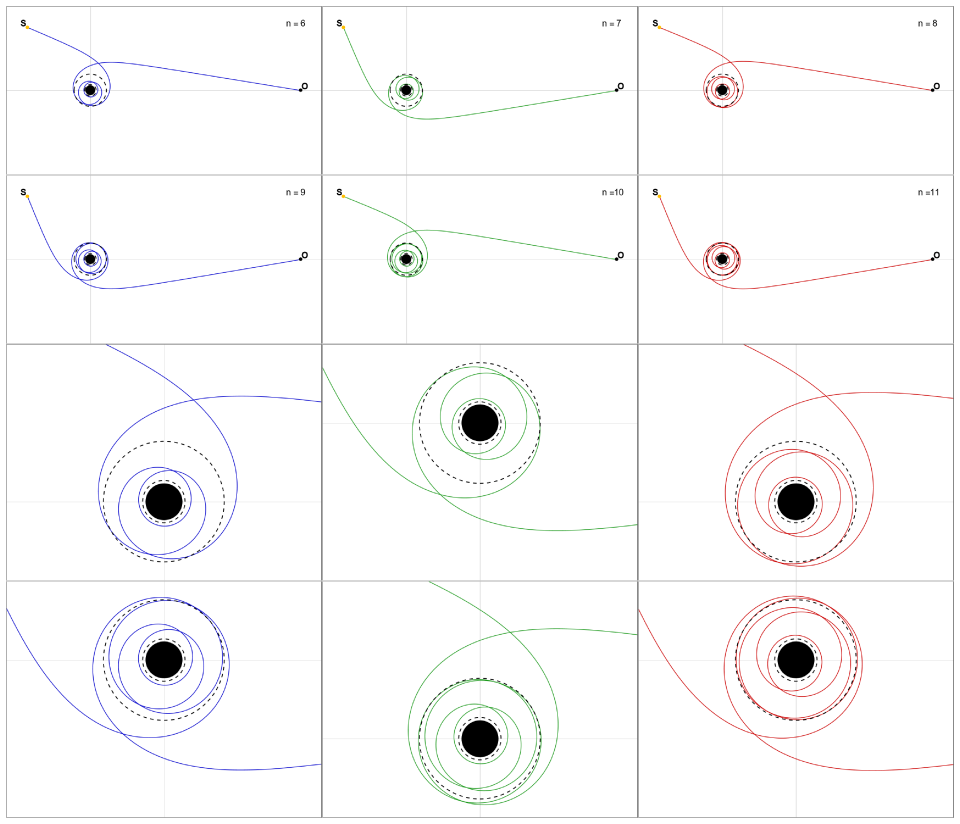
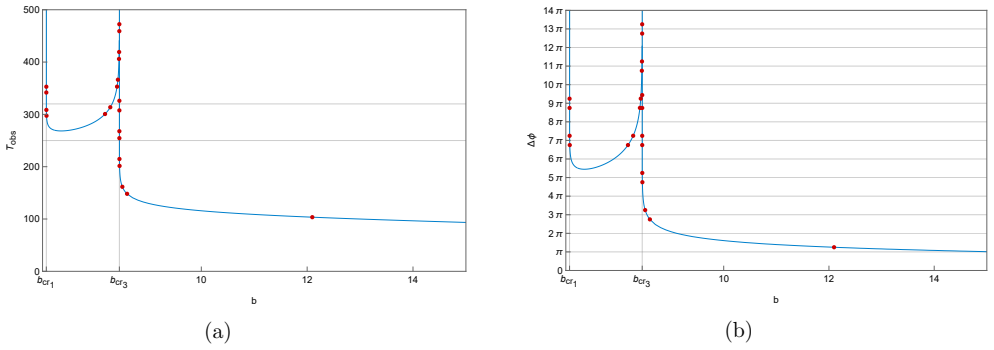
Time delay observables associated with higher-order images of transient sources provide a robust probe to break degeneracies across different spherically symmetric spacetime geometries that admit multiple photon spheres. Adopting a model-independent parametrized static spherically symmetric framework that captures the generic features of double-peaked effective potentials, photon geodesics are quantified by angular deflection, travel time, and image order. Trajectories that probe the region between the unstable photon spheres display nontrivial temporal behavior, including a minimum travel time, a minimum angular deflection, and a characteristic triplet structure of higher-order images with
What carries the argument
Time delays and arrival sequences of higher-order photon geodesics that traverse the region between two unstable photon spheres in a double-peaked effective potential.
Load-bearing premise
The chosen parametrized static spherically symmetric framework with double-peaked effective potentials captures the generic features of all relevant spacetimes and the identified temporal signatures remain distinctive once realistic source variability, plasma, and non-spherical effects are included.
What would settle it
Time-resolved lensing observations of a transient source that either detect or fail to detect the predicted minimum travel time together with the specific triplet arrival sequence for higher-order images.
Figures






read the original abstract
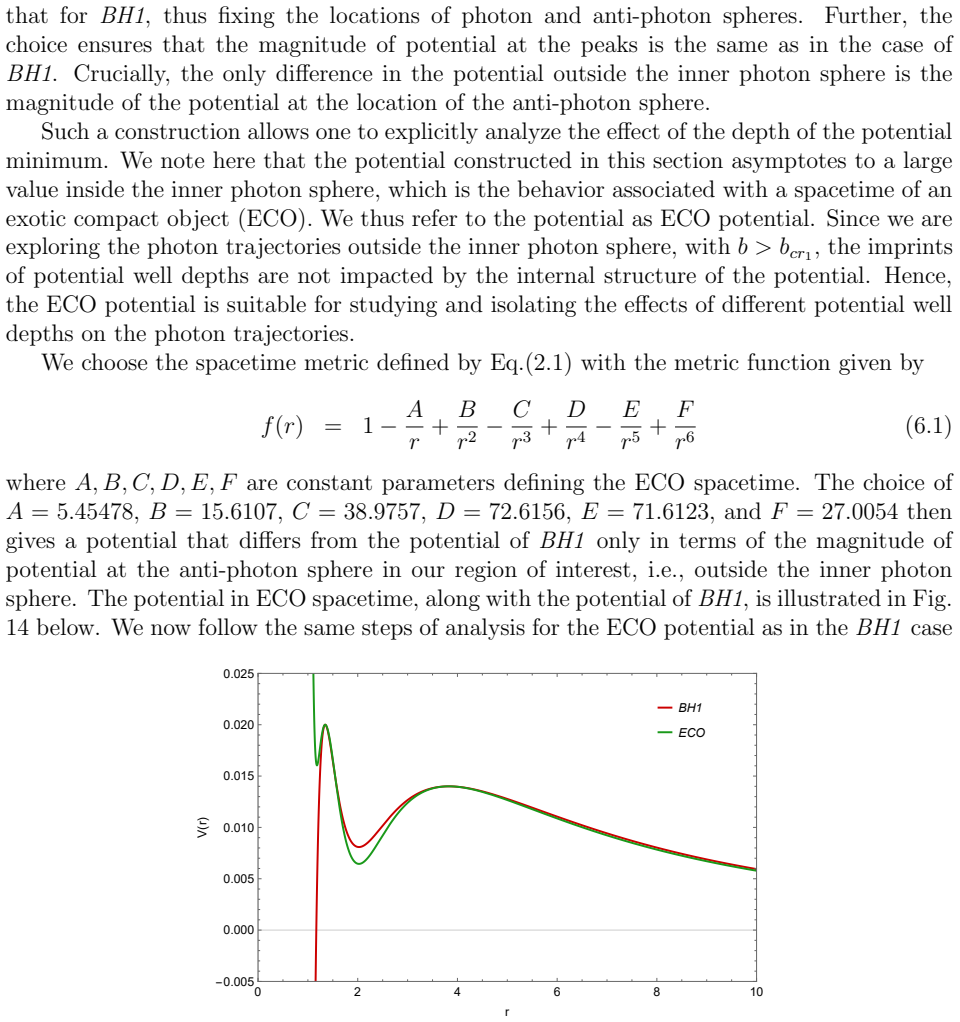
Black hole shadow images are primarily determined by the properties of photon spheres and can exhibit degeneracies across different spherically symmetric spacetime geometries. We show that time delay observables associated with higher-order images of transient sources provide a robust probe to break such degeneracies in spacetimes admitting multiple photon spheres. Adopting a model-independent, parametrized, static, spherically symmetric framework that captures the generic features of double-peaked effective potentials, we investigate photon geodesics and quantify them in terms of angular deflection, travel time, and the order of the image. We identify distinctive signatures of trajectories probing the region between the unstable photon spheres. In particular, we find that these trajectories are characterized by the nontrivial temporal behavior, including a minimum travel time, a minimum angular deflection, and a characteristic triplet structure of higher-order images with a specific arrival sequence. We further show that the influence of the depth of the potential well, between the two photon spheres, on the observed time delays provides a direct handle on otherwise inaccessible regions of the spacetime. Our results highlight that time-domain lensing observables encode information beyond static shadow images and offer a promising avenue for probing the structure of compact objects and the strong-field regime of gravity.
Editorial analysis
A structured set of objections, weighed in public.
Referee Report
Summary. The manuscript claims that time-delay observables associated with higher-order images of transient sources provide a robust probe to break degeneracies in black-hole shadow images for spacetimes admitting multiple photon spheres. Adopting a parametrized static spherically symmetric metric that produces double-peaked effective potentials, the authors integrate null geodesics and report distinctive signatures: a minimum travel time, a minimum angular deflection, and a characteristic triplet structure with specific arrival ordering for trajectories that probe the inter-photon-sphere region. They further argue that varying the depth of the potential well between the two unstable photon spheres directly influences the observed time delays, thereby accessing otherwise inaccessible spacetime structure.
Significance. If the reported temporal signatures remain distinctive under realistic conditions, the work would supply a concrete time-domain complement to shadow imaging, enabling stronger constraints on strong-field gravity and the interior structure of compact objects. The choice of a parametrized framework is a clear strength, as it aims at model-independent statements rather than case-by-case metric studies, and the emphasis on transient sources aligns with forthcoming observational capabilities.
major comments (3)
- [§3] §3 (Geodesic integration and effective-potential parametrization): the manuscript does not specify the numerical integrator, step-size control, or convergence tests used to compute travel times and deflection angles. Without these, it is impossible to judge the quantitative reliability of the claimed minimum-travel-time feature, which is central to the assertion that time delays break shadow degeneracies.
- [§4.2–4.3] §4.2–4.3 (Travel-time and image-order results): the analysis is performed exclusively for vacuum null geodesics in a static, spherically symmetric background. No quantitative assessment is given of how a time-varying source profile, refractive plasma, or small non-spherical perturbations would shift the arrival-time ordering or erase the reported minimum-travel-time signature; this directly limits the robustness claim for generic spacetimes with multiple photon spheres.
- [§5] §5 (Dependence on potential-well depth): while the depth parameter is varied, the paper does not demonstrate that the triplet structure and minimum-deflection feature persist across a wider family of metrics that admit multiple photon spheres (e.g., those with different asymptotic fall-off or non-vacuum stress-energy). This leaves open whether the signatures are generic or tied to the specific parametrization chosen.
minor comments (2)
- [Figure 3, Table 2] Figure 3 and Table 2: the plotted time-delay curves and tabulated image orders would benefit from explicit indication of the parameter values used and the units of the time delay (coordinate or observer time).
- [Abstract, §1] The abstract and §1 refer to “model-independent” results, yet the framework is still a specific two-parameter family; a brief clarification of the precise sense in which the results are model-independent would improve readability.
Simulated Author's Rebuttal
We are grateful to the referee for the thorough review and valuable suggestions. We have carefully considered each comment and revised the manuscript to improve clarity and address the concerns raised. Below we provide point-by-point responses.
read point-by-point responses
-
Referee: [§3] §3 (Geodesic integration and effective-potential parametrization): the manuscript does not specify the numerical integrator, step-size control, or convergence tests used to compute travel times and deflection angles. Without these, it is impossible to judge the quantitative reliability of the claimed minimum-travel-time feature, which is central to the assertion that time delays break shadow degeneracies.
Authors: We thank the referee for pointing this out. In the revised version, we have included a detailed description of the numerical methods in Section 3. Specifically, we employ a 4th-order Runge-Kutta integrator with adaptive step-size control based on local truncation error estimates. Convergence is ensured by requiring that travel times and deflection angles change by less than 0.1% upon halving the step size, and we have validated the code against known analytic results for the Schwarzschild metric. These additions should allow readers to assess the reliability of the minimum-travel-time feature. revision: yes
-
Referee: [§4.2–4.3] §4.2–4.3 (Travel-time and image-order results): the analysis is performed exclusively for vacuum null geodesics in a static, spherically symmetric background. No quantitative assessment is given of how a time-varying source profile, refractive plasma, or small non-spherical perturbations would shift the arrival-time ordering or erase the reported minimum-travel-time signature; this directly limits the robustness claim for generic spacetimes with multiple photon spheres.
Authors: We agree that extending the analysis to these effects would strengthen the robustness claims. However, a full quantitative study would require significant additional computations, including ray-tracing in time-dependent or non-vacuum spacetimes. In the revision, we have added a paragraph in §4.3 discussing the expected impact: for transient sources with duration much longer than the time delays, the signatures persist; plasma refraction is negligible for radio frequencies in low-density environments; small perturbations may broaden the images but preserve the ordering for sufficiently deep potential wells. We have also noted this as a direction for future work. revision: partial
-
Referee: [§5] §5 (Dependence on potential-well depth): while the depth parameter is varied, the paper does not demonstrate that the triplet structure and minimum-deflection feature persist across a wider family of metrics that admit multiple photon spheres (e.g., those with different asymptotic fall-off or non-vacuum stress-energy). This leaves open whether the signatures are generic or tied to the specific parametrization chosen.
Authors: The parametrized framework was constructed precisely to encompass generic static spherically symmetric metrics with multiple photon spheres, focusing on the local shape of the effective potential rather than global asymptotics. To address this, we have expanded §5 to include comparisons with specific examples from the literature, such as certain regular black hole models and modified gravity solutions that exhibit double-peaked potentials with varying asymptotic behaviors. In these cases, the triplet structure and minimum deflection persist when the inter-sphere potential depth is comparable. This supports the generality within the class of metrics considered. revision: yes
Circularity Check
No circularity: time-delay signatures computed directly from parametrized geodesics
full rationale
The paper adopts a parametrized static spherically symmetric metric chosen to admit double-peaked effective potentials, then integrates null geodesics to obtain deflection angles, travel times, and image orders. These quantities are derived outputs of the geodesic equations applied to the metric functions; they are not obtained by fitting parameters to the same observables and then relabeling the fit as a prediction, nor do they rely on a self-citation chain that itself assumes the target result. The central claim that certain temporal features (minimum travel time, triplet structure) distinguish the inter-photon-sphere region follows from explicit integration within the chosen family of metrics and does not reduce to a definitional identity or to a prior result whose validity is presupposed by the present work. The analysis therefore remains self-contained against external benchmarks.
Axiom & Free-Parameter Ledger
free parameters (1)
- parameters controlling the depth and location of the double-peaked effective potential
axioms (2)
- standard math Light propagates along null geodesics of the spacetime metric
- domain assumption The spacetime is static and spherically symmetric
Reference graph
Works this paper leans on
-
[1]
Event Horizon Telescope Collaboration et al, ApJL,875, L1, (2019)
2019
-
[2]
Event Horizon Telescope Collaboration et al, ApJL930, L12, (2022)
2022
-
[3]
et al., Galaxies11, 32 (2023)
Galison, P. et al., Galaxies11, 32 (2023)
2023
-
[4]
M. D. Johnson et al., Galaxies11, 61 (2023)
2023
-
[5]
Ayzenberg, et al., Living Rev
D. Ayzenberg, et al., Living Rev. Relativity28, 4 (2025)
2025
-
[6]
M. D. Johnson et al., Proc. SPIE Int. Soc. Opt. Eng.13092, 130922D (2024)
2024
-
[7]
Lupsasca et al., Proc
A. Lupsasca et al., Proc. SPIE Int. Soc. Opt. Eng.13092, 130922Q (2024)
2024
-
[8]
K. S. Virbhadra and G. F. R. Ellis, Phys. Rev. D62, 084003 (2000). 28
2000
-
[9]
Bozza, Phys
V. Bozza, Phys. Rev. D66, 103001 (2002)
2002
-
[10]
Bozza and L
V. Bozza and L. Mancini, Gen. Relativ. Gravit.36, 435 (2004)
2004
-
[11]
Matt Visser, Sayan Kar, and Naresh Dadhich, Phys. Rev. Lett.90, 201102 (2003)
2003
-
[12]
Ovalle, R
J. Ovalle, R. Casadio, E. Contreras, and A. Sotomayor, Phys. Dark Universe31, 100744 (2021)
2021
-
[13]
C. A. R. Herdeiro, E. Radu, N. Sanchis-Gual, and J. A. Font, Phys. Rev. Lett.121, 101102 (2018)
2018
-
[14]
Cardoso et al., Phys
V. Cardoso et al., Phys. Rev. D105, L061501 (2022)
2022
-
[15]
Liu, Z.-F
H.-S. Liu, Z.-F. Mai, Y.-Z. Li, and H. L¨ u, Sci. China Phys. Mech. Astron. 63, 240411 (2020)
2020
-
[16]
Tim Johannsen and Dimitrios Psaltis, Phys. Rev. D83, 124015 (2011)
2011
-
[17]
G. Guo, Y. Lu, P. Wang, H. Wu, and H. Yang, Phys. Rev. D 107, 124037 (2023)
2023
-
[18]
G. W. Gibbons and C. M. Warnick, Phys. Lett. B763, 169 (2016)
2016
-
[19]
Caio F. B. Macedo et al., Phys.Rev.D113, 064004 (2026)
2026
-
[20]
Rueda and E
A. Rueda and E. Contreras, Phys. Rev. D111, 044019 (2025)
2025
-
[21]
Meng, X.-M
Y. Meng, X.-M. Kuang, X.-J. Wang, B. Wang, and J.-P. Wu, Phys. Rev. D108, 064013 (2023)
2023
-
[22]
Q. Gan, P. Wang, H. Wu, and H. Yang, Phys. Rev. D104, 044049 (2021)
2021
-
[23]
Sergio V. M. C. B. Xavier et al., Phys. Rev. D107, 064040 (2023)
2023
-
[24]
G. Guo, X. Jiang, P. Wang, and H. Wu, Phys. Rev. D105, 124064 (2022)
2022
-
[25]
Guerrero et al., Phys
M. Guerrero et al., Phys. Rev. D106, 044070 (2022)
2022
-
[26]
Xi-Jing Wang, Yuan Meng, Xiao-Mei Kuang, and Kai Liao, Phys. Rev. D112, 124016 (2025)
2025
-
[27]
Yiqian Chen, Peng Wang, and Haitang Yang, Phys. Rev. D110, 044020 (2024)
2024
-
[28]
L¨ utf¨ uo˘ glu, Physics Letters B872, 140082 (2026)
B.C. L¨ utf¨ uo˘ glu, Physics Letters B872, 140082 (2026)
2026
-
[29]
Chen and P
C.-Y. Chen and P. Kotlaˇ r´ ık, Phys. Rev. D108, 064052 (2023)
2023
-
[30]
G. Guo, P. Wang, H. Wu, and H. Yang, J. High Energy Phys.06(2022) 073
2022
-
[31]
Lu, Phys
Hyat Huang, Min-Yan Ou, Meng-Yun Lai, and H. Lu, Phys. Rev. D105, 104049 (2022). 29
2022
-
[32]
G. Guo, P. Wang, H. Wu, and H. Yang, J. High Energy Phys.06(2022) 060
2022
-
[33]
Shapiro, Phys
I.I. Shapiro, Phys. Rev. Lett.13, 789 (1964)
1964
-
[34]
G. N. Wong, L. Medeiros, A. C´ ardenas-Avenda˜ no, and J. M. Stone, Astrophys. J. Lett. 975, L40 (2024)
2024
-
[35]
Perlick and O
V. Perlick and O. Y. Tsupko, Phys. Rep.947, 1 (2022). 30
2022
discussion (0)
Sign in with ORCID, Apple, or X to comment. Anyone can read and Pith papers without signing in.