Charmed baryon decays at BESIII
Pith reviewed 2026-05-10 09:24 UTC · model grok-4.3
The pith
Rare semi-leptonic decay of charmed baryon to neutron observed using graph neural network
A machine-rendered reading of the paper's core claim, the machinery that carries it, and where it could break.
Core claim
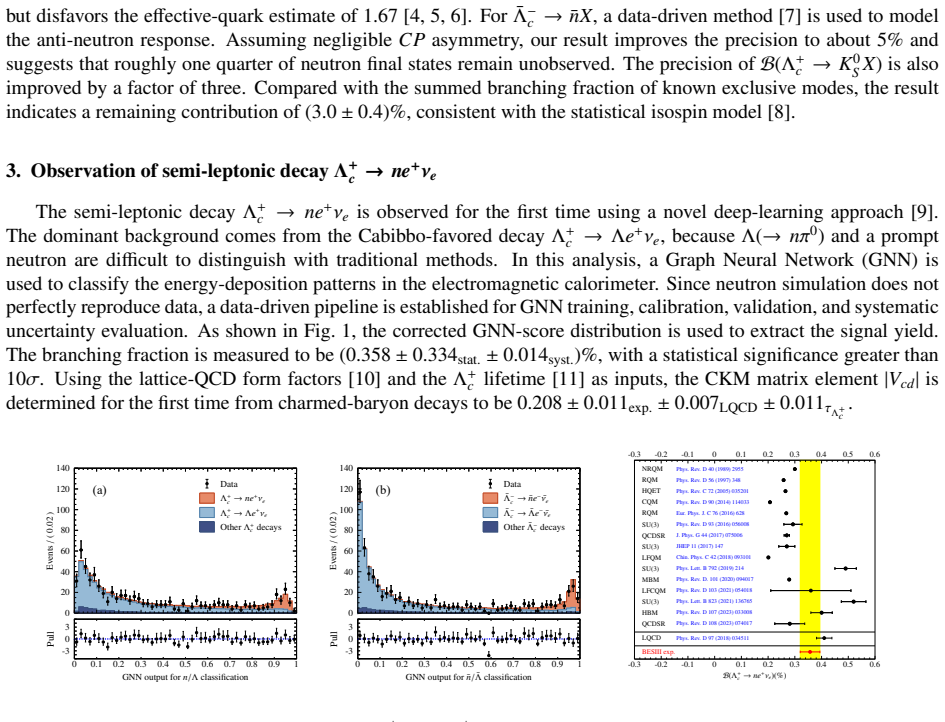
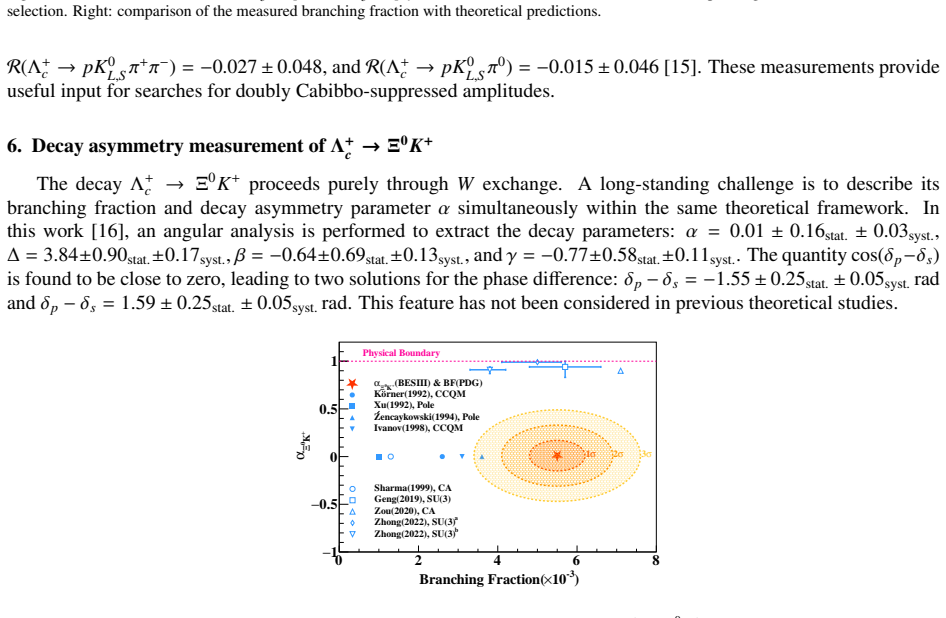
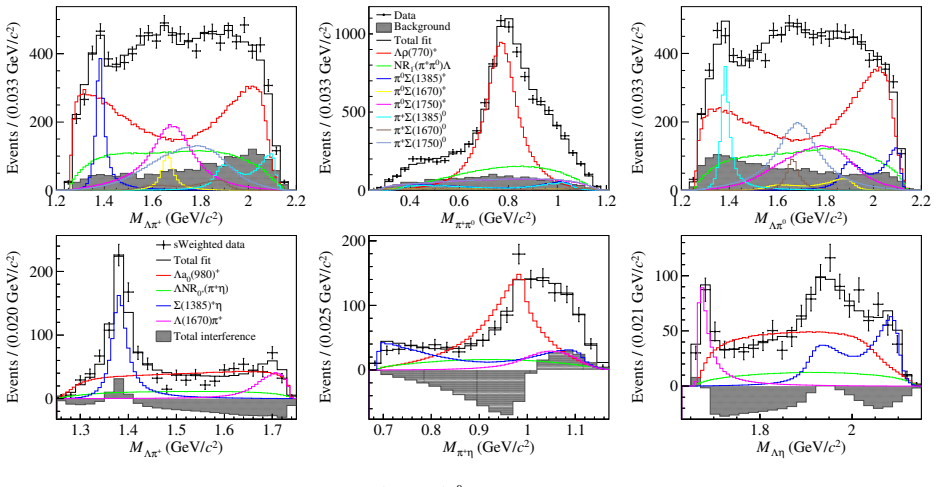
The paper establishes the observation of the rare semi-leptonic decay Lambda_c^+ to neutron electron neutrino through multivariate selection with a graph neural network on the full data set. It simultaneously reports the first determination of the decay asymmetry in the pure W-exchange channel Lambda_c^+ to Xi^0 K^+. Complementary results include branching fraction measurements for the inclusive modes Lambda_c^+ to X electron neutrino and anti-Lambda_c to anti-neutron X, together with amplitude analyses of Lambda_c^+ to Lambda pi^+ pi^0 and Lambda_c^+ to Lambda pi^+ eta.
What carries the argument
The graph neural network classifier that isolates the rare signal from background in the semi-leptonic channel.
If this is right
- The observed decay rate can be compared directly with predictions from quark models or lattice calculations for semi-leptonic charmed baryon transitions.
- The measured asymmetry in the W-exchange decay supplies a new constraint on non-leptonic weak interaction amplitudes.
- The inclusive branching fractions serve as normalization references for other decay channels of the same baryon.
- The partial wave results map the resonant substructure that appears in multi-pion final states.
Where Pith is reading between the lines
- Application of graph neural networks to other rare decay searches could increase sensitivity in heavy-flavor experiments.
- The new data may help clarify why certain decay patterns differ between charmed baryons and charmed mesons.
- Higher-statistics samples could allow extraction of form factors or angular distributions in the observed channels.
Load-bearing premise
The graph neural network training and background modeling assumptions correctly isolate the rare signal without introducing large biases or false positives.
What would settle it
An independent analysis of the same data set that uses a different selection method or omits the graph neural network and finds no excess events in the signal region would falsify the observation.
Figures
read the original abstract
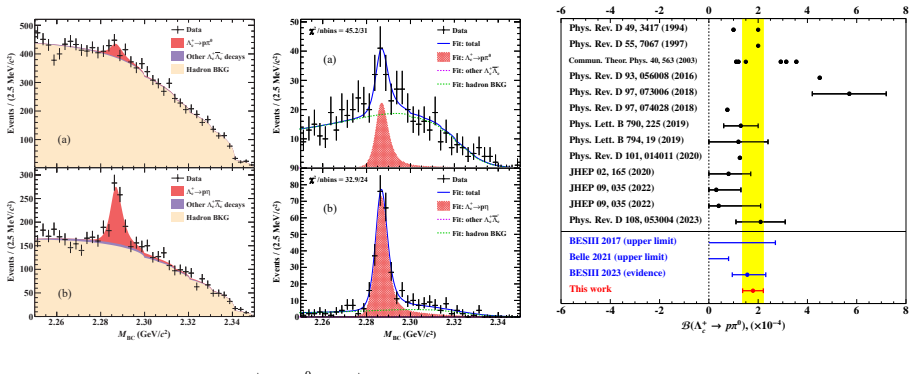
BESIII has accumulated 4.5 fb$^{-1}$ of $e^+e^-$ collision data in the 4.6 to 4.7 GeV energy range, corresponding to the world's largest sample of $\Lambda_c^+\bar{\Lambda}_c^-$ pairs. This paper summarizes recent BESIII results on charmed-baryon decays, including the observation of the rare semi-leptonic decay $\Lambda_c^+\to ne^+\nu_e$ using a Graph Neural Network, the first measurement of the decay asymmetry in the pure $W$-exchange decay $\Lambda_c^+\to\Xi^0K^+$, and branching fraction measurements of the inclusive decays $\Lambda_c^+\to Xe^+\nu_e$ and $\bar{\Lambda}_c^-\to \bar{n}X$. We also report partial wave analyses of $\Lambda_c^+\to\Lambda\pi^+\pi^0$ and $\Lambda_c^+\to\Lambda\pi^+\eta$, measurements of Cabibbo-suppressed decays such as $\Lambda_c^+\to p\pi^0$, and studies of $K_S^0-K_L^0$ asymmetries in $\Lambda_c^+$ decays.
Editorial analysis
A structured set of objections, weighed in public.
Referee Report
Summary. This paper summarizes recent results from the BESIII collaboration on charmed baryon decays, utilizing a data sample of 4.5 fb^{-1} collected at center-of-mass energies from 4.6 to 4.7 GeV. It highlights the observation of the rare semileptonic decay Λ_c^+ → n e^+ ν_e using a Graph Neural Network, the first measurement of the decay asymmetry in the pure W-exchange decay Λ_c^+ → Ξ^0 K^+, branching fraction measurements for inclusive decays Λ_c^+ → X e^+ ν_e and Λ_c^- → n-bar X, partial wave analyses of Λ_c^+ → Λ π^+ π^0 and Λ_c^+ → Λ π^+ η, measurements of Cabibbo-suppressed decays such as Λ_c^+ → p π^0, and studies of K_S^0 - K_L^0 asymmetries in Λ_c^+ decays.
Significance. If the reported results hold, they provide important new experimental inputs to heavy-flavor physics, particularly for rare semileptonic decays and asymmetry parameters in charmed baryons. These data can constrain form-factor models, test isospin relations, and probe W-exchange mechanisms, with the large BESIII sample enabling measurements that were previously inaccessible.
minor comments (3)
- [Abstract] The abstract does not include statistical significances, central values, or uncertainties for the key new results (e.g., the GNN-based observation or the asymmetry parameter), which would allow readers to assess the claims at a glance without consulting the referenced primary papers.
- A summary table compiling all reported branching fractions, asymmetries, and their uncertainties would improve readability and facilitate comparison across the multiple analyses presented.
- Particle notation (e.g., subscripts and superscripts for Λ_c^+, Ξ^0, K_S^0) should be checked for consistent LaTeX formatting throughout the text and figures.
Simulated Author's Rebuttal
We thank the referee for the careful reading of our manuscript summarizing recent BESIII results on charmed baryon decays and for the positive assessment of its significance. The recommendation for minor revision is noted. However, the report contains no specific major comments requiring response or changes to the text.
Circularity Check
No circularity: direct experimental measurements from data
full rationale
This is a concise summary paper reporting multiple BESIII experimental results on charmed baryon decays, including observations and branching fractions extracted from collision data. No theoretical derivation chain, equations, or parameter fittings exist within the document that could reduce to self-inputs by construction. The GNN-based signal isolation and background modeling are acknowledged as load-bearing but are not re-derived here; they reside in referenced primary papers. All quantities are direct measurements, making the paper self-contained against external benchmarks with no self-definitional, fitted-prediction, or self-citation circularity.
Axiom & Free-Parameter Ledger
axioms (1)
- domain assumption Standard Model conservation laws and particle identification techniques apply to the analyzed decays
Reference graph
Works this paper leans on
-
[1]
M. Ablikim et al. [BESIII Collaboration], Phys. Rev. D 107 (2023) no.5, 052005
work page 2023
-
[2]
M. Ablikim et al. [BESIII Collaboration], Phys. Rev. D 108 (2023) no.3, L031101
work page 2023
-
[3]
M. Ablikim et al. [BESIII Collaboration], J. High Energ. Phys. 06 (2025), 194
work page 2025
-
[4]
A. V . Manohar and M. B. Wise, Phys. Rev. D 49 (1994), 1310-1329
work page 1994
- [5]
-
[6]
J. L. Rosner, Phys. Rev. D 86 (2012), 014017
work page 2012
-
[7]
L. Liu, X. Zhou and H. Peng, Nucl. Instrum. Meth. A 1033 (2022), 166672
work page 2022
- [8]
-
[9]
M. Ablikim et al. [BESIII Collaboration], Nature Commun. 16 (2025) no.1, 681
work page 2025
- [10]
-
[11]
F. Abudinén et al. [Belle-II Collaboration], Phys. Rev. Lett. 130 (2023) no.7, 071802
work page 2023
-
[12]
S. X. Li et al. [Belle Collaboration], Phys. Rev. D 103 (2021) no.7, 072004
work page 2021
-
[13]
M. Ablikim et al. [BESIII Collaboration], Phys. Rev. D 109 (2024) no.9, L091101
work page 2024
-
[14]
M. Ablikim et al. [BESIII Collaboration], Phys. Rev. D 111 (2025) no.5, L051101
work page 2025
- [15]
-
[16]
M. Ablikim et al. [BESIII Collaboration], Phys. Rev. Lett. 132 (2024) no.3, 031801
work page 2024
- [17]
-
[18]
M. Ablikim et al. [BESIII Collaboration], Phys. Rev. Lett. 134 (2025) no.2, 021901
work page 2025
- [19]
- [20]
-
[21]
P . R. Li, X. R. Lyu and Y . Zheng, Chin. Phys. 50 (2026) no.2, 022002. 5
work page 2026
discussion (0)
Sign in with ORCID, Apple, or X to comment. Anyone can read and Pith papers without signing in.