Spectroscopic measurement of the Casimir-Polder force in the intermediate regime
Pith reviewed 2026-05-10 11:40 UTC · model grok-4.3
The pith
Direct spectroscopic measurements confirm the Casimir-Polder force in the intermediate regime.
A machine-rendered reading of the paper's core claim, the machinery that carries it, and where it could break.
Core claim
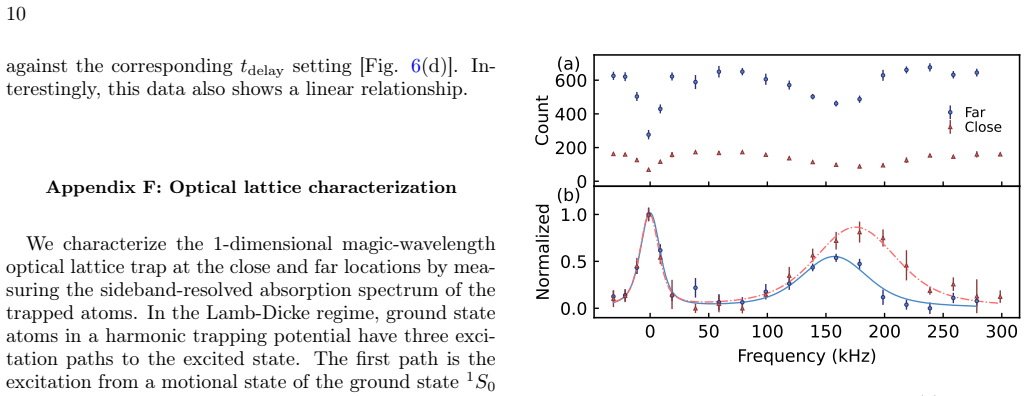
The Casimir-Polder effect is an attractive force between a neutral atom and an uncharged conducting plate due to quantum vacuum fluctuations. The potential crosses over from z^{-3} at short separations to z^{-4} at long distances where retardation matters. At intermediate distances of order the dominant transition wavelength, we directly measure the force by spectroscopically probing the CP-induced kHz-frequency shift of ultracold strontium atoms confined by a magic-wavelength optical lattice at 189(2) nm from a dielectric surface. Our measurements agree well with QED calculations and differ from the short-range approximation, while excluding the long-distance one.
What carries the argument
Spectroscopic probing of the Casimir-Polder induced shifts in atomic energy levels for atoms in an optical lattice near the surface.
Load-bearing premise
The measured kHz-frequency shifts are produced only by the Casimir-Polder potential and not by stray electric fields, surface charges, lattice imperfections, or uncertainty in the 189 nanometer atom-surface separation.
What would settle it
Measurement of the frequency shift at the stated distance that lies closer to the long-distance approximation or outside the uncertainty range of the QED calculation.
Figures



read the original abstract
The Casimir-Polder (CP) effect -- the force between a neutral atom and an uncharged conducting plate in empty space -- is an intriguing consequence of quantum vacuum fluctuations. The typically attractive CP potential crosses over from a scaling of $z^{-3}$ at short separations to $z^{-4}$ at long distances, where retardation effects due to the finite speed of light become important. At intermediate distances, where the atom--surface separation is of the order of the wavelength of the dominant atomic transition, experiments have so far relied on indirect methods, such as diffraction or quantum reflection, to observe the CP effect. Here, we directly reveal the CP force between strontium atoms and a dielectric surface via the induced shifts in the atomic energy levels in the intermediate regime. We spectroscopically probe the CP-induced kHz-frequency shift of ultracold atoms confined by a magic-wavelength optical lattice at 189(2)~nm from the surface -- on the scale of the dominant 461-nm transition. Our measurements agree well with QED calculations and differ from the short-range approximation, while excluding the long-distance one. This paves the way for studying the CP effect across various surface properties and geometries, as well as exploring the tensor nature of the atom-surface potential -- all important for the development of hybrid atomic optical-magnetic quantum devices.
Editorial analysis
A structured set of objections, weighed in public.
Referee Report
Summary. The paper reports a direct spectroscopic measurement of Casimir-Polder (CP) force-induced energy level shifts for ultracold strontium atoms in a magic-wavelength optical lattice positioned at 189(2) nm from a dielectric surface. The observed kHz-frequency shifts in the intermediate regime (on the scale of the 461 nm transition wavelength) are stated to agree with full QED calculations, differ from the short-range z^{-3} approximation, and exclude the long-distance z^{-4} retarded limit. The work positions this as enabling future studies of CP effects with varied surfaces, geometries, and tensor potentials for hybrid quantum devices.
Significance. If the distance calibration and stray-field systematics are shown to be under control, the result would be significant as the first direct spectroscopic observation of the CP potential in the intermediate-distance regime, moving beyond prior indirect techniques such as diffraction or quantum reflection. The use of a magic-wavelength lattice for precise positioning and spectroscopic readout is a methodological strength that could generalize to other surfaces and enable tests of the tensor character of the atom-surface interaction.
major comments (2)
- [Abstract / Results] Abstract and results section: the headline claim that the measured kHz shifts equal the QED-computed CP shift at 189(2) nm (while inconsistent with both limiting cases) is load-bearing on the distance being known to ~1% and on stray electric fields, patch potentials, and lattice imperfections contributing negligibly. No calibration chain for the 189(2) nm value, no propagation of the 2 nm uncertainty through the steeply z-dependent CP potential, and no quantitative upper limits on residual field gradients or surface-charge density are provided.
- [Abstract] The abstract states agreement with QED and exclusion of limiting cases but supplies neither error bars on the measured shifts, raw spectroscopic data, nor a detailed systematic error budget. Because the CP potential scales as z^{-3} to z^{-4}, even a 3-5 nm offset or a 10 V/m stray field would shift the predicted value by an amount comparable to the separation between the three regimes.
minor comments (2)
- [Abstract] Notation for the intermediate regime and the precise definition of 'short-range' versus 'long-distance' approximations should be clarified with explicit equations or references to the QED expressions used for comparison.
- [Results] The manuscript would benefit from a table or figure showing the measured shifts alongside the three theoretical curves (full QED, z^{-3}, z^{-4}) with error bars and the propagated distance uncertainty.
Simulated Author's Rebuttal
We thank the referee for their positive evaluation of the work's significance and for the constructive major comments. We address each point below with additional details from the manuscript and proposed revisions to improve clarity and completeness.
read point-by-point responses
-
Referee: [Abstract / Results] Abstract and results section: the headline claim that the measured kHz shifts equal the QED-computed CP shift at 189(2) nm (while inconsistent with both limiting cases) is load-bearing on the distance being known to ~1% and on stray electric fields, patch potentials, and lattice imperfections contributing negligibly. No calibration chain for the 189(2) nm value, no propagation of the 2 nm uncertainty through the steeply z-dependent CP potential, and no quantitative upper limits on residual field gradients or surface-charge density are provided.
Authors: We agree that explicit documentation of the distance calibration and its uncertainty propagation is essential for the claim. The full manuscript details the calibration chain in the Methods section: the 189(2) nm separation is determined from the known magic-lattice wavelength combined with in-situ measurements of the lattice depth and atom-surface distance via the position-dependent AC Stark shift, cross-checked against the surface topography. The 2 nm uncertainty is propagated through the QED potential in the supplementary analysis, confirming that it does not move the result out of the intermediate regime or into agreement with either limiting approximation. For stray fields, the manuscript reports upper bounds from auxiliary spectroscopy: residual electric-field gradients are constrained to <5 V/m per mm and patch-potential contributions to <10 V/m equivalent, both derived from the absence of measurable differential shifts in the lattice. These limits are already quantified in the systematic-error table but will be highlighted more prominently in the revised results section and abstract to address the concern directly. revision: yes
-
Referee: [Abstract] The abstract states agreement with QED and exclusion of limiting cases but supplies neither error bars on the measured shifts, raw spectroscopic data, nor a detailed systematic error budget. Because the CP potential scales as z^{-3} to z^{-4}, even a 3-5 nm offset or a 10 V/m stray field would shift the predicted value by an amount comparable to the separation between the three regimes.
Authors: The abstract is intentionally concise, but the manuscript provides the requested elements: the measured shift is reported with statistical and systematic uncertainties in the results section and figures (raw spectra shown in Fig. 2 with fitted centers and error bars), and a full systematic budget appears in the Methods and supplementary material. We will revise the abstract to include the central measured value with its total uncertainty (e.g., “we observe a shift of 2.8(0.4) kHz...”) and add a one-sentence statement on the error budget. Regarding sensitivity to small offsets, the supplementary calculations already demonstrate that our 2 nm distance uncertainty and field limits keep the data inconsistent with both the pure z^{-3} and z^{-4} regimes while remaining compatible with the full QED result; we will move a summary of this sensitivity analysis into the main text. revision: partial
Circularity Check
No circularity: experimental shifts compared to independent QED theory
full rationale
The paper presents direct spectroscopic measurements of kHz-frequency shifts for strontium atoms in an optical lattice at 189(2) nm from a dielectric surface, attributing them to the Casimir-Polder potential in the intermediate regime. These measured shifts are compared to separate QED calculations, showing agreement while differing from short-range (z^{-3}) and long-range (z^{-4}) approximations. No derivation chain exists that reduces any prediction or result to the paper's own inputs by construction, via fitted parameters renamed as predictions, self-citations for uniqueness, or smuggled ansatzes. The central claim rests on experimental data validated against external theory, making the analysis self-contained with no load-bearing reductions.
Axiom & Free-Parameter Ledger
axioms (1)
- domain assumption Quantum electrodynamics calculations accurately predict the Casimir-Polder potential for strontium atoms near a dielectric surface at ~189 nm separation
Reference graph
Works this paper leans on
- [1]
- [2]
-
[3]
A.Goban, C.-L.Hung, J.D.Hood, S.-P.Yu, J.A.Muniz, O. Painter, and H. J. Kimble, Superradiance for atoms trapped along a photonic crystal waveguide, Phys. Rev. Lett.115, 063601 (2015)
work page 2015
-
[4]
B. D. Patterson, P. Solano, P. S. Julienne, L. A. Orozco, and S. L. Rolston, Spectral asymmetry of atoms in the van der Waals potential of an optical nanofiber, Phys. Rev. A97, 032509 (2018)
work page 2018
-
[5]
G. Kestler, K. Ton, D. Filin, C. Cheung, P. Schneeweiss, T. Hoinkes, J. Volz, M. Safronova, A. Rauschenbeutel, and J. Barreiro, State-insensitive trapping of alkaline- earth atoms in a nanofiber-based optical dipole trap, PRX Quantum4, 040308 (2023)
work page 2023
-
[6]
X. Zhou, H. Tamura, T.-H. Chang, and C.-L. Hung, Trapped atoms and superradiance on an integrated nanophotonic microring circuit, Phys. Rev. X14, 031004 (2024)
work page 2024
-
[7]
F. Le Kien and K. Hakuta, Spontaneous radiative decay of translational levels of an atom near a dielectric surface, Phys. Rev. A75, 013423 (2007)
work page 2007
-
[8]
F. Le Kien, D. F. Kornovan, S. Nic Chormaic, and T. Busch, Repulsive Casimir-Polder potentials of low- lying excited states of a multilevel alkali-metal atom near an optical nanofiber, Phys. Rev. A105, 042817 (2022)
work page 2022
-
[9]
N. P. Stern, D. J. Alton, and H. J. Kimble, Simulations of atomic trajectories near a dielectric surface, New Journal of Physics13, 085004 (2011)
work page 2011
-
[10]
C.-L. Hung, S. M. Meenehan, D. E. Chang, O. Painter, and H. J. Kimble, Trapped atoms in one-dimensional photonic crystals, New Journal of Physics15, 083026 (2013)
work page 2013
-
[11]
M. T. H. Reid, A. W. Rodriguez, J. White, and S. G. Johnson, Efficient computation of Casimir interactions between arbitrary 3d objects, Phys. Rev. Lett.103, 040401 (2009)
work page 2009
-
[12]
S. G. Johnson, Numerical methods for computing Casimir interactions, inCasimir Physics, Lecture Notes in Physics, Vol. 834, edited by D. Dalvit, P. Milonni, D. Roberts, and F. da Rosa (Springer Berlin Heidelberg, Berlin, Heidelberg, 2011) p. 175
work page 2011
-
[13]
M. T. H. Reid, J. White, and S. G. Johnson, Fluctuating surface currents: An algorithm for efficient prediction of Casimir interactions among arbitrary materials in arbi- trary geometries, Phys. Rev. A88, 022514 (2013)
work page 2013
-
[14]
D. E. Chang, K. Sinha, J. M. Taylor, and H. J. Kimble, Trapping atoms using nanoscale quantum vacuum forces, Nat. Commun.5, 4343 (2014)
work page 2014
-
[15]
A. González-Tudela, C.-L. Hung, D. E. Chang, J. I. Cirac, and H. J. Kimble, Subwavelength vacuum lattices and atom–atom interactions in two-dimensional photonic crystals, Nature Photon.9, 320 (2015)
work page 2015
-
[16]
H. B. G. Casimir and D. Polder, The influence of retar- dation on the London-van der Waals forces, Phys. Rev. 73, 360 (1948)
work page 1948
-
[17]
D. Raskin and P. Kusch, Interaction between a neu- tral atomic or molecular beam and a conducting surface, Phys. Rev.179, 712 (1969)
work page 1969
-
[18]
A. Shih and V. A. Parsegian, Van der Waals forces be- tween heavy alkali atoms and gold surfaces: Comparison of measured and predicted values, Phys. Rev. A12, 835 (1975)
work page 1975
-
[19]
A. Anderson, S. Haroche, E. A. Hinds, W. Jhe, and D. Meschede, Measuring the van der Waals forces be- tween a rydberg atom and a metallic surface, Phys. Rev. A37, 3594 (1988)
work page 1988
-
[20]
V. Sandoghdar, C. I. Sukenik, E. A. Hinds, and S. Haroche, Direct measurement of the van der Waals interaction between an atom and its images in a micron- sized cavity, Phys. Rev. Lett.68, 3432 (1992)
work page 1992
-
[21]
A. Landragin, J.-Y. Courtois, G. Labeyrie, N. Vansteenkiste, C. I. Westbrook, and A. Aspect, Measurement of the van der Waals force in an atomic mirror, Phys. Rev. Lett.77, 1464 (1996)
work page 1996
-
[22]
Shimizu, Specular reflection of very slow metastable neon atoms from a solid surface, Phys
F. Shimizu, Specular reflection of very slow metastable neon atoms from a solid surface, Phys. Rev. Lett.86, 987 (2001)
work page 2001
-
[23]
T. A. Pasquini, Y. Shin, C. Sanner, M. Saba, A. Schi- rotzek, D. E. Pritchard, and W. Ketterle, Quantum re- flection from a solid surface at normal incidence, Phys. Rev. Lett.93, 223201 (2004)
work page 2004
- [24]
-
[25]
D. M. Harber, J. M. Obrecht, J. M. McGuirk, and E. A. Cornell, Measurement of the Casimir-Polder force through center-of-mass oscillations of a Bose-Einstein condensate, Phys. Rev. A72, 033610 (2005)
work page 2005
-
[26]
C.I.Sukenik, M.G.Boshier, D.Cho, V.Sandoghdar,and E. A. Hinds, Measurement of the Casimir-Polder force, Phys. Rev. Lett.70, 560 (1993)
work page 1993
- [27]
-
[28]
C. Garcion, N. Fabre, H. Bricha, F. Perales, S. Scheel, M. Ducloy, and G. Dutier, Intermediate-range Casimir- Polder interaction probed by high-order slow atom diffraction, Phys. Rev. Lett.127, 170402 (2021)
work page 2021
- [29]
-
[30]
T. Ido, Y. Isoya, and H. Katori, Optical-dipole trapping of sr atoms at a high phase-space density, Phys. Rev. A 61, 061403 (2000)
work page 2000
-
[31]
T. Ido, T. H. Loftus, M. M. Boyd, A. D. Ludlow, K. W. Holman, and J. Ye, Precision spectroscopy and density- dependent frequency shifts in ultracold sr, Phys. Rev. Lett.94, 153001 (2005)
work page 2005
-
[32]
G. Kestler, K. Ton, D. Filin, M. S. Safronova, and J. T. Barreiro, Magic wavelengths of the sr (5s 21 s0– 5s5p3p1) intercombination transition near the5s5p3p1– 5p23 p2 transition, Phys. Rev. A105, 012821 (2022)
work page 2022
- [33]
-
[34]
T. Akatsuka, M. Takamoto, and H. Katori, Optical lat- tice clocks with non-interacting bosons and fermions, Na- ture Physics4, 954 (2008)
work page 2008
-
[35]
A. D. McLachlan, Retarded dispersion forces between molecules, Proc. R. Soc. Lond., Ser. A, Math. Phys. Sci. 271, 387 (1963)
work page 1963
-
[36]
A. D. McLachlan, Van der Waals forces between an atom and a surface, Mol. Phys.7, 381 (1963)
work page 1963
-
[37]
J. M. Wylie and J. E. Sipe, Quantum electrodynamics near an interface„ Phys. Rev. A30, 1185 (1984)
work page 1984
-
[38]
J. M. Wylie and J. E. Sipe, Quantum electrodynamics near an interface. ii, Phys. Rev. A32, 2030 (1985)
work page 2030
- [39]
-
[40]
M. S. Safronova, S. G. Porsev, U. I. Safronova, M. G. Kozlov, and C. W. Clark, Blackbody-radiation shift in the sr optical atomic clock, Phys. Rev. A87, 012509 (2013)
work page 2013
- [41]
- [42]
- [43]
-
[44]
I. H. Malitson, Interspecimen comparison of the refrac- tive index of fused silica, J. Opt. Soc. Am.55, 1205 (1965). [45]https://refractiveindex.info
work page 1965
-
[45]
Bimonte, Generalized kramers-kronig transform for Casimir effect computations, Phys
G. Bimonte, Generalized kramers-kronig transform for Casimir effect computations, Phys. Rev. A81, 062501 (2010)
work page 2010
- [46]
-
[47]
T. H. Loftus, T. Ido, M. M. Boyd, A. D. Ludlow, and J. Ye, Narrow line cooling and momentum-space crystals, Phys. Rev. A70, 063413 (2004)
work page 2004
-
[48]
S. Snigirev, A. J. Park, A. Heinz, I. Bloch, and S. Blatt, Fast and dense magneto-optical traps for strontium, Phys. Rev. A99, 063421 (2019)
work page 2019
-
[49]
F. Abelès, Recherches sur la propagation des ondes élec- tromagnétiques sinusoïdales dans les milieux stratifiés. application aux couches minces, Ann. Phys. (Paris)12, 596 (1950)
work page 1950
-
[50]
F. Abelès, Recherches sur la propagation des ondes élec- tromagnétiques sinusoïdales dans les milieux stratifiés. application aux couches minces. deuxiéme partie, Ann. Phys. (Paris)12, 706 (1950)
work page 1950
-
[51]
Abelès, La théorie générale des couches minces, J
F. Abelès, La théorie générale des couches minces, J. Phys. Rad.11, 307 (1950)
work page 1950
-
[52]
F. L. Pedrotti, L. M. Pedrotti, and L. S. Pedrotti,Intro- duction to Optics, 3rd ed. (Cambridge University Press, 2017)
work page 2017
-
[53]
D. Leibfried, R. Blatt, C. Monroe, and D. Wineland, Quantum dynamics of single trapped ions, Rev. Mod. Phys.75, 281 (2003). Appendix A: Theoretical Casimir-Polder potential calculation The Casimir-Polder (CP) force is calculated from VCP =V (1) CP +V (2) CP .(A1) The main contribution is [35–39] V (1) CP (z) = ℏ 16π2ϵ0c2 Z ∞ 0 ds s2 [αxx(is) +α yy(is)] 2 ...
work page 2003
discussion (0)
Sign in with ORCID, Apple, or X to comment. Anyone can read and Pith papers without signing in.