High-order kernel regularization of singular and hypersingular Helmholtz boundary integral operators
Pith reviewed 2026-05-10 10:31 UTC · model grok-4.3
The pith
Error-function smoothing with polynomial moment corrections regularizes all four singular and hypersingular Helmholtz boundary integral operators at high order for standard quadrature in three dimensions.
A machine-rendered reading of the paper's core claim, the machinery that carries it, and where it could break.
Core claim
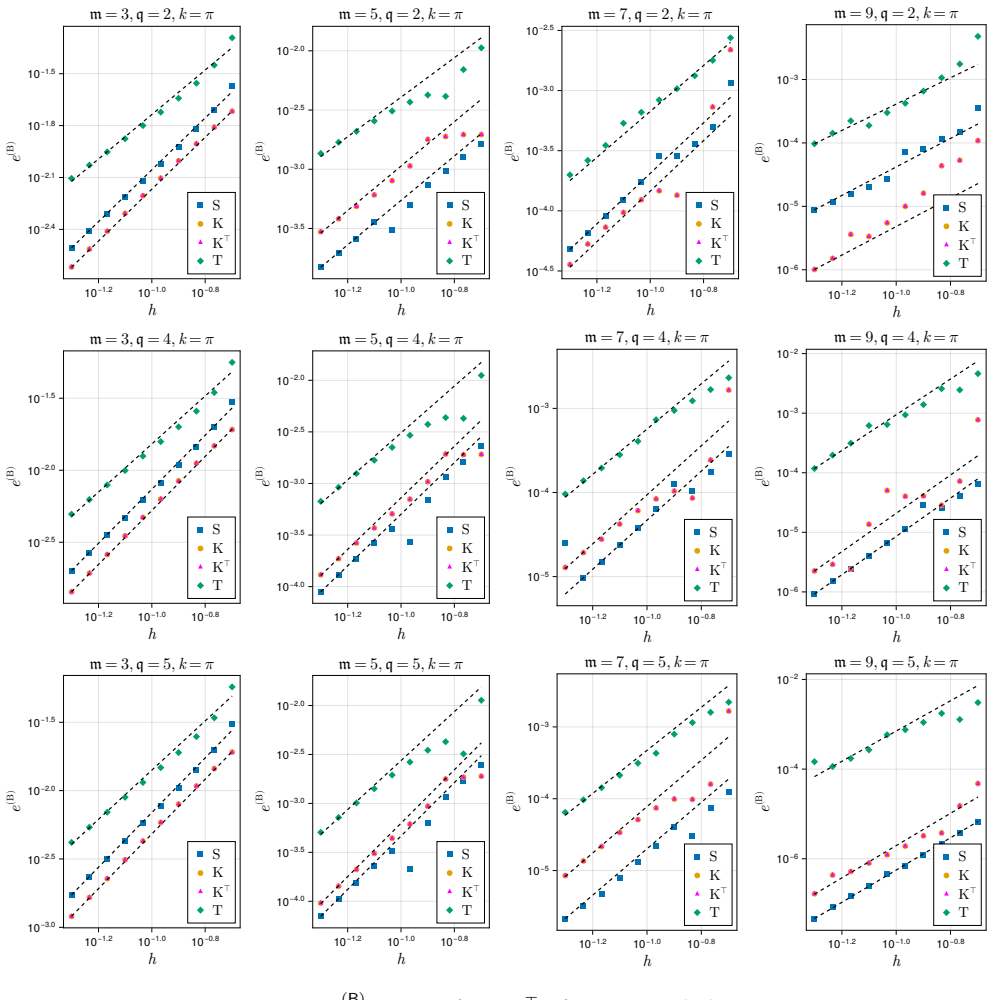
Each of the four kernels (single-layer, double-layer, adjoint double-layer, hypersingular) is replaced by a smooth modification constructed from the error function and a low-degree polynomial correction. The polynomial coefficients are chosen so that the first several moments of the modified kernel match those of the original singular kernel. When the regularization parameter scales with mesh size, the combined regularization-plus-quadrature error converges at a rate determined by the minimum of the moment-matching order and the quadrature exactness degree. The construction is uniform across operators and applies to both Helmholtz and Laplace kernels.
What carries the argument
The regularizing function: an error-function-based smoothing of the singular part together with a polynomial correction whose coefficients are fixed by moment conditions that enforce agreement with the original kernel through low-order moments.
If this is right
- The same regularization construction and error bound apply uniformly to the single-layer, double-layer, adjoint double-layer, and hypersingular operators.
- Overall convergence rates are explicit once the regularization parameter is scaled with mesh size and are governed by the minimum of regularization order and quadrature degree of exactness.
- Numerical evaluation reduces entirely to standard quadrature of smooth surface integrals, with no need for element-local solves or specialized singularity rules.
- H-matrix acceleration can be applied in black-box fashion to the resulting dense matrices.
- The method produces accurate solutions for sound-soft and sound-hard acoustic scattering on smooth obstacles while verifying the predicted rates.
Where Pith is reading between the lines
- The reduction to ordinary quadrature could be paired with existing H-matrix libraries to accelerate large-scale scattering simulations without rewriting fast multipole or other kernel-specific accelerators.
- If analogous moment conditions can be derived for other singular kernels, the framework may extend directly to electromagnetic or elastic boundary integral equations.
- Local adaptation of the regularization width to local mesh size could support adaptive surface discretizations for problems with localized features or corners.
Load-bearing premise
The moment conditions on the polynomial corrections, together with the error-function smoothing, produce the stated high-order accuracy for the hypersingular operator without additional restrictions on surface curvature or solution regularity beyond those stated in the error analysis.
What would settle it
Apply the regularized hypersingular operator to a known smooth solution on a sequence of uniformly refined meshes of a smooth closed surface and check whether the observed error decays at the rate predicted by the chosen regularization order and quadrature degree.
Figures




read the original abstract
This paper extends and analyzes the high-order kernel regularization framework of Beale & Tlupova (arXiv:2510.13639) to all four on-surface boundary integral operators of the Helmholtz Calderon calculus in three dimensions: the single-layer, double-layer, adjoint double-layer, and hypersingular operators. To the best of our knowledge, this work provides the first high-order kernel regularization of the hypersingular operator for both the Helmholtz and Laplace equations in three dimensions. The regularization replaces each singular kernel with a smooth modification constructed from error functions together with a polynomial correction whose coefficients are determined through moment conditions. Alongside the derivation of the regularizing functions, the paper provides a unified error analysis of the combined regularization and quadrature discretization procedure. By coupling the regularization parameter to the mesh size, the two error contributions can be balanced, leading to explicit overall convergence rates that depend jointly on the order of the regularization and the degree of exactness of the surface quadrature rule. A key practical feature of the method is its implementation simplicity. Once the regularizing functions are determined, the numerical task reduces entirely to the evaluation of smooth surface integrals using standard quadrature, without the need for element-local solves, singularity-specific precomputations, or specialized quadrature rules. Although the modified kernel is generally incompatible with kernel-specific fast methods, this limitation is addressed through H-matrix acceleration, applicable in a black-box manner. Numerical examples -- including verification of the predicted convergence rates and solution of sound-soft and sound-hard scattering problems by smooth obstacles -- demonstrate the accuracy and practicality of the proposed methodology.
Editorial analysis
A structured set of objections, weighed in public.
Referee Report
Summary. The manuscript extends the high-order kernel regularization framework of Beale & Tlupova to the single-layer, double-layer, adjoint double-layer, and hypersingular operators for the 3D Helmholtz Calderón calculus. Regularizers are constructed from error-function smoothing plus polynomial corrections fixed by moment conditions; a unified error analysis couples the regularization width to mesh size to balance regularization and quadrature errors, yielding explicit convergence rates depending on regularization order and quadrature exactness. The approach reduces to standard smooth quadrature plus H-matrix acceleration, with numerical verification of rates and application to sound-soft and sound-hard scattering.
Significance. If the error analysis for the hypersingular operator holds under the stated assumptions, the work provides a practical, unified regularization method for all four operators that avoids element-local solves or specialized quadrature rules. Strengths include the deterministic construction of the regularizers, the explicit balancing argument, and the numerical confirmation of predicted rates for both Laplace and Helmholtz cases. The implementation simplicity and black-box H-matrix treatment are clear advantages for large-scale problems.
major comments (1)
- The unified error analysis asserts that the moment conditions derived from the error-function smoothing suffice to cancel singular terms up to the target order for the hypersingular operator under the same surface and solution regularity used for the single- and double-layer cases. However, the hypersingular kernel involves two normal derivatives, which introduce geometry-dependent curvature terms (second fundamental form) not necessarily present in the flat-space moment-matching derivation. It is unclear whether these residuals are controlled by the stated assumptions or whether they produce an O(h^k) error that prevents the claimed balancing when the regularization parameter is tied to mesh size. A explicit expansion of the remainder for a curved patch or a numerical test with known curvature would resolve this.
minor comments (2)
- The abstract states that the method is 'incompatible with kernel-specific fast methods' but is addressed via H-matrix acceleration; the numerical section should specify the H-matrix parameters (admissibility, maximum rank, tolerance) used in the scattering examples to allow reproduction.
- Table or figure captions for the convergence studies should explicitly list the regularization width scaling (e.g., ε = C h^α) and the quadrature degree of exactness for each operator and mesh family.
Simulated Author's Rebuttal
We thank the referee for the careful review and constructive feedback on our manuscript extending the high-order kernel regularization to the Helmholtz Calderón operators. We address the major comment below and plan to revise the manuscript to clarify the analysis for the hypersingular operator.
read point-by-point responses
-
Referee: The unified error analysis asserts that the moment conditions derived from the error-function smoothing suffice to cancel singular terms up to the target order for the hypersingular operator under the same surface and solution regularity used for the single- and double-layer cases. However, the hypersingular kernel involves two normal derivatives, which introduce geometry-dependent curvature terms (second fundamental form) not necessarily present in the flat-space moment-matching derivation. It is unclear whether these residuals are controlled by the stated assumptions or whether they produce an O(h^k) error that prevents the claimed balancing when the regularization parameter is tied to mesh size. A explicit expansion of the remainder for a curved patch or a numerical test with known curvature would resolve this.
Authors: We thank the referee for pointing out this subtlety in the hypersingular case. The derivation in the manuscript proceeds by expressing the kernels in local tangential coordinates on the surface, where the singular parts (including those from the two normal derivatives) are expanded using the fundamental solution and its derivatives. The moment conditions are set to match and cancel these singular contributions up to the desired order, with the error function providing the smoothing. Curvature effects enter through the metric and normal variations, but under the assumed surface regularity (sufficiently smooth for the Taylor expansions to hold), these appear as regular terms that are absorbed into the O(ε^m) regularization error, where m is the regularization order. Consequently, the balancing ε ~ h^{q/m} with quadrature error of order h^q remains valid without additional O(h^k) terms. To strengthen the presentation, we will add an explicit remainder expansion for a curved surface patch in the revised manuscript, along with numerical verification on a sphere demonstrating the convergence rates for the hypersingular operator. revision: yes
Circularity Check
Minor self-citation to prior regularization framework; derivation and error analysis otherwise independent
full rationale
The paper extends the kernel regularization approach from Beale & Tlupova (arXiv:2510.13639) with overlapping authorship (Tlupova), but the central contributions—the explicit construction of regularizing functions for the hypersingular operator via error functions and moment conditions, plus the unified error analysis balancing regularization parameter against quadrature degree—are developed directly in this work using deterministic matching and standard quadrature theory. No prediction reduces to a fitted input by construction, no ansatz is smuggled, and no uniqueness theorem from self-citation is invoked to force the result. The chain remains self-contained.
Axiom & Free-Parameter Ledger
axioms (1)
- domain assumption The surface is sufficiently smooth and the solution possesses the regularity needed for the quadrature error estimates to hold at the stated orders.
Reference graph
Works this paper leans on
-
[1]
M. Abramowitz and I. A. Stegun.Handbook of Mathematical Functions: With Formulas, Graphs, and Mathematical Tables, volume 55. Courier Corporation, 1965
work page 1965
-
[2]
T. G. Anderson, M. Bonnet, L. M. Faria, and C. P´ erez-Arancibia. Fast, high-order numerical evalu- ation of volume potentials via polynomial density interpolation.Journal of Computational Physics, 511:113091, 2024
work page 2024
-
[3]
J. T. Beale and S. Tlupova. Extrapolated regularization of nearly singular integrals on surfaces. Advances in Computational Mathematics, 50(4):61, 2024
work page 2024
- [4]
-
[5]
J. T. Beale, W. Ying, and J. R. Wilson. A simple method for computing singular or nearly singular integrals on closed surfaces.Communications in Computational Physics, 20(3):733–753, 2016
work page 2016
-
[6]
O. P. Bruno and E. Garza. A Chebyshev-based rectangular-polar integral solver for scattering by geometries described by non-overlapping patches.Journal of Computational Physics, 421:109740, 2020
work page 2020
-
[7]
O. P. Bruno and L. A. Kunyansky. A fast, high-order algorithm for the solution of surface scattering problems: basic implementation, tests, and applications.Journal of Computational Physics, 2001
work page 2001
-
[8]
L. M. Faria, C. P´ erez-Arancibia, and M. Bonnet. General-purpose kernel regularization of boundary integral equations via density interpolation.Computer Methods in Applied Mechanics and Engineering, 378:113703, 2021
work page 2021
-
[9]
M. Ganesh and I. G. Graham. A high-order algorithm for obstacle scattering in three dimensions. Journal of Computational Physics, 198(1):211–242, 2004
work page 2004
-
[10]
M. Ganesh and S. C. Hawkins. A spectrally accurate algorithm for electromagnetic scattering in three dimensions.Numerical Algorithms, 43(1):25–60, 2006. 39
work page 2006
-
[11]
C. Geuzaine and J.-F. Remacle. Gmsh: A 3-D finite element mesh generator with built-in pre-and post-processing facilities.International journal for numerical methods in engineering, 79(11):1309– 1331, 2009
work page 2009
-
[12]
L. Greengard and V. Rokhlin. A new version of the fast multipole method for the Laplace equation in three dimensions.Acta Numerica, 6:229–269, 1997
work page 1997
-
[13]
N. A. Gumerov and R. Duraiswami.Fast multipole methods for the Helmholtz equation in three dimensions. Elsevier, 2005
work page 2005
-
[14]
Hackbusch.Hierarchical Matrices: Algorithms and Analysis
W. Hackbusch.Hierarchical Matrices: Algorithms and Analysis. Springer, 2015
work page 2015
-
[15]
G. C. Hsiao and W. L. Wendland.Boundary Integral Equations. Springer, 2021
work page 2021
-
[16]
J. Hu, E. Garza, and C. Sideris. A chebyshev-based high-order-accurate integral equation solver for maxwell’s equations.IEEE Transactions on Antennas and Propagation, 69(9):5790–5800, 2021
work page 2021
- [17]
-
[18]
A. Kl¨ ockner, A. Barnett, L. Greengard, and M. O’Neil. Quadrature by expansion: A new method for the evaluation of layer potentials.Journal of Computational Physics, 252:332–349, 2013
work page 2013
-
[19]
S. G. Krantz and H. R. Parks.The Implicit Function Theorem: History, Theory, and Applications. Springer Science & Business Media, 2002
work page 2002
-
[20]
R. Kress. On the numerical solution of a hypersingular integral equation in scattering theory.Journal of Computational and Applied Mathematics, 61(3):345–360, Aug. 1995
work page 1995
-
[21]
L. Maltez-Faria, C. P´ erez-Arancibia, and C. Turc. Combined field-only boundary integral equations for PEC electromagnetic scattering problem in spherical geometries.SIAM Journal on Applied Math- ematics, 84(1):19–38, 2024
work page 2024
-
[22]
C. P´ erez-Arancibia, L. M. Faria, and C. Turc. Harmonic density interpolation methods for high-order evaluation of Laplace layer potentials in 2D and 3D.Journal of Computational Physics, 376:411–434, 2019
work page 2019
-
[23]
C. P´ erez-Arancibia, C. Turc, and L. Faria. Planewave density interpolation methods for 3D Helmholtz boundary integral equations.SIAM Journal on Scientific Computing, 41(4):A2088–A2116, 2019
work page 2019
-
[24]
Y. Saad and M. H. Schultz. GMRES: A generalized minimal residual algorithm for solving nonsym- metric linear systems.SIAM Journal on Scientific and Statistical Computing, 7(3):856–869, 1986
work page 1986
-
[25]
S. A. Sauter and C. Schwab.Boundary Element Methods. Springer, 2010
work page 2010
-
[26]
B. Vioreanu and V. Rokhlin. Spectra of multiplication operators as a numerical tool.SIAM Journal on Scientific Computing, 36(1):A267–A288, 2014
work page 2014
-
[27]
H. Whitney. Differentiable even functions. InHassler Whitney Collected Papers, pages 309–310. Springer, 1943
work page 1943
-
[28]
B. Wu and P.-G. Martinsson. Corrected trapezoidal rules for boundary integral equations in three dimensions.Numerische Mathematik, 149:1025–1071, 2021. 40
work page 2021
-
[29]
B. Wu and P.-G. Martinsson. A unified trapezoidal quadrature method for singular and hypersingular boundary integral operators on curved surfaces.SIAM Journal on Numerical Analysis, 61(5):2182– 2208, 2023. 41
work page 2023
discussion (0)
Sign in with ORCID, Apple, or X to comment. Anyone can read and Pith papers without signing in.