Pattern formation during melting of lamellar eutectics
Pith reviewed 2026-05-10 11:07 UTC · model grok-4.3
The pith
Melting velocity and lamellar spacing together produce diverse patterns in eutectic solids through distinct mechanisms with clear scaling laws.
A machine-rendered reading of the paper's core claim, the machinery that carries it, and where it could break.
Core claim
Depending on the melting velocity Vm and the spacing λ of the pre-solidified lamellar microstructure, an unexpectedly rich diversity of melting patterns is observed, with good agreement between experiments and simulations. The different physical mechanisms leading to this diversity are unraveled, and the scaling behaviors of the penetration of the liquid along the solid-solid interface at large Vm, the thickening of the primary-phase fingers at low Vm, and a period-doubling instability for small λ values are established.
What carries the argument
Directional melting in a temperature gradient, where solid-liquid and solid-solid interface motion couples to solute transport, as captured by two-dimensional phase-field simulations validated on thin-sample experiments with a transparent eutectic alloy.
If this is right
- Liquid channels form along solid-solid interfaces and penetrate at a rate that scales with melting velocity at high speeds.
- Primary-phase fingers thicken according to a separate scaling relation when melting proceeds slowly.
- A period-doubling instability appears in the pattern when the initial lamellar spacing falls below a threshold.
- The observed patterns and their scalings supply a starting point for modeling repeated melting-solidification cycles in additive manufacturing.
Where Pith is reading between the lines
- The same velocity-spacing framework could be applied to other eutectic alloys by substituting their measured diffusion and interfacial properties.
- Tuning melting speed relative to microstructure scale may allow deliberate selection or suppression of specific patterns in manufactured parts.
- Three-dimensional extensions of the thin-sample geometry would likely generate additional pattern types arising from the extra spatial degree of freedom.
Load-bearing premise
The phase-field model calibrated to the chosen transparent alloy correctly captures the dominant interface motion and solute transport physics during melting.
What would settle it
If new experiments at high melting velocity show liquid penetration depths that deviate from the predicted scaling with Vm, or if small spacings produce no period-doubling, the identified mechanisms would be ruled out.
Figures
read the original abstract
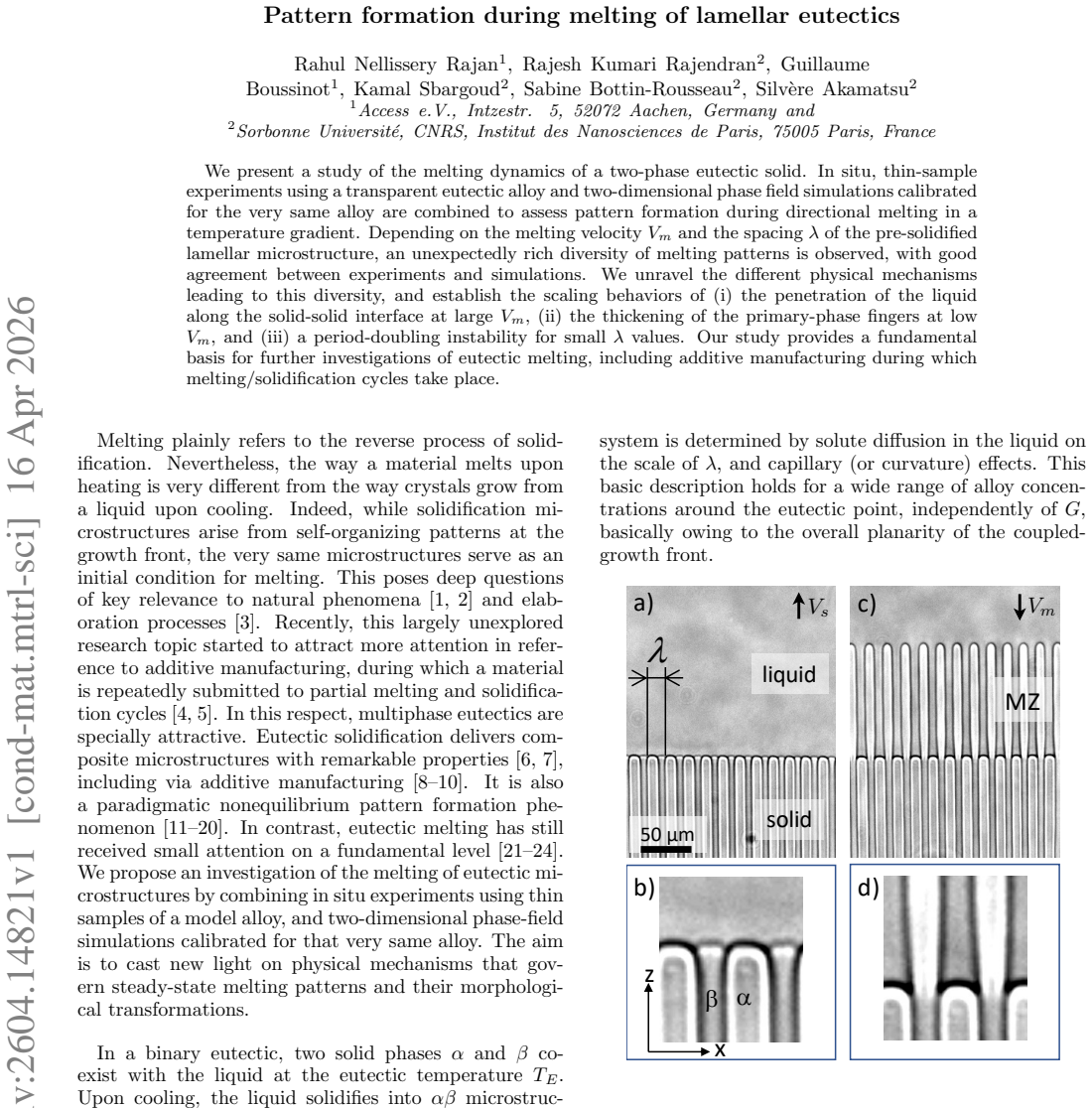
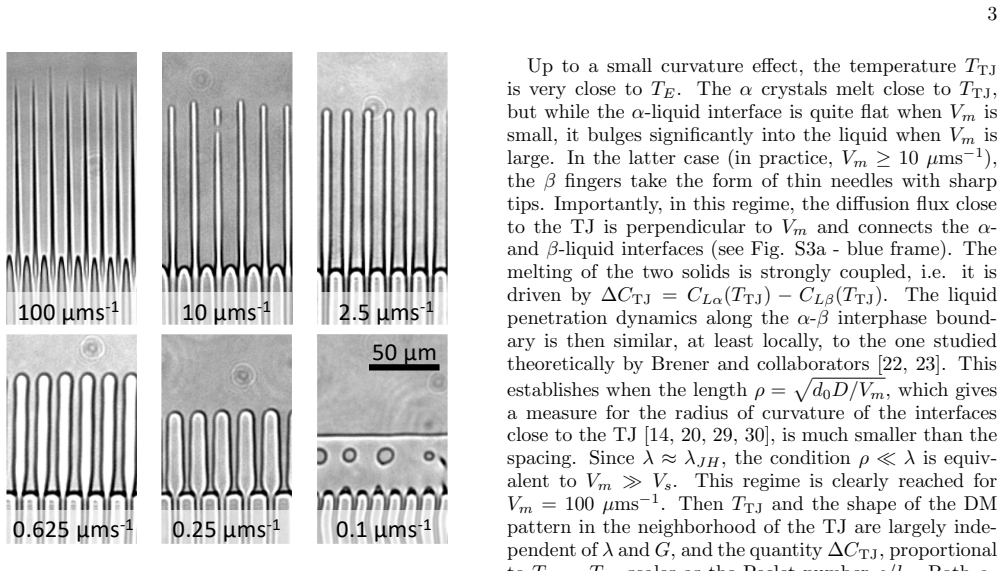
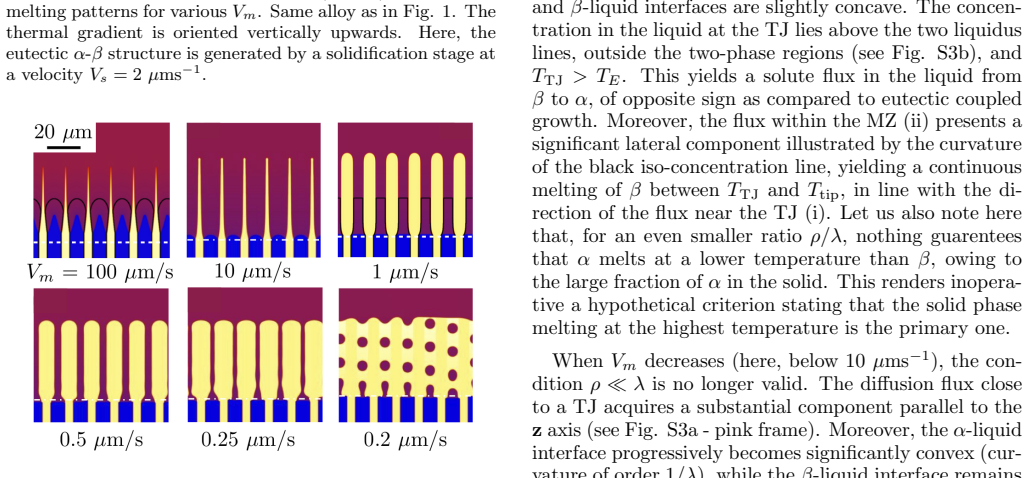
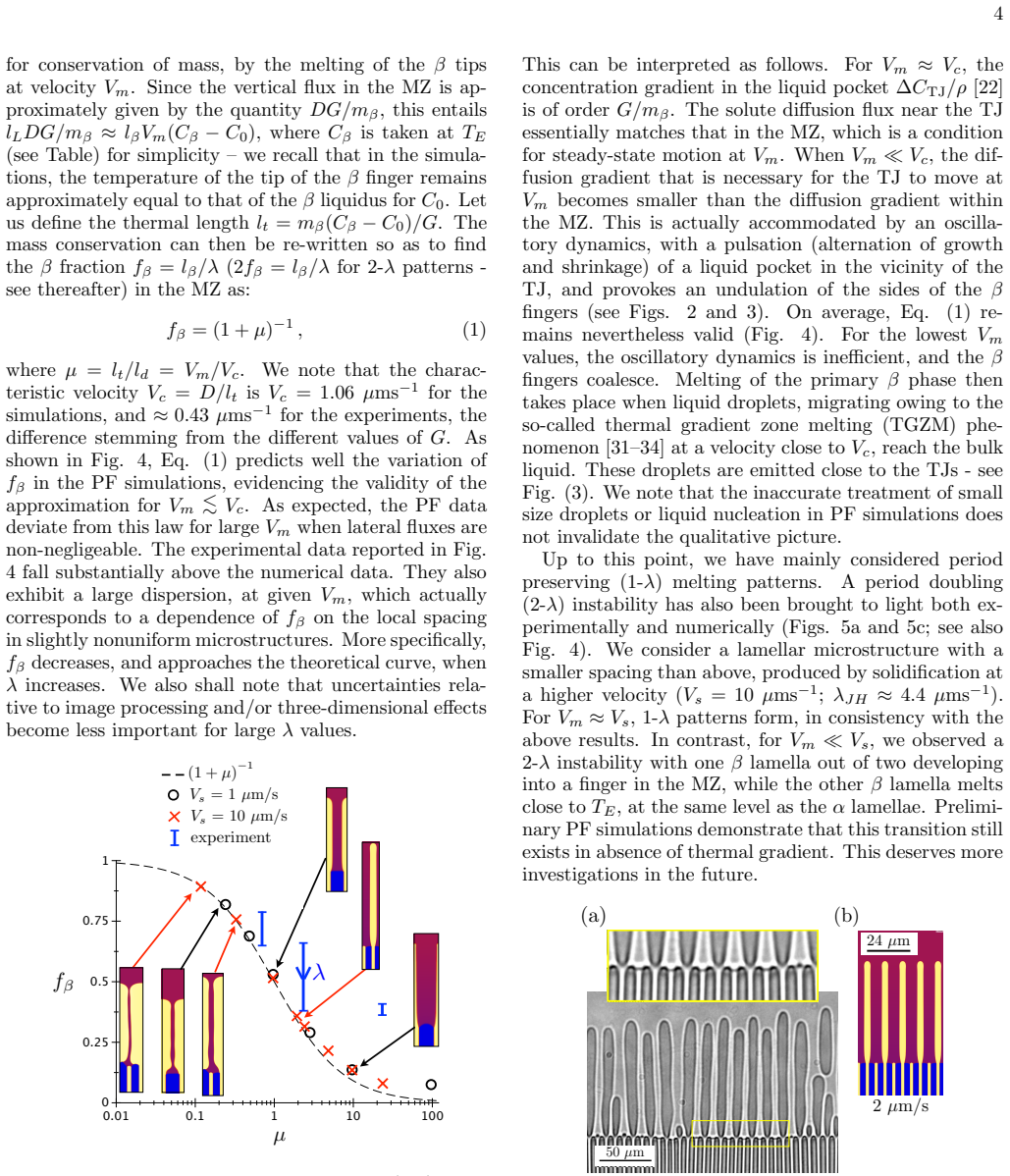
We present a study of the melting dynamics of a two-phase eutectic solid. In situ, thin-sample experiments using a transparent eutectic alloy and two-dimensional phase field simulations calibrated for the very same alloy are combined to assess pattern formation during directional melting in a temperature gradient. Depending on the melting velocity $V_m$ and the spacing $\lambda$ of the pre-solidified lamellar microstructure, an unexpectedly rich diversity of melting patterns is observed, with good agreement between experiments and simulations. We unravel the different physical mechanisms leading to this diversity, and establish the scaling behaviors of (i) the penetration of the liquid along the solid-solid interface at large $V_m$, (ii) the thickening of the primary-phase fingers at low $V_m$, and (iii) a period-doubling instability for small $\lambda$ values. Our study provides a fundamental basis for further investigations of eutectic melting, including additive manufacturing during which melting/solidification cycles take place.
Editorial analysis
A structured set of objections, weighed in public.
Referee Report
Summary. The manuscript presents a combined experimental and numerical investigation of pattern formation during directional melting of pre-solidified lamellar eutectic microstructures. In-situ thin-sample experiments on a transparent eutectic alloy are paired with two-dimensional phase-field simulations calibrated to the same alloy. The central claim is that a rich diversity of melting patterns emerges depending on melting velocity Vm and lamellar spacing λ, with good agreement between experiments and simulations. The authors identify the physical mechanisms responsible and establish scaling behaviors for (i) liquid penetration along the solid-solid interface at large Vm, (ii) thickening of primary-phase fingers at low Vm, and (iii) a period-doubling instability at small λ. The work is positioned as providing a basis for understanding eutectic melting in contexts such as additive manufacturing.
Significance. If the reported agreement between experiment and simulation holds and the three scaling regimes are robustly established without post-hoc selection, the study would provide a valuable foundation for understanding non-equilibrium interface dynamics in eutectic systems. The strength lies in the direct comparison of in-situ visualization with calibrated phase-field modeling, which allows mechanistic interpretation that is otherwise inaccessible. The scaling relations offer concrete, testable predictions. This has clear relevance to microstructure control in additive manufacturing processes involving repeated melting-solidification cycles.
major comments (3)
- [§4.2] §4.2 (phase-field calibration): The model parameters are fixed by matching to the experimental alloy's phase diagram and diffusion coefficients, but no sensitivity analysis is reported on how ±5% variations in the interface kinetic coefficient or solute diffusivity affect the locations of the pattern boundaries in the (Vm, λ) plane. This directly impacts the weakest assumption that the calibrated model correctly ranks the relative importance of kinetics, diffusion, and temperature gradient.
- [§5.3] §5.3 (high-Vm scaling): The claimed penetration depth scaling δ ~ Vm^{-1/2} is presented as established, yet the text does not show an explicit derivation from the governing equations or a parameter-free argument; it appears obtained by fitting simulation data. Please clarify whether this is dimensional analysis, asymptotic analysis, or empirical fit, and provide the supporting plot of raw data versus the proposed scaling.
- [§6.1] §6.1 (period-doubling): The onset of period-doubling at small λ is identified numerically, but no linear stability analysis around the steady lamellar state is supplied to predict the critical λ or the growth rate. Without this, it remains unclear whether the instability is captured by the model for fundamental reasons or is an artifact of the chosen discretization.
minor comments (3)
- [Figure 3] Figure 3: the experimental and simulation panels are not aligned at the same magnification; a scale bar common to both would improve direct visual comparison.
- The abstract states 'good agreement' without quantifying it (e.g., overlap of pattern boundaries or RMS deviation in finger thickness). A short quantitative statement in the results section would strengthen the claim.
- Notation: Vm is used for melting velocity while V is sometimes used for solidification velocity in the introduction; consistent symbols would reduce confusion.
Simulated Author's Rebuttal
We appreciate the referee's positive assessment and constructive comments on our manuscript. We address each of the major comments below and will make the necessary revisions to strengthen the paper.
read point-by-point responses
-
Referee: [§4.2] §4.2 (phase-field calibration): The model parameters are fixed by matching to the experimental alloy's phase diagram and diffusion coefficients, but no sensitivity analysis is reported on how ±5% variations in the interface kinetic coefficient or solute diffusivity affect the locations of the pattern boundaries in the (Vm, λ) plane. This directly impacts the weakest assumption that the calibrated model correctly ranks the relative importance of kinetics, diffusion, and temperature gradient.
Authors: We thank the referee for this suggestion. Although the model parameters are independently determined from the phase diagram and measured diffusion coefficients, we agree that a sensitivity analysis enhances confidence in the results. In the revised manuscript, we will include in §4.2 a sensitivity study demonstrating that ±5% variations in the interface kinetic coefficient and solute diffusivity have negligible impact on the locations of the pattern boundaries in the (Vm, λ) plane. revision: yes
-
Referee: [§5.3] §5.3 (high-Vm scaling): The claimed penetration depth scaling δ ~ Vm^{-1/2} is presented as established, yet the text does not show an explicit derivation from the governing equations or a parameter-free argument; it appears obtained by fitting simulation data. Please clarify whether this is dimensional analysis, asymptotic analysis, or empirical fit, and provide the supporting plot of raw data versus the proposed scaling.
Authors: The scaling δ ~ Vm^{-1/2} is obtained via dimensional analysis by balancing the solute diffusion time scale across the lamellar spacing with the time for the melting interface to advance a distance δ. We will add this explicit derivation to the text in §5.3. Furthermore, we will include a supporting plot in the revised manuscript that shows the raw data for the penetration depth versus melting velocity, confirming the proposed scaling. revision: yes
-
Referee: [§6.1] §6.1 (period-doubling): The onset of period-doubling at small λ is identified numerically, but no linear stability analysis around the steady lamellar state is supplied to predict the critical λ or the growth rate. Without this, it remains unclear whether the instability is captured by the model for fundamental reasons or is an artifact of the chosen discretization.
Authors: We concur that a linear stability analysis would be valuable for predicting the critical λ and growth rates. However, conducting such an analysis on the phase-field model, which includes a temperature gradient and moving interfaces, is a substantial undertaking that lies outside the scope of the present study. The period-doubling instability is observed at the same critical λ in both the experiments and the simulations, providing strong evidence that it is a genuine physical phenomenon rather than a numerical artifact. In the revised version, we will expand the discussion in §6.1 to include this explanation and acknowledge the lack of stability analysis as a limitation of the current work. revision: partial
Circularity Check
No significant circularity
full rationale
The paper combines direct in-situ experimental observations of melting patterns in a transparent eutectic alloy with phase-field simulations calibrated to the identical alloy. The reported diversity of patterns, their boundaries in the (Vm, λ) plane, and the three scaling regimes (liquid penetration along solid-solid interfaces at high Vm, primary-phase finger thickening at low Vm, and period-doubling at small λ) are extracted from the experimental data and from the emergent behavior of the calibrated model. No derivation step is shown to reduce by construction to a fitted parameter, no self-citation is invoked as a uniqueness theorem that forbids alternatives, and no ansatz is smuggled in via prior work by the same authors. The central claims therefore remain independent of the inputs once the model parameters are fixed, rendering the argument self-contained.
Axiom & Free-Parameter Ledger
free parameters (1)
- phase-field calibration parameters
Reference graph
Works this paper leans on
-
[1]
B. E. Schmidt et al., Nature614, 471 (2023)
work page 2023
-
[2]
JF Xu, R Shinjo, MJ Defant, Q Wang, RP Rapp, Geol- ogy30, 1111 (2002)
work page 2002
-
[3]
C. Zhao, B. Shi, S. Chen, D. Du., T. Sun, B.J. Simonds, K. Fezzaa, A. Rollett, Rev. Mod. Phys.94, 045002 (2022)
work page 2022
- [4]
-
[5]
C. K¨ orner, M. Markl, J.A. Koepf, Metallurgical and Ma- terials Transactions A51, 4970 (2020)
work page 2020
-
[6]
C. S. Tiwary et al., Progress in Materials Science123, 100793 (2022)
work page 2022
-
[7]
S. B. Kang, Advanced Materials36, 2308720 (2024)
work page 2024
-
[8]
A. Plotkowski, O. Rios, N. Sridharan, Z. Sims, K. Unocic, R.T. Ott, R.R. Dehoff, S.S. Babu, Acta Mater.126, 507 (2017)
work page 2017
-
[9]
G. Boussinot, M. D¨ oring, S. Hemes, O. Stryzhyboroda, M. Apel, M. Schmidt, Materials and Design198, 109299 (2021)
work page 2021
-
[10]
G. Boussinot, M. D¨ oring, M. Schmidt, M. Apel, Phys. Rev. Mat.6, 043405 (2022)
work page 2022
-
[11]
J. S. Langer, Phys. Rev. Lett. 44 (1980) 1023-1026
work page 1980
- [12]
- [13]
-
[14]
K. Kassner, C. Misbah, Phys. Rev. Lett.66, 445 (1991); Phys. Rev. A446513 (1991); Phys. Rev. A44, 6533 (1991)
work page 1991
- [15]
- [16]
-
[17]
S. Akamatsu, M. Plapp, Current Opinion in Solid State and Materials Science20, 46 (2016)
work page 2016
- [18]
-
[19]
S. Akamatsu, M. Perrut, S. Bottin-Rousseau, G. Faivre, Phys. Rev. Lett.104, 056101 (2010)
work page 2010
- [20]
- [21]
- [22]
-
[23]
E A Brener, G Boussinot, C H¨ uter, M Fleck1 D Pilipenko, R Spatschek, D E Temkin, J. Phys.: Condens. Matter 21 (2009) 464106
work page 2009
-
[24]
T. Pusztai, L. R´ atkai, L. Horv´ ath, L. Gr´ an´ asy, Acta Mater.227, 117678 (2022)
work page 2022
-
[25]
K. A. Jackson, J. D. Hunt, Trans. Metall. Soc. AIME 236, 1129 (1966)
work page 1966
- [26]
- [27]
-
[28]
https://www.micress.de, version 7.2
-
[29]
G. Boussinot, C. H¨ uter, R. Spatschek, E.A. Brener, Acta Mat.75, 212 (2014)
work page 2014
-
[30]
C. H¨ uter, G. Boussinot, E.A. Brener, D.E. Temkin, Phys. Rev. E83, 050601(R) (2011)
work page 2011
- [31]
-
[32]
H. Nguyen-Thi, G. Reinhart, A. Buffet, T. Schenk, N. Mangelinck-No¨ el, H. Jung, N. Bergeon, B. Billia, J. H¨ artwig, J. Baruchel, J. Cryst. Growth310, 2906 (2008)
work page 2008
-
[33]
G. Salloum-Abou-Jaoude, G. Reinhart, H. Combeau, M. 6 Zaloznik, T.A. Lafford, H. Nguyen-Thi, J. Cryst. Growth 411, 88 (2015)
work page 2015
-
[34]
G. Boussinot, M. Apel, Acta Materialia122, 310 (2017). 7 Supplemental Information 8 Vs microscope yzxHot blockCold blocklinear motorsolidliquidVm T+T- FIG. S1: Schematic representation of the thin-sample directional solidification method. FIG. S2: Phase diagram of the CBr 4-C2Cl6 eutectic. See J. Mergy, G. Faivre, C. Guthmann, R. Mellet, Journal of Crysta...
work page 2017
discussion (0)
Sign in with ORCID, Apple, or X to comment. Anyone can read and Pith papers without signing in.