Toward Accurate RIXS Spectra at Heavy Element Edges: A Relativistic Four-Component and Exact Two-Component TDDFT Approach
Pith reviewed 2026-05-10 09:35 UTC · model grok-4.3
The pith
A relativistic TDDFT method using four-component and exact two-component Hamiltonians accurately simulates RIXS spectra at heavy-element edges.
A machine-rendered reading of the paper's core claim, the machinery that carries it, and where it could break.
Core claim
We present a relativistic TDDFT approach for RIXS spectra based on both a full four-component Dirac-Coulomb Hamiltonian and a modern atomic mean-field exact two-component Hamiltonian model. The approach builds on the pseudo-wavefunction formalism and a core-valence separation scheme, enabling efficient evaluation of couplings between two manifolds of excited states relative to a common ground state as required for solving the Kramers-Heisenberg equation. The amfX2C transformation accounts for two-electron and exchange-correlation picture-change effects and delivers four-component quality results at lower cost. Applications to 2p3d and 3d4f RIXS maps of selected ruthenium and uranium complexs
What carries the argument
The atomic mean-field exact two-component (amfX2C) Hamiltonian, which incorporates picture-change corrections from the X2C transformation to provide four-component accuracy for relativistic TDDFT RIXS calculations at reduced computational cost.
If this is right
- Two-dimensional RIXS maps for heavy-element complexes can be computed with near four-component accuracy at substantially lower cost.
- Reliable assignments of experimental spectral peaks become available for inner-shell processes in ruthenium and uranium systems.
- High-energy-resolution fluorescence detection and resonant X-ray emission spectra can be obtained directly from the same framework.
- Both scalar relativistic and spin-orbit effects are variationally included, which is essential for describing the relevant inner-shell excitations.
Where Pith is reading between the lines
- The approach may scale to larger molecular systems containing heavy elements where full four-component calculations are currently intractable.
- Improved RIXS modeling could help interpret spectroscopic data for actinide chemistry and catalysis involving ruthenium.
- The core-valence separation technique might be transferable to other core-excitation spectroscopies beyond RIXS.
Load-bearing premise
The pseudo-wavefunction formalism combined with core-valence separation accurately evaluates the couplings between excited-state manifolds needed to solve the Kramers-Heisenberg equation.
What would settle it
If the amfX2C-computed 2p3d and 3d4f RIXS maps for the tested ruthenium and uranium complexes show large deviations in peak positions, intensities, or missing features compared to the reference four-component results or experimental spectra, the accuracy claim is falsified.
Figures
read the original abstract
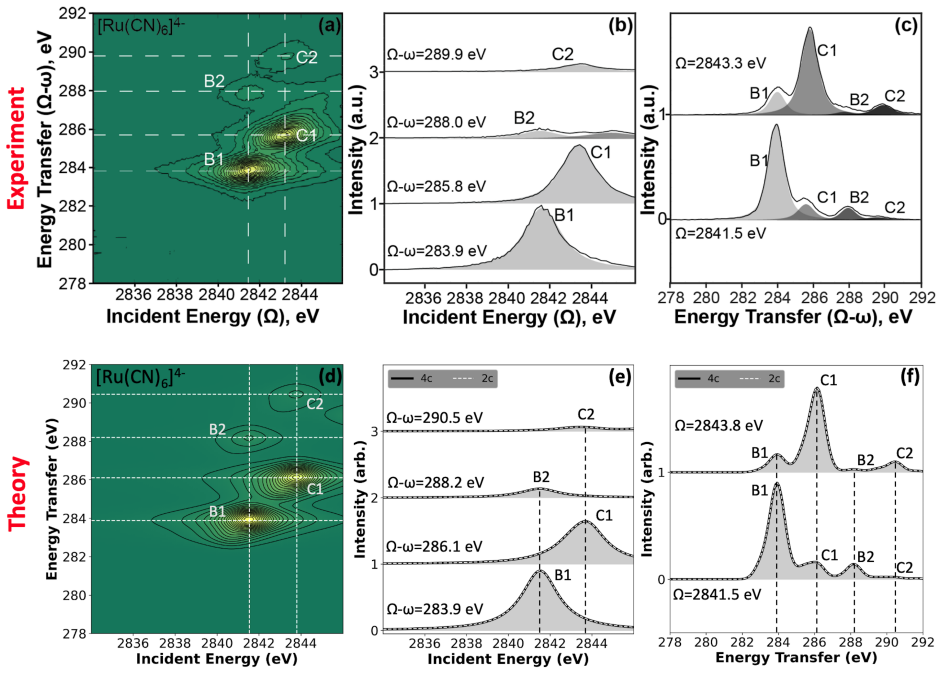
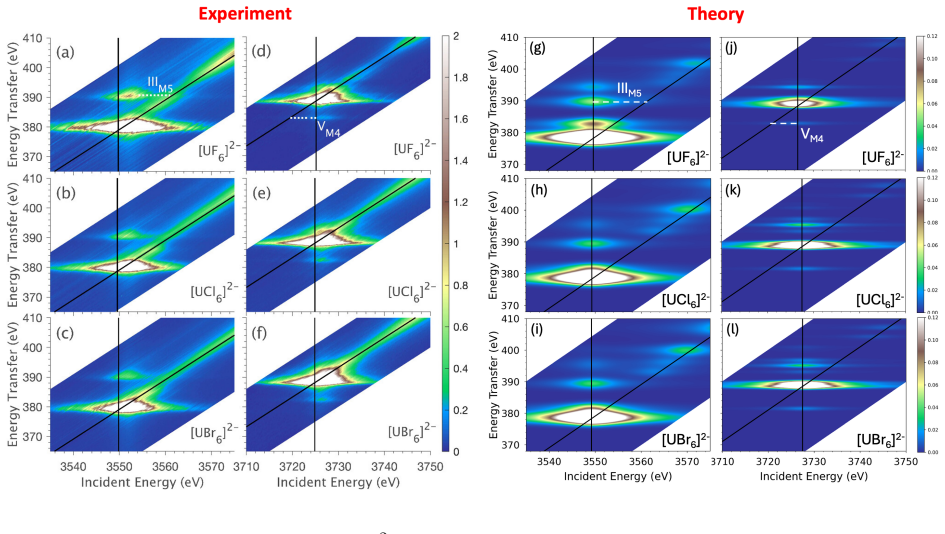
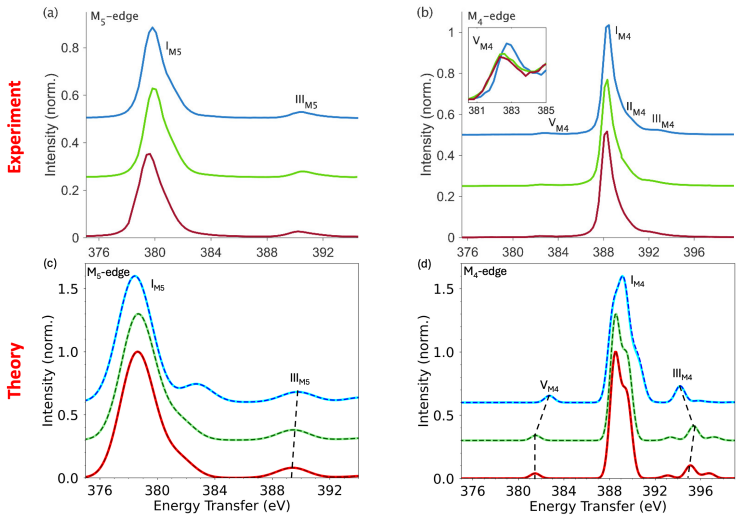
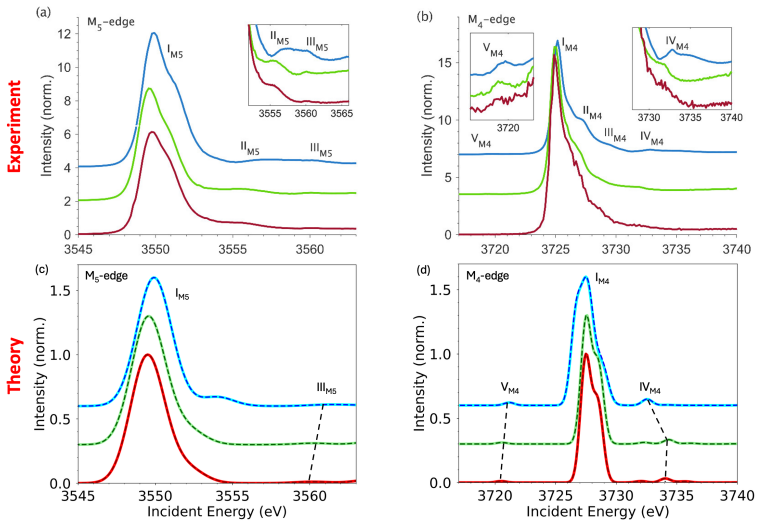
We present a relativistic time-dependent density functional theory (TDDFT) approach for the simulation of resonant inelastic X-ray scattering (RIXS) spectra, based on both a full four-component (4c) Dirac-Coulomb Hamiltonian and a modern atomic mean-field exact two-component (amfX2C) Hamiltonian model. The approach builds on the pseudo-wavefunction formalism and a core-valence separation scheme, enabling the efficient evaluation of couplings between two manifolds of excited states relative to a common ground state, as required for solving the Kramers-Heisenberg equation for RIXS. The relativistic formulation provides a variational description of scalar and spin-orbit relativistic effects, which are essential for accurately describing inner-shell excitations involved in RIXS processes. Its transformation to the 2c regime via the amfX2C Hamiltonian significantly reduces the computational cost while offering 4c-quality results by accounting for two-electron and exchange-correlation picture-change effects arising from the X2C transformation. In addition to two-dimensional RIXS maps, the methodology enables the direct evaluation of high-energy-resolution fluorescence detection (HERFD) and resonant X-ray emission spectra (RXES). Applications to 2p3d and 3d4f RIXS maps of selected ruthenium and uranium complexes demonstrate that the amfX2C approach reproduces reference 4c results and experimental spectra with high accuracy, capturing all key spectral features and providing reliable peak assignments.
Editorial analysis
A structured set of objections, weighed in public.
Referee Report
Summary. The manuscript develops a relativistic TDDFT framework for RIXS spectra using both the full four-component Dirac-Coulomb Hamiltonian and an atomic mean-field exact two-component (amfX2C) Hamiltonian. It relies on a pseudo-wavefunction formalism together with core-valence separation to obtain the excited-state couplings needed to solve the Kramers-Heisenberg equation. The approach is applied to 2p3d and 3d4f RIXS maps of selected ruthenium and uranium complexes, with the central claim that amfX2C reproduces the reference 4c results and experimental spectra with high accuracy while also enabling HERFD and RXES calculations.
Significance. If the numerical agreement holds, the work supplies a practical route to accurate relativistic RIXS simulations at heavy-element edges at substantially lower cost than full 4c calculations. The variational inclusion of scalar and spin-orbit effects plus explicit treatment of picture-change corrections in the amfX2C model directly addresses a long-standing bottleneck in inner-shell spectroscopy of actinides and late transition metals. The reported reproduction of both benchmark 4c spectra and experimental features for Ru and U complexes would constitute a useful advance for the community.
major comments (2)
- Applications section: the claim that amfX2C 'reproduces reference 4c results and experimental spectra with high accuracy' is central, yet the manuscript provides no tabulated quantitative error metrics (e.g., RMS deviations in peak positions or integrated intensities) across the full set of 2p3d and 3d4f maps; visual inspection alone is insufficient to support the quantitative assertion for the uranium complexes where relativistic effects are largest.
- Methodology, pseudo-wavefunction + CVS paragraph: the core-valence separation scheme is used to evaluate inter-manifold couplings for the Kramers-Heisenberg equation; a direct numerical test of the approximation's error (for example, by comparing selected couplings with and without CVS on a smaller model system) is needed to establish that the scheme does not degrade the claimed 4c-quality results.
minor comments (3)
- The abstract and introduction should explicitly state the exchange-correlation functional and basis sets employed in all reported calculations.
- Figure captions for the RIXS maps should include the incident-photon energy grid spacing and the broadening parameters used to generate the 2D plots.
- A short paragraph comparing the present amfX2C timings to a standard 4c TDDFT run on the same hardware would help readers assess the practical speedup.
Simulated Author's Rebuttal
We thank the referee for the positive assessment and recommendation for minor revision. We address each major comment below and outline the changes we will make to strengthen the manuscript.
read point-by-point responses
-
Referee: Applications section: the claim that amfX2C 'reproduces reference 4c results and experimental spectra with high accuracy' is central, yet the manuscript provides no tabulated quantitative error metrics (e.g., RMS deviations in peak positions or integrated intensities) across the full set of 2p3d and 3d4f maps; visual inspection alone is insufficient to support the quantitative assertion for the uranium complexes where relativistic effects are largest.
Authors: We appreciate this observation. While the figures demonstrate close visual agreement between 4c and amfX2C results as well as with experiment, we agree that tabulated quantitative metrics would provide stronger support for the central claim, particularly for the uranium complexes. In the revised manuscript we will add tables reporting RMS deviations in peak positions (in eV) and relative integrated intensities for all 2p3d and 3d4f maps, comparing 4c vs. amfX2C and, where experimental data permit, theory vs. experiment. revision: yes
-
Referee: Methodology, pseudo-wavefunction + CVS paragraph: the core-valence separation scheme is used to evaluate inter-manifold couplings for the Kramers-Heisenberg equation; a direct numerical test of the approximation's error (for example, by comparing selected couplings with and without CVS on a smaller model system) is needed to establish that the scheme does not degrade the claimed 4c-quality results.
Authors: We agree that an explicit numerical validation of the CVS approximation is warranted to confirm it does not compromise accuracy. In the revised manuscript we will add a dedicated test on a smaller model system (a simplified ruthenium complex), reporting selected inter-manifold couplings computed both with and without CVS and quantifying the resulting differences in the final RIXS intensities. revision: yes
Circularity Check
No significant circularity in derivation chain
full rationale
The paper presents a relativistic TDDFT method for RIXS spectra via 4c Dirac-Coulomb and amfX2C Hamiltonians, employing pseudo-wavefunction formalism and core-valence separation to solve the Kramers-Heisenberg equation. Central claims rest on direct numerical reproduction of independent 4c reference calculations and experimental spectra for Ru and U complexes, which serve as external benchmarks rather than self-referential inputs. No steps reduce by construction to fitted parameters, self-definitions, or load-bearing self-citations; the approach builds on established TDDFT/X2C frameworks but validates against separate 4c results and data. The derivation remains self-contained against external checks.
Axiom & Free-Parameter Ledger
axioms (1)
- domain assumption The core-valence separation scheme combined with the pseudo-wavefunction formalism accurately captures the required excited-state couplings for RIXS.
Reference graph
Works this paper leans on
-
[1]
Quantisierung als Eigenwertproblem.Annalen der Physik1926,384, 361–376
(1) Schr¨ odinger, E. Quantisierung als Eigenwertproblem.Annalen der Physik1926,384, 361–376. (2) Schr¨ odinger, E. An Undulatory Theory of the Mechanics of Atoms and Molecules. Phys. Rev.1926,28, 1049–1070. (3) Moore, W.Schr¨ odinger: Life and Thought; Cambridge University Press: Cambridge,
work page 1926
-
[2]
(4) Dirac, P. A. M. The Quantum Theory of the Electron.Proc. Roy. Soc.A 1928,117, 610–624. (5) Dirac, P. A. M. The Quantum Theory of the Electron. II.Proc. Roy. Soc.A 1928, 118, 351–361. (6) The Nobel Prize in Physics 1933.https://www.nobelprize.org/prizes/physics/ 1933/summary/, 2026; Accessed April 12,
work page 1928
-
[3]
(7) Gaunt, J. A. The triplets of helium.Proc. Roy. Soc.A 1929,122, 513–532. (8) Breit, G. The Effect of Retardation on the Interaction of Two Electrons.Phys. Rev. 1929,34, 553–573. 21 (9) Pyykk¨ o, P.Advances in Quantum Chemistry Volume 11; Elsevier, 1978; p 353–409. (10) Pyykk¨ o, P. Relativistic effects in structural chemistry.Chem. Rev.1988,88, 563–594...
work page 1929
-
[4]
(27) Ehrman, J.; Martinez-Baez, E.; Jenkins, A. J.; Li, X. Improving one-electron exact-two- component relativistic methods with the Dirac–Coulomb–Breit-parameterized effective spin–orbit coupling.J. Chem. Theory Comp.2023,19, 5785–5790. (28) Konecny, L.; Komorovsky, S.; Vicha, J.; Ruud, K.; Repisky, M. Exact Two-Component TDDFT with Simple Two-Electron P...
work page 2023
-
[5]
(48) Faber, R.; Coriani, S. Resonant Inelastic X-ray Scattering and Nonesonant X-ray Emis- sion Spectra from Coupled-Cluster (Damped) Response Theory.J. Chem. Theory Com- put.2019,15, 520–528. 26 (49) Faber, R.; Coriani, S. Core–valence-separated coupled-cluster-singles-and-doubles complex-polarization-propagator approach to X-ray spectroscopies.Phys. Che...
work page 2019
-
[6]
28 (65) Konecny, L.; Vicha, J.; Komorovsky, S.; Ruud, K.; Repisky, M. Accurate X-ray Absorp- tion Spectra near L- and M-Edges from Relativistic Four-Component Damped Response Time-Dependent Density Functional Theory.Inorg. Chem.2022,61, 830–846. (66) Kramers, H. A.; Heisenberg, W. ¨Uber die Streuung von Strahlung durch Atome.Z. Phys.1925,31, 681–708. (67)...
work page 2022
-
[7]
(73) Parker, S. M.; Roy, S.; Furche, F. Unphysical divergences in response theory. J. Chem. Phys.2016,145, 134105. 29 (74) Parker, S. M.; Rappoport, D.; Furche, F. Quadratic response properties from TDDFT: Trials and tribulations.J. Chem. Theory Comp.2018,14, 807–819. (75) Bowman, D. N.; Asher, J. C.; Fischer, S. A.; Cramer, C. J.; Govind, N. Excited-stat...
work page 2016
-
[8]
(93) Slater, J. C. A simplification of the Hartree-Fock method.Phys. Rev.1951,81, 385–390. (94) Perdew, J. P.; Burke, K.; Ernzerhof, M. Generalized Gradient Approximation Made Simple.Phys. Rev. Lett.1996,77, 3865–3868. (95) Perdew, J. P.; Burke, K.; Ernzerhof, M. Generalized Gradient Approximation Made Simple [Phys. Rev. Lett. 77, 3865 (1996)].Phys. Rev. ...
work page 1951
discussion (0)
Sign in with ORCID, Apple, or X to comment. Anyone can read and Pith papers without signing in.