A Validated Low-to-Intermediate Mass Planetary Interior Structure Model and New Mass-Radius Relations
Pith reviewed 2026-05-10 09:36 UTC · model grok-4.3
The pith
A new planetary interior model reproduces solar system radii to within 1 percent and supplies updated mass-radius curves for exoplanets of different compositions.
A machine-rendered reading of the paper's core claim, the machinery that carries it, and where it could break.
Core claim
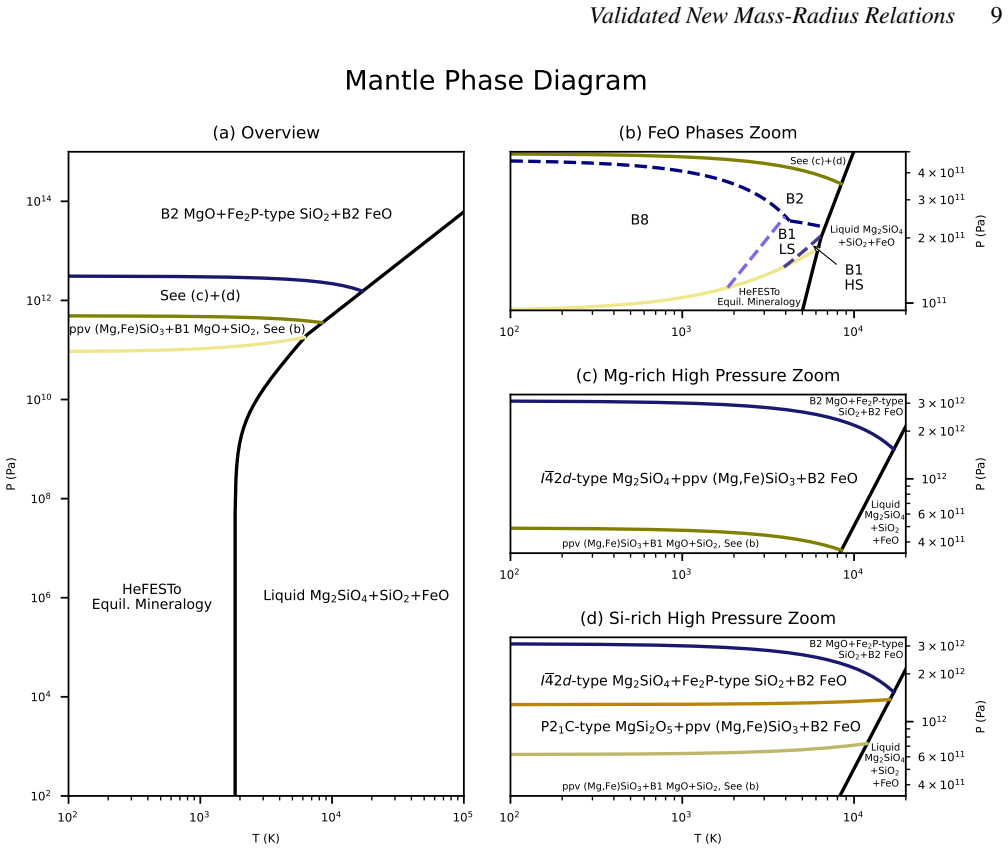
The authors construct and validate an interior structure code that employs state-of-the-art equations of state, a mineralogy permitting multiple phases within each layer, non-adiabatic temperature profiles, and melting. The code reproduces the radii and moments of inertia of Earth, Mars, the Moon, Mercury, Venus, and Europa at the stated precision levels. Mass-radius tables are computed for four compositional classes across 0.01–100 Earth masses, yielding 32,971 individual models whose publicly released data are fitted by piece-wise power laws below 8 Earth masses; the power-law exponent increases with mass and core fraction, and the resulting radii depart from previous relations in a manner
What carries the argument
The validated interior structure model that combines updated equations of state, multi-species mineralogy, non-adiabatic temperature profiles, and melting to compute planetary radii from mass and composition.
If this is right
- Mass-radius relations must be recomputed with current equations of state if observational uncertainties continue to shrink.
- The power-law exponent in M = a R^b increases with both planetary mass and core-mass fraction for planets below 8 Earth masses.
- Radii at a given mass are smaller than prior literature values for low-instellation planets and larger for high-instellation planets.
- Public tables of 32,971 model planets allow direct comparison with new observations.
- State-of-the-art models are required to interpret current and near-future mass-radius data at the precision now available.
Where Pith is reading between the lines
- The model’s ability to handle arbitrary compositions could be tested by applying it to planets with independently measured core fractions from transit-timing or atmospheric data.
- Differences at high instellation may affect interpretations of the radius valley if stellar irradiation alters interior thermal profiles.
- Extension to masses above 100 Earth masses would require checking whether the same mineralogies hold at higher central pressures.
- The public release of the full model grid allows community re-derivation of occurrence rates or formation constraints without re-running the structure code.
Load-bearing premise
Mineralogies and equations of state calibrated on solar-system bodies and laboratory data remain valid when applied to exoplanets that may have different formation histories, pressures, and temperatures.
What would settle it
A high-precision mass and radius measurement of an exoplanet whose bulk composition can be independently constrained (for example by atmospheric spectroscopy or formation context) that lies more than 3 sigma outside the new model’s predicted radius for that composition.
Figures


read the original abstract
The increasing precision of planetary mass and radius observations is bringing major questions about the structure and formation of planets--such as the nature of the radius valley and origin of super-Mercuries--within reach, demanding the development of interior structure models with more physics to more accurately determine planetary radii for a given composition. Here, we present a new model that includes state-of-the-art equations of state following the latest experimental and computational results, a physically-motivated mineralogy allowing multiple species to coexist within planetary layers, a non-adiabatic temperature profile, melting, and other features. This model replicates Earth's radius and moment of inertia coefficient to within $0.2\%$, Mars and the Moon's to within $0.5\%$, and Mercury, Venus, and Europa's to within $1\%$ or 3$\sigma$. We use this model to calculate mass-radius relationships for H/He-enveloped, water-rich, Earth-like, and iron-rich bodies with masses between $0.01$--$100\, M_\oplus$. We calculate mass-radius tables and fit piece-wise power-laws to them for ${<}8M_\oplus$ planets, finding that the exponent in $M=bR^a$ increases with mass and core mass fraction. We find radii generally smaller than in literature mass-radius relations at low instellations and larger at high instellations, with our improvement on the literature comparable to observational uncertainties. State-of-the-art interior structure models are thus required to interpret observational data. Our mass-radius curves comprising 32,975 model planets are publicly available.
Editorial analysis
A structured set of objections, weighed in public.
Referee Report
Summary. The manuscript presents a new planetary interior structure model incorporating updated equations of state based on recent experimental and computational results, a multi-species mineralogy allowing coexistence within layers, non-adiabatic temperature profiles, melting, and related features. The model is validated against solar-system bodies, reproducing Earth's radius and moment of inertia coefficient to within 0.2%, Mars and the Moon to within 0.5%, and Mercury, Venus, and Europa to within 1% or 3σ. The authors then compute mass-radius relations for H/He-enveloped, water-rich, Earth-like, and iron-rich compositions across 0.01–100 M⊕, derive piecewise power-law fits (M = a R^b) for planets below 8 M⊕, and publicly release a dataset of 32,971 model planets. They report that the new relations differ from literature values at a level comparable to observational uncertainties, with generally smaller radii at low instellations and larger radii at high instellations.
Significance. If the central results hold, the work provides a meaningfully more physics-rich interior model whose validation precision on multiple independent solar-system constraints (Earth radius+MOI, Mars, Moon, etc.) and public release of the full model grid directly support improved interpretation of exoplanet mass-radius data, including questions such as the radius valley and super-Mercury origins. The explicit quantification of differences from prior relations at the scale of current observational uncertainties, together with the reproducible dataset, strengthens the practical utility of the findings.
minor comments (3)
- [Abstract] The abstract states that radii are 'generally smaller than in literature mass-radius relations at low instellations and larger at high instellations'; the main text should explicitly identify the section or figure where this comparison is quantified and clarify how instellation enters the interior model (e.g., via the surface temperature boundary condition).
- The piecewise power-law fits for <8 M⊕ planets are central to the new relations; the manuscript should include a table or appendix listing the fitted coefficients a and b, the break points, and the mass ranges for each composition to allow direct use and reproduction.
- Acronyms such as EOS (equations of state) and MOI (moment of inertia) should be defined at first use in the main text, even if defined in the abstract.
Simulated Author's Rebuttal
We thank the referee for their positive assessment of our manuscript and for recommending minor revision. We appreciate the recognition of the model's validation precision against multiple solar-system bodies and the value of the publicly released 32,971-planet dataset. No specific major comments were listed in the report, so we have no individual points requiring detailed response at this stage. We will prepare the revised version incorporating any minor editorial changes as needed.
Circularity Check
No significant circularity in derivation chain
full rationale
The paper builds its interior model from external experimental and computational EOS data plus a physically motivated multi-species mineralogy, then validates it against independent solar-system observations (Earth radius/MOI to 0.2%, Mars/Moon to 0.5%, etc.) without defining parameters to force those matches. Mass-radius curves for H/He, water, Earth-like and iron-rich compositions are computed directly from the model and piecewise power-laws are fitted to those computed outputs; neither step reduces to the input data by construction. No load-bearing self-citations, self-definitional steps, or fitted-input-as-prediction patterns appear in the presented chain.
Axiom & Free-Parameter Ledger
axioms (2)
- standard math Hydrostatic equilibrium and mass continuity hold throughout the planet.
- domain assumption Equations of state from recent experiments and computations accurately describe material behavior at planetary pressures and temperatures.
discussion (0)
Sign in with ORCID, Apple, or X to comment. Anyone can read and Pith papers without signing in.