Python library supporting Discrete Variational Formulations and training solutions with Collocation-based Robust Variational Physics Informed Neural Networks (DVF-CRVPINN)
Pith reviewed 2026-05-10 11:08 UTC · model grok-4.3
The pith
A Python library defines discrete weak formulations with Kronecker delta test functions so that neural networks can be trained on finite point sets to solve PDEs like the Stokes equations using only finite difference derivatives.
A machine-rendered reading of the paper's core claim, the machinery that carries it, and where it could break.
Core claim
The central claim is that discrete weak formulations using Kronecker delta test functions on a finite point set, together with a neural-network representation of the solution at those same points and discrete finite-difference derivatives, produce a loss function that is mathematically well-posed, robust, and directly related to the true error of the discrete problem, thereby furnishing controllable numerical accuracy when the network is trained on PDEs such as the two-dimensional Stokes equations.
What carries the argument
The discrete weak formulation with Kronecker delta test functions on a finite point set, which supplies the loss for training a neural network that stores the solution only at those points and approximates all derivatives by finite differences inside automatic differentiation.
If this is right
- The loss remains well-posed and tied to the true discrete error, allowing direct monitoring of numerical accuracy during training.
- Robust error control is obtained for the Stokes equations without continuous-mesh or additional regularization terms.
- The same discrete machinery applies unchanged to the Laplace problem.
- Training uses only discrete automatic differentiation of finite-difference gradients and the Adamax optimizer.
Where Pith is reading between the lines
- The approach could be applied to other linear elliptic PDEs by simply changing the discrete weak form while keeping the same training loop.
- Refining the point set density would act like mesh refinement and could be used to drive adaptive accuracy.
- Because the loss is provably related to the true error, the method might serve as a diagnostic tool for when a physics-informed network has converged on a given discretization.
Load-bearing premise
The discrete weak formulation built from Kronecker delta test functions on a finite point set accurately represents the continuous PDE without extra regularization or mesh-dependent adjustments.
What would settle it
Solve the Stokes equations on a known analytic solution over successively denser point sets, train the network to a fixed loss tolerance, and verify that the pointwise solution error decreases at a consistent rate with the number of points.
Figures


read the original abstract
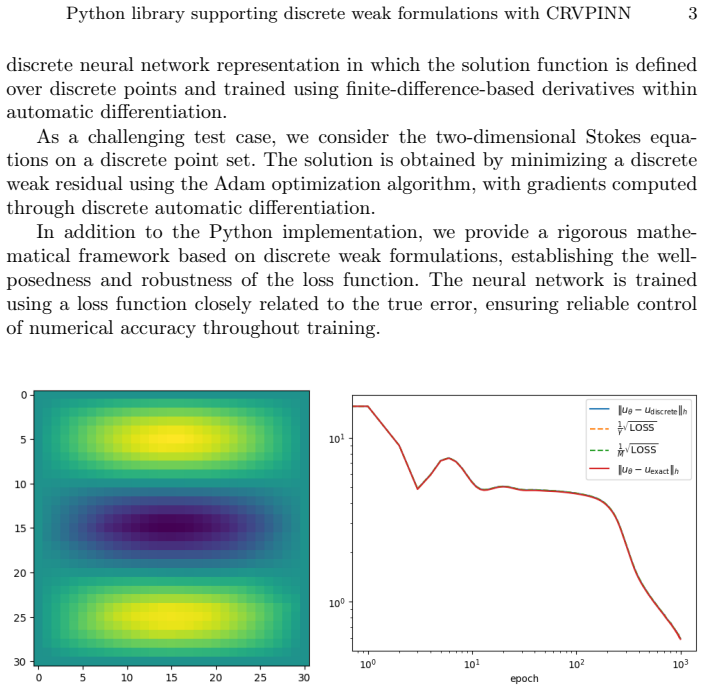
We explore the possibility of solving Partial Differential Equations (PDEs) using discrete weak formulations. We propose a programming environment for defining a discrete computational domain, introducing discrete functions defined over a set of points, constructing discrete inner products, and introducing discrete weak formulations employing Kronecker delta test functions. Building on this setup, we propose a discrete neural network representation, training the solution function defined over a discrete set of points and employing discrete finite difference derivatives in the automatic differentiation procedures. As a challenging computational model example, we focus on Stokes equations in two-dimensions, defined over a discrete set of points. We train the solution using the discrete weak residual and the Adamax algorithm with discrete automatic differentiation of the discrete gradients. Despite introducing the python environment, we also provide a rigorous mathematical formulation based on discrete weak formulations, proving the well-posedness and robustness of the loss function. The solution of the discrete weak formulations is based on neural network training employing a robust loss function that is related to the true error. In this way, we have a robust control of the numerical error during the training of the neural networks. Besides the Stokes formulation, we also explain the functionality of the proposed library using the Laplace problem formulation.
Editorial analysis
A structured set of objections, weighed in public.
Referee Report
Summary. The paper introduces a Python library for defining discrete computational domains, discrete functions over point sets, discrete inner products, and weak formulations that employ Kronecker-delta test functions. It proposes a discrete neural-network representation of the solution, trained via the discrete weak residual using finite-difference derivatives inside automatic differentiation, with application to the 2D Stokes equations (and Laplace as illustration). A rigorous discrete mathematical formulation is supplied that claims to prove well-posedness and robustness of the resulting loss, asserting that the loss is directly related to the true error and thereby furnishes robust numerical-error control during training.
Significance. If the well-posedness and robustness claims can be substantiated with consistency analysis, the library would supply a practical, open-source environment for experimenting with discrete variational PINN-style methods on point clouds. The explicit linkage of training loss to true error (when it holds) would be a useful engineering contribution for controlling discretization error in neural PDE solvers.
major comments (2)
- [Mathematical formulation / discrete weak formulations] The choice of Kronecker-delta test functions on a finite point set reduces the discrete weak form exactly to pointwise collocation of the residual at those points (see the definition of the discrete inner product and test functions in the mathematical formulation section). Consequently the claimed proof of well-posedness and robustness applies only to this algebraic collocation loss; no consistency argument is supplied showing that the discrete residual converges to the continuous weak residual under point-set refinement, nor any a-priori estimate relating the training loss to the true PDE error in a continuous norm.
- [Stokes equations numerical results] For the Stokes example, the manuscript asserts robust control of numerical error during training, yet no numerical tables, convergence rates under increasing point density, or comparison against standard collocation or weak-form PINNs are referenced in the results section. Without such verification the claim that the loss is “related to the true error” remains unanchored.
minor comments (2)
- [Library description] The library API description would benefit from a short usage example that shows how a user defines a discrete domain, registers a discrete function, and assembles the loss for a new PDE; the current text jumps directly to the Stokes implementation.
- [Discrete automatic differentiation] Notation for the discrete gradient operator and the automatic-differentiation pipeline should be introduced once with a clear table or diagram; repeated inline definitions make the exposition harder to follow.
Simulated Author's Rebuttal
We thank the referee for the thorough review and valuable comments on our manuscript. We address each major comment below, indicating planned revisions where appropriate to clarify the discrete nature of the approach and strengthen the numerical evidence.
read point-by-point responses
-
Referee: The choice of Kronecker-delta test functions on a finite point set reduces the discrete weak form exactly to pointwise collocation of the residual at those points (see the definition of the discrete inner product and test functions in the mathematical formulation section). Consequently the claimed proof of well-posedness and robustness applies only to this algebraic collocation loss; no consistency argument is supplied showing that the discrete residual converges to the continuous weak residual under point-set refinement, nor any a-priori estimate relating the training loss to the true PDE error in a continuous norm.
Authors: We agree that the Kronecker-delta test functions render the discrete weak formulation equivalent to pointwise collocation of the residual at the discrete points. The provided mathematical formulation proves well-posedness and robustness strictly in the discrete setting: the loss is equivalent to a discrete norm of the residual and thus directly controls the discrete approximation error. We acknowledge that the manuscript supplies neither a consistency analysis relating the discrete residual to the continuous weak form under point-set refinement nor a-priori estimates in continuous norms. In the revised manuscript we will insert a new subsection explicitly noting this equivalence to collocation, discussing its implications for point-cloud discretizations, and stating the absence of continuous consistency results as a current limitation of the framework while highlighting the practical utility of the discrete loss for neural-network training on unstructured point sets. revision: partial
-
Referee: For the Stokes example, the manuscript asserts robust control of numerical error during training, yet no numerical tables, convergence rates under increasing point density, or comparison against standard collocation or weak-form PINNs are referenced in the results section. Without such verification the claim that the loss is “related to the true error” remains unanchored.
Authors: The referee is correct that the results section describes the Stokes application but does not include numerical tables, convergence rates with respect to point density, or comparisons against standard collocation or weak-form PINNs. While the text illustrates the training procedure and asserts robust error control via the discrete loss, additional quantitative support is needed to anchor the claim. We will revise the results section to incorporate error tables for varying point densities, convergence plots of the discrete residual and solution error, and a short comparison with a standard collocation PINN baseline, thereby providing concrete verification that the loss controls the discrete error as proven. revision: yes
Circularity Check
No significant circularity; derivation defines discrete objects and proves properties for them without reducing claims to inputs by construction
full rationale
The paper introduces a discrete computational domain, discrete functions, inner products, and weak formulations using Kronecker-delta test functions on a finite point set, then defines a neural-network representation trained via the resulting discrete residual loss with finite-difference derivatives inside autodiff. It supplies a mathematical proof of well-posedness and robustness specifically for this discrete algebraic loss and asserts that the loss is related to the true error, thereby giving control of numerical error during training. None of these steps reduce a claimed prediction or uniqueness result to a fitted parameter or to a self-citation whose content is itself the target claim; the discrete formulation is explicitly constructed and its properties are proved directly rather than smuggled in via prior work or by renaming an existing collocation method as a new weak-form result. The absence of any load-bearing self-citation chain or definitional loop keeps the central derivation self-contained.
Axiom & Free-Parameter Ledger
axioms (1)
- domain assumption Discrete weak formulations with Kronecker delta test functions are well-posed and produce a loss directly related to the true numerical error for the Stokes problem.
Reference graph
Works this paper leans on
-
[1]
Alber, M., Tepole, A.B., Cannon, W.R., De, S., Dura-Bernal, S., Garikipati, K., Karniadakis, G., Lytton, W.W., Perdikaris, P., Petzold, L., Kuhl, E.: Integrating machine learning and multiscale modeling-perspectives, challenges, and opportu- nities in the biologica biomedical, and behavioral sciences. NPJ Digital Medicine 2(2019). https://doi.org/10.1038/...
-
[2]
Computer Methods in Applied Mechanics and Engineering418(A) (2024)
Badia, S., Li, W., Martin, A.F.: Finite element interpolated neural networks for solving forward and inverse problems. Computer Methods in Applied Mechanics and Engineering418(A) (2024). https://doi.org/10.1016/j.cma.2023.116505
-
[3]
Acta Mechanica Sinica37(12), 1727–1738 (2021)
Cai, S., Mao, Z., Wang, Z., Yin, M., Karniadakis, G.E.: Physics-informed neural networks (PINNs) for fluid mechanics: A review. Acta Mechanica Sinica37(12), 1727–1738 (2021)
work page 2021
-
[4]
https://doi.org/10.1364/OE.384875
Chen, Y., Lu, L., Karniadakis, G.E., Dal Negro, L.: Physics-informed neural net- worksforinverseproblemsinnano-opticsandmetamaterials.OpticsExpress28(8), 11618–11633 (2020). https://doi.org/10.1364/OE.384875
-
[5]
Demkowicz, L.: Babuska <=> Brezzi ?? (2006), https://www.ices.utexas.edu/ media/reports/2006/0608.pdf
work page 2006
-
[6]
Geneva, N., Zabaras, N.: Modeling the dynamics of pde systems with physics- constrained deep auto-regressive networks. Journal of Computational Physics403 (2020). https://doi.org/10.1016/j.jcp.2019.109056
-
[7]
Gheisari, M., Wang, G., Bhuiyan, M.Z.A.: A survey on deep learning in big data. In: 2017 IEEE international conference on computational science and engineering (CSE) and IEEE international conference on embedded and ubiquitous computing (EUC). vol. 2, pp. 173–180. IEEE (2017) 24 T. Służalec et al
work page 2017
-
[8]
Goswami, S., Anitescu, C., Chakraborty, S., Rabczuk, T.: Transfer learning en- hanced physics informed neural network for phase-field modeling of fracture. The- oretical and applied fracture machanics106(2020). https://doi.org/10.1016/j. tafmec.2019.102447
work page doi:10.1016/j 2020
-
[9]
IEEE Signal processing magazine29(6), 82–97 (2012)
Hinton, G., Deng, L., Yu, D., Dahl, G.E., Mohamed, A.r., Jaitly, N., Senior, A., Vanhoucke, V., Nguyen, P., Sainath, T.N., et al.: Deep neural networks for acoustic modeling in speech recognition: The shared views of four research groups. IEEE Signal processing magazine29(6), 82–97 (2012)
work page 2012
-
[10]
Huang, X., Liu, H., Shi, B., Wang, Z., Yang, K., Li, Y., Wang, M., Chu, H., Zhou, J., Yu, F., Hua, B., Dong, B., Chen, L.: A universal pinns method for solving partial differentialequationswithapointsource.ProceedingsoftheFourteenInternational Joint Conference on Artificial Intelligence (IJCAI-22) pp. 3839–3846 (2022)
work page 2022
-
[11]
Jin, H., Mattheakis, M., Protopapas, P.: Physics-informed neural networks for quantum eigenvalue problems. In: 2022 International Joint Conference on Neu- ralNetworks(IJCNN).pp.1–8(2022).https://doi.org/10.1109/IJCNN55064.2022. 9891944
-
[12]
V ariational physics-informed neural networks for solving partial di fferential equations
Kharazmi, E., Zhang, Z., Karniadakis, G.E.: Variational physics-informed neural networks for solving partial differential equations. arXiv preprint arXiv:1912.00873 (2019)
-
[13]
Computer Methods in Ap- plied Mechanics and Engineering374, 113547 (2021)
Kharazmi, E., Zhang, Z., Karniadakis, G.E.: hp-vpinns: Variational physics- informed neural networks with domain decomposition. Computer Methods in Ap- plied Mechanics and Engineering374, 113547 (2021)
work page 2021
-
[14]
In: 35th AAAI Conference on Artificial Intelligence, AAAI 2021
Kim, J., Lee, K., Lee, D., Jin, S.Y., Park, N.: Dpm: A novel training method for physics-informed neural networks in extrapolation. In: 35th AAAI Conference on Artificial Intelligence, AAAI 2021. pp. 8146–8154 (2021)
work page 2021
-
[15]
Korean Journal of Chemical Engineering40(9), 2119–2127 (SEP 2023)
Kim, Y., Kwak, H., Nam, J.: Physics-informed neural networks for learning fluid flows with symmetry. Korean Journal of Chemical Engineering40(9), 2119–2127 (SEP 2023). https://doi.org/10.1007/s11814-023-1420-4
-
[16]
Computer Methods in Applied Mechanics and Engineering358(2020)
Kissas, G., Yang, Y., Hwuang, E., Witschey, W.R., Detre, J.A., Perdikaris, P.: Machine learning in cardiovascular flows modeling: Predicting arterial blood pressure from non-invasive 4d flow mri data using physics-informed neural net- works. Computer Methods in Applied Mechanics and Engineering358(2020). https://doi.org/10.1016/j.cma.2019.112623
-
[17]
Communications of the ACM60(6), 84–90 (2017)
Krizhevsky, A., Sutskever, I., Hinton, G.E.: Imagenet classification with deep con- volutional neural networks. Communications of the ACM60(6), 84–90 (2017)
work page 2017
-
[18]
Ling, J., Kurzawski, A., Templeton, J.: Reynolds averaged turbulence modelling using deep neural networks with embedded invariance. Journal of Fuild Mechanics 807, 155–166 (2016). https://doi.org/10.1017/jfm.2016.615
-
[19]
International Journal of Applied Mechanics15(08) (2023)
Liu, C., Wu, H.A.: A variational formulation of physics-informed neural net- work for the applications of homogeneous and heterogeneous material proper- ties identification. International Journal of Applied Mechanics15(08) (2023). https://doi.org/10.1142/S1758825123500655
-
[20]
Extreme Mechanics Letter63(2023)
Liu, C., Wu, H.: cv-pinn: Efficient learning of variational physics-informed neural network with domain decomposition. Extreme Mechanics Letter63(2023). https: //doi.org/10.1016/j.eml.2023.102051
-
[21]
In: International Con- ference on Computational Science
Maczuga, P., Paszyński, M.: Influence of activation functions on the convergence of physics-informed neural networks for 1d wave equation. In: International Con- ference on Computational Science. pp. 74–88. Springer (2023)
work page 2023
-
[22]
Mao, Z., Jagtap, A.D., Karniadakis, G.E.: Physics-informed neural networks for high-speed flows. Computer Methods in Applied Mechanics and Engineering360, 112789 (2020) Python library supporting discrete weak formulations with CRVPINN 25
work page 2020
-
[23]
IMA Journal of Numerical Analysis42(2), 981–1022 (2022)
Mishra, S., Molinaro, R.: Estimates on the generalization error of physics-informed neural networks for approximating a class of inverse problems for PDEs. IMA Journal of Numerical Analysis42(2), 981–1022 (2022)
work page 2022
-
[24]
Nellikkath, R., Chatzivasileiadis, S.: Physics-informed neural networks for min- imising worst-case violations in dc optimal power flow. In: 2021 IEEE Inter- national Conference on Communications, Control, and Computing Technologies for Smart Grids (SmartGridComm). pp. 419–424 (2021). https://doi.org/10.1109/ SmartGridComm51999.2021.9632308
-
[25]
Journal of Computational physics378, 686–707 (2019)
Raissi, M., Perdikaris, P., Karniadakis, G.E.: Physics-informed neural networks: A deep learning framework for solving forward and inverse problems involving nonlinear partial differential equations. Journal of Computational physics378, 686–707 (2019)
work page 2019
-
[26]
Journal of Geophysical Research: Solid Earth127(5), e2021JB023120 (2022)
Rasht-Behesht, M., Huber, C., Shukla, K., Karniadakis, G.E.: Physics-informed neural networks (pinns) for wave propagation and full waveform inversions. Journal of Geophysical Research: Solid Earth127(5), e2021JB023120 (2022)
work page 2022
-
[27]
Computers & Mathematics with Applications67(4), 966–995 (Mar 2014)
Roberts, N.V., Bui-Thanh, T., Demkowicz, L.: The DPG method for the Stokes problem. Computers & Mathematics with Applications67(4), 966–995 (Mar 2014). https://doi.org/10.1016/j.camwa.2013.12.015, https://linkinghub.elsevier. com/retrieve/pii/S0898122113007116
-
[28]
Computer Methods in Applied Mechanics and Engineering425, 116904 (2024)
Rojas, S., Maczuga, P., Muñoz-Matute, J., Pardo, D., Paszyński, M.: Robust varia- tional physics-informed neural networks. Computer Methods in Applied Mechanics and Engineering425, 116904 (2024)
work page 2024
-
[29]
In: Mikyška, J., de Mulatier, C., Paszynski, M., Krzhizhanovskaya, V.V., Dongarra, J.J., Sloot, P.M
Służalec, T., Paszyński, M.: Fast solver for advection dominated diffusion us- ing residual minimization and neural networks. In: Mikyška, J., de Mulatier, C., Paszynski, M., Krzhizhanovskaya, V.V., Dongarra, J.J., Sloot, P.M. (eds.) Com- putational Science – ICCS 2023. pp. 517–531. Springer Nature Switzerland, Cham (2023)
work page 2023
-
[30]
Computer Methods in Applied Mechanics and Engineering361, 112732 (2020)
Sun, L., Gao, H., Pan, S., Wang, J.X.: Surrogate modeling for fluid flows based on physics-constrained deep learning without simulation data. Computer Methods in Applied Mechanics and Engineering361, 112732 (2020)
work page 2020
-
[31]
Proceed- ings of the AAAI Conference on Artificial Intelligence36(8), 8529–8538 (2022)
Wandel, N., Weinmann, M., Neidlin, M., Klein, R.: Spline-pinn: Approaching pdes without data using fast, physics-informed hermite-spline cnns. Proceed- ings of the AAAI Conference on Artificial Intelligence36(8), 8529–8538 (2022). https://doi.org/10.1609/aaai.v36i8.20830, https://ojs.aaai.org/index.php/AAAI/ article/view/20830
-
[32]
Journal of Computational Physics394, 136–152 (2019)
Yang, Y., Perdikaris, P.: Adversarial uncertainty quantification in physics-informed neural networks. Journal of Computational Physics394, 136–152 (2019)
work page 2019
-
[33]
Computers & Structures316, 107839 (Sep 2025)
Łoś, M., Służalec, T., Maczuga, P., Vilkha, A., Uriarte, C., Paszyński, M.: Collocation-based robust variational physics-informed neural net- works (CRVPINNs). Computers & Structures316, 107839 (Sep 2025). https://doi.org/10.1016/j.compstruc.2025.107839, https://linkinghub.elsevier. com/retrieve/pii/S004579492500197X
discussion (0)
Sign in with ORCID, Apple, or X to comment. Anyone can read and Pith papers without signing in.