Recognition: unknown
A gem system with a lava world and a habitable zone sub-Neptune orbiting TOI-1752
Pith reviewed 2026-05-10 07:53 UTC · model grok-4.3
The pith
TOI-1752 hosts a validated lava-world planet and a sub-Neptune in the optimistic habitable zone.
A machine-rendered reading of the paper's core claim, the machinery that carries it, and where it could break.
Core claim
The authors validate TOI-1752 b as a bona fide planet with radius 1.69 ± 0.07 Earth radii and orbital period 0.935186 +0.000001/-0.000002 days, and TOI-1752 c with radius 2.29 +0.13/-0.14 Earth radii and period 32.7144 ± 0.0004 days. The combined TESS and ground-based data plus TRICERATOPS and WATSON-Net assessments rule out false positives, place TOI-1752 c in the optimistic habitable zone, and assign TOI-1752 b an emission spectroscopy metric up to about 8, marking it as a strong target for atmospheric characterization.
What carries the argument
The TRICERATOPS statistical validation framework and WATSON-Net neural-network classifier, applied to combined TESS and multi-color ground-based photometry to confirm planetary transits and exclude false positives.
If this is right
- TOI-1752 c sits in the optimistic habitable zone of its M1 V host, supplying a concrete sub-Neptune target for habitability-related observations.
- TOI-1752 b's estimated emission spectroscopy metric of up to ~8 makes it a high-priority object for emission spectroscopy and atmospheric retrievals.
- The system is established as a new multi-planet configuration around a star 103 parsecs away, adding to the census of compact M-dwarf systems.
- Ground-based multi-color follow-up proved decisive in the validation, demonstrating a practical route for confirming other TESS candidates.
Where Pith is reading between the lines
- Systems like this increase the sample of small planets with measured radii near or inside the habitable zone of M dwarfs, which can later be used to test occurrence-rate models.
- The lava-world label for the inner planet implies extreme dayside temperatures that could be probed with thermal phase curves or secondary eclipse measurements.
- If similar validation pipelines are applied to the remaining TESS candidates, the number of confirmed sub-Neptunes in habitable zones may grow rapidly enough to enable statistical studies of their atmospheric compositions.
Load-bearing premise
The validation tools and photometry have no significant unaccounted systematics or remaining false-positive scenarios for this system.
What would settle it
Higher-precision photometry or spectroscopy that shows the transit depths vary with wavelength or timing in a pattern matching an eclipsing binary or other non-planetary source rather than the reported radii and periods.
Figures


read the original abstract
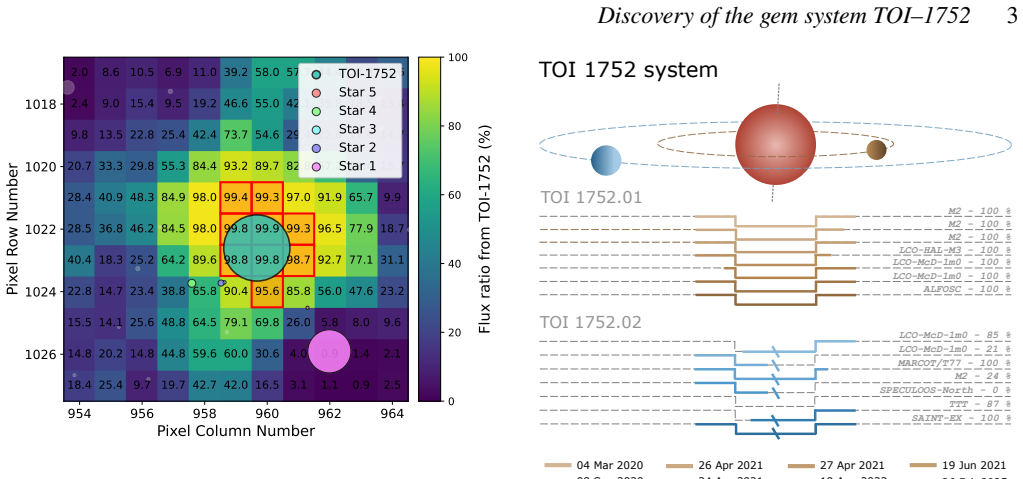
The Transiting Exoplanet Survey Satellite (TESS) has delivered a large number of transiting planet candidates around nearby stars by identifying periodic decreases in stellar brightness. Establishing the planetary nature of these signals and determining their fundamental properties is a necessary step toward detailed studies of their internal structure, atmospheres, and formation pathways. In this work, we investigate the planetary nature of the TOI-1752 system (M1 V, $103.02\pm0.34$ pc), which hosts two TESS candidates: TOI-1752 b, a short-period object consistent with a lava-world scenario, and TOI-1752 c, a sub-Neptune-size planet candidate located in the optimistic habitable zone. We obtained ground-based multi-color photometric follow-up observations of TOI-1752, which we combined with TESS photometry to assess the nature of both signals. We performed a formal statistical validation using the TRICERATOPS framework, while independently vetting the candidates with the neural-network-based classifier WATSON-Net, which provides a machine-learning assessment of their planetary likelihood based on light-curve morphology, centroid diagnostics, and auxiliary vetting features. We validate TOI-1752 b as a bona fide planet with a radius of $1.69\pm0.07 R_{\oplus}$ and an orbital period of $0.935186^{+0.000001}_{-0.000002}$ days, and TOI-1752 c with a radius of $2.29^{+0.13}_{-0.14} R_{\oplus}$ and an orbital period of $32.7144\pm0.0004$ days. The combined analysis confirms TOI-1752 as a new planetary system, places TOI-1752 c within the optimistic habitable zone of its host star, and identifies TOI-1752 b as a promising target for atmospheric characterization, with an estimated emission spectroscopy metric (ESM) of up to $\sim8$.
Editorial analysis
A structured set of objections, weighed in public.
Referee Report
Summary. The manuscript validates two transiting planets around the M1V star TOI-1752 at 103 pc using combined TESS photometry and ground-based multi-color follow-up. TOI-1752 b is reported as a 1.69±0.07 R⊕ lava-world candidate on a 0.935186+0.000001−0.000002 day orbit, while TOI-1752 c is a 2.29+0.13−0.14 R⊕ sub-Neptune on a 32.7144±0.0004 day orbit placed in the optimistic habitable zone. Validation relies on TRICERATOPS false-positive probability assessment and independent WATSON-Net machine-learning classification of light-curve morphology and centroid diagnostics; the system is presented as suitable for atmospheric characterization with an ESM up to ~8 for planet b.
Significance. If the validations hold, the system is a useful addition to the sample of M-dwarf multi-planet systems, offering both an ultra-short-period rocky target for emission spectroscopy and a sub-Neptune in the habitable zone for transmission studies. The reported parameters follow directly from standard joint transit modeling and enable immediate follow-up prioritization with facilities such as JWST.
major comments (1)
- [§4] §4 (Validation and modeling): The central claim that both signals are bona fide planets rests on TRICERATOPS FPP values and WATSON-Net probabilities, yet the manuscript does not quote the numerical FPP or ML scores for each candidate. Without these explicit thresholds and any sensitivity tests to priors (e.g., stellar density or multiplicity), the robustness of the <1% FPP threshold cannot be independently assessed.
minor comments (3)
- [Abstract] Abstract: The ESM value is quoted as 'up to ∼8' without stating the adopted planetary temperature, albedo, or bandpass assumptions; a one-sentence clarification would improve reproducibility.
- [Figures] Figure 2 (or equivalent phase-folded plots): The light curves for both planets should display the best-fit transit model and residuals to allow visual assessment of fit quality and any correlated noise.
- [§2.2] §2.2 (Ground-based observations): The text should specify the exact filter bandpasses and exposure times used in the multi-color photometry, as these directly affect the chromaticity test for false-positive rejection.
Simulated Author's Rebuttal
We thank the referee for their positive evaluation of the manuscript and for the constructive comment on the validation section. We address the point below and will revise the manuscript to improve transparency.
read point-by-point responses
-
Referee: [§4] §4 (Validation and modeling): The central claim that both signals are bona fide planets rests on TRICERATOPS FPP values and WATSON-Net probabilities, yet the manuscript does not quote the numerical FPP or ML scores for each candidate. Without these explicit thresholds and any sensitivity tests to priors (e.g., stellar density or multiplicity), the robustness of the <1% FPP threshold cannot be independently assessed.
Authors: We agree that the manuscript would benefit from explicitly quoting the numerical TRICERATOPS FPP values and WATSON-Net planetary probabilities for both candidates. In the revised version we will add these results to §4, together with the validation thresholds applied. For sensitivity to priors, the TRICERATOPS runs incorporated the stellar density derived from our joint photometric analysis and the TESS Input Catalog parameters; the resulting FPPs are driven primarily by the multi-color photometry and centroid shifts that exclude common false-positive scenarios. We will include a concise discussion of this robustness in the revision. revision: yes
Circularity Check
No significant circularity detected
full rationale
The paper derives planetary radii, periods, and habitable-zone status by fitting transit models to combined TESS and ground-based multi-color photometry, then applies independent statistical validation via the external TRICERATOPS tool and separate ML classification with WATSON-Net. These steps rely on direct data modeling and external frameworks rather than any self-definition, fitted-input-as-prediction, or load-bearing self-citation chain. Habitable-zone placement and ESM estimates follow from standard stellar parameters and orbital elements without reducing to the input light-curve fits by construction. The derivation chain is self-contained against external benchmarks.
Axiom & Free-Parameter Ledger
free parameters (1)
- planet radii and orbital periods
axioms (1)
- domain assumption The observed periodic brightness dips are caused by transiting planets and not by astrophysical false positives or instrumental artifacts
Reference graph
Works this paper leans on
-
[1]
P.,Tinetti G.,2021, ApJ,917, 37 Aller A., Lillo-Box J., Jones D., Miranda L
Acuña L., Deleuil M., Mousis O., 2023, A&A, 677, A14 Al-Refaie A.F., ChangeatQ., WaldmannI. P.,Tinetti G.,2021, ApJ,917, 37 Aller A., Lillo-Box J., Jones D., Miranda L. F., Barceló Forteza S., 2020, A&A, 635, A128 Ballard S., 2019, AJ, 157, 113 Barclay T., Pepper J., Quintana E. V., 2018, ApJS, 239, 2 Barkaoui K., et al., 2024a, Nature Astronomy, 8, 909 B...
discussion (0)
Sign in with ORCID, Apple, or X to comment. Anyone can read and Pith papers without signing in.