Novel microscopic approaches for Spin-Isospin excitations and Beta-decay
Pith reviewed 2026-05-10 08:02 UTC · model grok-4.3
The pith
Self-consistent models that include two-particle two-hole couplings and tensor correlations explain quenching of magnetic dipole and Gamow-Teller transitions while calculating beta decay lifetimes.
A machine-rendered reading of the paper's core claim, the machinery that carries it, and where it could break.
Core claim
Within the self-consistent Hartree-Fock plus random phase approximation and the subtracted second random phase approximation that includes two-particle two-hole couplings, the quenching of magnetic dipole and Gamow-Teller transition strengths is attributed to the effects of those higher-order configurations together with tensor correlations, while the same models are shown to reproduce beta decay lifetimes of semi-magic and magic nuclei when realistic isoscalar and isovector pairing interactions are employed.
What carries the argument
The subtracted second random phase approximation (SSRPA) extended by explicit couplings to two-particle two-hole states, which works on top of a self-consistent Hartree-Fock mean field that already contains realistic pairing and tensor forces.
If this is right
- Quenching factors for spin-isospin transitions become traceable to concrete 2p-2h and tensor mechanisms rather than ad-hoc adjustments.
- Beta decay lifetimes of magic and semi-magic nuclei can be computed directly from the same microscopic wave functions used for the transition strengths.
- The framework supplies consistent matrix elements that enter both laboratory spectroscopy and astrophysical reaction networks.
- Tensor correlations emerge as a necessary ingredient alongside pairing forces for quantitative agreement with data.
Where Pith is reading between the lines
- The same machinery could be tested on chains of nuclei away from closed shells to check whether the quenching pattern persists.
- Accurate Gamow-Teller matrix elements obtained this way would directly improve predictions for neutrinoless double-beta decay rates.
- If the approach holds, it offers a route to reduce theoretical uncertainties in r-process nucleosynthesis calculations that rely on beta decay rates.
Load-bearing premise
That self-consistent HF+RPA and SSRPA models supplied with realistic isoscalar and isovector pairing interactions and tensor correlations can serve as a universal theoretical framework for both nuclear and astrophysical phenomena.
What would settle it
Precise measurements of Gamow-Teller or magnetic dipole strengths, or of beta decay lifetimes, in a set of closed-shell nuclei that fall outside the range of values obtained from the SSRPA calculations with the chosen realistic interactions.
Figures



read the original abstract
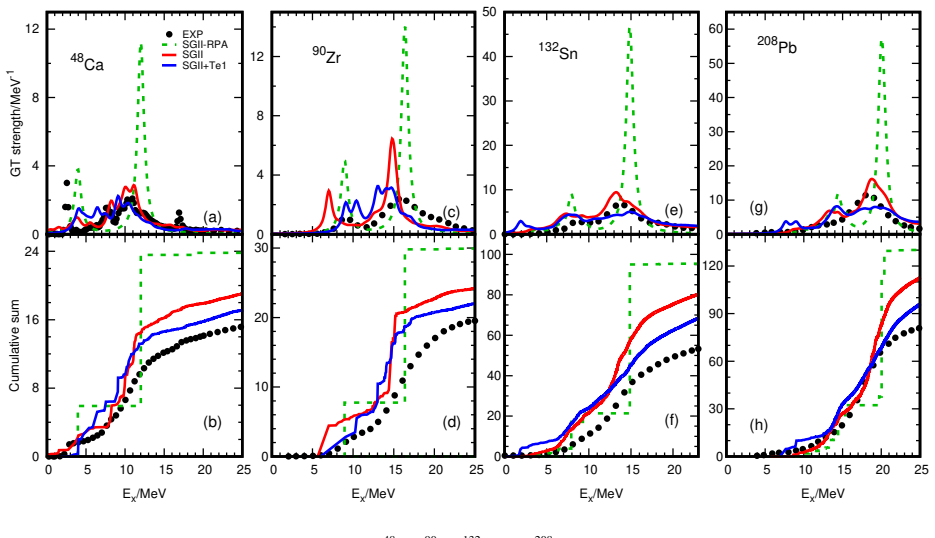
We explore unsolved nuclear structure problems related with the spin and isospin degree of freedom by using microscopic models which accommodate realistic isoscalar and isovector pairing interactions, and also tensor correlations. For the attempt of universal theoretical framework for both nuclear and astrophysical phenomena, we adopt a self-consistent Hartree-Fock (HF)+random phase approximation (RPA) models, and a state-of-the-art beyond mean field model, Subtracted Second RPA (SSRPA), including the couplings to two-particle two-hole states. The quenching problems of magnetic dipole and Gamow-Teller transitions are discussed in terms of the coupling to 2p-2h configurations and also the tensor correlations. The $\beta$ decay life time of semi-magic and magic nuclei are discussed in RPA and SSRPA models.
Editorial analysis
A structured set of objections, weighed in public.
Referee Report
Summary. The manuscript explores unsolved nuclear structure problems related to spin and isospin degrees of freedom using microscopic models that include realistic isoscalar and isovector pairing interactions and tensor correlations. It employs self-consistent HF+RPA and SSRPA models to discuss the quenching of M1 and GT transitions in terms of 2p-2h couplings and tensor correlations, and to discuss beta-decay lifetimes of semi-magic and magic nuclei.
Significance. The work aims to provide a universal theoretical framework for nuclear and astrophysical phenomena. If the models successfully incorporate the mentioned effects to address quenching, it could contribute to resolving long-standing issues in spin-isospin excitations relevant to beta-decay rates. However, the manuscript is framed as an exploratory discussion of the approaches rather than a presentation of new quantitative predictions, validations against experiment, or error analyses.
minor comments (1)
- The abstract uses phrases such as 'are discussed' without indicating whether new calculations, figures, or tables are provided in the manuscript to support the discussion of quenching mechanisms.
Simulated Author's Rebuttal
We thank the referee for their summary of our manuscript and for highlighting its potential relevance to spin-isospin excitations. We address the principal observation concerning the exploratory framing of the work below.
read point-by-point responses
-
Referee: The manuscript is framed as an exploratory discussion of the approaches rather than a presentation of new quantitative predictions, validations against experiment, or error analyses.
Authors: We agree that the manuscript is structured around the exploration and application of the self-consistent HF+RPA and SSRPA frameworks, with emphasis on how realistic isoscalar/isovector pairing and tensor correlations affect quenching of M1 and GT transitions via 2p-2h couplings. The text does include concrete model comparisons for beta-decay lifetimes in selected semi-magic and magic nuclei, as well as explicit discussion of the resulting quenching mechanisms. While we do not claim exhaustive validation across all available data or a full uncertainty quantification, the presented results demonstrate the impact of the included correlations. We will expand the revised manuscript with additional quantitative comparisons to experimental quenching factors and lifetimes to strengthen the presentation. revision: partial
Circularity Check
No significant circularity
full rationale
The manuscript is framed as an exploratory discussion ('we explore', 'are discussed') of spin-isospin problems within established self-consistent HF+RPA and SSRPA frameworks that incorporate realistic pairing and tensor terms drawn from prior literature. No quantitative predictions, fitted parameters renamed as outputs, or load-bearing uniqueness theorems are advanced. The central activity consists of qualitative discussion of quenching and lifetimes rather than a derivation chain that reduces to its own inputs by construction. No self-citations function as circular justification, and the models remain independent of the paper's own results.
Axiom & Free-Parameter Ledger
Reference graph
Works this paper leans on
-
[1]
Eunja Ha, Myung-Ki Cheoun, and H. Sagawa, Prog. Theor. Exp. Phys. 2022, 043D01(2022); Prog. Theor. Exp. Phys. 2024, 063D02 (2024)
work page 2022
-
[2]
Shuai Sun, Li-Gang Cao, Feng-Shou Zhang, Hiroyuki Sagawa, and Gianluca Colò, Phys. Phys. C109, 014321 (2024)
work page 2024
-
[3]
M. J. Yang, H. Sagawa, C. L. Bai, and H. Q. Zhang, Phys. Rev. C 106, 014319 (2022), ; Phys. Rev. C 107, 014325 (2023)
work page 2022
- [4]
- [5]
-
[6]
M. J. Yang, H. Sagawa, C. L. Bai, and H. Q. Zhang, Phys. Rev. C 106, 014319 (2022)
work page 2022
-
[7]
Okubo, Progress of Theoretical Physics, 12, 603 (1954)
S. Okubo, Progress of Theoretical Physics, 12, 603 (1954). S. Y . Lee and K. Suzuki, Phys. Letters 91B (1980), 173. K. Suzuki and S. Y . Lee, Progress of Theoretical Physics, 64, 2091 (1980)
work page 1954
-
[8]
M. J. Yang, H. Sagawa, C. L. Bai, and H. Q. Zhang, Phys. Rev. C 107, 014325/pp. 1-6 (2023)
work page 2023
- [9]
- [10]
- [11]
- [12]
-
[13]
M. J. Yang, C. L. Bai, H. Sagawa, and H. Q. Zhang, Phys. Rev. C 109, 054319 (2024)
work page 2024
-
[14]
S. Shen, G. Colò, and X. Roca-Maza, Phys. Rev. C 99, 034322 (2019)
work page 2019
- [15]
- [16]
-
[17]
J. Birkhan, H. Matsubara, P. von Neumann-Cosel, N. Pietralla, V . Y . Ponomarev, A. Richter, A. Tamii, and J. Wambach, Phys. Rev. C 93, 041302(R) (2016)
work page 2016
- [18]
-
[19]
E. Caurier, G. Martínez-Pinedo, F. Nowack, A. Poves, and A. P. Zuker, Rev. Mod. Phys. 77, 427 (2005)
work page 2005
-
[20]
Y . F. Niu, Z. M. Niu, G. Colò, and E. Vigezzi, Phys. Rev. Lett. 114, 142501 (2015)
work page 2015
-
[21]
http://www.nndc.bnl.gov
discussion (0)
Sign in with ORCID, Apple, or X to comment. Anyone can read and Pith papers without signing in.