Charged-current quasielastic-like neutrino scattering from ¹²C in the coherent density fluctuation model with two-nucleon emission
Pith reviewed 2026-05-10 07:33 UTC · model grok-4.3
The pith
The coherent density fluctuation model with relativistic effective nucleon mass of 0.8 times the free mass calculates neutrino and antineutrino scattering cross sections on carbon-12.
A machine-rendered reading of the paper's core claim, the machinery that carries it, and where it could break.
Core claim
The quasielastic cross-sections of charged-current neutrino and antineutrino scattering on 12C are obtained in the CDFM_M* model by incorporating the modification of the nucleon effective mass m_N^*=0.8 m_N from the relativistic mean field treatment, together with explicit two-particle emission channels also evaluated in the same RMF framework, yielding predictions for the observed cross sections.
What carries the argument
CDFM_M*, the coherent density fluctuation model with relativistic effective mass, which uses the density-dependent effective nucleon mass from the RMF model to compute the quasielastic-like response while adding two-nucleon knockout contributions.
Load-bearing premise
The relativistic effective mass is fixed at exactly 0.8 times the free nucleon mass and the relativistic mean field treatment accurately represents the nuclear medium modifications for the kinematics of the neutrino scattering processes.
What would settle it
A large, systematic discrepancy between the calculated cross sections and the measured values in any of the MiniBooNE, T2K, or MINERvA data sets over the relevant energy and momentum-transfer ranges would show that the chosen mass value or RMF framework does not capture the relevant nuclear effects.
Figures



read the original abstract
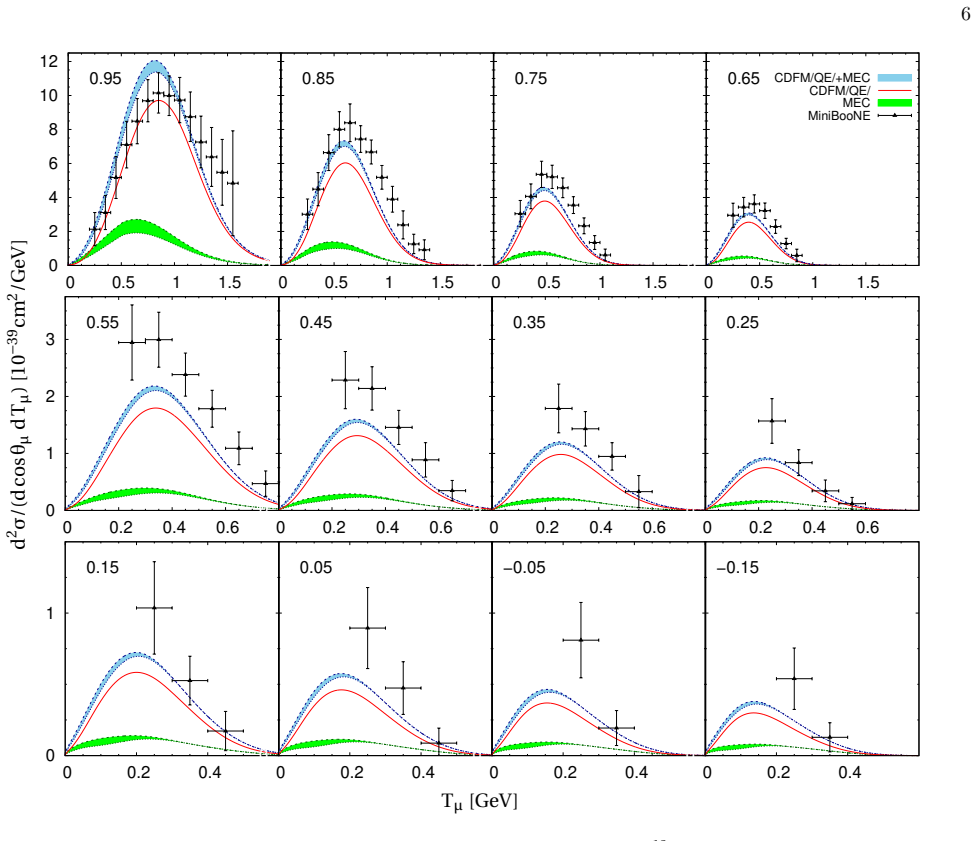
The quasielastic cross-sections of charged-current neutrino and antineutrino scattering on $^{12}$C are calculated using the coherent density fluctuation model with a relativistic effective mass $m_N^* =0.8 m_N$ (CDFM$_{M^*}$). The model explicitly considers the modification of the relativistic effective mass of the nucleon within the relativistic mean field (RMF) model of nuclear matter. In addition, our calculations include neutrino-induced two-particle emission processes, which are evaluated within the RMF model of nuclear matter. Utilizing the CDFM$_{M^*}$, we provide predictions for the neutrino and antineutrino cross sections of $^{12}$C, which have been observed in accelerator experiments, such as MiniBooNE, T2K, and MINERvA. Also, we analyze the axial form factor value for the excitation of the $\Delta$ at zero momentum transfer (commonly denoted as $C^A_5 (0)$) which is important for the treatment of the $\Delta$ current in the meson-exchange currents (MEC) calculation. In addition, the quasielastic results obtained within CDFM$_{M^*}$ model are thoroughly evaluated for different regions of the momentum transfer.
Editorial analysis
A structured set of objections, weighed in public.
Referee Report
Summary. The manuscript calculates charged-current quasielastic-like neutrino and antineutrino cross sections on ^{12}C within the coherent density fluctuation model that incorporates a relativistic effective nucleon mass (CDFM_{M^*}) fixed at m_N^*=0.8 m_N from RMF nuclear matter. It includes neutrino-induced two-nucleon emission processes evaluated in the RMF framework, analyzes the axial form factor C_5^A(0) relevant to meson-exchange currents, and evaluates the quasielastic results for different momentum-transfer regions, providing predictions for comparison with MiniBooNE, T2K, and MINERvA data.
Significance. If the fixed effective-mass choice and RMF-based 2N treatment prove robust for neutrino kinematics, the CDFM_{M^*} framework could provide a useful tool for interpreting accelerator neutrino-nucleus data by combining density fluctuations with two-body currents. The explicit evaluation across Q regions and inclusion of MEC contributions via the Delta current are constructive elements that could aid model development in the field.
major comments (3)
- Abstract and model description: The relativistic effective mass is fixed at m_N^*=0.8 m_N from RMF calculations of symmetric nuclear matter at saturation density, yet no sensitivity study or explicit check is shown that this value remains appropriate for the off-shell kinematics and momentum transfers probed by accelerator neutrinos on ^{12}C. This choice is load-bearing for all reported cross sections.
- Two-nucleon emission processes: The 2N emission is evaluated within the RMF model and embedded in CDFM_{M^*}, but the manuscript does not demonstrate consistency of the effective-mass parameter (or other RMF inputs) between the one-body current and the two-body currents, leaving open the possibility of uncontrolled parameter mismatch in the quasielastic-like regime.
- Results for different momentum-transfer regions: Although the abstract states that results are 'thoroughly evaluated' for different Q regions and predictions are supplied for already-measured data, no quantitative agreement metrics, flux-averaged comparisons, or uncertainty estimates are referenced, weakening the claim that the calculations constitute usable predictions.
minor comments (1)
- The notation CDFM_{M^*} and the precise definition of 'quasielastic-like' should be introduced with a brief equation or reference at first appearance to aid readability.
Simulated Author's Rebuttal
We thank the referee for the careful reading and constructive comments on our manuscript. We address each major comment point by point below, indicating planned revisions where appropriate.
read point-by-point responses
-
Referee: Abstract and model description: The relativistic effective mass is fixed at m_N^*=0.8 m_N from RMF calculations of symmetric nuclear matter at saturation density, yet no sensitivity study or explicit check is shown that this value remains appropriate for the off-shell kinematics and momentum transfers probed by accelerator neutrinos on ^{12}C. This choice is load-bearing for all reported cross sections.
Authors: The value m_N^*=0.8 m_N is the standard result from RMF calculations of symmetric nuclear matter at saturation density and is adopted in CDFM_{M^*} to represent the average effect of density fluctuations across the nucleus. This choice is consistent with prior applications of RMF-based models to finite nuclei. To directly address the concern about off-shell kinematics and neutrino momentum transfers on ^{12}C, we will add a dedicated paragraph in the revised manuscript justifying the applicability of this fixed value and include a limited sensitivity study varying m_N^* around 0.8 m_N to quantify its effect on the reported cross sections. revision: yes
-
Referee: Two-nucleon emission processes: The 2N emission is evaluated within the RMF model and embedded in CDFM_{M^*}, but the manuscript does not demonstrate consistency of the effective-mass parameter (or other RMF inputs) between the one-body current and the two-body currents, leaving open the possibility of uncontrolled parameter mismatch in the quasielastic-like regime.
Authors: The two-nucleon emission is computed in the same RMF framework of nuclear matter that supplies the effective mass for the CDFM_{M^*} one-body currents, so the parameter m_N^*=0.8 m_N and other RMF inputs are identical by construction. We will revise the model description section to explicitly state this shared RMF origin and parameter consistency for the one- and two-body contributions, thereby removing any ambiguity. revision: yes
-
Referee: Results for different momentum-transfer regions: Although the abstract states that results are 'thoroughly evaluated' for different Q regions and predictions are supplied for already-measured data, no quantitative agreement metrics, flux-averaged comparisons, or uncertainty estimates are referenced, weakening the claim that the calculations constitute usable predictions.
Authors: The thorough evaluation in the manuscript consists of explicit calculations and direct visual comparisons of the quasielastic-like cross sections in distinct momentum-transfer regions against MiniBooNE, T2K, and MINERvA data. We agree that the absence of quantitative metrics (e.g., chi-squared values) and uncertainty bands limits the immediate usability of the predictions. In the revised version we will therefore add flux-averaged results where relevant and include basic uncertainty estimates derived from the model variations already explored. revision: yes
Circularity Check
No significant circularity; model inputs are external to the neutrino data
full rationale
The paper fixes m_N^*=0.8 m_N from the RMF model of nuclear matter as an input parameter and computes CCQE-like cross sections (including 2N emission) within the CDFM_M* framework for comparison against external accelerator data (MiniBooNE, T2K, MINERvA). No equations or text indicate that parameters are fitted to the neutrino cross-section measurements themselves, nor any self-definitional loop, fitted-input-renamed-as-prediction, or load-bearing self-citation that reduces the output to the input by construction. The derivation chain remains independent of the target observables.
Axiom & Free-Parameter Ledger
free parameters (2)
- relativistic effective mass m_N^* =
0.8 m_N
- C^A_5(0)
axioms (2)
- domain assumption The coherent density fluctuation model with RMF effective mass accurately represents the nuclear response for quasielastic neutrino scattering.
- domain assumption Two-nucleon emission processes can be reliably evaluated within the RMF model of nuclear matter for neutrino kinematics.
Reference graph
Works this paper leans on
-
[1]
W. M. Alberico, A. Molinari, T. W. Donnelly, E. L. Kro- nenberg, and J. W. Van Orden, Scaling in electron scat- tering from a relativistic fermi gas, Phys. Rev. C38, 1801 (1988)
work page 1988
-
[2]
M. Barbaro, R. Cenni, A. D. Pace, T. Donnelly, and A. Molinari, Relativisticy-scaling and the coulomb sum rule in nuclei, Nuclear Physics A643, 137 (1998)
work page 1998
-
[3]
T. W. Donnelly and I. Sick, Superscaling in inclusive electron-nucleus scattering, Phys. Rev. Lett.82, 3212 (1999)
work page 1999
-
[4]
T. W. Donnelly and I. Sick, Superscaling of inclusive electron scattering from nuclei, Phys. Rev. C60, 065502 (1999)
work page 1999
-
[5]
C. Maieron, T. W. Donnelly, and I. Sick, Extended su- perscaling of electron scattering from nuclei, Phys. Rev. C65, 025502 (2002)
work page 2002
-
[6]
M. B. Barbaro, J. A. Caballero, T. W. Donnelly, and C. Maieron, Inelastic electron-nucleus scattering and scaling at high inelasticity, Phys. Rev. C69, 035502 (2004)
work page 2004
-
[7]
A. N. Antonov, M. K. Gaidarov, D. N. Kadrev, M. V. Ivanov, E. Moya de Guerra, and J. M. Udias, Superscal- ing in nuclei: A search for a scaling function beyond the relativistic fermi gas model, Phys. Rev. C69, 044321 (2004)
work page 2004
-
[8]
A. N. Antonov, M. K. Gaidarov, M. V. Ivanov, D. N. Kadrev, E. Moya de Guerra, P. Sarriguren, and J. M. Udias, Superscaling, scaling functions, and nucleon mo- mentum distributions in nuclei, Phys. Rev. C71, 014317 (2005)
work page 2005
-
[9]
A. N. Antonov, P. E. Hodgson, and I. Z. Petkov,Nucleon Momentum and Density Distributions in Nuclei(Claren- don Press, Oxford, 1988)
work page 1988
-
[10]
A. N. Antonov, P. E. Hodgson, and I. Z. Petkov,Nu- cleon Correlations in Nuclei(Springer-Verlag, Berlin- Heidelberg-New York, 1993)
work page 1993
-
[11]
A. N. Antonov, V. A. Nikolaev, and I. Z. Petkov, Bulg. J. Phys.6, 151 (1979)
work page 1979
-
[12]
A. N. Antonov, V. A. Nikolaev, and I. Z. Petkov, Nucleon momentum and density distributions of nuclei, Zeitschrift f¨ ur Physik A Atoms and Nuclei297, 257 (1980)
work page 1980
-
[13]
A. N. Antonov, V. A. Nikolaev, and I. Z. Petkov, Spectral functions and hole nuclear states, Zeitschrift f¨ ur Physik A Atoms and Nuclei304, 239 (1982)
work page 1982
-
[14]
A. N. Antonov, V. A. Nikolaev, and I. Z. Petkov, Extreme breathing excitations of atomic nuclei, Il Nuovo Cimento A86, 23 (1985)
work page 1985
-
[15]
A. N. Antonov, E. N. Nikolov, I. Z. Petkov, C. V. Chris- tov, and P. E. Hodgson, Natural orbitals and occupa- tion numbers in the coherent density fluctuation model, Il Nuovo Cimento A102, 1701 (1989)
work page 1989
-
[16]
A. N. Antonov, D. N. Kadrev, and P. E. Hodgson, Effect of nucleon correlations on natural orbitals, Phys. Rev. C 50, 164 (1994)
work page 1994
-
[17]
J. J. Griffin and J. A. Wheeler, Collective motions in nu- clei by the method of generator coordinates, Phys. Rev. 108, 311 (1957)
work page 1957
-
[18]
A. N. Antonov, M. V. Ivanov, M. K. Gaidarov, E. Moya de Guerra, P. Sarriguren, and J. M. Udias, Scal- ing functions and superscaling in medium and heavy nu- clei, Phys. Rev. C73, 047302 (2006)
work page 2006
-
[19]
A. N. Antonov, M. V. Ivanov, M. K. Gaidarov, E. Moya de Guerra, J. A. Caballero, M. B. Barbaro, J. M. Udias, and P. Sarriguren, Superscaling analysis of inclusive electron scattering and its extension to charge- changing neutrino-nucleus cross sections beyond the rel- ativistic fermi gas approach, Phys. Rev. C74, 054603 (2006)
work page 2006
-
[20]
M. V. Ivanov, M. B. Barbaro, J. A. Caballero, A. N. Antonov, E. Moya de Guerra, and M. K. Gaidarov, Su- perscaling and charge-changing neutrino scattering from nuclei in the ∆ region beyond the relativistic fermi gas model, Phys. Rev. C77, 034612 (2008)
work page 2008
-
[21]
A. N. Antonov, M. V. Ivanov, M. B. Barbaro, J. A. Ca- ballero, E. Moya de Guerra, and M. K. Gaidarov, Super- scaling and neutral current quasielastic neutrino-nucleus scattering beyond the relativistic fermi gas model, Phys. Rev. C75, 064617 (2007)
work page 2007
-
[22]
V. L. Martinez-Consentino, I. Ruiz Simo, J. E. Amaro, and E. Ruiz Arriola, Fermi-momentum dependence of rel- ativistic effective mass below saturation from superscal- ing of quasielastic electron scattering, Phys. Rev. C96, 064612 (2017)
work page 2017
-
[23]
J. E. Amaro, V. L. Martinez-Consentino, E. Ruiz Ar- riola, and I. Ruiz Simo, Global superscaling analysis of quasielastic electron scattering with relativistic effective mass, Phys. Rev. C98, 024627 (2018)
work page 2018
-
[24]
V. L. Martinez-Consentino, P. R. Casale, and J. E. Amaro, Improved superscaling description of electron and charged-current neutrino quasielastic scattering us- ing effective mass dynamics, Phys. Rev. D112, 033008 (2025)
work page 2025
-
[25]
M. V. Ivanov and A. N. Antonov, Superscaling analysis of inclusive electron and (anti)neutrino scattering within the coherent density fluctuation model, Phys. Rev. C 109, 064621 (2024)
work page 2024
-
[26]
M. V. Ivanov and A. N. Antonov, Inclusive neutrino and antineutrino scattering on the 12C nucleus within the coherent density fluctuation model, Universe11, 10.3390/universe11040119 (2025)
-
[27]
J. E. Amaro, E. Ruiz Arriola, and I. Ruiz Simo, Scaling violation and relativistic effective mass from quasi-elastic electron scattering: Implications for neutrino reactions, Phys. Rev. C92, 054607 (2015)
work page 2015
-
[28]
J. E. Amaro, E. Ruiz Arriola, and I. Ruiz Simo, Super- scaling analysis of quasielastic electron scattering with relativistic effective mass, Phys. Rev. D95, 076009 (2017)
work page 2017
-
[29]
I. Ruiz Simo, V. L. Martinez-Consentino, J. E. Amaro, and E. Ruiz Arriola, Quasielastic charged-current neu- trino scattering in the scaling model with relativistic ef- fective mass, Phys. Rev. D97, 116006 (2018)
work page 2018
-
[30]
A. Aguilar-Arevaloet al.(MiniBooNE Collaboration), First measurement of the muon neutrino charged cur- rent quasielastic double differential cross section, Phys. Rev. D81, 092005 (2010)
work page 2010
-
[31]
A. A. Aguilar-Arevaloet al.(MiniBooNE Collaboration), First measurement of the muon antineutrino double- differential charged-current quasielastic cross section, Phys. Rev. D88, 032001 (2013)
work page 2013
-
[32]
K. Abeet al.(T2K Collaboration), Measurement of double-differential muon neutrino charged-current inter- 14 actions on c8h8 without pions in the final state using the t2k off-axis beam, Phys. Rev. D93, 112012 (2016)
work page 2016
-
[33]
D. Ruterborieset al.(MINERνA Collaboration), Mea- surement of quasielastic-like neutrino scattering at <Eν >∼3.5 GeV on a hydrocarbon target, Phys. Rev. D99, 012004 (2019)
work page 2019
-
[34]
C. E. Patricket al.(MINERνA Collaboration), Measure- ment of the muon antineutrino double-differential cross section for quasielastic-like scattering on hydrocarbon at Eν ∼3.5 GeV, Phys. Rev. D97, 052002 (2018)
work page 2018
-
[35]
V. L. Martinez-Consentino, J. E. Amaro, and I. Ruiz Simo, Semiempirical formula for electroweak response functions in the two-nucleon emission channel in neutrino-nucleus scattering, Phys. Rev. D104, 113006 (2021)
work page 2021
-
[36]
V. L. Martinez-Consentino, J. E. Amaro, P. R. Casale, and I. Ruiz Simo, Extended superscaling with two- particle emission in electron and neutrino scattering, Phys. Rev. D108, 013007 (2023)
work page 2023
-
[37]
V. L. Martinez-Consentino and J. E. Amaro, Charged- current quasielastic neutrino scattering from 12C in an extended superscaling model with two-nucleon emission, Phys. Rev. D108, 113006 (2023)
work page 2023
-
[38]
J. E. Amaro, M. B. Barbaro, J. A. Caballero, T. W. Donnelly, A. Molinari, and I. Sick, Using electron scat- tering superscaling to predict charge-changing neutrino cross sections in nuclei, Phys. Rev. C71, 015501 (2005)
work page 2005
-
[39]
J. E. Amaro, M. B. Barbaro, J. A. Caballero, T. W. Donnelly, and C. Maieron, Semirelativistic description of quasielastic neutrino reactions and superscaling in a con- tinuum shell model, Phys. Rev. C71, 065501 (2005)
work page 2005
-
[40]
J. Patterson and R. Peterson, Empirical distributions of protons within nuclei, Nuclear Physics A717, 235 (2003)
work page 2003
-
[41]
J. W. Van Orden and T. W. Donnelly, Mesonic processes in deep inelastic electron scattering from nuclei, Annals Phys.131, 451 (1981)
work page 1981
-
[42]
W. Alberico, M. Ericson, and A. Molinari, The role of two particle-two hole excitations in the spin-isospin nuclear response, Annals of Physics154, 356 (1984)
work page 1984
-
[43]
M. J. Dekker, P. J. Brussaard, and J. A. Tjon, Rela- tivistic meson exchange and isobar currents in electron scattering: Noninteracting fermi gas analysis, Phys. Rev. C49, 2650 (1994)
work page 1994
-
[44]
A. De Pace, M. Nardi, W. M. Alberico, T. W. Donnelly, and A. Molinari, The 2p - 2h electromagnetic response in the quasielastic peak and beyond, Nucl. Phys. A726, 303 (2003)
work page 2003
-
[45]
M. Martini, M. Ericson, G. Chanfray, and J. Marteau, A Unified approach for nucleon knock-out, coherent and incoherent pion production in neutrino interactions with nuclei, Phys. Rev. C80, 065501 (2009)
work page 2009
-
[46]
M. Martini, M. Ericson, and G. Chanfray, Neutrino quasielastic interaction and nuclear dynamics, Phys. Rev. C84, 055502 (2011)
work page 2011
- [47]
-
[48]
G. D. Megias, J. E. Amaro, M. B. Barbaro, J. A. Ca- ballero, T. W. Donnelly, and I. Ruiz Simo, Charged- current neutrino-nucleus reactions within the superscal- ing meson-exchange current approach, Phys. Rev. D94, 093004 (2016)
work page 2016
-
[49]
T. Van Cuyck, N. Jachowicz, R. Gonz´ alez-Jim´ enez, J. Ryckebusch, and N. Van Dessel, Seagull and pion-in- flight currents in neutrino-induced 1nand 2nknockout, Phys. Rev. C95, 054611 (2017)
work page 2017
-
[50]
M. V. Ivanov and A. N. Antonov, Superscaling analysis of inclusive electron scattering within the coherent den- sity fluctuation model, in“Nuclear Theory”: Proc. 42 nd International Workshop on Nuclear Theory (Rila, Bul- garia, 29 June – 5 July 2025), edited by M. Gaidarov and N. Minkov (Heron Press Science Series, Sofia, Bul- garia, 2025) pp. 102–110
work page 2025
-
[51]
E. Hern´ andez, J. Nieves, and M. Valverde, Weak pion production off the nucleon, Phys. Rev. D76, 033005 (2007)
work page 2007
-
[52]
R. Gonz´ alez-Jim´ enez, G. D. Megias, M. B. Barbaro, J. A. Caballero, and T. W. Donnelly, Extensions of super- scaling from relativistic mean field theory: The susav2 model, Phys. Rev. C90, 035501 (2014)
work page 2014
-
[53]
R. Gonz´ alez-Jim´ enez, A. Nikolakopoulos, N. Jachowicz, and J. M. Ud´ ıas, Nuclear effects in electron-nucleus and neutrino-nucleus scattering within a relativistic quantum mechanical framework, Phys. Rev. C100, 045501 (2019)
work page 2019
- [54]
discussion (0)
Sign in with ORCID, Apple, or X to comment. Anyone can read and Pith papers without signing in.