Single-Satellite Quantum Repeater Performance Analysis
Pith reviewed 2026-05-10 07:58 UTC · model grok-4.3
The pith
A single satellite distributes entanglement more effectively via direct dual downlink than a quantum repeater for many overpass geometries.
A machine-rendered reading of the paper's core claim, the machinery that carries it, and where it could break.
Core claim
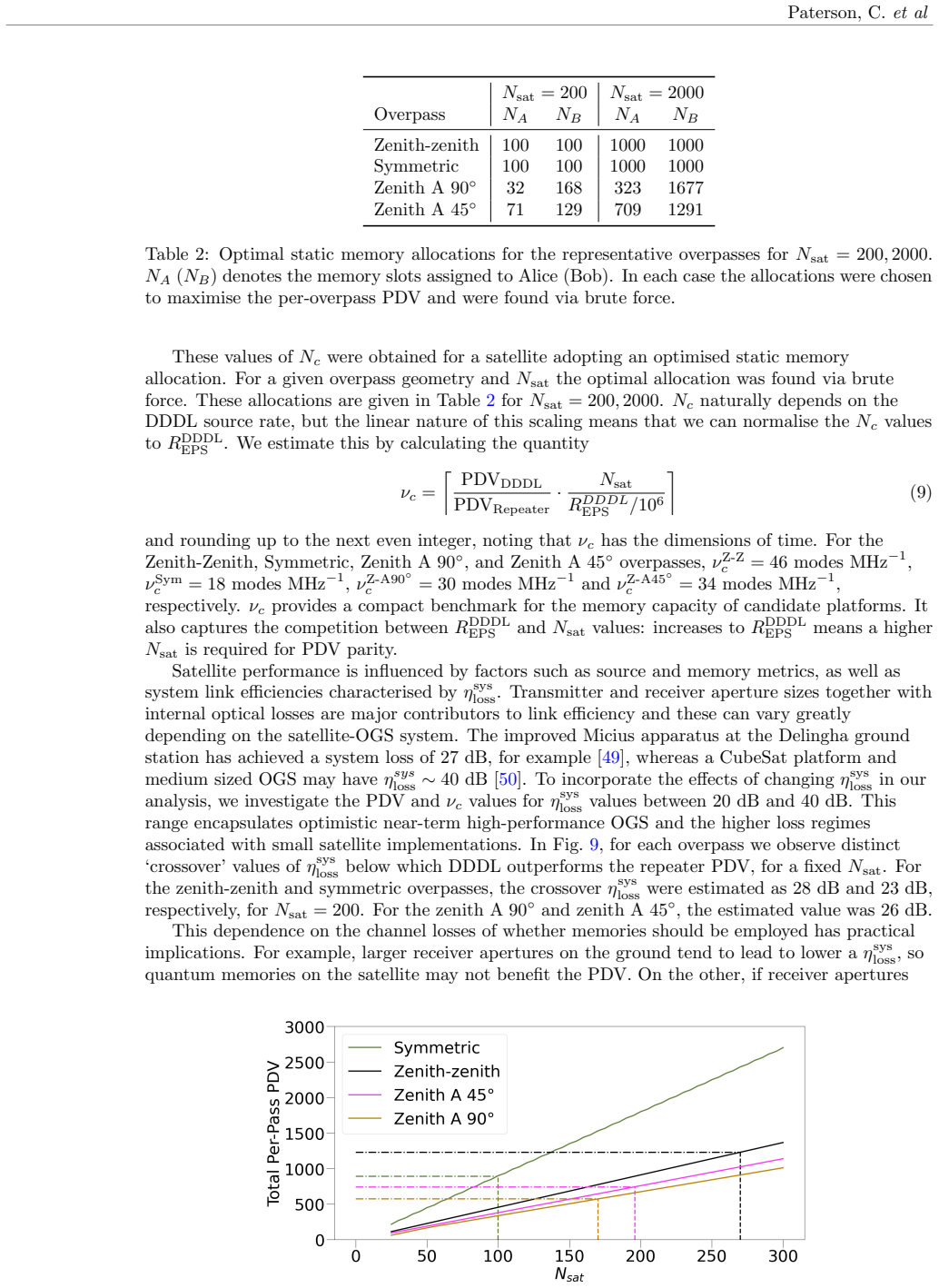
Direct dual downlink entangled pair distribution does not suffer the classical communication latency of the entanglement swapping process required in a repeater, hence can brute force the problem of high dual channel loss through increased source rate, while a space-based quantum repeater remains constrained by that latency; the two approaches are compared for general overpass geometries, long-term performance is evaluated for different ground station pairs with altitudinal dependence, and fidelity statistics are obtained from Monte Carlo modelling of waiting times and rate statistics under varying memory capacity, decoherence rates, and operational policies.
What carries the argument
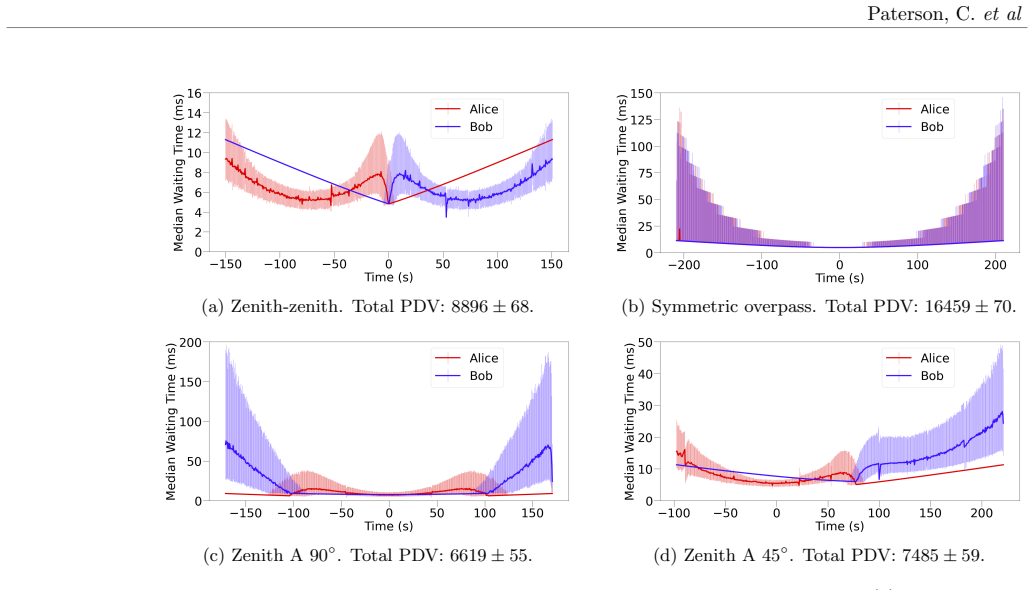
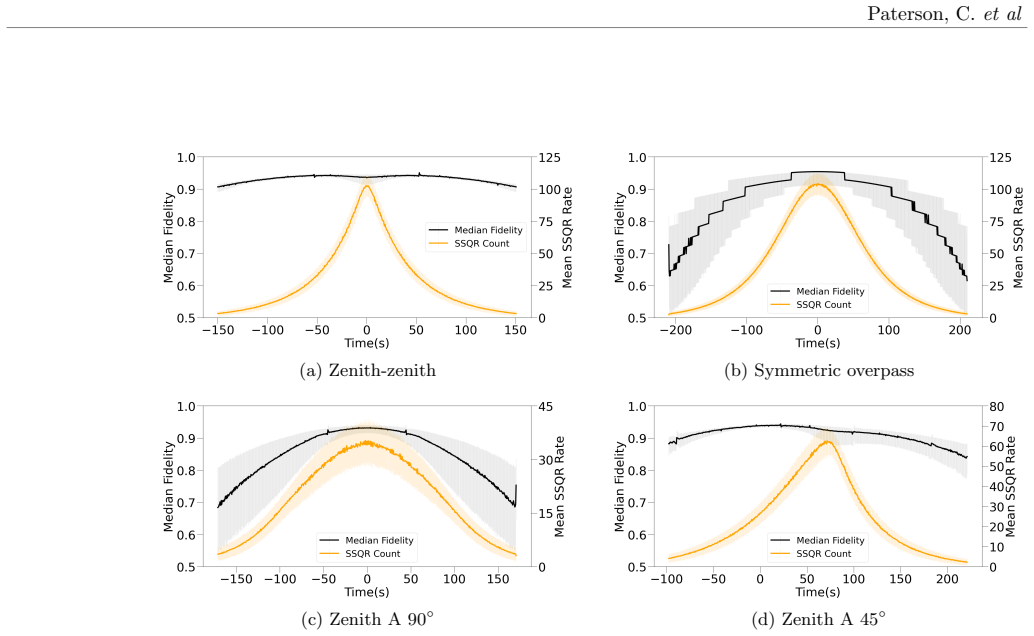
Monte Carlo modelling of waiting times and rate statistics that tracks fidelity distribution as a function of quantum memory capacity, decoherence rates, and operational policies for the repeater case.
If this is right
- Direct downlink rates can be raised arbitrarily by brighter sources without being limited by classical round-trip times.
- Repeater performance improves only when memory decoherence is slow enough relative to the waiting time for classical signals.
- Long-term average rates depend on the specific latitude and separation of the two ground stations and on the satellite's altitude.
- Different policies for when to discard or keep stored qubits change the delivered fidelity distribution.
Where Pith is reading between the lines
- Early satellite quantum networks may therefore start with simple direct-downlink payloads before adding the complexity of onboard quantum memories.
- The same geometric comparison framework could be reused to study constellations of several satellites or hybrid links that combine space and fiber segments.
- Atmospheric turbulence and pointing jitter, treated here as average losses, would need to be modeled dynamically to predict performance on individual passes.
Load-bearing premise
The models use fixed input values for loss rates, source brightness, and memory decoherence times rather than deriving those quantities from first principles.
What would settle it
A measurement campaign that records actual entanglement rates and fidelities during a real satellite overpass and then compares the observed numbers against the model's predictions for both the direct-downlink and repeater modes under the same geometry.
Figures






read the original abstract
Space-based entanglement distribution has the potential to extend the range of quantum communication beyond that achievable through optical fibres that are constrained by exponential losses. Quantum repeaters have been proposed to mitigate the effects of channel losses for both fibre and satellite networks. Although quantum repeaters can improve entanglement distribution efficiency, the rate is constrained by classical communication latency in the entanglement swapping process. Direct dual downlink entangled pair distribution does not suffer such a latency restriction, hence can ``brute force'' the problem of high dual channel loss through increased source rate. Hence, the comparative requirements of direct pair distribution versus quantum repeater satellites are important for the design and deployment of space-based entanglement distribution systems. Here, we consider the simplest case of a single satellite establishing entanglement between two ground stations, comparing the performance of direct dual downlink to that of a space-based quantum repeater for general overpass geometries. We also study the long-term entanglement distribution performance for different ground station pairs and determine altitudinal dependence. Finally, we study the fidelity distribution of a satellite repeater system through Monte Carlo modelling of waiting times and rate statistics, exploring the effect of quantum memory capacity, decoherence rates, and operational policies. These results will inform mission design for future space-borne quantum repeater nodes, as well as requirements on space-based memory platforms.
Editorial analysis
A structured set of objections, weighed in public.
Referee Report
Summary. The paper presents Monte Carlo simulations comparing direct dual-downlink entanglement distribution to a single-satellite quantum repeater for linking two ground stations. It examines performance across general overpass geometries, long-term statistics for different station pairs, altitudinal dependence, and the effects of memory capacity, decoherence rates, and operational policies on rates, waiting times, and fidelity distributions.
Significance. If the numerical comparisons hold under the stated assumptions, the work supplies concrete guidance for space-based quantum communication mission design by clarifying when latency-limited repeater nodes outperform or underperform brute-force direct distribution. The Monte Carlo treatment of waiting-time and fidelity statistics is a methodological strength that enables statistical characterization beyond mean-field approximations.
major comments (2)
- [Abstract] Abstract and results sections: the central claim that direct downlink can 'brute force' high dual-channel loss via increased source rate while the repeater is constrained by classical latency is load-bearing, yet the reported comparisons use fixed numerical values for loss rates and source brightness with no sweeps or sensitivity analysis (in contrast to the sweeps performed for memory capacity and decoherence). This leaves the ranking between architectures sensitive to the chosen inputs.
- [Monte Carlo modelling] Monte Carlo modelling description: no error bars, no statement of the number of runs performed, and no explicit validation of the simulated rates or fidelities against analytic limits are provided, which weakens confidence in the quantitative performance metrics that underpin the geometry and policy comparisons.
minor comments (1)
- Clarify in the text the exact numerical values adopted for channel loss, source brightness, and memory parameters so that the Monte Carlo results are fully reproducible.
Simulated Author's Rebuttal
We thank the referee for their constructive feedback and detailed assessment of our work on single-satellite quantum repeater performance. We address each major comment below and outline revisions that will strengthen the manuscript without altering its core conclusions.
read point-by-point responses
-
Referee: [Abstract] Abstract and results sections: the central claim that direct downlink can 'brute force' high dual-channel loss via increased source rate while the repeater is constrained by classical latency is load-bearing, yet the reported comparisons use fixed numerical values for loss rates and source brightness with no sweeps or sensitivity analysis (in contrast to the sweeps performed for memory capacity and decoherence). This leaves the ranking between architectures sensitive to the chosen inputs.
Authors: We agree that the central claim depends on the latency distinction allowing direct distribution to compensate loss via higher source rates. The chosen loss and brightness values are representative of current experimental capabilities for LEO links, and the qualitative advantage holds across the simulated geometries. However, to demonstrate robustness, the revised manuscript will add a sensitivity analysis subsection with sweeps over source brightness and dual-channel loss rates, showing how the rate ranking between architectures varies with these parameters while preserving the latency-limited behavior of the repeater. revision: yes
-
Referee: [Monte Carlo modelling] Monte Carlo modelling description: no error bars, no statement of the number of runs performed, and no explicit validation of the simulated rates or fidelities against analytic limits are provided, which weakens confidence in the quantitative performance metrics that underpin the geometry and policy comparisons.
Authors: We acknowledge that the Monte Carlo section lacks these statistical details. The simulations were run to convergence for each configuration, but reporting was incomplete. In the revised manuscript we will state the number of trials performed per geometry and policy (sufficient for sub-percent statistical uncertainty), add error bars to all rate, waiting-time, and fidelity results, and include a validation subsection comparing simulated rates and fidelities to analytic limits (e.g., direct-distribution rate formula with no memory and zero-decoherence fidelity of 1). These additions will directly support the quantitative claims. revision: yes
Circularity Check
No circularity: Monte Carlo performance comparison uses external parameters as inputs
full rationale
The paper conducts Monte Carlo simulations to compare direct dual-downlink entanglement distribution against a space-based quantum repeater for satellite overpass geometries. It takes channel loss rates, source brightness, memory decoherence times, and related quantities as fixed external inputs for the runs and explores their effects on rates, waiting times, and fidelities. No derivation chain, equation, or claim reduces any output metric to these inputs by construction, nor does any self-citation or ansatz bear the central comparative result. The analysis is self-contained computational evaluation under stated assumptions rather than a tautological prediction.
Axiom & Free-Parameter Ledger
free parameters (2)
- source rate
- memory decoherence rate
axioms (2)
- domain assumption Exponential loss in atmospheric and free-space channels
- standard math Poisson arrival statistics for photon pairs
Reference graph
Works this paper leans on
-
[1]
Charles H. Bennett and Gilles Brassard. Quantum cryptography: Public key distribution and coin tossing.Theoretical Computer Science, 560:7–11, 2014
work page 2014
-
[2]
Peter W. Shor and John Preskill. Simple proof of security of the bb84 quantum key distribution protocol.Physical Review Letters, 85(2):441–444, July 2000
work page 2000
-
[3]
Cerf, Miloslav Duˇ sek, Norbert L¨ utkenhaus, and Momtchil Peev
Valerio Scarani, Helle Bechmann-Pasquinucci, Nicolas J. Cerf, Miloslav Duˇ sek, Norbert L¨ utkenhaus, and Momtchil Peev. The security of practical quantum key distribution.Reviews of Modern Physics, 81(3):1301–1350, September 2009
work page 2009
-
[4]
Quantum metrology.Physical review letters, 96(1):010401, 2006
Vittorio Giovannetti, Seth Lloyd, and Lorenzo Maccone. Quantum metrology.Physical review letters, 96(1):010401, 2006
work page 2006
-
[5]
Quantum sensing.Reviews of modern physics, 89(3):035002, 2017
Christian L Degen, Friedemann Reinhard, and Paola Cappellaro. Quantum sensing.Reviews of modern physics, 89(3):035002, 2017
work page 2017
-
[6]
A clock synchronization method based on quantum entanglement
Jianxin Shi and Shanshan Shen. A clock synchronization method based on quantum entanglement. Scientific Reports, 12:10185, 06 2022
work page 2022
-
[7]
Peter W. Shor. Polynomial-time algorithms for prime factorization and discrete logarithms on a quantum computer.SIAM Journal on Computing, 26(5):1484–1509, October 1997
work page 1997
-
[8]
S. Pirandola, U. L. Andersen, L. Banchi, M. Berta, D. Bunandar, R. Colbeck, D. Englund, T. Gehring, C. Lupo, C. Ottaviani, J. L. Pereira, M. Razavi, J. Shamsul Shaari, M. Tomamichel, V. C. Usenko, G. Vallone, P. Villoresi, and P. Wallden. Advances in quantum cryptography.Advances in Optics and Photonics, 12(4):1012, December 2020
work page 2020
-
[9]
H.-J. Briegel, W. D¨ ur, J. I. Cirac, and P. Zoller. Quantum repeaters: The role of imperfect local operations in quantum communication.Phys. Rev. Lett., 81:5932–5935, Dec 1998
work page 1998
-
[10]
Micius quantum experiments in space
Chao-Yang Lu, Yuan Cao, Cheng-Zhi Peng, and Jian-Wei Pan. Micius quantum experiments in space. Rev. Mod. Phys., 94:035001, Jul 2022
work page 2022
-
[11]
Jasminder S. Sidhu, Siddarth K. Joshi, Mustafa G¨ undo˘ gan, Thomas Brougham, David Lowndes, Luca Mazzarella, Markus Krutzik, Sonali Mohapatra, Daniele Dequal, Giuseppe Vallone, Paolo Villoresi, Alexander Ling, Thomas Jennewein, Makan Mohageg, John G. Rarity, Ivette Fuentes, Stefano Pirandola, and Daniel K. L. Oi. Advances in space quantum communications....
work page 2021
-
[12]
Alessio Belenchia, Matteo Carlesso, ¨Omer Bayraktar, Daniele Dequal, Ivan Derkach, Giulio Gasbarri, Waldemar Herr, Ying Lia Li, Markus Rademacher, Jasminder Sidhu, et al. Quantum physics in space. Physics Reports, 951:1–70, 2022
work page 2022
-
[13]
Seid Koudia, Junaid ur Rehman, and Symeon Chatzinotas. Space-based quantum internet: Entanglement distribution in time-varying leo constellations.arXiv:2409.17032, 2024
-
[14]
Sidhu, Victoria Henderson, Luca Mazzarella, Janik Wolters, Daniel K
Mustafa G¨ undogan, Jasminder S. Sidhu, Victoria Henderson, Luca Mazzarella, Janik Wolters, Daniel K. L. Oi, and Marcus Krutzik. Proposal for space-borne quantum memories for global quantum networking.npj Quantum Information, 7, August 2021
work page 2021
-
[15]
Entanglement swapping in orbit: a satellite quantum link case study
Paolo Fittipaldi, Kentaro Teramoto, Naphan Benchasattabuse, Michal Hajduˇ sek, Rodney Van Meter, and Fr´ ed´ eric Grosshans. Entanglement swapping in orbit: a satellite quantum link case study. In2024 IEEE International Conference on Quantum Computing and Engineering (QCE), page 1924–1930. IEEE, September 2024
work page 1924
-
[16]
Quantum repeaters in space.New Journal of Physics, 23(5):053021, May 2021
Carlo Liorni, Hermann Kampermann, and Dagmar Bruß. Quantum repeaters in space.New Journal of Physics, 23(5):053021, May 2021
work page 2021
-
[17]
Mustafa G¨ undoˇ gan, Jasminder S Sidhu, Markus Krutzik, and Daniel KL Oi. Time-delayed single satellite quantum repeater node for global quantum communications.Optica Quantum, 2(3):140–147, 2024
work page 2024
-
[18]
Jasminder S Sidhu, Sarah E McCarthy, Cameron Paterson, and Daniel KL Oi. Operational limits to entanglement-based satellite quantum key distribution.arXiv preprint arXiv:2602.11833, 2026
-
[19]
Finite key effects in satellite quantum key distribution.npj Quantum Information, 8(1):18, 2022
Jasminder S Sidhu, Thomas Brougham, Duncan McArthur, Roberto G Pousa, and Daniel KL Oi. Finite key effects in satellite quantum key distribution.npj Quantum Information, 8(1):18, 2022
work page 2022
-
[20]
Tanvirul Islam, Jasminder S. Sidhu, Brendon L. Higgins, Thomas Brougham, Tom Vergoossen, Daniel K.L. Oi, Thomas Jennewein, and Alexander Ling. Finite-resource performance of small-satellite-based quantum-key-distribution missions.PRX Quantum, 5:030101, Jul 2024. 21 Paterson, C.et al
work page 2024
-
[21]
Cody Jones, Danny Kim, Matthew T Rakher, Paul G Kwiat, and Thaddeus D Ladd. Design and analysis of communication protocols for quantum repeater networks.New Journal of Physics, 18(8):083015, August 2016
work page 2016
-
[22]
All-photonic quantum repeaters.Nature communications, 6(1):6787, 2015
Koji Azuma, Kiyoshi Tamaki, and Hoi-Kwong Lo. All-photonic quantum repeaters.Nature communications, 6(1):6787, 2015
work page 2015
-
[23]
Quantum dots as solid-state sources of entangled photon pairs.arXiv preprint arXiv:2602.05245, 2026
Xingling Pan, Zhiming Chen, Yingtao Ding, Weibo Gao, Fei Ding, and Zhaogang Dong. Quantum dots as solid-state sources of entangled photon pairs.arXiv preprint arXiv:2602.05245, 2026
-
[24]
Entanglement demonstration on board a nano-satellite.Optica, 7(7):734–737, 2020
Aitor Villar, Alexander Lohrmann, Xueliang Bai, Tom Vergoossen, Robert Bedington, Chithrabhanu Perumangatt, Huai Ying Lim, Tanvirul Islam, Ayesha Reezwana, Zhongkan Tang, et al. Entanglement demonstration on board a nano-satellite.Optica, 7(7):734–737, 2020
work page 2020
-
[25]
Sarah E McCarthy, Ali Anwar, Daniel KL Oi, and Loyd J McKnight. Compact and stable source of polarization-entangled photon-pairs based on a folded linear displacement interferometer.Optics Express, 33(18):38657–38668, 2025
work page 2025
-
[26]
Xingyu Wang, Jiahao Li, Bolong Wang, Yuexiang Cao, Yonghui Li, Haoran Hu, Qian Li, Nan Xiao, Chen Dong, Kai Guo, and Lei Shi. Scalability bottlenecks in entanglement-based satellite quantum key distribution: downlink asymmetry, orbit dependence and finite-key effects.preprint https: // doi. org/ 10. 21203/ rs. 3. rs-8708341/ v1, 2026
work page 2026
-
[27]
L-M Duan, Mikhail D Lukin, J Ignacio Cirac, and Peter Zoller. Long-distance quantum communication with atomic ensembles and linear optics.Nature, 414(6862):413–418, 2001
work page 2001
-
[28]
Koji Azuma, Sophia E Economou, David Elkouss, Paul Hilaire, Liang Jiang, Hoi-Kwong Lo, and Ilan Tzitrin. Quantum repeaters: From quantum networks to the quantum internet.Reviews of Modern Physics, 95(4):045006, 2023
work page 2023
-
[29]
Munro, Koji Azuma, Kiyoshi Tamaki, and Kae Nemoto
William J. Munro, Koji Azuma, Kiyoshi Tamaki, and Kae Nemoto. Inside quantum repeaters.IEEE Journal of Selected Topics in Quantum Electronics, 21(3):78–90, 2015
work page 2015
-
[30]
K Boone, J-P Bourgoin, E Meyer-Scott, K Heshami, T Jennewein, and C Simon. Entanglement over global distances via quantum repeaters with satellite links.Physical Review A, 91(5):052325, 2015
work page 2015
-
[31]
Manik Dawar, Clement Paillet, Nilesh Vyas, Andrew Thain, Rodrigo Henriques Guilherme, and Ralf Riedinger. Feasibility of satellite-augmented global quantum repeater networks.arXiv preprint arXiv:2603.11127, 2026
-
[32]
Matthias J. Bayerbach, Simone E. D’Aurelio, Peter van Loock, and Stefanie Barz. Bell-state measurement exceeding 50% success probability with linear optics.Science Advances, 9(32):eadf4080, 2023
work page 2023
-
[33]
Quarc: Quantum research cubesat—a constellation for quantum communication.Cryptography, 4(1):7, 2020
Luca Mazzarella, Christopher Lowe, David Lowndes, Siddarth Koduru Joshi, Steve Greenland, Doug McNeil, Cassandra Mercury, Malcolm Macdonald, John Rarity, and Daniel Kuan Li Oi. Quarc: Quantum research cubesat—a constellation for quantum communication.Cryptography, 4(1):7, 2020
work page 2020
-
[34]
Martin B. Plenio and Shashank Virmani. An introduction to entanglement measures.Quantum Info. Comput., 7(1):1–51, January 2007
work page 2007
-
[35]
Quantum entanglement.Reviews of Modern Physics, 81(2):865–942, June 2009
Ryszard Horodecki, Pawe l Horodecki, Micha l Horodecki, and Karol Horodecki. Quantum entanglement.Reviews of Modern Physics, 81(2):865–942, June 2009
work page 2009
-
[36]
General teleportation channel, singlet fraction, and quasidistillation.Phys
Micha l Horodecki, Pawe l Horodecki, and Ryszard Horodecki. General teleportation channel, singlet fraction, and quasidistillation.Phys. Rev. A, 60:1888–1898, Sep 1999
work page 1999
-
[37]
Laurent de Forges de Parny, Olivier Alibart, Julien Debaud, Sacha Gressani, Alek Lagarrigue, Anthony Martin, Alexandre Metrat, Matteo Schiavon, Tess Troisi, Eleni Diamanti, et al. Satellite-based quantum information networks: use cases, architecture, and roadmap.Communications Physics, 6(1):12, 2023
work page 2023
-
[38]
Simulating quantum repeater strategies for multiple satellites
Julius Walln¨ ofer, Frederik Hahn, Mustafa G¨ undo˘ gan, Jasminder S Sidhu, Fabian Wiesner, Nathan Walk, Jens Eisert, and Janik Wolters. Simulating quantum repeater strategies for multiple satellites. Communications Physics, 5(1):169, 2022
work page 2022
-
[39]
Ledingham, Kutlu Kutluer, Margherita Mazzera, and Hugues de Riedmatten
Mustafa G¨ undo˘ gan, Patrick M. Ledingham, Kutlu Kutluer, Margherita Mazzera, and Hugues de Riedmatten. Solid state spin-wave quantum memory for time-bin qubits.Phys. Rev. Lett., 114:230501, Jun 2015. 22 Paterson, C.et al
work page 2015
-
[40]
A millisecond quantum memory for scalable quantum networks.Nature Physics, 5(2):95–99, 2009
Bo Zhao, Yu-Ao Chen, Xiao-Hui Bao, Thorsten Strassel, Chih-Sung Chuu, Xian-Min Jin, J¨ org Schmiedmayer, Zhen-Sheng Yuan, Shuai Chen, and Jian-Wei Pan. A millisecond quantum memory for scalable quantum networks.Nature Physics, 5(2):95–99, 2009
work page 2009
-
[41]
Manjin Zhong, Morgan P Hedges, Rose L Ahlefeldt, John G Bartholomew, Sarah E Beavan, Sven M Wittig, Jevon J Longdell, and Matthew J Sellars. Optically addressable nuclear spins in a solid with a six-hour coherence time.Nature, 517(7533):177–180, 2015
work page 2015
-
[42]
Towards highly multimode optical quantum memory for quantum repeaters.Phys
Pierre Jobez, Nuala Timoney, Cyril Laplane, Jean Etesse, Alban Ferrier, Philippe Goldner, Nicolas Gisin, and Mikael Afzelius. Towards highly multimode optical quantum memory for quantum repeaters.Phys. Rev. A, 93:032327, Mar 2016
work page 2016
-
[43]
Erbium-doped fibre quantum memory for chip-integrated quantum-dot single photons at 980 nm
Nasser Gohari Kamel, Arsalan Mansourzadeh, Ujjwal Gautam, Vinaya Kumar Kavatamane, Ashutosh Singh, Edith Yeung, David B Northeast, Paul Barclay, Philip J Poole, Dan Dalacu, et al. Erbium-doped fibre quantum memory for chip-integrated quantum-dot single photons at 980 nm. arXiv preprint arXiv:2508.01416, 2025
-
[44]
Shi-Hai Wei, Bo Jing, Xue-Ying Zhang, Jin-Yu Liao, Hao Li, Li-Xing You, Zhen Wang, You Wang, Guang-Wei Deng, Hai-Zhi Song, et al. Quantum storage of 1650 modes of single photons at telecom wavelength.npj Quantum Information, 10(1):19, 2024
work page 2024
-
[45]
Faithfully simulating near-term quantum repeaters.PRX Quantum, 5(1), March 2024
Julius Walln¨ ofer, Frederik Hahn, Fabian Wiesner, Nathan Walk, and Jens Eisert. Faithfully simulating near-term quantum repeaters.PRX Quantum, 5(1), March 2024
work page 2024
-
[46]
Daoheng Niu, Yuxuan Zhang, Alireza Shabani, and Hassan Shapourian. All-photonic one-way quantum repeaters with measurement-based error correction.npj Quantum Information, 9(1):106, 2023
work page 2023
-
[47]
´Alvaro G I˜ nesta, Gayane Vardoyan, Lara Scavuzzo, and Stephanie Wehner. Optimal entanglement distribution policies in homogeneous repeater chains with cutoffs.npj Quantum Information, 9(1):46, 2023
work page 2023
-
[48]
F Rozp¸ edek, K Goodenough, J Ribeiro, N Kalb, V Caprara Vivoli, A Reiserer, R Hanson, S Wehner, and D Elkouss. Parameter regimes for a single sequential quantum repeater.Quantum Science and Technology, 3(3):034002, apr 2018
work page 2018
-
[49]
Entanglement-based secure quantum cryptography over 1,120 kilometres
J Yin, Y-H Li, S-K Liao, M Yang, Y Cao, L Zhang, J-G Ren, W-Q Cai, W-Y Liu, S-L Li, R Shu, Y-M Huang, L Deng, L Li, Q Zhang, N-L Liu, Y-A Chen, C-Y Lu, X-B Wang, F Xu, X-B Wang, C-Z Peng, AK Ekert, and J-W Pan. Entanglement-based secure quantum cryptography over 1,120 kilometres. Nature, 582:501–505, 2020
work page 2020
-
[50]
Design and test of optical payload for polarization encoded qkd for nanosatellites
Jaya Sagar, Elliott Hastings, Peide Zhang, Milan Stefko, David Lowndes, Daniel Oi, John Rarity, and Siddarth K Joshi. Design and test of optical payload for polarization encoded qkd for nanosatellites. InQuantum Technology: Driving Commercialisation of an Enabling Science III, volume 12335, pages 64–70. SPIE, 2023
work page 2023
-
[51]
Cubesat quantum communications mission.EPJ Quantum Technology, 4(1), April 2017
Daniel KL Oi, Alex Ling, Giuseppe Vallone, Paolo Villoresi, Steve Greenland, Emma Kerr, Malcolm Macdonald, Harald Weinfurter, Hans Kuiper, Edoardo Charbon, and Rupert Ursin. Cubesat quantum communications mission.EPJ Quantum Technology, 4(1), April 2017
work page 2017
-
[52]
Satellites promise global-scale quantum networks.Optica Quantum, 3(6):590–605, 2025
Sumit Goswami, Sayandip Dhara, Neil Sinclair, Makan Mohageg, Jasminder S Sidhu, Sabyasachi Mukhopadhyay, Markus Krutzik, John R Lowell, Daniel KL Oi, Mustafa G¨ undo˘ gan, et al. Satellites promise global-scale quantum networks.Optica Quantum, 3(6):590–605, 2025
work page 2025
-
[53]
Ali Anwar, Chithrabhanu Perumangatt, Fabian Steinlechner, Thomas Jennewein, and Alexander Ling. Entangled photon-pair sources based on three-wave mixing in bulk crystals.Review of Scientific Instruments, 92(4), 2021
work page 2021
-
[54]
Boosting end-to-end entanglement fidelity in quantum repeater networks via hybridized strategies
Poramet Pathumsoot, Theerapat Tansuwannont, Naphan Benchasattabuse, Ryosuke Satoh, Michal Hajduˇ sek, Poompong Chaiwongkhot, Sujin Suwanna, and Rodney Van Meter. Boosting end-to-end entanglement fidelity in quantum repeater networks via hybridized strategies. In2024 International Conference on Quantum Communications, Networking, and Computing (QCNC), page...
work page 2024
-
[55]
Jean-Philippe Bourgoin, Evan Meyer-Scott, Brendon L Higgins, B Helou, Chris Erven, Hannes Huebel, B Kumar, D Hudson, Ian D’Souza, Ralph Girard, et al. A comprehensive design and performance analysis of low earth orbit satellite quantum communication.New Journal of Physics, 15(2):023006, 2013
work page 2013
-
[56]
A. Berk, P. Conforti, R. Kennett, T. Perkins, F. Hawes, and J. van den Bosch. Modtran®6: A major upgrade of the modtran®radiative transfer code. In2014 6th Workshop on Hyperspectral Image and Signal Processing: Evolution in Remote Sensing (WHISPERS), pages 1–4, 2014. 23 Paterson, C.et al Appendices A Single OGS Links The simplest kind of space quantum lin...
work page 2014
discussion (0)
Sign in with ORCID, Apple, or X to comment. Anyone can read and Pith papers without signing in.